Wagner Pinless Moisture Meter: Technology Deep Dive
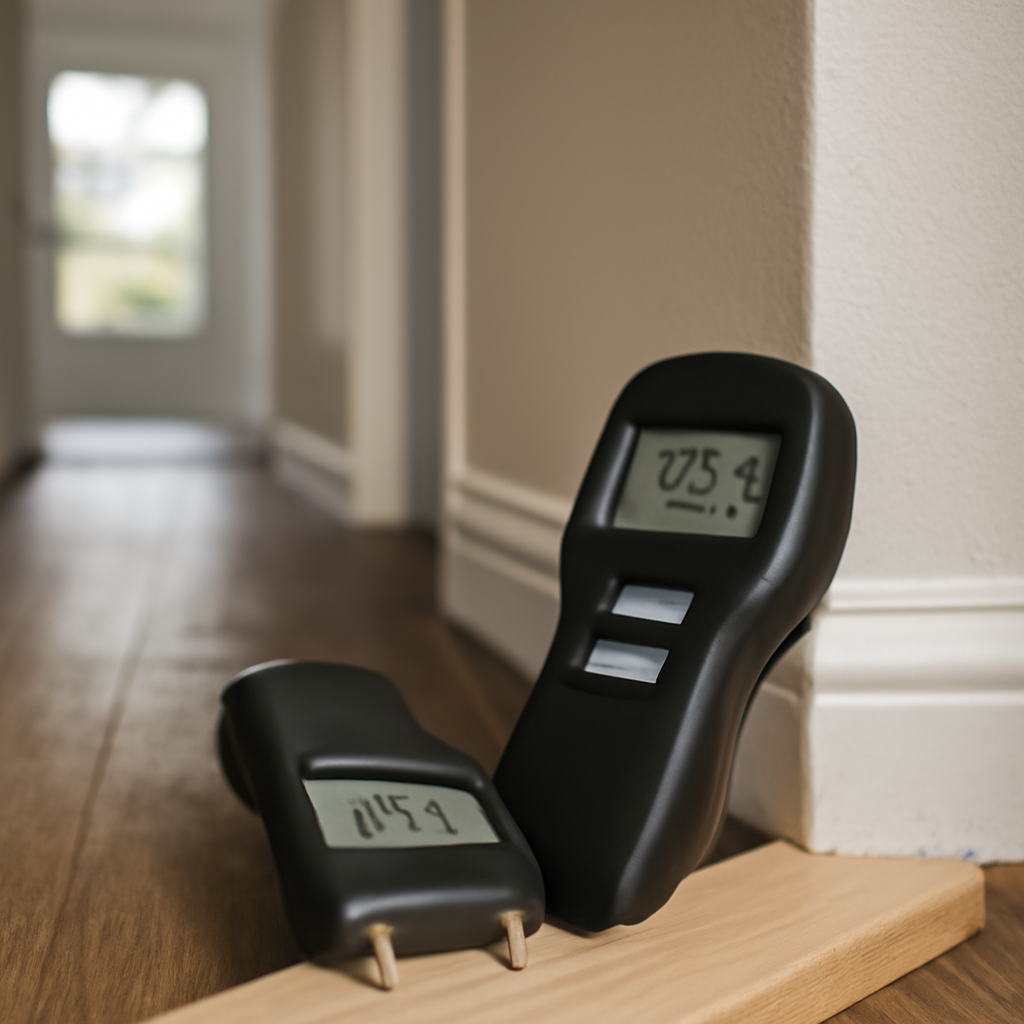
Pinless moisture meters read the moisture content of wood and engineered substrates without driving probes into the surface, and Wagner Meters is the company that built the category. The Wagner pinless moisture meter family in 2026 centers on the Orion 940 and Orion 950 instruments, both of which use capacitive sensing to deliver non-destructive readings on finished floors, fine furniture, musical instruments, and any substrate where pin holes are unacceptable. This guide walks through how the technology actually works, what makes the Wagner implementation distinctive, and where the pinless approach earns its premium over pin-type alternatives.
How capacitive sensing works
A pinless meter’s sensor pad sits on the back of the instrument. When pressed flat against a substrate, the pad generates an electromagnetic field that penetrates the material to a depth determined by the pad geometry (roughly 1/4 inch on the Orion 940 in shallow mode, 3/4 inch in deep mode). The dielectric constant of the substrate (how the material responds to the field) changes with moisture content because water has a much higher dielectric constant than dry wood.
The meter measures the field’s behavior, runs it through a calibration curve specific to the species and density of the substrate, and displays a moisture-content percentage. No physical contact with the wood’s interior is required, which is the whole point: the surface stays intact, the reading is repeatable, and large areas can be scanned in seconds.
The Wagner Orion 940 ($300 to $450)
The Orion 940 is the standard inspector and flooring-installer pinless meter. The sensor pad is roughly 2 inches square, the reading range covers 5 to 30 percent moisture content, and the species-correction table covers more than 200 hardwoods, softwoods, and engineered substrates. A single button switches between shallow (1/4 inch) and deep (3/4 inch) reading modes.
What made the 940 popular and what keeps it on most pro tool belts is the calibration stability. The included check block lets you verify the meter is still reading accurately at any time; long-term drift is rare in normal use. The warranty is 7 years on the electronics, which is unusual in this category and tells you something about Wagner’s confidence in the build.
The Wagner Orion 950 ($400 to $550)
The Orion 950 is the higher-end variant with three additions: onboard data logging (the meter stores readings with timestamps and species tags), Bluetooth syncing to a mobile app that exports data to client reports, and tighter accuracy specs at the dry end below 8 percent moisture content. The data-logging feature alone earns the price difference for flooring installers and home inspectors who need defensible documentation for client deliverables.
Everything else is similar to the 940: same sensor geometry, same species coverage, same calibration check block. The 950 is the right choice when documentation matters; the 940 is the right choice when it does not.
What pinless does well
Finished hardwood floors. A pinless meter scans large areas in seconds without leaving holes. Flooring inspectors can verify moisture content across a whole room in minutes; the same survey with a pin-type meter would mean dozens of small holes that must be patched.
Fine furniture and cabinetry. Visible faces cannot accept pin holes. A pinless meter pressed against the back or underside of a piece reads through to the bulk of the wood without any cosmetic damage. Luthiers (instrument makers) use pinless meters during construction to verify tonewood moisture content without compromising the finished surface.
Speed surveys. A flooring contractor checking subfloor moisture across a large slab can take readings every few feet with no setup time per reading. A pin-type survey of the same area would take many times longer.
What pinless does less well
Layered substrates. Engineered hardwood with a thin veneer over a substrate of different density produces readings that average across the layers; the meter cannot isolate the veneer’s moisture content. For layered products, pin-type meters with insulated probes that read at a specific depth give better data.
Edge readings. Pinless sensors cannot read accurately within about 2 inches of an edge because the field extends past the substrate and into air. Pin-type meters have no such limitation.
Very dense or very thin stock. Stock thinner than the meter’s penetration depth produces readings that include air on the back side. Stock denser than the calibration curve assumes (some exotic hardwoods, ipe, lignum vitae) requires manual interpretation or species-correction adjustment.
Calibration and species correction
Different wood species have different dielectric constants, so a meter calibrated for white oak will read incorrectly on Brazilian cherry without species correction. The Wagner Orion line applies correction internally based on the species code the user enters before measuring. The 950 stores frequently used species as favorites for quick selection.
For engineered floors, MDF, OSB, and plywood, separate calibration curves apply. The Orion documentation lists supported substrates. For stock outside the supported list, the meter reads accurately enough for screening but should not be used for precision documentation.
Use cases beyond woodworking
Home inspectors use Wagner pinless meters to sweep finished hardwood floors and exterior trim for moisture concentrations that suggest hidden plumbing leaks or condensation problems. The U.S. Department of Energy’s moisture-control guidance treats elevated wood moisture content as a primary indicator of building envelope failure; a pinless sweep is the fastest way to find concentrations without damaging finished surfaces.
For a wider view of where moisture sensing fits in the home-inspection toolkit, see our moisture meters for drywall overview, which covers the building-inspection cousins of the wood-specific Wagner instruments.
Positioning vs other pinless brands
Lignomat sells European-style pinless meters at a similar price point with narrower species coverage but a strong reputation among instrument makers. Tramex sells building-specific pinless meters that read drywall, concrete, and EIFS rather than wood. Wagner’s positioning is the broad-species woodworking and flooring market plus the home-inspection cross-over.
Within the Wagner lineup, the Orion 940 versus 950 choice is purely about data logging. If you do not need it, the 940 is the rational pick; if you do, the 950 is worth the difference.
Buying logistics
The Wagner Orion family sells through woodworking specialty retailers, flooring industry distributors, and several online tool retailers. The instruments ship with a hard carrying case, the calibration check block, a basic species reference card, and a 9-volt battery. The 7-year warranty is honored through US-based service centers; sensors and battery doors are field-replaceable. Our Wagner wood moisture meter brand guide covers the broader brand context.
When to combine pinless and pin-type
Most serious users carry both technologies. The pinless meter handles the routine survey work; the pin-type meter confirms unusual readings at depth or in substrates where pinless cannot read reliably. The combined cost ($350 to $700 for the pair) is small compared to the cost of being wrong about subfloor moisture content before installing $5,000 worth of hardwood flooring.
The bigger context
Moisture sensing is one slice of the broader home-inspection tool stack. For the full kit including thermal cameras, borescopes, and gas detectors, our home inspection tools buyer guide walks through the categories that complement moisture metering.
The fiber saturation point and reading interpretation
Wood moisture content is reported as a percentage of the dry weight of the wood. The fiber saturation point sits around 28 to 30 percent for most species. Below the FSP, wood shrinks as it dries and swells as it absorbs moisture. Above the FSP, dimensions stay roughly constant. The Wagner Orion line displays readings from 5 to 30 percent moisture content because that is where dimensional behavior changes and where most practical decisions get made.
Readings of 5 to 12 percent typically indicate equilibrium with most indoor environments. Readings of 12 to 19 percent indicate wood that has not fully dried or is exposed to higher humidity than typical interior conditions. Readings above 19 percent indicate sustained moisture exposure and warrant investigation of the moisture source.
Field-use procedure
The standard field procedure: power on the meter, select the species code, choose shallow or deep mode based on substrate thickness, hold the sensor pad flat against a clean dry surface, press read, note the result. For each board or area, take three readings at different points and average. Avoid measuring within 2 inches of any edge because the field extends into air past the edge and produces low readings.
Verifying calibration with the check block
The calibration check block included with each Orion meter is a reference standard with a known dielectric response. Press the sensor pad against the block, press read, and compare to the expected value (printed on the block label). A deviation greater than the meter’s stated tolerance suggests calibration drift and warrants factory service.
Use the check block weekly during heavy use and at the start of any major project. Cross-check unusual field readings against the block to confirm that the unexpected result is the wood, not the meter. The block itself is robust and lasts the life of the instrument.
Comparison to Tramex and other pinless brands
Tramex makes building-specific pinless meters (the Wet Wall Detector and the Moisture Encounter Plus) calibrated for drywall, concrete, and EIFS rather than wood. They overlap with Wagner only in the general capacitive-sensing principle; the calibration curves are different and they will not produce accurate wood readings. For building-inspection moisture survey work, Tramex is the right choice. For wood-specific work, Wagner is the right choice. Many inspectors carry both.
Within wood-specific pinless meters, the Wagner Orion line is dominant in North America. Lignomat offers competing instruments at similar prices with a European-style approach to species correction and a strong following among instrument makers.
The two-mode read decision
The Orion 940 and 950 toggle between shallow mode (roughly 1/4 inch depth) and deep mode (roughly 3/4 inch depth). Use shallow mode for engineered hardwood (where the veneer thickness is less than 1/4 inch), thin stock, and veneers on the underside of furniture. Use deep mode for solid wood, framing lumber, and any substrate thicker than 1 inch.
Mixing modes during a single survey produces inconsistent data. Decide on the appropriate mode based on the predominant substrate and use it consistently. Switch only when measuring a clearly different stock type, and note the mode change in your records.
Battery and maintenance
The Orion 940 uses a standard 9-volt alkaline battery. Battery life is typically 100 to 200 hours of intermittent use, with a low-battery indicator that activates 5 to 10 hours before readings become unreliable. The Orion 950 uses three AA cells with similar life.
Maintenance is minimal: keep the sensor pad clean with a soft dry cloth, replace the battery when the indicator activates, store in the included hard case. Avoid prolonged exposure to standing water or sustained high humidity. With normal use, the Orion 940 and 950 deliver 10 to 15 years of accurate service.
Why pinless adoption keeps growing
The pinless category has grown faster than the pin-type category in the last decade for two reasons. First, the cosmetic non-destructive nature of the reading is unconditionally better for finished work; nobody wants pin holes in a finished floor or visible cabinet face. Second, the scan speed is dramatically faster; a flooring contractor can sweep a 1,000-square-foot room in minutes versus an hour with a pin-type meter taking individual point readings.
The trade-off (calibration curves that vary by species and substrate) has been mostly solved at the pro tier by built-in species-correction tables. Wagner’s Orion line is the implementation that has the broadest species coverage and the most stable long-term calibration in the market.
References
- Moisture Control Guidance — U.S. Department of Energy
- InterNACHI Moisture Intrusion Inspection — International Association of Certified Home Inspectors
- ASHRAE Standards and Guidelines — American Society of Heating, Refrigerating and Air-Conditioning Engineers
- Mold and Moisture Control — U.S. Environmental Protection Agency
Moisture meters for home inspection
Pin meters read deep but leave marks; pinless meters scan surfaces non-destructively. Many inspectors carry both.
| Product | Why | Buy |
|---|---|---|
 Klein Tools ET140 Pinless Klein Tools ET140 Pinless | Non-destructive scanning; affordable. | Amazon — $49.97 |
 General Tools MMD4E General Tools MMD4E | Best-selling pin meter for drywall/wood. | Amazon — $39.98 |
 Lignomat Mini-Ligno Lignomat Mini-Ligno | Trusted by woodworkers; species-calibrated. | Amazon — $99.00 |