FLIR E8 Pro: What Homeowners Should Know About It
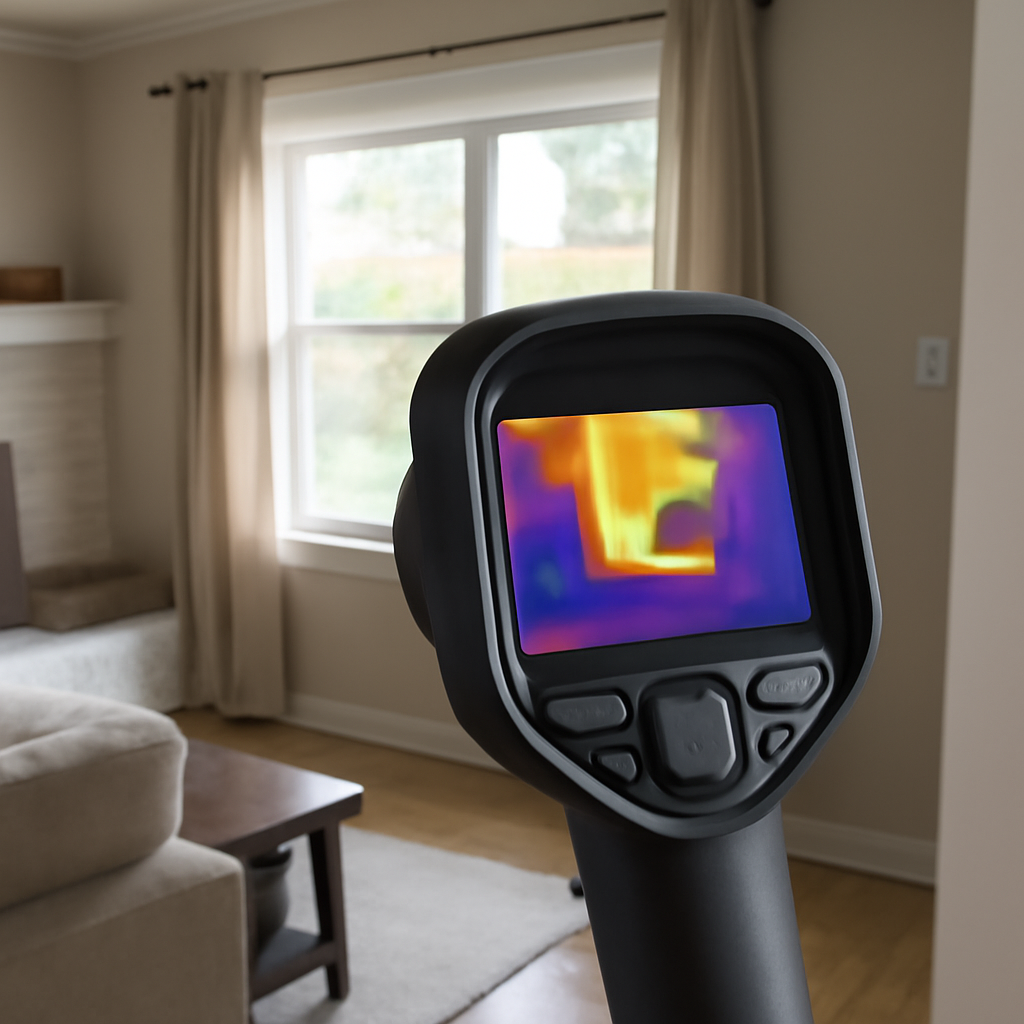
The FLIR E8 Pro sits near the top of what most home inspectors carry: a point-and-shoot thermal camera with enough resolution to map a wall, a ceiling, or an electrical panel in real detail. For homeowners researching whether to hire an inspector who uses one — or, rarely, whether to buy one — knowing what the E8 Pro does, what its specs mean, and where it lands against cheaper and pricier options clarifies the decision. This guide draws on manufacturer specifications and home-inspection trade-association guidance current as of 2026.
Part of our Thermal Imaging for Homes guide — start there for the full picture →
What is the FLIR E8 Pro?
The FLIR E8 Pro is a handheld, professional-grade thermal imaging camera in FLIR’s Exx-series Pro line. It captures a thermal image showing surface temperature differences as color, overlays calibrated temperature data so the user can measure points and areas, and blends a visible-light picture for clarity. Unlike a monocular you view through an eyepiece, the E8 Pro shows the image on a built-in display you hold in front of a surface, which is the format building diagnostics rely on.
It is designed for trades that need reliable readings: home inspectors, electricians, HVAC technicians, and building-envelope professionals. The “Pro” designation reflects its detector resolution and feature set, which step well above entry handhelds. For context on how this class of tool fits a broader kit, our home inspection tools buyer’s guide places thermal cameras alongside the moisture meters and borescopes inspectors carry, none of which replaces the others.
FLIR E8 Pro specifications and features
The headline number is detector resolution: the E8 Pro carries a 320 by 240 pixel thermal sensor — 76,800 temperature points per image. That is a large jump from entry cameras in the 160×120 range (19,200 points) and resolves far smaller anomalies, which matters when a moisture stain or a missing-insulation gap is only a few inches across. Its thermal sensitivity (NETD) is rated under 0.04°C (40 mK), meaning it distinguishes very small temperature differences — the kind that separate a damp wall from a dry one.
Several features round it out. MSX (Multi-Spectral Dynamic Imaging) embosses visible-light edge detail onto the thermal image, so doorframes, outlets, and labels stay legible without losing the heat map — a meaningful aid for documenting exactly where an anomaly is. The camera measures across a temperature range suitable for building work (roughly -20°C to 550°C), captures radiometric images you can re-analyze later in software, and includes Wi-Fi for transferring images into reports. A laser pointer and an integrated visible camera support clear documentation. Build quality targets daily field use, with a rugged body and a battery that lasts through inspection sessions.
What the resolution numbers mean in practice
Resolution and sensitivity together determine what you can actually see. A 320×240 detector at the E8 Pro’s sensitivity will clearly outline a wet patch behind drywall or a cold band where insulation is missing, whereas a 160×120 entry camera might blur the same feature into an ambiguous smudge. For an inspector scanning quickly and needing defensible images, that clarity reduces both missed findings and false alarms. Our explainer on reading infrared images in a home shows why pixel count and sensitivity translate directly into diagnostic confidence rather than just a prettier picture.
Why radiometric capture matters
A radiometric image stores a temperature value for every pixel, not just a color. That lets an inspector pull a finished image into software afterward, move a measurement spot around, adjust the temperature scale to reveal subtle gradients, and document an exact reading in the report. A non-radiometric camera saves only a picture, so you cannot re-measure later. For professional reports — where a finding may be challenged or relied on in a transaction — radiometric capture is the difference between a defensible measurement and a suggestive snapshot.
How the FLIR E8 Pro is used in a home inspection
Thermal imaging is an ancillary service, and the E8 Pro is purpose-built for it. Typical home uses:
- Moisture behind drywall. Evaporating water cools a surface; the camera reveals the cool pattern, and a moisture meter then confirms it. Thermal imaging itself does not measure moisture — it points the meter where to check.
- Missing or settled insulation. Gaps in attic or wall insulation show as temperature differences across the ceiling and wall planes, useful for energy assessments the Department of Energy describes in thermographic inspections.
- Electrical hot spots. An overloaded circuit or loose connection at a panel runs hotter than its neighbors; the radiometric reading quantifies the difference safely from a distance.
- Air leaks and HVAC issues. Drafts around windows and gaps in ductwork appear as temperature anomalies, helping diagnose comfort and efficiency complaints.
- Radiant-floor verification. Confirming in-floor heating loops are running and evenly distributed.
Reading these patterns correctly is a learned skill, which is why InterNACHI offers separate infrared certification and ASHI treats thermal scanning as a specialized add-on rather than a standard inclusion. The camera is only as good as the operator interpreting it. Homeowners can learn what to expect from our guide to a thermal imaging inspection.
FLIR E8 Pro price and value
The E8 Pro typically lists in the range of roughly $2,500 to $4,000 depending on configuration and seller, placing it firmly in professional territory. That is far above pocket cameras like the FLIR C-series (a few hundred dollars) or spot thermometers with a small imager like the TG-series, and below industrial cameras with 640×480 detectors that run many thousands more.
For a working inspector, the resolution and documentation features can justify the cost through faster, more defensible reports and the ability to offer infrared as a paid add-on service. For a typical homeowner, buying an E8 Pro rarely makes sense — the device sits unused most of the year, requires training to interpret, and would need periodic calibration to stay accurate. Hiring an inspector who already owns one and knows how to read it is more economical. Homeowners curious about cheaper handhelds can compare the broader FLIR thermal imaging camera lineup to see where the E8 Pro fits in the price ladder.
How it compares to alternatives
Two comparisons frame the E8 Pro well. Against the FLIR C-series (a pocket camera with lower resolution), the E8 Pro offers roughly four times the thermal pixels and far better sensitivity, trading portability and a few hundred dollars for serious diagnostic clarity. Against a spot device like the FLIR TG165 or TG267, which our guide to that TG-class covers, the E8 Pro is a true imaging camera rather than a thermometer with a tiny picture — a different tier entirely.
Competing brands like Fluke and Hikmicro make cameras at similar resolution and price points, and the practical choice often comes down to software ecosystem, MSX-equivalent features, warranty, and service network rather than raw specs. For most buyers the resolution and sensitivity matter more than the badge, but the report-generation software and how easily images export into a deliverable report sway many professionals’ decisions.
Maintenance, calibration, and limitations
Thermal cameras need little daily care but a few non-negotiables. The germanium lens is delicate and expensive — clean it only with approved methods and protect it from scratches. Let the camera acclimate to the ambient temperature before scanning for stable readings. Keep firmware current, since updates improve measurement and software compatibility. Professional cameras carry a recommended calibration interval (commonly every couple of years through the manufacturer) to keep radiometric readings accurate; this is a service step, not a user task, and skipping it undermines the very measurement precision the camera is bought for.
The limitations matter as much as the features. Thermal cameras do not see through walls, glass, or water — they read surface temperatures only, and reflective surfaces (shiny metal, glass) can fool them by mirroring nearby heat. They reveal temperature differences, so a wall that is uniformly wet may not stand out without a moisture meter to confirm. Results also depend on thermal contrast: a scan on a mild day with little indoor-outdoor temperature difference reveals less than one taken with heating or cooling running. And the camera finds anomalies; it does not diagnose causes. Used by a trained inspector alongside a moisture meter, the FLIR E8 Pro is a powerful diagnostic tool — but it is one instrument in a kit, not a magic window into the structure.
The E8 Pro within the Exx-series
FLIR’s Exx Pro line spans several models that share a body and feature set but step up in resolution, which clarifies where the E8 Pro lands. The E5 Pro sits below it with a smaller detector; the E8 Pro carries the 320×240 sensor; and higher models like the E96 reach much larger detectors and longer feature lists aimed at industrial use. The shared platform means an inspector who learns one Exx Pro camera can move between them easily, and the report-generation software is common across the line.
For home inspection specifically, the 320×240 detector in the E8 Pro hits a practical sweet spot: high enough resolution to resolve the small anomalies that matter in residential work, without the cost of an industrial-grade sensor whose extra pixels a house rarely demands. That is why the E8 Pro and its direct competitors cluster at this resolution for inspection use — it is the point where added resolution stops meaningfully improving residential findings and starts mostly adding price. Buyers tempted by a higher model should ask whether the additional resolution serves the work they actually do, or just the spec sheet.
What to ask an inspector who uses one
For most homeowners, the relevant question is not whether to buy an E8 Pro but how to make sure an inspector uses one well. When booking a thermal scan, ask what camera the inspector carries and its resolution — a 320×240 or higher detector signals serious equipment. Ask whether they hold InterNACHI infrared certification or equivalent training, since interpretation is the skill that turns the image into a finding. Ask how they confirm what the camera shows; the right answer involves a moisture meter for suspected moisture, not a colorful image presented as proof on its own.
Finally, ask about conditions. A scan is most productive with thermal contrast — a cold morning, or with the home’s heating or cooling running — so an inspector who notes the conditions and explains their effect on the results understands the tool’s limits. The detailed model comparisons in our FLIR thermal imaging camera guide and the interpretation walkthrough in our infrared images guide give homeowners enough background to judge whether an inspector’s thermal offering is substantive or just a marketing line.
Why MSX matters for documentation
Among the E8 Pro’s features, MSX deserves a closer look because it solves a real problem in reporting. A pure thermal image is a wash of color with no recognizable detail — it can be hard to tell which wall, which outlet, or which corner you are looking at weeks later. MSX embosses the edges from the visible-light camera onto the thermal picture, so the doorframe, the light switch, the label on the panel all stay legible while the heat map remains intact. The result is an image a homeowner or a third party can actually orient within the house.
That clarity does double duty: it speeds the inspector’s work in the field and it makes the report defensible afterward. When a finding might influence a purchase or a repair claim, an image that plainly shows where the anomaly is — not just that one exists — carries far more weight than an ambiguous blob of color. It is a small feature with an outsized effect on how usable the inspection deliverable turns out to be.
References
- ENERGY STAR: Seal and Insulate — U.S. Environmental Protection Agency (ENERGY STAR)
- Infrared Certified Thermography Program — InterNACHI
- Inspection Services and Ancillary Tools — American Society of Home Inspectors
- Thermal Imaging for Home Inspectors — InterNACHI
Frequently asked questions
What is the resolution of the FLIR E8 Pro?
The E8 Pro has a 320 by 240 pixel thermal detector — 76,800 temperature points — with sensitivity under 0.04°C. That is about four times the pixels of entry 160×120 cameras, letting it resolve small moisture or insulation anomalies that lower-resolution cameras blur.
How much does a FLIR E8 Pro cost?
It typically lists in the range of roughly $2,500 to $4,000 depending on configuration. That places it in professional territory, well above pocket C-series cameras and spot TG-series devices, and below high-resolution industrial cameras.
Can the FLIR E8 Pro find moisture behind walls?
It can reveal the cool surface pattern that evaporating moisture creates, but it does not measure moisture directly. An inspector uses it to locate suspect areas, then confirms with a moisture meter. It also cannot see through walls — only surface temperatures.
Should a homeowner buy a FLIR E8 Pro?
Usually no. The camera is expensive, requires training to interpret, needs periodic calibration, and would sit unused most of the year. Hiring an inspector who already owns one and holds infrared certification is more economical for typical homeowners.
Thermal imaging cameras
Infrared cameras reveal hidden moisture, missing insulation, and air leaks. Phone-attachment models are the budget entry point; standalone units have higher resolution.
| Product | Why | Buy |
|---|---|---|
 FLIR ONE Pro (phone) FLIR ONE Pro (phone) | Plugs into iPhone/Android; inspector favorite. | Amazon — $349.00 |
 Topdon TC001 Topdon TC001 | High-res phone module at a low price. | Amazon — $199.99 |
 FLIR C5 Compact FLIR C5 Compact | Standalone pocket camera with Wi-Fi. | Amazon — $611.50 |