Evaporative vs Ultrasonic Humidifier: Which Is Better?

Evaporative humidifiers are usually the safer, lower-maintenance choice for homes with hard tap water and for anyone worried about over-humidifying, because they add moisture invisibly, leave no white dust and naturally slow down as the room gets more humid. Ultrasonic humidifiers are quieter, cheaper to buy, often sleeker and very energy efficient, but EPA notes they are among the types most likely to disperse minerals and microorganisms from their tanks into the air, so they need distilled or demineralized water and frequent cleaning. In a dry Front Range winter, either type can bring a bedroom up to a comfortable range; the better choice depends on water quality, noise tolerance and how much cleaning the household will actually do. This guide compares the two on air quality, maintenance, noise, cost and control. It summarizes EPA guidance and general product patterns as of 2026; follow the humidifier’s own manual for care instructions.
Part of our Humidity Control guide — start there for the full picture →
Quick Comparison Table
| Factor | Evaporative humidifier | Ultrasonic humidifier |
|---|---|---|
| How it adds moisture | Fan blows air through a wet wick, belt or filter | Vibrating plate breaks water into a fine visible mist |
| Visible mist | No | Yes |
| Mineral “white dust” | Not expected (minerals stay in the wick) | Common with tap water |
| Microorganism dispersal (per EPA) | Generally less, if any | Among the greatest of common types |
| Self-limiting output | Yes, evaporation slows as humidity rises | No, keeps misting unless a humidistat stops it |
| Noise | Fan hum; louder on high | Near silent; occasional gurgle |
| Typical power draw | Low (fan only) | Low (transducer plus small fan) |
| Ongoing parts | Replacement wicks or filters | Demineralization cartridges on some models; distilled water |
| Cleaning | Tank and base; wick rinse or replace | Tank, base and transducer; frequent |
| Best fit | Hard water, larger rooms, families who want set-and-forget | Bedrooms and nurseries where quiet matters, with distilled water |
Power draw and maintenance needs are typical patterns across portable models; check the specific product’s manual and label.
How Each Type Works
Evaporative humidifiers
EPA describes evaporative humidifiers as units that “transmit moisture into the air invisibly by using a fan to blow air through a moistened absorbent material, such as a belt, wick, or filter.” Water wicks up from the reservoir into the pad, and the fan pushes dry room air across it. Only pure water vapor leaves the pad. Minerals stay behind in the wick, which gradually hardens and needs replacing.
Because evaporation depends on how dry the air is, output naturally falls as the room approaches higher humidity. That self-limiting behavior makes evaporative units harder to overrun, though they can still push a small, tight room above the healthy range if left on high.
Ultrasonic humidifiers
EPA describes ultrasonic humidifiers as units that “create a cool mist by means of ultrasonic sound vibrations.” A small ceramic or metal plate vibrates at a very high frequency just under the water surface, shattering water into tiny droplets that a small fan or natural airflow carries into the room. Everything dissolved or suspended in the water, including minerals and any microbes growing in the tank, leaves with the mist.
Ultrasonic output does not slow down as the room gets humid. Without a built-in humidistat, an ultrasonic humidifier will keep misting until the tank runs dry, which is how window condensation and damp sills happen.
The other types for context
EPA lists two other common types. Impeller or “cool mist” humidifiers use a spinning disk and, like ultrasonic models, tend to disperse minerals and microbes. Steam vaporizers boil water with an electric element; “warm mist” models cool the steam before release. EPA notes that steam vaporizer and evaporative humidifiers are not expected to disperse substantial amounts of minerals. Steam units use far more electricity and pose burn risks around children, which EPA flags as well.
Best Evaporative Humidifier: our top 3 picks
| Product | Best for | Key features | Price | Buy |
|---|---|---|---|---|
| Levoit Superior Studio Smart | Best overall evaporative |
| $125.99as of Oct 21, 2026 12:55 am GMT+0000 | Buy now →Check current price |
| Vornado EV100 | Hard to over-humidify |
| $59.69as of Oct 21, 2026 3:43 pm GMT+0000 | Buy now →Check current price |
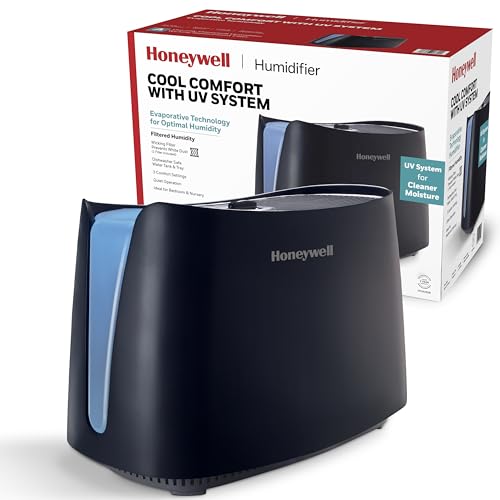
| Honeywell HCM350B | Easiest dishwasher cleaning |
| $76.40as of Oct 21, 2026 12:55 am GMT+0000 | Buy now →Check current price |


Prices are Amazon’s listed prices as of the time shown and change often; check Amazon for today’s price. As an Amazon Associate we earn from qualifying purchases.
Air Quality: White Dust and Microorganisms
This is the biggest practical difference. EPA reports that several studies have shown ultrasonic and impeller humidifiers can disperse materials, such as microorganisms and minerals, from their water tanks into indoor air, and that these two types generally appear to produce the greatest dispersions of both. Breathing mist containing these pollutants has been implicated in a certain type of lung inflammation, and EPA notes that the young, the elderly and people with lung diseases or respiratory allergies may be particularly susceptible. EPA also says the health effects of dispersed microorganisms and minerals are not fully understood, so its recommendations are precautionary.
White dust
EPA notes that ultrasonic and impeller humidifiers are very efficient at dispersing minerals in tap water, and that some consumers notice a “white dust” on surfaces. More importantly, minerals in tap water build scale inside the humidifier, and scale can be a breeding ground for microorganisms. EPA’s recommendation for these types is to use bottled water labeled “distilled,” which it calls the most effective demineralization method, or demineralization cartridges, with the caution that cartridge performance varies widely.
Water hardness varies across the Front Range. Many homes on large municipal surface-water systems have moderately soft to moderately hard water, while well water in the foothills and on the plains can be considerably harder. The utility’s annual water quality report or a simple hardness test strip shows where a home falls. Harder water tilts the decision toward evaporative.
Standing water
EPA cautions that evaporative and steam units can also allow microbial growth if they have a tank of standing water, even though they disperse less of it. No humidifier type is maintenance-free.
Maintenance Compared
EPA’s care guidance applies to both types, with extra emphasis for ultrasonic and impeller units:
- Empty the tank, wipe all surfaces dry and refill with fresh water daily in portable humidifiers, unplugging the unit first.
- Clean portable humidifiers every third day, scrubbing off scale, deposits or film.
- Follow the manufacturer’s directions for cleaning products; in the absence of instructions, EPA suggests a 3 percent hydrogen peroxide solution on surfaces in contact with water, rinsed thoroughly afterward.
- Change wicks, filters and cartridges as the manufacturer directs.
- Dry the humidifier completely before storing it at the end of the season.
Evaporative upkeep
The wick does much of the mineral filtering, so it hardens and loses output over weeks or months, depending on water hardness and run time. Replacement wicks are an ongoing cost. Running an evaporative humidifier with a crusted or moldy wick defeats its advantage. Whole-house furnace-mounted humidifiers use the same principle with a replaceable humidifier water panel that typically needs changing at least once per heating season.
Ultrasonic upkeep
The cost here is distilled water, which adds up quickly for a large unit running daily, plus cleaning the transducer plate gently so scale does not reduce output. Some models include antimicrobial tanks or UV features; these do not replace EPA’s cleaning schedule.
Noise, Energy Use and Cost
Noise
Ultrasonic humidifiers are close to silent, which is the main reason they are popular in bedrooms and nurseries. Evaporative models have a fan that hums on low and can be distracting on high. Some people find the white noise helpful; light sleepers often do not.
Energy
Both evaporative and ultrasonic portable humidifiers typically draw modest power, often in the tens of watts, far less than steam vaporizers, which use an electric heating element. Operating cost differences between the two are usually small compared with the cost of replacement wicks or distilled water.
Purchase price
Ultrasonic units span a wide price range and include many inexpensive small models. Evaporative humidifiers are often priced similarly for comparable output, with larger console units costing more. Ongoing supplies usually matter more than the sticker price over several winters.
Humidity Control and the Over-Humidifying Risk
The right target matters more than the humidifier type. EPA’s mold guidance recommends keeping indoor relative humidity below 60 percent, ideally between 30 and 50 percent, and its humidifier guidance says not to humidify above 50 percent because higher levels may encourage biological growth. EPA suggests using a hygrometer, sold at hardware stores, to check levels, and notes that some humidifiers have a built-in humidistat that can be adjusted.
EPA’s practical warning signs: if water condenses on windows, walls or pictures, relocate the humidifier, lower its humidistat setting or reduce its use. Do not let the area around the humidifier become damp or wet, and do not let carpets, drapes or tablecloths get damp.
Ultrasonic units need more vigilance here because they do not self-limit. A model with an accurate built-in humidistat and auto shut-off, backed up by a separate inexpensive hygrometer across the room, is the safest combination. Evaporative units are more forgiving but still benefit from a humidistat.
Front Range Winters: Dry Air and Window Condensation
Colorado’s semi-arid climate and cold winters create very dry indoor air once the furnace runs. Indoor relative humidity in heated homes along the Front Range can fall well below 30 percent on cold days, which is why static shocks, dry skin and cracked wood furniture are common complaints. EPA notes that humidifiers help relieve dry nose, throat, lips and skin, and reduce static electricity and cracks in paint and furniture.
The catch is window condensation. When it is very cold outside, the inside surface of windows, especially older single-pane or aluminum-frame windows, gets cold enough that even moderate indoor humidity condenses on the glass. A common rule of thumb in cold climates is to lower the indoor humidity target as outdoor temperatures drop, aiming near the bottom of EPA’s 30 to 50 percent range during cold snaps. Persistent condensation that runs onto sills can lead to peeling paint, swollen trim and mold on window frames, so it is a signal to turn the humidifier down rather than to wipe and carry on.
In homes with an attached garage or a cold, closed-off room, keep humidifiers out of spaces where moist air can reach cold surfaces.
Placement helps, too. Set a portable humidifier a few feet away from exterior walls and windows, on a water-resistant surface raised slightly off the floor, with clear space around it so moisture disperses into the room instead of collecting on one cold surface. Closing a bedroom door overnight concentrates moisture in a small space, so check the hygrometer in the morning during the first week of use and adjust the setting before damp sills or fogged glass become a routine.
Output Ratings and Room Size
Humidifier output is usually listed in gallons per day, along with a manufacturer’s suggested room or home size. Those coverage figures assume average construction and climate, and they are best read as rough guidance. A tight, newer home holds moisture far better than a drafty older house, and a room with a vaulted ceiling needs more output than its floor area suggests.
Two points matter for the evaporative-versus-ultrasonic choice:
- Evaporative ratings drift. As the wick loads up with minerals, actual output drops below the rating. A unit that seemed sufficient in December may fall short by February if the wick is not changed.
- Ultrasonic output is steadier. As long as the transducer is clean, output stays close to the setting, which is good for consistency and bad if the humidistat is inaccurate.
Because Front Range winter air is so dry, a humidifier often needs to run near its rated output to reach even the low end of the healthy range in a larger room. Choosing a model with some reserve capacity and running it on a moderate setting is usually quieter and gentler on wicks than running a small model flat out. Our companion guide on humidifier sizing walks through a gallons-per-day estimate step by step.
Which Type Fits Common Situations
Nursery or child’s bedroom
Quiet operation makes ultrasonic tempting, and cool-mist designs avoid the burn risk EPA associates with steam vaporizers. If ultrasonic is chosen, use distilled water and follow EPA’s daily refill and every-third-day cleaning routine without exception. An evaporative unit is a solid alternative for parents who would rather avoid mist and white dust, accepting a little fan noise.
Household members with asthma or allergies
EPA notes that people with lung diseases or respiratory allergies may be particularly susceptible to airborne pollutants dispersed by humidifiers, and that excess moisture can encourage dust mites and mold. Evaporative or steam types, a strict cleaning schedule and keeping humidity at or below 50 percent are the cautious approach. Anyone with health concerns should ask their physician about humidifier use.
Homes with hard well water
Evaporative usually wins. Ultrasonic units on hard water need a steady supply of distilled water to avoid white dust and rapid scaling.
Home office or living room
Either works. Evaporative fan noise is often unnoticeable during the day, and its self-limiting output suits a room where no one is watching the hygrometer.
Renters and small apartments
A compact ultrasonic unit with a humidistat is easy to store and run in a small space, but small, tight apartments over-humidify quickly, so the hygrometer check matters even more.
Common Mistakes With Either Type
- Topping off old water instead of emptying and refilling daily, as EPA recommends.
- Placing the humidifier on carpet or close to curtains, bedding or wood furniture, which can get damp.
- Aiming mist directly at a window or exterior wall in cold weather.
- Relying on a built-in humidistat without verifying it with a separate hygrometer.
- Storing the unit wet at the end of winter, then restarting it in fall without cleaning.
- Adding essential oils or additives not approved by the manufacturer, which can damage parts and add chemicals to the air.
Portable or Whole-House?
Portable evaporative and ultrasonic units humidify one room or a small open area. For a whole home, a furnace-mounted whole-house humidifier, usually a bypass, fan-powered or steam design, ties into the ductwork and a wall humidistat. Bypass and fan-powered models work on the evaporative principle. They need a water line, a drain on many models and an HVAC contractor’s installation, but they eliminate daily tank refilling.
When the comparison is settled, our roundups of the best humidifiers and the best whole-house humidifiers compare current portable and furnace-mounted models.
When to Call an HVAC Pro or Inspector
Call an HVAC contractor to install or service a whole-house humidifier, to check whether the furnace and ducts can support one, or when a house has persistent condensation, musty smells or visible mold around windows despite moderate humidifier settings. Excess moisture can point to ventilation problems that a humidifier makes worse. Our guide to hiring heating and cooling professionals covers what to ask. For buyers, an inspector may note signs of chronic condensation, water-stained sills or a neglected furnace humidifier, which are clues about how moisture has been managed in the home.
References
- Use and Care of Home Humidifiers — U.S. Environmental Protection Agency
- Biological Contaminants and Indoor Air Quality — U.S. Environmental Protection Agency
- A Brief Guide to Mold, Moisture and Your Home — U.S. Environmental Protection Agency
Frequently asked questions
Is an evaporative or ultrasonic humidifier healthier?
EPA reports that ultrasonic and impeller humidifiers generally disperse the most minerals and microorganisms from their tanks, while evaporative and steam types disperse less, if any. Either can be used safely with clean water, daily refills and cleaning every third day, but evaporative units are more forgiving.
How can white dust from an ultrasonic humidifier be stopped?
EPA recommends using bottled water labeled distilled, which has much lower mineral content than most tap water, or demineralization cartridges if the manufacturer supplies them. Cartridge performance varies, so distilled water is the more reliable fix.
Do evaporative humidifiers need filters?
Yes. They use a wick, belt or filter that soaks up water and traps minerals. It hardens over time and should be replaced on the manufacturer's schedule, more often with hard water, to keep output up and prevent microbial growth.
What humidity should a humidifier be set to in winter?
EPA recommends keeping indoor relative humidity between 30 and 50 percent and not above 50 percent. In cold Colorado weather, staying near the lower end helps prevent condensation on windows.
Are ultrasonic humidifiers quieter than evaporative ones?
Generally yes. Ultrasonic units are near silent, while evaporative models rely on a fan that hums, especially on high. That quietness is a key reason ultrasonic humidifiers are popular in bedrooms and nurseries.
Seeing heavy window condensation or musty smells in a Front Range home you are considering? Contact our team to connect with a local inspector.