Does Radon Have a Smell: The Chemistry Explained

Does radon have a smell? The chemistry answer is no, and the reason traces directly to how the periodic table is organized. Radon sits in the rightmost column of the table, the noble gases, alongside helium, neon, argon, krypton, and xenon. Noble gases share a defining property: their outer electron shell is full, which means they do not readily form chemical bonds with other elements. Olfactory perception depends on molecules binding to receptors in the human nose, and noble gases do not bind. They do not have a smell because they cannot interact with the chemistry of smell. This guide summarizes EPA and NIH guidance current as of 2026 and is not a substitute for testing your specific home or consulting a certified radon professional. The chemistry-focused framing here exists because understanding why radon is undetectable helps homeowners take testing seriously instead of relying on their senses.
Part of our Radon Levels guide — start there for the full picture →
Does radon have a smell at any concentration or temperature?
No. Radon’s lack of smell is not a matter of concentration or temperature — it is a fundamental property of the atom. Radon-222, the isotope most relevant to indoor air quality, is a monatomic noble gas with atomic number 86. Its electron configuration ends in 6p⁶, a closed shell, which means it has no available electron pairs to form chemical bonds with other elements under normal conditions. Without bonding chemistry, radon cannot interact with olfactory receptors in the nose, cannot form the small reactive species that produce taste signals on the tongue, and cannot produce any of the sensory cues humans rely on for chemical detection.
Even at concentrations that would be acutely dangerous over long-term exposure — say, 100 picocuries per liter, twenty-five times the EPA action level — radon remains completely undetectable to human senses. The atomic property does not change with concentration. It does not change with temperature. It does not change with humidity. Radon is invisible, odorless, and tasteless in all conditions a homeowner will ever encounter.
Why noble gases as a class are odorless
The noble gas family — helium, neon, argon, krypton, xenon, and radon — share an electron configuration with a fully populated outer shell. Helium has 2 electrons (1s² full). Neon, argon, krypton, and xenon each have 8 electrons in their outer shells (the s²p⁶ configuration). Radon has 8 electrons in its 6s²6p⁶ outer shell. A closed shell is the lowest-energy, most stable configuration in chemistry, which is exactly why noble gases were historically called “inert gases.”
The closed-shell configuration matters for smell because olfaction is a binding-and-signaling process. Odorant molecules dock into pockets on olfactory receptor proteins through hydrogen bonds, van der Waals interactions, and occasional weak covalent interactions. Molecules that cannot form these interactions cannot trigger the receptor signal. Noble gases produce no docking, no signal, and therefore no smell.
Heavier noble gases like xenon and radon do form a few exotic compounds under extreme laboratory conditions — xenon hexafluoride, for example — but these are not occurring in a residential basement. In a home, radon exists as discrete monatomic gas atoms drifting through the air, chemically isolated from everything around them.
Comparison: molecules that DO smell
The contrast with detectable indoor air pollutants is sharp. A short list of indoor odorants and the chemistry that makes them smelly:
Hydrogen sulfide (H₂S): the rotten-egg smell of sewer gas. Two hydrogens bonded to a sulfur, with a strong dipole moment and reactive sulfur chemistry. Detectable by human olfaction at concentrations as low as 0.5 parts per billion.
Geosmin and 2-methylisoborneol: the earthy-musty smells produced by mold and soil microbes. Bicyclic terpenoid alcohols with hydroxyl groups that hydrogen-bond into olfactory receptors. Detectable at parts-per-trillion concentrations.
Formaldehyde (HCHO): the pungent off-gas from particle board, some adhesives, and embalming fluid. A reactive carbonyl group that forms covalent and hydrogen-bond interactions.
Limonene and pinene: the citrus and pine smells from cleaning products and air fresheners. Terpenes with conjugated double bonds.
Ammonia (NH₃): the sharp smell of old cleaning supplies and decomposing organic material. A small polar molecule with a lone pair on nitrogen.
Every one of these molecules has reactive chemistry that lets it bind to olfactory receptors. Every one of them produces a clear sensory signal. None of them are radon. When a homeowner notices “a smell in the basement,” the molecules producing that smell are not radon — they are some combination of the chemistry above.
Radon’s actual physical and radiochemical properties
What radon does have, instead of smell, is radioactivity. Radon-222 has a half-life of 3.8 days, decaying through a chain of short-lived progeny (polonium-218, lead-214, bismuth-214, polonium-214) that emit alpha particles, beta particles, and gamma radiation. The alpha-particle emissions are the dominant health-risk driver: when radon and its progeny are inhaled, the alpha particles deposit energy directly in lung tissue at the cellular level, damaging DNA and increasing lifetime lung-cancer risk.
The radioactivity is also undetectable by human senses. We have no nerves for ionizing radiation. We have no taste for alpha particles. The damage accumulates silently over years and decades, and the dose-response is generally treated as linear with no safe threshold. This is exactly why EPA, CDC, WHO, and CDPHE consistently recommend measurement-based decision making rather than sensory judgment.
For homeowners wanting deeper background on radon as an indoor air quality concern, our radon testing pillar covers measurement methods and mitigation in depth, and the sibling article can you smell radon covers the practical “why does my basement smell” question that often brings homeowners to this topic.
How measurement works without sensory cues
Because human senses cannot detect radon, every measurement method depends on detecting either radon’s alpha-particle emissions or radon-induced reactions in a sensitive medium:
Charcoal canister tests capture radon atoms onto activated charcoal, where the alpha emissions from decay are counted in a lab gamma spectrometer.
Alpha-track detectors use a small plastic film that records etched marks where alpha particles passed through. Lab counting of the etched tracks produces an exposure measurement.
Electret detectors use an electrostatically charged disc whose charge is partially neutralized by ionization from radon decay. Charge measurement before and after deployment gives a concentration.
Continuous radon monitors use ion chambers or photodiode-based alpha detectors that report hour-by-hour readings electronically.
All four methods convert invisible alpha emissions into a numerical concentration in picocuries per liter. None of them rely on human sensory perception, because none would work if they did.
EPA action level and exposure framing
EPA’s residential action level is 4 pCi/L, WHO sets a more conservative 2.7 pCi/L, and both agencies frame radon-induced lung cancer risk as having no truly safe lower threshold. EPA estimates approximately 21,000 lung-cancer deaths per year in the United States are attributable to radon exposure, making it the leading cause of lung cancer among non-smokers and the second leading cause overall after smoking.
The Front Range of Colorado sits in EPA Radon Zone 1, the highest-risk classification. Front Range geology contains uranium-bearing rock formations that release radon into soil gas at higher-than-average rates, and the typical Front Range home features a basement or daylight basement that maximizes soil-gas entry. CDPHE data consistently shows more than half of tested Front Range homes register above the 4 pCi/L action level.
What this means for homeowners
The chemistry above leads to a clear practical conclusion. Because radon’s lack of smell is rooted in atomic structure rather than concentration, homeowners cannot use their senses to judge whether their home is safe. The undetectability is permanent and absolute. Decisions about radon exposure must be made on measured data, not perceived absence of smell. That means testing every home, retesting every two years, mitigating when results exceed 4 pCi/L, and confirming post-mitigation levels through follow-up testing. The chemistry will not change. The decision framework should not either.
How radon’s radioactive decay produces the lung-cancer risk
Radon’s lack of smell does not mean radon is biologically inert. The danger comes from a completely different mechanism than chemistry: ionizing radiation from radioactive decay. Radon-222 decays with a half-life of 3.8 days, emitting an alpha particle as it transforms into polonium-218. Polonium-218 in turn decays through several short-lived progeny — lead-214, bismuth-214, polonium-214 — each emitting alpha particles, beta particles, or gamma radiation as the nuclear chain proceeds toward stable lead-210.
The alpha particles are the dominant biological hazard. An alpha particle is essentially a helium-4 nucleus, traveling at high velocity, carrying enough energy to ionize hundreds or thousands of atoms along a track only a few cell-diameters long. When radon or its progeny are inhaled and decay within the lung, the alpha particles deposit energy directly into the cells lining the airways and the deep lung. The DNA damage that follows is the molecular initiating event for radon-induced lung cancer.
The progeny matter as much as radon itself. Radon-222 attaches loosely to nothing in indoor air because of its noble-gas inertness, but the progeny formed in the air are particulates that bind to dust and water droplets. Inhaled progeny lodge in the lung tissue at the moment of decay, depositing their alpha-particle energy locally rather than diffusing back out. This is why the “radon” hazard is really a hazard of radon plus its progeny acting together in indoor air.
Atomic-mass effects on radon behavior in air
Radon-222 has an atomic mass of 222 atomic mass units, making it the heaviest naturally occurring noble gas. The high mass affects radon’s behavior in indoor air in subtle ways:
Settling tendency: radon is heavier than air, with a density roughly 7.6 times that of nitrogen at the same temperature. In a perfectly still room, radon would tend to settle toward the floor. In a real room with normal HVAC operation, convection currents, and human movement, radon mixes thoroughly through the indoor air on a timescale of minutes.
Basement accumulation: radon entering through the basement floor and walls does tend to accumulate at the lowest level of the home before stack effect and HVAC operation distribute it upward. This contributes to the typical 2-to-4-fold concentration gradient between basement and upper floors.
Half-life and transport: the 3.8-day half-life is short enough that radon entering a building has limited time to migrate far before decaying. Most exposure happens close to the source — the foundation — rather than at distant locations within the home.
None of these mass-related behaviors give radon a smell. They affect spatial distribution, not olfactory detectability.
How alpha-track and electret detectors exploit the chemistry-vs-radioactivity distinction
The contrast between radon’s chemical inertness and radon’s radioactive emissions is exactly what makes detection technology work. Sensors that depended on chemical reactivity would fail with radon because radon does not react. Sensors that detect alpha particles directly — counting individual decay events — succeed because each decay event releases a high-energy particle that can be detected by a specialized medium.
Alpha-track detectors use a small piece of CR-39 polymer film. When an alpha particle passes through the film, it damages the polymer chains along its track. After the deployment period, the film is etched with a chemical bath that enlarges the tracks into visible pits. A microscope or automated counter measures track density, which is proportional to the time-integrated radon exposure during deployment. Electret detectors use a similarly indirect principle: a small disc of permanently charged polymer (an electret) loses charge in proportion to the ionization caused by radon decay in the surrounding air. Charge measurement before and after deployment converts radon exposure into a number.
Both methods produce a useful quantitative measurement of something that humans cannot sense at all. The technology fills the perceptual gap that biology cannot.
References
- EPA Radon homeowner program — U.S. Environmental Protection Agency
- CDC Radon and Lung Cancer — Centers for Disease Control and Prevention
- NIEHS Radon health information — National Institute of Environmental Health Sciences
- CDPHE Colorado Radon Program — Colorado Department of Public Health and Environment
Frequently asked questions
Does radon have a smell at high concentrations?
No. Radon-222 is a monatomic noble gas with a closed outer electron shell, so it cannot form the chemical bonds required to trigger olfactory receptors. Radon is odorless at every concentration humans encounter, including concentrations that are dangerous over long-term exposure.
Why are noble gases odorless as a class?
Their outer electron shell is fully populated, which makes them chemically inert under normal conditions. Smell requires odorant molecules to dock into receptor pockets in the nose through hydrogen bonds and similar interactions. Noble gases do not form those interactions, so they produce no signal.
If radon can't smell, how is it measured?
Measurement uses radon's radioactive decay rather than its chemistry. Charcoal canisters capture radon atoms and measure decay in a lab. Alpha-track detectors record etched marks from alpha particles. Electret detectors measure ionization-induced charge loss. Continuous radon monitors count alpha emissions electronically.
How does radon harm health if it has no chemistry?
The harm comes from radioactive decay rather than chemical interaction. When radon and its progeny are inhaled, the alpha particles from decay deposit energy directly in lung tissue, damaging DNA at the cellular level. The cumulative damage increases lifetime lung-cancer risk.
This guide summarizes EPA and NIH guidance current as of 2026 and is not a substitute for testing your specific home or consulting a certified radon professional. Front Range homeowners can connect with a vetted certified radon professional through our contact page.
Test your home for radon
Radon is invisible and odorless, so a test is the only way to know your level. A short-term kit gives a first reading in days; a digital monitor tracks it over time.
| Product | Why | Buy |
|---|---|---|
 AirChek Charcoal Radon Test Kit | Lab fee usually included; EPA short-term protocol. | Amazon |
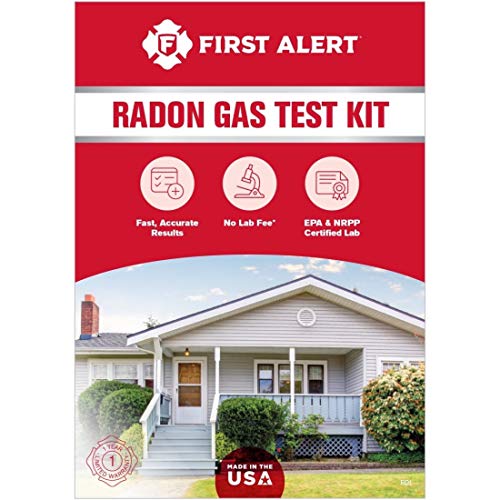 First Alert RD1 Radon Test Kit | Widely stocked; 48-hour charcoal test. | Amazon — $17.95 |
 Airthings Corentium Home | Digital monitor with a long-term average. | Amazon — $142.99 |