Borescope With Articulating Head: Mechanism Deep Dive
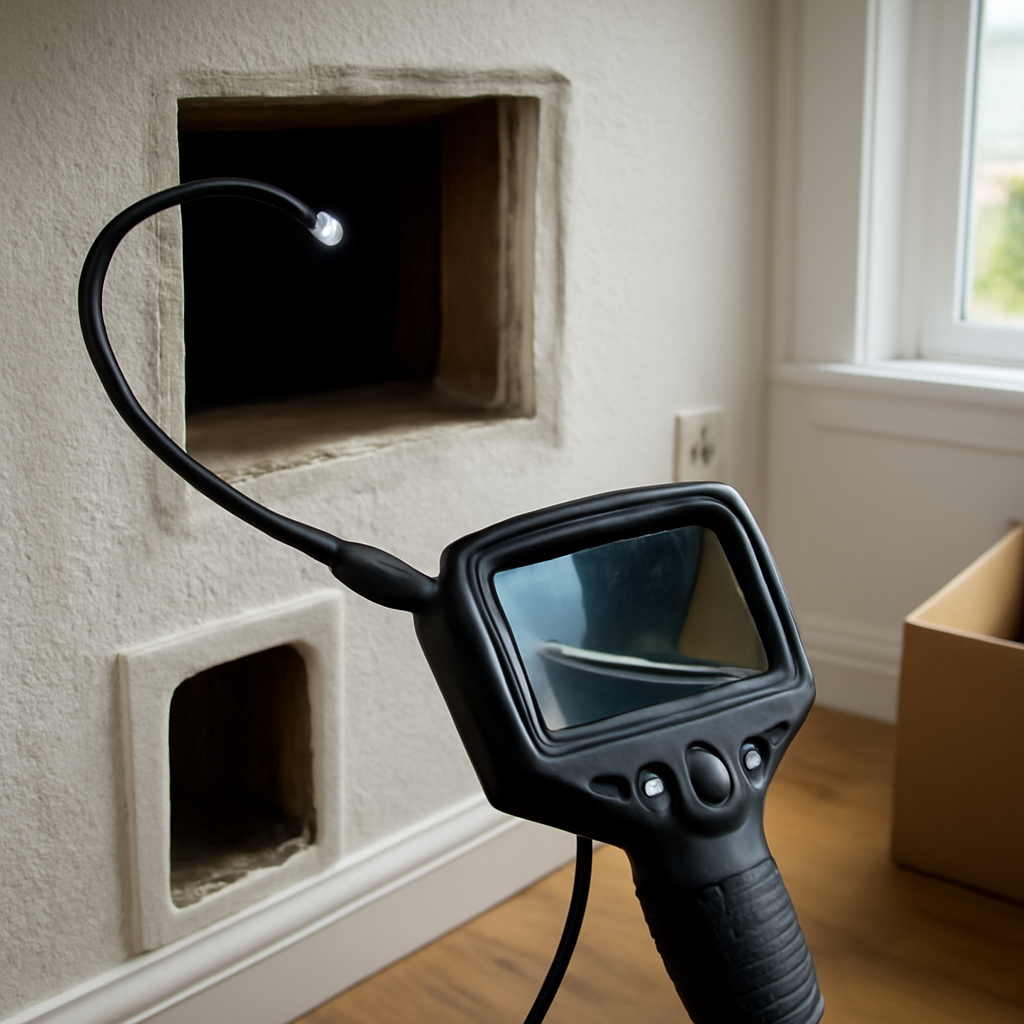
A borescope with an articulating head bends its camera tip on command, letting the operator look around corners, examine cylinder walls, navigate complex cavities, and inspect surfaces that a straight-tube camera could never see. The mechanism varies between models — joystick-controlled tip movement on industrial units, cable-pull articulation on consumer handhelds, and motorized articulation on premium models. This guide focuses on how articulation works mechanically, where it earns its price premium, and how to choose between articulation depths.
How articulation actually works
Articulation in a borescope refers to controlled bending of the camera tip without disturbing the rest of the cable. Three primary mechanisms drive the bend.
Cable-pull articulation
Most consumer-tier articulating borescopes use cable-pull mechanics. Thin steel cables run from a thumb wheel or lever at the handle, through the borescope cable, to the camera tip. Turning the wheel tensions the cable and bends the tip toward the cable side. Releasing tension lets the tip relax to neutral.
Cable-pull articulation is simple, durable, and affordable. The tradeoff is precision — cable-pull articulation has noticeable hysteresis (slight lag between control input and tip position), and the articulation angle is limited by cable strength and bend radius before the cable kinks or the tip refuses to return to neutral.
Joystick-controlled articulation
Mid-tier and industrial borescopes use joystick-controlled articulation, often with motorized assistance. A small joystick on the handle controls tip position in two perpendicular directions (up/down, left/right) simultaneously. The joystick translates to precise tip angles through internal mechanisms — typically motorized cable systems in industrial units.
Joystick articulation gives smoother, more precise control than thumb-wheel cable-pull. The tradeoff is cost and complexity — motorized articulation systems require maintenance and add failure modes that simple cable-pull doesn’t have.
Motorized multi-axis articulation
High-end industrial borescopes (Olympus IPLEX premium models, specialized aerospace inspection tools) use motorized articulation with multi-axis capability, often allowing full 360° rotation of the camera tip with smooth analog control. Precision approaches what robotic surgical scopes deliver.
Articulation depth: 1-way, 2-way, 4-way
The number of articulation directions is the headline spec.
1-way articulation
The camera tip bends in one direction — typically up or “toward operator” — controlled by a single thumb wheel. Common on consumer-tier articulating borescopes ($200-400 range). 1-way articulation handles inspecting tops of HVAC ductwork, looking up into ceiling cavities, and viewing the upper surfaces of cylinder bores when the camera is inserted from below.
The honest limit: 1-way articulation only works if you can physically rotate the borescope cable to point the articulation direction where you need it. In tight cavities where the cable can’t be rotated freely, 1-way articulation can leave you with the wrong bend direction.
2-way articulation
The camera tip bends in two perpendicular directions, controlled by two thumb wheels or a small joystick. Common on automotive borescopes and mid-tier consumer models ($400-1,500). 2-way articulation handles complex cavities where the inspection target isn’t aligned with the cable’s rotation, and where you can’t rotate the cable freely.
For most working inspector use cases — HVAC ductwork after turns, complex behind-wall cavities, attic crawl spaces — 2-way articulation is the practical capability ceiling. It’s enough to navigate around obstacles and orient toward the inspection target reliably.
4-way articulation
The camera tip bends with full directional freedom, typically controlled by a joystick that maps directly to tip position. Common on industrial borescopes ($1,500+). 4-way articulation handles aerospace inspection, jet engine cylinder examination, and any cavity where the inspection target requires complex multi-axis approach.
For residential home inspection, 4-way articulation is generally over-specified — the use cases that need it are commercial and industrial, not residential.
Articulation angle: how far the tip bends
Beyond direction count, the articulation angle matters. A 1-way borescope bending only 30° gives much less practical capability than one bending 180°.
Consumer-tier articulating borescopes typically deliver 90°-150° articulation angles in their primary direction. Industrial borescopes deliver up to 180° or beyond. The practical question: can the tip see backward toward the operator side of the cable? Articulation angles approaching 180° mean yes; angles around 90° mean no.
Where articulation actually earns its price premium
Articulation matters when the inspection target is not aligned with where the borescope cable can be inserted from. Three common scenarios.
Cylinder bore inspection
Inspecting cylinder walls in an engine requires looking sideways from the cable’s axis. The cable enters through the spark plug hole or valve port; the inspection target is the cylinder wall perpendicular to that entry. Articulation lets the camera face the cylinder wall directly. Without articulation, the camera looks straight down and misses most of the bore surface.
HVAC ductwork after turns
Ductwork that turns 90° at junctions can’t be inspected past the turn with a non-articulating borescope. The camera enters the duct, reaches the turn, and the rigid cable can’t bend around it. Articulating borescopes navigate the turn by bending the camera tip while the cable feeds through.
Wall cavities with obstructions
Wall cavities often contain wiring, plumbing, or insulation that block direct paths to the inspection target. Articulating cameras navigate around these obstructions; non-articulating cameras stop at the first obstacle.
When articulation isn’t necessary
For straight-tube inspection — drain traps, refrigerator backs, simple attic crawlspaces, single-cavity electrical boxes — non-articulating borescopes work fine. The price premium for articulation in those cases doesn’t earn its money.
Long borescope reach guide covers cable-length considerations for inspecting straight cavities at distance.
Articulation durability concerns
Articulation mechanisms are the most failure-prone part of a borescope. Cable-pull mechanisms can fail when cables stretch or fray. Motorized mechanisms can fail when motors burn out or drive trains develop slop. Multi-axis joystick controllers can fail when control electronics develop intermittent connection issues.
For working inspectors, this means articulation models carry higher replacement and repair frequency than non-articulating models. Budget accordingly. Home inspection tools hub covers tool replacement planning in the broader inspector workflow.
Choosing articulation depth for your use case
Start with the cavity geometry. Straight cavities don’t need articulation. Cavities with one turn or accessible from one direction benefit from 1-way articulation. Cavities with multiple turns or where the cable can’t be rotated freely benefit from 2-way articulation. Complex multi-axis inspection (cylinder bores, jet engines, complex industrial machinery) requires 4-way.
Most working home inspectors are well-served by 1-way or 2-way articulating borescopes in the $300-800 range. Spending more on articulation depth that won’t be used in residential inspection contexts doesn’t earn its money.
Control interface matters
Beyond articulation count and angle, the control interface matters for daily usability. Thumb wheels are durable but slow to operate. Joysticks are fast but more delicate. Trigger-style controls (squeeze to articulate) are intuitive but limited in precision.
For inspectors holding the borescope in one hand while navigating cavities, single-hand control matters. Two-handed control schemes that require operating the joystick with one hand and feeding the cable with the other slow inspection workflow substantially.
Image storage during articulation
Articulation while capturing video can introduce motion blur and shaky footage. For documentation, capture still images at stable positions rather than video while articulating. Best borescope buyer guide covers the broader tier comparison.
The honest assessment of articulation value
Articulation transforms what a borescope can inspect. For working inspectors hitting articulation-required use cases regularly (cylinder bores, HVAC turns, complex cavities), the price premium pays back quickly in inspection capability. For occasional homeowner use checking straight cavities, articulation is often capability you’ll pay for and not use.
Pick by use case. If you’re not sure whether you need articulation, look at the cavities you actually intend to inspect. If most are straight, skip articulation. If most involve turns or complex geometry, pay for at least 1-way.
Maintenance practices that extend articulation life
Articulation mechanisms last longer with proper handling. Avoid forcing the tip against resistance — if the cable is bent past its tolerance or the tip is jammed against an obstacle, additional articulation input damages the cable-pull mechanism. Clean the camera tip and articulation joint after each use to prevent dust and debris from working into the mechanism. Store the borescope with articulation in neutral position rather than locked at extreme angles, which reduces stress on control cables during storage.
Working inspectors who follow these practices typically see articulation mechanisms last 2-4 years before requiring service or replacement. Inspectors who don’t see failure within 12-18 months of regular use. The maintenance overhead is minimal — a few minutes of cleaning per inspection — but the durability difference is substantial.
Articulation in specialty applications
Beyond general home inspection, articulation matters specifically in several specialty contexts. Aviation pre-purchase inspection often requires cylinder bore examination using 2-way or 4-way articulating borescopes to view valve seats and cylinder walls. Marine engine inspection during boat surveys uses articulation to navigate around engine block complexity. Industrial chiller and boiler inspection uses articulation to view interior surfaces of pressure vessels through inspection ports. Each specialty has slightly different articulation depth requirements; researching the specific application’s norms before purchasing prevents over- or under-buying.
For residential home inspectors expanding into pre-purchase aviation or marine work, the borescope tier likely needs to upgrade from consumer to automotive-tier or industrial-tier articulating models. Inspection borescope overview covers the working inspector tier comparison.
Articulation versus rotation in cavity navigation
Articulation and rotation accomplish different things and are sometimes confused. Articulation bends the camera tip relative to the cable axis — letting you see in a different direction than the cable points. Rotation rotates the entire camera around the cable axis, letting you see what’s around the cylinder of view at the same tip position. Some industrial borescopes offer both articulation and tip rotation as independent controls; consumer units typically offer only articulation.
The practical implication is that articulation lets you navigate around bends in cavities while rotation lets you scan around a static position. For complex industrial inspections, both capabilities matter. For most residential and automotive inspection, articulation alone covers the use cases adequately because the inspector can rotate the entire borescope cable manually to achieve similar effect to dedicated rotation control.
How articulation depth scales with industrial requirements
Industrial inspection standards in aerospace, power generation, and certain manufacturing contexts specify articulation depth requirements for inspection sign-off. Aviation engine inspection commonly requires 4-way articulation with specific minimum bend angles to verify visibility of all cylinder surfaces. Nuclear power plant inspection programs specify articulation capabilities matched to specific inspection ports and required visual coverage. These industrial standards drive demand at the high-end of the articulating borescope market.
For residential home inspection, no equivalent standards mandate specific articulation requirements. Inspectors choose articulation depth based on practical use cases rather than regulatory compliance. The freedom to pick by use case is one of the reasons residential inspection tooling is much more variable than aviation or nuclear inspection tooling.
References
- InterNACHI Inspection Tools Resources — International Association of Certified Home Inspectors
- ASHRAE Standards and Guidelines — American Society of Heating, Refrigerating and Air-Conditioning Engineers
- ICC International Codes — International Code Council
- OSHA Confined Spaces Guidance — Occupational Safety and Health Administration
Borescopes & inspection cameras
A borescope lets you see inside walls, ducts, drains, and crawlspaces without opening anything up.
| Product | Why | Buy |
|---|---|---|
 DEPSTECH Wireless Borescope DEPSTECH Wireless Borescope | Wi-Fi to your phone; semi-rigid cable. | Amazon — $48.99 |
 Teslong Dual-Lens Borescope Teslong Dual-Lens Borescope | Side + front view; good for ducts. | Amazon — $159.99 |
 Ridgid micro CA-150 Ridgid micro CA-150 | Rugged handheld with screen. | Amazon — $295.05 |