Best Washer Hoses (2026): 7 Braided and Rubber Supply Lines

The best washer hoses are the ones you never think about, because a washing machine supply line sits under constant water pressure behind an appliance nobody looks behind. When a hose splits, it does not drip; it floods until someone closes the valve. Braided stainless steel hoses are the common upgrade from plain rubber, but “burst proof” on a listing is a marketing phrase, not a standard. What actually differs is the inner core material, the stated pressure rating, the fitting metal, the length and whether there is a 90-degree elbow. Below are seven picks from the current Amazon shelf, each for a specific laundry setup, then a guide to installing, inspecting and replacing them.
Part of our Plumbing & Water guide — start there for the full picture →
As an Amazon Associate we earn from qualifying purchases.
How we compared: we compared 13 current Amazon listings for washing machine fill hoses on what each listing states: outer jacket, inner core material, stated pressure rating, temperature range, fitting metal, length, elbow design and warranty wording. A 50-foot pressure washer hose that appeared in the same search was excluded as a different product. We did not lab-test or install any hose. Prices and availability change often, so check the current listing before buying.
Quick picks: the best washer hoses by laundry setup
| Product | Best for | Key features | Price | Buy |
|---|---|---|---|---|
| TOMOON 4 ft Braided | Best overall braided pair |
| $13.99as of Oct 19, 2026 10:14 pm GMT+0000 | Buy now →Check current price |
| Querix WMH532617 | EPDM core, stated working pressure |
| $9.99as of Oct 19, 2026 10:14 pm GMT+0000 | Buy now →Check current price |
| Puxyblue 6 ft 90-Degree | Washer pushed close to the wall |
| $16.47as of Oct 19, 2026 10:14 pm GMT+0000 | Buy now →Check current price |
| Beaquicy 4 ft 90-Degree | Short run with an elbow |
| $16.17as of Oct 20, 2026 12:44 am GMT+0000 | Buy now →Check current price |
| Beaquicy 6 ft Straight | Cold garage or basement laundry |
| $16.97as of Oct 20, 2026 12:44 am GMT+0000 | Buy now →Check current price |
| K&J Premium 6 ft | Interchangeable hot and cold |
| $23.45as of Oct 20, 2026 12:44 am GMT+0000 | Buy now →Check current price |
| Fetechmate 6 ft Rubber | Reinforced rubber alternative |
| $16.29as of Oct 20, 2026 12:44 am GMT+0000 | Buy now →Check current price |
Prices are Amazon’s listed prices as of the time shown and change often; check Amazon for today’s price. As an Amazon Associate we earn from qualifying purchases.
The seven picks, compared listing by listing
1. TOMOON 4 ft Stainless Steel Washer Hoses — Best Overall Braided Pair
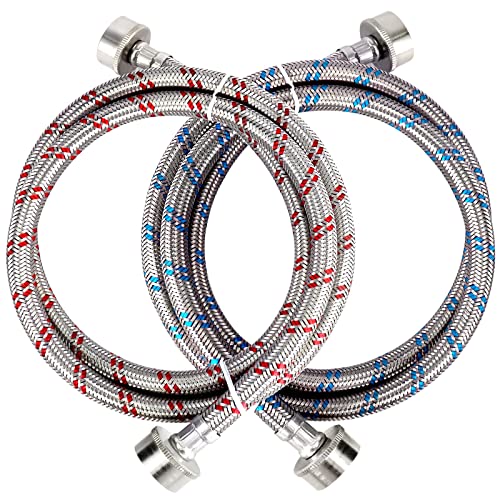
Grade 304 braided stainless washer hoses with two-layer PVC core, brass fittings and a stated 1500 PSI maximum.
Check price on Amazon$13.99 as of Oct 19, 2026 10:14 pm GMT+0000 — prices change; see Amazon for current price.Why we like it
- Names Grade 304 stainless steel for the braid
- States a maximum rating of 1500 PSI
- Brass nuts, ferrules and nipples
- Gives exact hose and connector diameters
| Specification | Details |
|---|---|
| Jacket / core | Grade 304 braided stainless over two layers of PVC |
| Pressure rating | 1500 PSI maximum, per listing |
| Fittings | Brass nuts, ferrules and nipples; 3/4 in. connections with gasket inserts |
| Length | 4 ft (about 48.4 in.) |
| Hot / cold | Red and blue lined; listing says both share the same temperature rating |
| Warranty | Listing describes a 10-year guarantee of after-sales service |
TOMOON 4 ft — 304 stainless braid, 2-ply PVC core, brass fittings, 1500 PSI stated, red/blue pair
One of Only Two Listings That Name 304 Stainless and a 1500 PSI Figure Together
Five of the 13 on-topic listings name Grade 304 stainless for the braid, and four state a 1500 PSI figure. Only two listings state both: this TOMOON and the Puxyblue in pick 3. Most of the rest describe their braid only as “premium” or “high tensile,” which tells you nothing you can compare.
The TOMOON listing is also unusually specific about dimensions: a hose outer diameter of about 0.512 inches and a connector of 0.986 inches. It states that both hoses have the same temperature ratings and differ only in color, which is useful if you ever swap them. Brass ferrules and nipples matter more than they sound; the crimped joint where the braid meets the fitting is where many hoses fail.
What the listing does not say: it never names a test standard for that pressure figure, and its install note mentions using pliers, which can crush a fitting if overdone. Hand-tight plus a quarter turn with a wrench is a typical guideline; follow the washer manual.
Pros
- 304 stainless and a pressure figure both stated
- All-brass fitting components
- Exact diameters listed
Cons
- No test standard named for the rating
- PVC core rather than EPDM rubber
- “Guarantee” is after-sales service, not defined coverage
Check TOMOON 4 ft Braided price on Amazon
2. Querix WMH532617 4 ft Hoses — Best EPDM Core With a Working Pressure Rating

Braided stainless hoses with an EPDM core, solid brass nuts, 250 psi working pressure and a 2-year warranty.
Check price on Amazon$9.99 as of Oct 19, 2026 10:14 pm GMT+0000 — prices change; see Amazon for current price.Why we like it
- EPDM rubber core inside the braid
- States working pressure, not just burst claims
- Solid brass nuts
- 2-year manufacturer warranty in the spec field
| Specification | Details |
|---|---|
| Jacket / core | Braided stainless steel over EPDM |
| Pressure rating | 250 psi maximum working pressure |
| Fittings | Solid brass nuts; 3/4 in. FHT x 3/4 in. FHT |
| Length | 4 ft |
| Hot / cold | Red and blue color coded |
| Warranty | 2-year manufacturer warranty |
Querix WMH532617 — braided stainless over EPDM, 250 psi working, brass nuts, 3/4 in. FHT, 4 ft, 2-yr warranty
A Working-Pressure Number Instead of a Burst Claim
Three listings name an EPDM core: Querix, Azeziann and GA1FSL. EPDM is the synthetic rubber widely used for hot-water hoses, and it is the core material many plumbers expect inside a braided washer line. Seven listings instead describe a PVC core, which is common in budget braided hoses.
The bigger difference is how pressure is described. Two listings, Querix and GA1FSL, give a maximum working pressure of 250 psi. Four others quote 1500 psi without saying whether that is working or burst pressure. A working rating is the more honest number. For context, the EPA’s WaterSense program says fixtures operate best when household service pressure is between 45 and 60 psi, so 250 psi of working capacity is generous headroom.
The Querix is also the only listing whose spec field states a defined manufacturer warranty of two years. Many others advertise “10 years” in their bullet points, but describe it as after-sales service or support rather than written coverage. The listing does not state a temperature range.
Pros
- EPDM core rather than PVC
- Clear 250 psi working pressure
- Defined 2-year manufacturer warranty
Cons
- No temperature range stated
- 4 ft may be short for some layouts
- Braid grade not named
Check Querix WMH532617 price on Amazon
3. Puxyblue 6 ft Hoses With 90-Degree Elbow — Best for Washers Close to the Wall

6 ft braided 304 stainless hoses with a 90-degree elbow on one end, 1500 psi stated and a 15 to 158 F range.
Check price on Amazon$16.47 as of Oct 19, 2026 10:14 pm GMT+0000 — prices change; see Amazon for current price.Why we like it
- 90-degree elbow keeps the hose from kinking
- States 1500 psi and a temperature range
- Lead-free PVC core, 304 braid
- Four spare sealing gaskets included
| Specification | Details |
|---|---|
| Jacket / core | Braided 304 stainless over lead-free PVC |
| Pressure / temperature | Up to 1500 psi; 15 F to 158 F |
| Elbow | 90-degree elbow on one end |
| Connection | 3/4 in. female hose thread |
| Length | 6 ft (about 71.8 in.) |
| In the box | Red hose, blue hose, 4 rubber gaskets |
Puxyblue 6 ft 90-degree — 304 braid, lead-free PVC core, 1500 psi, 15–158 F, elbow one end, 4 gaskets
The Only Elbow Hose That States Both a Pressure and a Temperature Range
Four listings include a 90-degree elbow: two from Beaquicy, one from Fetechmate and this Puxyblue. Elbows let the washer sit closer to the wall without forcing the hose into a sharp bend at the inlet, which is one of the stress points that shortens hose life. Of those four, only the Puxyblue states both a pressure figure (1500 psi) and a temperature range (15 to 158 F).
Put the elbow on the washer end, where the space is tightest. The 6-foot length suits a supply box set off to one side, or a stacked or pedestal installation. Too much extra length is not harmless, though; coiled slack behind a vibrating machine rubs against the wall and the cabinet.
The listing’s “10 Years warranty” is framed as replacement or refund support. It also calls the core “explosion-proof,” which is not a meaningful plumbing term. The useful facts are the elbow, the ranges and the 304 braid.
Pros
- Elbow reduces sharp bends at the inlet
- Pressure and temperature ranges stated
- Extra gaskets included
Cons
- PVC core, not EPDM
- 6 ft can leave slack in tight closets
- Warranty is support-based wording
Check Puxyblue 6 ft 90-Degree price on Amazon
4. Beaquicy 4 ft Hoses With 90-Degree Elbows — Best Short Run With an Elbow

4 ft braided 304 stainless hoses with a 90-degree elbow, lead-free PVC core and a 15 to 158 F range.
Check price on Amazon$16.17 as of Oct 20, 2026 12:44 am GMT+0000 — prices change; see Amazon for current price.Why we like it
- Only 4 ft elbow hose on the shelf
- 304 stainless braid, lead-free core
- States 15 to 158 F operating range
- Pure rubber inner hose layer described
| Specification | Details |
|---|---|
| Jacket / core | 304 braided stainless; lead-free PVC core with rubber inner hose |
| Temperature | 15 F to 158 F |
| Elbow | 90-degree on one end |
| Connection | 3/4 in. female hose thread |
| Length | 4 ft |
| Pressure rating | Not stated in listing |
Beaquicy 4 ft 90-degree — 304 braid, lead-free PVC/rubber core, 15–158 F, elbow one end, 3/4 in. FHT
The Shortest Elbow Option Among Four
The other three elbow listings are all 6 feet. If the supply box sits directly behind the washer, a 4-foot hose with an elbow avoids the loop of slack a 6-foot hose leaves. Seven of the 13 listings are 4-foot hoses and six are 6-foot, but this is the only 4-foot hose with an elbow.
The listing names 304 stainless, a lead-free PVC core and a pure rubber inner hose, along with the same 15 to 158 F range other Beaquicy listings give. Four listings use the phrase lead-free, and three of them are Beaquicy products. Drinking water does not run through a washer fill line, but lead-free materials are still the better default in a home plumbing system.
It does not state a pressure rating, and its bullet points mention both a 5-year after-sales guarantee and 10 years of return and exchange, which do not match. Treat warranty wording on this shelf as vague in general.
Pros
- Short length with an elbow
- 304 braid and lead-free core
- Temperature range stated
Cons
- No pressure rating given
- Conflicting warranty wording
- Too short for offset supply boxes
Check Beaquicy 4 ft 90-Degree price on Amazon
5. Beaquicy 6 ft Straight Braided Hoses — Best for Cold Garage or Basement Laundry

6 ft 304 stainless braided hoses with nickel-plated brass fittings; listing claims they resist cracking from freezing.
Check price on Amazon$16.97 as of Oct 20, 2026 12:44 am GMT+0000 — prices change; see Amazon for current price.Why we like it
- Only listing that addresses freezing directly
- Nickel-plated brass nuts, ferrules and nipples
- Gasket dimensions published
- 304 stainless, lead-free PVC core
| Specification | Details |
|---|---|
| Jacket / core | 304 braided stainless; lead-free PVC core and rubber inner tube |
| Temperature | 15 F to 158 F |
| Fittings | Nickel-plated brass nuts, ferrules, nipples; 3/4 in. connections |
| Gaskets | 4 black gaskets, 0.5 in. inner / 0.94 in. outer diameter |
| Length | 6 ft (72 in.), straight both ends |
| Pressure rating | Not stated in listing |
Beaquicy 6 ft straight — 304 braid, lead-free PVC core, nickel-plated brass, 15–158 F, freeze-crack claim
The Only Listing That Mentions Freezing
Front Range laundry often lives in a garage, an unfinished basement or a mudroom on an exterior wall. One listing out of 13 addresses cold directly: Beaquicy says this hose will not crack from freezing water in cold temperatures. Take that as a hose claim only. A hose surviving does not mean the washer’s inlet valves, the supply valves or the pipes in the wall will, and the stated range bottoms out at 15 F.
Two listings describe nickel-plated brass fittings, this one and the Fetechmate rubber hose in pick 7. Plating adds a little corrosion resistance where hard water and humidity sit on the threads. The listing also publishes its gasket dimensions, which helps when you need replacements later.
No pressure rating is stated. For a cold space, the bigger protection is keeping the room above freezing, or shutting the supply valves and draining the lines when the house sits empty in winter.
Pros
- Addresses freezing conditions
- Nickel-plated brass fittings
- Gasket sizes published
Cons
- No pressure rating
- Freeze claim covers the hose, not the washer
- Straight ends can kink near a wall
Check Beaquicy 6 ft Straight price on Amazon
6. K&J Premium 6 ft Washer Hoses — Best Interchangeable Pair

6 ft braided stainless washer hoses that can be used interchangeably for hot or cold water.
Check price on Amazon$23.45 as of Oct 20, 2026 12:44 am GMT+0000 — prices change; see Amazon for current price.Why we like it
- Either hose works on hot or cold
- 6 ft length for offset supply boxes
- Simple listing with fewer inflated claims
| Specification | Details |
|---|---|
| Jacket | Braided stainless steel |
| Core | Not stated in listing |
| Hot / cold | Interchangeable; no color coding needed |
| Length | 6 ft |
| Weight | About 1.9 lb for the pair |
| Pressure rating / warranty | Not stated in listing |
K&J Premium 6 ft — braided stainless pair, interchangeable hot/cold, core and rating not stated
The Only Pair Sold as Fully Interchangeable
Most listings sell a red hose and a blue hose, and one rubber listing (MIFLUS) warns that mixing them up can shorten hose life. K&J takes the opposite approach: its listing says the two hoses can be used for hot or cold interchangeably. TOMOON says something similar about its own pair, noting that both share the same temperature rating, but still color codes them.
Interchangeability is a convenience, not a quality signal. The K&J listing is thin on specifics. It does not name the core material, a pressure rating, a temperature range or a warranty, and its claim that the hoses will “outlast your washing machine” is not backed by anything stated.
That makes it a reasonable pick when you simply want two identical 6-foot braided lines and plan to inspect them yourself, but a weaker choice if you want documented ratings. The heavier listed weight suggests more metal in the fittings, though the listing does not say.
Pros
- No hot/cold mix-ups possible
- 6 ft reach
- Braided stainless jacket
Cons
- No core, rating or temperature stated
- No warranty stated
- Lifespan claim is unsupported
Check K&J Premium 6 ft price on Amazon
7. Fetechmate 6 ft Rubber Washer Hoses — Best Reinforced Rubber Alternative

6 ft rubber and reinforced PVC washer hoses with nickel-plated brass fittings and a stated 1500 psi rating.
Check price on Amazon$16.29 as of Oct 20, 2026 12:44 am GMT+0000 — prices change; see Amazon for current price.Why we like it
- Rubber hose with reinforced PVC layer
- States a 1500 psi rating
- Nickel-plated brass fittings both ends
- Flexible where braid is awkward
| Specification | Details |
|---|---|
| Construction | Rubber with reinforced PVC; no steel braid |
| Pressure rating | Up to 1500 psi, per listing |
| Fittings | Nickel-plated brass; 3/4 in. connections |
| Length | 6 ft, straight |
| Hot / cold | Red and blue color coded |
| Warranty | 1-year manufacturer per spec field; bullets mention 10-year support |
Fetechmate 6 ft rubber — rubber + reinforced PVC, 1500 psi stated, nickel-plated brass, red/blue, 1-yr warranty
One of Two Rubber Hoses, and the One With Better-Described Fittings
Two of the 13 listings are rubber hoses without a steel braid: this Fetechmate and a 4-foot MIFLUS. Rubber is the traditional washer hose material and what many older homes still have. Without a braid, a weakened spot can bulge visibly before it fails, which gives an attentive owner a warning a braided hose may hide.
Between the two, the Fetechmate gives more useful detail, naming nickel-plated brass fittings and a reinforced PVC layer. Both claim 1500 psi. The Fetechmate’s spec field lists a 1-year manufacturer warranty while its bullets advertise 10-year service, so rely on the shorter figure.
Many homeowners upgrade from rubber to braided lines for the abrasion protection. If you choose rubber, inspect it more often and replace it at the first sign of cracking, bulging or stiffening.
Pros
- Bulges are easier to see than on braid
- Nickel-plated brass fittings
- Pressure figure stated
Cons
- No steel braid for abrasion protection
- Warranty wording conflicts
- Ages faster than braided hoses in general
Check Fetechmate 6 ft Rubber price on Amazon
How to read washer hose specs
Jacket and core
A braided stainless hose is two parts: the steel braid you see and an inner tube that actually holds the water. The braid resists abrasion and limits swelling; the core does the sealing. Listings name either PVC (seven on this shelf) or EPDM rubber (three). Five listings name the braid grade as 304 stainless, which resists corrosion well in a laundry room.
Pressure ratings
Two numbers appear on this shelf: 250 psi, given as a working pressure, and 1500 psi, given without saying whether it is working or burst pressure. Neither is tied to a named test standard in any listing. The EPA says household service pressure works best between 45 and 60 psi, and recommends a pressure-regulating valve when it runs much higher. If your house pressure is high, fixing that protects every hose and valve in the home.
Fittings, length and elbows
- Fittings: Brass is the norm; nickel plating adds corrosion resistance. All listings here use standard 3/4-inch hose thread.
- Length: Measure from each supply valve to each washer inlet, then add enough slack to pull the washer out for service. Avoid large coils.
- Elbows: A 90-degree elbow at the washer end prevents a tight bend right at the fitting.
- Gaskets: Every hose seals on a rubber washer inside the coupling. Replace them whenever the hoses come off.
Burst risk and when to replace washer hoses
The EPA’s WaterSense guide to leak detection lists a washing machine hose failure alongside a failed water heater and a burst pipe as examples of a catastrophic leak, and notes that leak devices with automatic shut-off valves can stop the water supply before large-scale damage occurs. It suggests placing leak sensors in leak-prone or hard-to-see spots such as behind a clothes washer.
No federal agency sets a washer hose replacement schedule. Washer manuals and hose makers often give one, so check yours. Practical triggers to replace now:
- Any bulge, crack, stiffness or discoloration on a rubber hose.
- Rust, fraying or broken strands on a braided jacket, especially near the crimp.
- Moisture, mineral crust or corrosion at either fitting.
- Hoses of unknown age in a house you just bought.
- A kink or sharp bend where the hose meets the washer.
Write the install date on a piece of tape on each hose. It is the simplest way to know their age next time.
Installation and protection tips
- Shut both supply valves and unplug the washer first, as several listings note.
- Thread fittings by hand to avoid cross-threading, then snug them gently. Overtightening distorts the gasket.
- Run the washer briefly and check both ends for drips, then check again a day later.
- Consider a washer drain pan on upper floors and finished spaces. It catches slow leaks but will not contain a full burst.
- A recessed washer box keeps valves accessible and the hoses from being crushed against the wall.
- Turn the supply valves off before a trip. A closed valve cannot flood.
- The USFA advises plugging washers and dryers directly into a wall outlet, never an extension cord.
Our washer hoses guide covers hose types and installation in more detail.
Front Range notes
Laundry in Colorado basements and garages faces two local issues. First, winter cold: an unheated garage can freeze hose, valves and the washer’s internal plumbing. Insulate exterior-wall supply lines and keep the space above freezing, or drain the system for vacant periods. Second, hard water in parts of the metro leaves mineral crust on fittings and valve stems, which is worth checking when you inspect the hoses. Upstairs laundry rooms, common in newer suburban builds, raise the stakes because a burst floods ceilings below.
If you are moving into a home with a stacked or combination unit, our guide to the washer dryer combo explains hookup and venting differences.
When to call a plumber or an inspector
Swapping washer hoses is a basic DIY task. Call a licensed plumber if the supply valves will not shut fully, drip at the stems, or are seized; if there is no washer box or drain standpipe; if house water pressure is well above 60 psi; or if you want an automatic shut-off valve installed. Water stains on drywall behind or below the washer deserve a closer look for hidden damage. The EPA advises drying wet materials within 24 to 48 hours to prevent mold growth.
During a home purchase, inspectors commonly note aging rubber hoses, missing drain pans over finished space, and corroded valves. See our plumbing and water hiring guide to find the right professional, or contact us to connect with a vetted local inspector.
Frequently asked questions
What are the best washer hoses to prevent leaks?
Braided stainless steel hoses with brass fittings are the common choice, ideally with a stated pressure rating and a named core material such as EPDM. Fit matters as much as material: the right length and a 90-degree elbow at the washer end help avoid sharp bends that stress the hose.
Are stainless steel washer hoses really burst proof?
No hose is truly burst proof. The braid limits swelling and resists abrasion, but the inner core and the crimped fittings can still fail. The EPA lists washing machine hose failure as an example of a catastrophic leak, which is why inspection, shut-off valves and leak sensors still matter.
How often should washing machine hoses be replaced?
No federal agency sets an interval, so follow your washer manual or the hose maker. Replace hoses right away if they bulge, crack, stiffen, rust or show corrosion at the fittings, and replace hoses of unknown age after buying a home. Writing the install date on each hose helps.
Should I get 4 ft or 6 ft washer hoses?
Measure from each valve to each washer inlet and allow enough slack to pull the machine out for service. A supply box directly behind the washer usually suits 4 ft hoses, while an offset box or a pedestal or stacked setup may need 6 ft. Avoid excess coils behind the machine.
Do I need a 90-degree elbow washer hose?
An elbow helps when the washer sits close to the wall, because it lets the hose turn without a sharp bend at the inlet fitting. Put the elbow end on the washer. If there is plenty of room behind the machine, straight hoses work fine.
References
- Know Your Flow and Curb Water Waste: A WaterSense Guide to Leak Detection and Flow Monitoring Devices — U.S. Environmental Protection Agency
- WaterSense Home Maintenance — U.S. Environmental Protection Agency
- A Brief Guide to Mold, Moisture and Your Home — U.S. Environmental Protection Agency
- Appliance and Electrical Fire Safety — U.S. Fire Administration