Best Robot Vacuums (2026): 7 Picks for Dust, Hair and Allergens

The best robot vacuum is the one that keeps fine dust, pet dander and tracked-in grit off your floors every day without blowing the smallest particles back into the room. That makes navigation, filtration and the dock more important than the biggest suction number printed on the box. A robot that maps your rooms, stays out of the dog bowl and empties into a sealed base does more for indoor air than a stronger model that wanders and has to be dumped by hand. This guide stays focused on vacuuming first: some picks also mop, but mopping is a bonus here, not the point. Below are seven picks, each matched to a specific home, followed by a buying guide on the specs that actually matter.
Part of our Structure & Exterior guide — start there for the full picture →
As an Amazon Associate we earn from qualifying purchases.
How we compared: we compared 12 current Amazon robot vacuum listings, eight of them vacuum-and-mop combos and four vacuum-only, on what each listing states: navigation type, filtration claims, dock and bin type, stated runtime, Wi-Fi and app requirements, and height. We did not lab-test or handle any of these robots. Where a listing leaves out a spec we say so instead of guessing. Prices and availability change often, so check the current listing before buying.
Quick picks: the best robot vacuums by home type
| Product | Best for | Key features | Price | Buy |
|---|---|---|---|---|
| Shark AV2501AE AI Ultra | Allergy-prone homes |
| $299.99as of Oct 19, 2026 8:55 pm GMT+0000 | Buy now →Check current price |
| iRobot Roomba 105 Vac | Simple LiDAR robot without a dock |
| $141.55as of Oct 19, 2026 8:55 pm GMT+0000 | Buy now →Check current price |
| roborock Q10 S5+ | Multi-level homes |
| $549.99as of Oct 19, 2026 8:55 pm GMT+0000 | Buy now →Check current price |
| Tikom G8000 Max | Budget single-floor robot |
| $108.21as of Oct 19, 2026 8:55 pm GMT+0000 | Buy now →Check current price |
| Tikom L8000 Plus | Longest gap between emptying |
| $208.99as of Oct 19, 2026 8:55 pm GMT+0000 | Buy now →Check current price |
| ILIFE V2 | No Wi-Fi or app needed |
| $84.99as of Oct 19, 2026 8:55 pm GMT+0000 | Buy now →Check current price |
| Bagotte M6 | Low furniture clearance |
| $159.99as of Oct 19, 2026 8:55 pm GMT+0000 | Buy now →Check current price |
Prices are Amazon’s listed prices as of the time shown and change often; check Amazon for today’s price. As an Amazon Associate we earn from qualifying purchases.
The 7 picks, compared listing by listing
1. Shark AV2501AE AI Ultra — Best for Allergy-Prone Homes

LiDAR robot with a bagless self-empty base that the listing says uses true HEPA filtration to 0.3 microns.
Check price on Amazon$299.99 as of Oct 19, 2026 8:55 pm GMT+0000 — prices change; see Amazon for current price.Why we like it
- Only listing here quoting 99.97% HEPA capture
- LiDAR maps the home, day or night
- Up to 120 minutes stated runtime
- Base holds up to 60 days of debris
| Specification | Details |
|---|---|
| Navigation | 360 degree LiDAR mapping with object detection |
| Filtration | True HEPA in the self-empty base, 99.97% of particles down to 0.3 microns per listing |
| Dock | Bagless XL self-empty base, up to 60 days of debris |
| Runtime | Up to 120 minutes; recharges and resumes |
| Mopping | None; vacuum only |
| Warranty | 1-year limited |
Shark AV2501AE — LiDAR, true HEPA bagless base (99.97% at 0.3 µm), 60-day capacity, up to 120 min, Alexa/Google, 1-yr warranty
The Only Robot on This Shelf That Puts a HEPA Efficiency Number in Writing
Two of the 12 listings use the word HEPA at all, and both are Shark. Only this one, the AV2501AE, states what that filter does: true HEPA filtration in the base capturing 99.97% of dust and allergens down to 0.3 microns. That figure lines up with the EPA definition of a HEPA filter, which the agency describes as removing at least 99.97% of particles at 0.3 microns, the hardest size to catch. The sister AV2511AE puts HEPA in its title but never gives a capture figure in its bullets.
Where that filter sits matters. The listing places the HEPA filtration in the self-empty base, which is where a robot dumps everything it collected. Emptying is the dustiest moment in robot ownership, so a sealed, filtered base is a sensible place to put the best filter. The listing does not say whether the robot body itself has a HEPA filter, and it does not describe an anti-allergen seal on the robot.
It is also one of only four vacuum-only robots on the shelf. If you want the robot to focus on dry dust and hair and you plan to mop by hand, there is no water tank or pad to manage. Its 120-minute stated runtime ties the much simpler ILIFE V2 for the longest among the vacuum-only robots.
Pros
- States true HEPA capture at 0.3 microns in the base
- LiDAR mapping with recharge and resume
- Bagless base, so no bags to buy
- Long 120-minute stated runtime
Cons
- No mopping function
- Bagless emptying of the base can still release dust
- No suction figure given in the listing
Check Shark AV2501AE AI Ultra price on Amazon
2. iRobot Roomba 105 Vac — Best Simple LiDAR Robot Without a Dock

Vacuum-only Roomba with ClearView LiDAR, keep-out zones and filter-life tracking in the app; charges on a basic dock.
Check price on Amazon$141.55 as of Oct 19, 2026 8:55 pm GMT+0000 — prices change; see Amazon for current price.Why we like it
- LiDAR mapping in a vacuum-only robot
- App shows remaining filter life
- Keep-out zones and room targeting
- Works with Alexa, Siri and Google
| Specification | Details |
|---|---|
| Navigation | ClearView LiDAR with cliff sensors for stairs |
| Cleaning system | Multi-surface brush plus edge-sweeping brush; suction stated only as 70x more than Roomba 600 series |
| App features | Room targeting, keep-out zones, filter life, number of passes, suction levels |
| Dock | Charging only; no self-empty base stated |
| Runtime | Not stated in listing; recharges and resumes |
| Weight / warranty | 6.15 lb; 1-year manufacturer warranty |
iRobot Roomba 105 Vac (Q312020) — ClearView LiDAR, keep-out zones, filter-life alerts, spot clean up to 5 min, 2.4 GHz Wi-Fi, 1-yr warranty
The Only Listing That Tracks Filter Life in the App
A filter that is clogged or past its life does not capture what it should, and most owners forget to check. The Roomba 105 Vac is the only one of the 12 listings that says its app reports filter life. For a household watching allergens, that reminder is more useful than another thousand pascals of suction.
It is also one of seven listings that name LiDAR navigation, and it pairs that with keep-out zones, adjustable passes and room scheduling. That is the core of what a mapping robot should do, without the cost and size of a self-empty tower. The tradeoff is that you empty the onboard bin by hand. Do that outdoors or over a trash bag, not in the living room.
What the listing does not say matters here. It gives no runtime, no bin size and no filter efficiency. The suction claim is relative to an older Roomba series rather than a figure you can compare. If you need hands-off emptying, look at the roborock Q10 S5+ or the Shark AV2501AE instead.
Pros
- Only listing with filter-life tracking
- LiDAR mapping and keep-out zones
- Three control methods: app, voice, buttons
Cons
- No self-empty base; bin emptied by hand
- Runtime and bin size not stated
- Suction only stated as a comparison to older Roombas
- Setup requires 2.4 GHz Wi-Fi
Check iRobot Roomba 105 Vac price on Amazon
3. roborock Q10 S5+ — Best for Multi-Level Homes

LiDAR robot with multi-level mapping, a 2.7L bagged self-empty dock and carpet sensing that lifts its sonic mop.
Check price on Amazon$549.99 as of Oct 19, 2026 8:55 pm GMT+0000 — prices change; see Amazon for current price.Why we like it
- Multi-level maps for split-level and two-story homes
- Bagged dock, rated up to 70 days
- Ultrasonic carpet detection boosts suction
- No-go zones and suction control in app
| Specification | Details |
|---|---|
| Navigation | 360 degree LiDAR with multi-level mapping; structured-light obstacle avoidance |
| Suction | 10,000 Pa stated |
| Dock | Self-empty station with 2.7L dust bag, up to 70 days |
| Mopping | Sonic vibration mop; lifts up to 8 mm on carpet |
| Runtime | Not stated in listing |
| Wi-Fi / warranty | 2.4 GHz only; 1 year for quality issues |
roborock Q10 S5+ — LiDAR multi-level maps, 10,000 Pa, 2.7L bag (70 days), sonic mop with 8 mm lift, 2.4 GHz Wi-Fi, 1-yr warranty
A Bagged Dock Plus Multi-Level Mapping, With Vacuuming Still the Priority
Front Range homes are full of tri-levels, split-levels and finished basements. A robot that only remembers one map has to relearn the house every time you carry it to another floor. The Q10 S5+ is one of only two listings on this shelf that describe saving maps for multiple floors; the other is the Tikom L8000 Plus.
The dock uses a 2.7-liter bag. Of the six listings with a self-emptying dock, three use bags (this one, the Qrevo S Pro and the Tikom L8000 Plus), the two Sharks are bagless, and the Airzeen does not say. A bag that you lift out and throw away keeps more of the fine dust contained than tipping a bagless canister into a trash can, which matters for anyone sensitive to dust. The listing does not, however, say anything about the filter grade in the robot or the dock.
It mops too, using a vibrating pad that lifts off carpet when the robot senses it. Treat that as a light daily wipe for sealed hard floors. If mopping is your main goal, our robot vacuum and mop comparison covers docks that wash and dry their own pads.
Pros
- Multi-level mapping for homes with several floors
- Bagged self-empty dock contains dust better
- Carpet detection raises suction and lifts the mop
- Stated 10,000 Pa suction
Cons
- No filter grade stated
- Runtime not stated
- Replacement bags are an ongoing cost
- 2.4 GHz Wi-Fi only
Check roborock Q10 S5+ price on Amazon
4. Tikom G8000 Max — Best Budget Robot for a Single Floor

Light, slim robot and mop with app, remote, voice and button control, a 450 ml bin and up to 150 minutes in quiet mode.
Check price on Amazon$108.21 as of Oct 19, 2026 8:55 pm GMT+0000 — prices change; see Amazon for current price.Why we like it
- Lightest stated weight of the 12 listings
- Four ways to control it, app optional
- Only listing giving an onboard bin volume
- 2.99 in tall for under-bed dust
| Specification | Details |
|---|---|
| Navigation | Anti-collision and anti-fall sensors; zig-zag, spot, edge and manual modes |
| Suction | 5,000 Pa stated |
| Bin / tank | 450 ml dustbin combined with 300 ml water tank |
| Runtime | Up to 150 minutes in quiet mode; auto-recharge |
| Control | App, remote, voice or onboard button |
| Height / weight | 2.99 in; 5.29 lb |
Tikom G8000 Max — sensor navigation, 5,000 Pa, 450 ml bin + 300 ml tank, up to 150 min (quiet), app/remote/voice/button, 5.29 lb
The Lightest Robot Listed and the Only One That States Its Onboard Bin Size
Most listings tell you how many days a dock holds but say nothing about the bin inside the robot, which is what you empty by hand on a robot without a dock. The G8000 Max is the only one of the 12 listings that gives that number: a 450 ml dustbin paired with a 300 ml water tank. At 5.29 lb it is also the lightest robot on the shelf by stated weight, which helps if you carry it up and down stairs.
It controls four ways (app, remote, voice and the button on top), so the app is optional rather than required. Navigation is sensor-based: the listing describes anti-collision and anti-fall sensors and a zig-zag mode, not LiDAR, so do not expect a room map or no-go zones. Five of the 12 listings do not name LiDAR, and this one, the UMMUND (infrared) and the ILIFE V2 are the clearest examples of sensor-only robots.
That makes it a fit for a single open floor, an apartment or a basement family room rather than a whole-house plan. It has no self-empty base and no stated filter grade, so emptying the bin outdoors is worth the habit. The 150-minute runtime is a quiet-mode figure.
Pros
- Lightest stated weight on the shelf
- App, remote, voice and button control
- States its bin and water tank volumes
- Slim enough for low furniture
Cons
- No LiDAR mapping or no-go zones
- No self-empty dock
- Filter type not stated
- Runtime figure is for quiet mode
Check Tikom G8000 Max price on Amazon
5. Tikom L8000 Plus — Best for the Longest Gap Between Emptying

LiDAR robot and mop with a 3L bagged self-empty base rated up to 90 days, five saved maps and dual-band Wi-Fi.
Check price on Amazon$208.99 as of Oct 19, 2026 8:55 pm GMT+0000 — prices change; see Amazon for current price.Why we like it
- 3L bag rated for up to 90 days
- Saves up to five floor maps
- Works on 2.4 and 5 GHz Wi-Fi
- No-go and no-mop zones in the app
| Specification | Details |
|---|---|
| Navigation | 360 degree LiDAR; up to 5 floor maps |
| Suction | Up to 6,000 Pa; boosts automatically on carpet |
| Dock | Self-empty base with 3L dust bag, up to 90 days |
| Runtime | Up to 150 minutes in Gentle mode |
| Mopping | Pad mop, 3 water levels; remove holder or set no-go zone to protect carpet |
| Wi-Fi | 2.4 GHz and 5 GHz; Alexa |
Tikom L8000 Plus — LiDAR, 5 maps, 6,000 Pa max, 3L bag (90 days), up to 150 min in Gentle mode, dual-band Wi-Fi
The Longest Stated Self-Empty Interval and the Only Dual-Band Wi-Fi Robot
Among the six self-emptying listings, stated capacity runs from 7 to 9 weeks (roborock Qrevo S Pro) and 60 days (both Sharks and the Airzeen) to 70 days (roborock Q10 S5+) and 90 days here. Fewer emptying sessions means fewer chances to release dust, and the L8000 Plus does it with a bag rather than a canister.
It is also the only listing of the 12 that says it supports 5 GHz Wi-Fi as well as 2.4 GHz. Six others name 2.4 GHz as the network they require. If your router is set to a single 5 GHz band, this saves you a settings change.
Be realistic about the 150-minute runtime: the listing ties it to the Gentle suction mode, and the 6,000 Pa figure is the maximum on carpet. The mop is a basic pad, and the listing itself tells you to remove the holder or draw a no-go zone so it does not dirty carpet. That is a vacuum with a mop attachment, not a mopping robot.
Pros
- Longest stated self-empty interval here
- Bagged base contains fine dust
- Only dual-band Wi-Fi listing
- Five saved maps for multi-floor homes
Cons
- Runtime figure is for the gentlest mode
- Basic pad mop needs manual carpet protection
- No filter grade stated
Check Tikom L8000 Plus price on Amazon
6. ILIFE V2 — Best When You Want No Wi-Fi or App
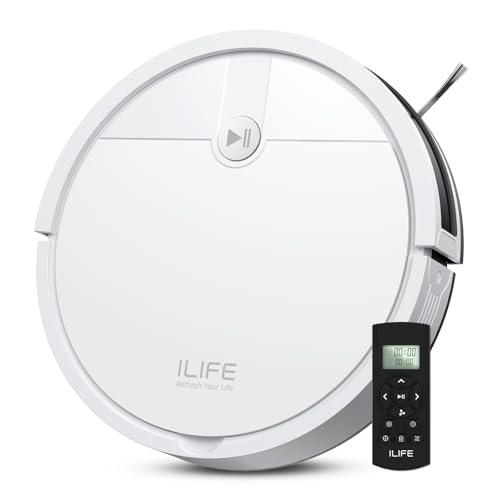
Slim vacuum-only robot run from a physical remote with scheduling and auto-recharge; no Wi-Fi connection required.
Check price on Amazon$84.99 as of Oct 19, 2026 8:55 pm GMT+0000 — prices change; see Amazon for current price.Why we like it
- Runs fully from a remote, no app
- No home map or data sent anywhere
- 2.99 in tall for under-bed dust
- Up to 120 minutes stated runtime
| Specification | Details |
|---|---|
| Control | Physical remote and one-touch button; no Wi-Fi required |
| Navigation | Not described; modes are auto, spot and edge |
| Intake | Tangle-free suction port instead of a roller brush |
| Runtime | Up to 120 minutes; returns to dock when low |
| Height | 2.99 in |
| Best floors | Hardwood, tile, laminate, stone, low-pile carpet |
ILIFE V2 — remote control, no Wi-Fi needed, tangle-free suction port, 2.99 in tall, up to 120 min, scheduling, 1-yr warranty
The Only Listing That Says It Needs No Wi-Fi at All
Every other robot on this shelf leans on an app for at least part of its setup or control. The ILIFE V2 is the only one of the 12 that states it needs no Wi-Fi connection, running instead from a remote and an onboard button. For households that do not want a mapped floor plan of their home in a cloud account, that is the cleanest answer, and none of the 12 listings describe a camera.
The cost is intelligence. The listing describes auto, spot and edge modes and scheduling but never names a navigation system, so expect random or pattern cleaning rather than room-by-room mapping, and no no-go zones. That is fine for an open-plan main floor of hard flooring; it is weaker in a cluttered home.
It uses a suction port rather than a roller brush, which helps with hair but is less suited to pulling grit out of carpet. Pair it with a stronger upright or stick for weekly carpet passes; our HEPA vacuum guide covers sealed machines for those deeper cleans.
Pros
- No Wi-Fi, app or account required
- Slim enough for low furniture
- Long stated runtime with auto-recharge
Cons
- No mapping or no-go zones described
- No self-empty base
- Suction and filter type not stated
- Best on hard floors and low-pile carpet only
Check ILIFE V2 price on Amazon
7. Bagotte M6 — Best for Low Furniture Clearance

2.66-inch-tall LiDAR robot and mop with app no-go zones and 8,000 Pa stated suction; no self-empty base.
Check price on Amazon$159.99 as of Oct 19, 2026 8:55 pm GMT+0000 — prices change; see Amazon for current price.Why we like it
- Lowest stated height on the shelf
- LiDAR mapping in a slim body
- App no-go zones around pet bowls
- Light at 6.27 lb
| Specification | Details |
|---|---|
| Navigation | 360 degree LiDAR with mapping and route planning |
| Suction | 8,000 Pa stated |
| Height / weight | 2.66 in; 6.27 lb |
| Mopping | Sweep, vacuum and mop in one machine; mop type not detailed |
| Runtime | Not stated in listing |
| Wi-Fi | 2.4 GHz only; app and Alexa |
Bagotte M6 — LiDAR, 8,000 Pa, 2.66 in tall, app no-go zones, sweep/vacuum/mop, 2.4 GHz Wi-Fi only
The Slimmest Body Listed, and Still Has LiDAR
Dust collects where you cannot reach: under beds, sofas and media cabinets. Four robots on this shelf list a body height of 3 inches or less (the ROPVACNIC S1, ILIFE V2, Tikom G8000 Max and this one), and at 2.66 inches the M6 is the lowest. It is also the only one of those four that names LiDAR navigation.
Many LiDAR robots carry a turret on top that adds height, so slim LiDAR is worth noting. The listing does not show the turret height separately, so measure your lowest furniture against the stated 2.66 inches and leave a little margin.
Gaps are significant. There is no self-empty dock, no stated runtime and no filter description, and the mopping function is described only in general terms. It is the right pick for a low-clearance bedroom floor, not for a whole-house allergen plan.
Pros
- Lowest stated height of the 12 listings
- LiDAR mapping and no-go zones
- Lightweight and easy to carry between floors
Cons
- No self-empty base
- Runtime and filtration not stated
- Mop details are vague
- 2.4 GHz Wi-Fi only
Check Bagotte M6 price on Amazon
Navigation: LiDAR vs camera vs bump sensors
Navigation decides whether a robot cleans your whole floor or just most of it. Seven of the 12 listings name LiDAR, a spinning laser that measures distance to walls and furniture to build a map. LiDAR works in the dark, supports room-by-room cleaning and makes no-go zones possible. It is the default choice for homes with more than a couple of rooms.
Camera-based robots use an image sensor to recognize objects like cords and pet waste. None of the 12 listings here describe a camera, which is notable for privacy: a camera robot moves a lens through your bedrooms, and its images may be processed by an app. If you ever consider one, read the privacy settings before you connect it.
Robots without LiDAR or a camera rely on infrared, cliff and bump sensors. They clean in patterns or randomly and generally cannot respect a drawn boundary. Five listings here do not name LiDAR; the UMMUND (infrared sensors), Tikom G8000 Max (anti-collision and anti-fall sensors) and ILIFE V2 (no navigation system named) are clearly in this simpler group. They are less precise, but cheaper and simpler.
Suction numbers, runtime and bins: how to read the specs
Robot vacuum suction is usually printed in pascals (Pa), a pressure figure. Eight of the 12 listings give one, ranging from 5,000 Pa to 18,500 Pa. The figures are maximums under each maker’s own conditions, and neither the shelf nor any standard here makes them directly comparable between brands. The Sharks and the Roomba give no Pa figure at all, and iRobot only compares its suction to an older Roomba series. Use suction as a rough tiebreaker, not a ranking.
Runtime is almost always stated for the quietest or lowest mode. The Tikom L8000 Plus says so outright (150 minutes in Gentle mode), and the UMMUND breaks its figures down by mode: 160 minutes quiet, 100 standard, 70 maximum. Plan on the middle number. Recharge-and-resume, which most mapping robots here offer, makes runtime less critical in larger homes.
Self-empty capacity is stated in days, which depends on how dusty your home is and how often you run the robot. A household with two shedding dogs will fill a 60-day base far faster than a retired couple in a condo.
Filtration, HEPA and what a robot can do for indoor air
The EPA defines a HEPA filter as one that can remove at least 99.97% of particles at 0.3 microns. A listing that says HEPA and gives that figure, as the Shark AV2501AE does for its base, is making a specific claim. A listing that says only “HEPA” in its title, or “high-efficiency filter,” is not. Several budget robots describe filters in vague terms or not at all, and none of the 12 claims a fully sealed robot body.
That matters because a vacuum cleans the floor while exhausting air into the room. The EPA advice on asthma triggers recommends a vacuum with a HEPA filter for carpets and upholstery, weekly vacuuming, and that people with asthma or allergies leave the room while it is being vacuumed. A robot is good at that last part: schedule it to run while you are out. EPA guidance on biological contaminants notes that household dust can carry mold, dust mite, pollen and pet allergens, and that people with allergies may need to clean more often. Daily robot runs fit that pattern well.
A robot is not a substitute for filtering the air itself. It removes what has settled, not what is floating. For airborne particles, see our guide to why a house gets so dusty and pair the robot with a room air cleaner.
How Front Range homes actually use a robot vacuum
Colorado’s dry air means dust that stays light and gets stirred back up easily, plus static that pulls pet hair onto rugs. Grit and gravel dust come in on boots from icy, sanded sidewalks all winter. A daily robot run near the entry door and the kitchen catches that before it gets ground into the floors.
Wildfire smoke seasons add fine ash that settles indoors. The EPA advises avoiding vacuuming during smoke events unless the vacuum has a HEPA filter, and after a smoke event it recommends wet mopping and a HEPA-type vacuum to avoid stirring ash back into the air. That is a strong argument for a robot with a filtered, sealed dock and for pairing it with a smoke-rated air purifier while the air is bad.
Split-level and two-story floor plans make multi-map support worth having. Carrying a robot between levels is fine; relearning the map each time is not. The roborock Q10 S5+ and Tikom L8000 Plus are the picks here that describe saving several floors.
When a robot vacuum is the wrong tool
Some dust should never go into a household vacuum. The EPA says not to dust, sweep or vacuum debris that may contain asbestos, and older Front Range homes can have asbestos in vinyl floor tile, popcorn ceilings and pipe insulation. If a ceiling is flaking or old tile is crumbling, keep the robot out of that room with a no-go zone and read our asbestos cleanup guide before anyone touches it.
Homes built before 1978 may have lead-based paint. The EPA notes that settled lead dust can re-enter the air when a home is vacuumed or swept, and it advises using only HEPA-filtered vacuums, and no dry sweeping, where there is visible dust or debris from chipping paint. A robot sweeping a windowsill-dust area every day would spread it. See our page on lead paint dust for testing and safe cleanup.
Recurring musty smells, dust that returns within hours of cleaning or visible mold are building problems, not vacuuming problems. Those point to moisture, duct or ventilation issues that a home inspector or IAQ professional should look at. Our overview of how to hire a home inspector explains what a good inspection covers. If you are on the Front Range and want a qualified local inspector to look at dust, mold or old-material concerns, contact us to get connected.
Frequently asked questions
What is the best robot vacuum for allergies?
Look for a robot whose listing states a HEPA capture figure, ideally 99.97% at 0.3 microns, and a sealed or bagged self-empty dock so emptying does not release dust. Of the 12 listings compared here, the Shark AV2501AE is the only one stating that figure for its base. Schedule runs while allergy sufferers are out of the room.
Is LiDAR navigation worth it on a robot vacuum?
For most homes with more than two or three rooms, yes. LiDAR builds a map so the robot cleans room by room, works in the dark and respects no-go zones. Robots with only bump or infrared sensors clean in patterns and tend to miss areas or repeat them.
Do robot vacuums replace a regular vacuum?
Not completely. A robot handles daily surface dust, hair and grit well, but carpets, stairs, upholstery and edges still benefit from a weekly pass with a full-size or stick vacuum, ideally one with sealed HEPA filtration.
Are self-emptying robot vacuums better for indoor air?
They can be. Fewer emptying sessions means fewer chances to release dust, and a bag that you lift out and discard contains fine dust better than tipping a bagless bin. Empty bagless bins outdoors or directly into a trash bag.
Can a robot vacuum pick up wildfire ash or old paint dust?
It should not be your tool for either. EPA guidance favors wet mopping and a HEPA-type vacuum for ash, and only HEPA vacuums with no dry sweeping where there is visible paint dust or chips in pre-1978 homes. Suspected asbestos debris should not be vacuumed at all.
References
- What is a HEPA filter? — U.S. Environmental Protection Agency
- Asthma Triggers: Gain Control — U.S. Environmental Protection Agency
- Biological Contaminants and Indoor Air Quality — U.S. Environmental Protection Agency
- Wildfires and Indoor Air Quality — U.S. Environmental Protection Agency
- Protect Your Family from Exposures to Asbestos — U.S. Environmental Protection Agency
- Reduce the Risk of Lead Exposure at Home — U.S. Environmental Protection Agency