Best Dehumidifiers (2026): 6 Listings Compared by Capacity

Picking the best dehumidifier starts with one number that most listings make confusing: pints per day. A unit rated at 80 pints under hot, saturated test air will pull far less from a cool room, and a small tank-style model rated in ounces is a different class of machine entirely. This roundup is the general-purpose guide: how to read capacity under the current federal test standard, why ENERGY STAR status is worth checking, and which listing fits which room. Basements, bedrooms and garages each get their own dedicated roundups on this site, so this page focuses on the all-round choice for a typical house. Six picks follow, each matched to a job, then a buying guide built around the specs that actually predict performance.
Part of our Humidity Control guide — start there for the full picture →
As an Amazon Associate we earn from qualifying purchases.
How we compared: we compared 11 current Amazon listings for portable dehumidifiers on what each listing states: rated capacity and the test conditions behind it, compressor or thermoelectric design, ENERGY STAR status, humidity setpoint range, drainage options, defrost protection and stated noise. We did not lab-test these units or handle them. Two of the 11 listings are color variants of the same ToLife model, so the shelf covers 10 distinct products. Prices and availability change often, so check the current listing before buying.
Quick picks: the best dehumidifiers by use case
| Product | Best for | Key features | Price | Buy |
|---|---|---|---|---|
| AEOCKY RHEA-001 | Best overall efficiency |
| $249.97as of Nov 19, 2026 2:21 am GMT+0000 | Buy now →Check current price |
| Waykar JD025CE-80 | Widest humidity range |
| $208.96as of Nov 19, 2026 2:21 am GMT+0000 | Buy now →Check current price |
| KNKA PD30MA-20-74P | Long included drain hose |
| — | Buy now →Check current price |
| KNKA PD22SC-12 | Mid-size rooms |
| $109.99as of Nov 19, 2026 2:21 am GMT+0000 | Buy now →Check current price |
| NineSky CT2 | Small damp rooms |
| $59.98as of Nov 19, 2026 2:21 am GMT+0000 | Buy now →Check current price |
| TABYIK DH-CS01 | Closets and tiny spaces |
| $42.99as of Nov 19, 2026 6:58 am GMT+0000 | Buy now →Check current price |
Prices are Amazon’s listed prices as of the time shown and change often; check Amazon for today’s price. As an Amazon Associate we earn from qualifying purchases.
The six picks, compared listing by listing
1. AEOCKY RHEA-001 — Best Overall for Efficiency

80-pint compressor unit listed as ENERGY STAR Most Efficient 2025, with a second rating at basement-like conditions.
Check price on Amazon$249.97 as of Nov 19, 2026 2:21 am GMT+0000 — prices change; see Amazon for current price.Why we like it
- Only listing here claiming ENERGY STAR Most Efficient 2025
- Gives a second, cooler-condition capacity figure
- Defrost sensors for rooms below 65°F
- Power-off memory resumes after outages
| Specification | Details |
|---|---|
| Type | Rotary compressor dehumidifier |
| Stated capacity | 80 pints/day at 95°F and 95% RH; 56 pints/day at 86°F and 80% RH |
| Efficiency claim | ENERGY STAR Most Efficient 2025 |
| Noise | 44 dB at lowest fan speed per listing |
| Size / weight | About 14.5 x 8.7 x 24.1 in; 31 lb |
| Certifications / coverage | ETL and RoHS named; 3-year coverage stated |
AEOCKY RHEA-001 — compressor, 80 pt (95°F/95%) / 56 pt (86°F/80%), Most Efficient 2025, 44 dB low, ETL, 3-yr coverage
The Only Listing on the Shelf That Claims Most Efficient Status
Four of the 11 listings say they are ENERGY STAR certified, and all four are compressor units: this AEOCKY, two KNKA models and the Waykar. Only the AEOCKY claims the higher Most Efficient 2025 designation, which ENERGY STAR reserves for the top performers in a product category. If the dehumidifier will run for months at a time, efficiency is where the long-term cost sits, so this is the listing we would start from.
The listing is also one of three compressor listings on the shelf that give a second capacity figure at cooler conditions (86°F and 80% RH) in addition to the headline number. That second figure, 56 pints, is closer to what a homeowner should expect in a real house. It also describes defrost sensors for operation below 65°F, which matters because frost on the coils is the classic failure mode of compressor units in cool rooms.
What the listing does not state is the integrated energy factor in liters per kilowatt-hour, the actual efficiency metric. Much of the listing copy is marketing language aimed at competitors, so confirm the model number (RHEA-001) in the ENERGY STAR product finder before buying. The tank size is not stated in the bullets.
Pros
- Most Efficient 2025 claim, the strongest efficiency signal here
- Two capacity ratings, including a cooler-condition figure
- Defrost protection for cool rooms
- Three-year coverage, longer than most listings
Cons
- Integrated energy factor not stated
- Tank volume not listed in the bullets
- Heavy at 31 lb
Check AEOCKY RHEA-001 price on Amazon
2. Waykar JD025CE-80 — Best for the Widest Humidity Range

ENERGY STAR 80-pint unit with a 30–80% RH setpoint, auto-swing louver and a standard garden hose fitting.
Check price on Amazon$208.96 as of Nov 19, 2026 2:21 am GMT+0000 — prices change; see Amazon for current price.Why we like it
- Setpoint reaches 30% RH, lower than many units
- Standard 3/4-inch garden hose connection
- Auto-defrost and overload protection described
- Names ENERGY STAR, DOE, CSA and CEC
| Specification | Details |
|---|---|
| Type | Compressor dehumidifier |
| Stated capacity | 80 pints/day at 95°F and 90% RH; up to 5,000 sq ft claimed |
| Humidity control | Adjustable 30% to 80% RH; 24-hour timer |
| Drainage | 1.14 gal tank or included 3.3 ft hose; 3/4-inch garden hose thread |
| Noise | About 42 dB per listing |
| Model / warranty | JD025CE-80; 1-year exchange plus 1 year on registration |
Waykar JD025CE-80 — compressor, 80 pt (95°F/90%), 30–80% RH, 90° swing, garden-hose drain, ENERGY STAR, 42 dB
The Only General-Shelf Listing With a Garden Hose Thread
Five of the 11 listings are compressor units, and all five include a drain hose. The Waykar is the only one that says its outlet takes a standard 3/4-inch garden hose directly, which means a homeowner can run a longer hose to a floor drain or laundry sink without hunting for adapters. That matters more than the length of the short hose in the box.
Four listings on the shelf offer a setpoint as low as 30% RH, and the Waykar is one of them. In practice most homes should not be held that low; the EPA suggests keeping indoor humidity below 60% and ideally between 30% and 50%. The wide range simply gives more room to dial in a target for a damp space.
The listing gives only the 95°F and 90% RH capacity figure, with no cooler-condition rating, so its 80 pints is not directly comparable with the AEOCKY’s 56-pint basement figure. The 90° auto-swing louver is unusual on this shelf and helps spread dry air through an open room. The listing does not state an integrated energy factor.
Pros
- Garden hose thread for longer drain runs
- 30% RH floor and 24-hour timer
- Several U.S. standards named in the listing
Cons
- Only the hot, saturated capacity figure is given
- Included hose is short at 3.3 ft
- Efficiency metric not stated
Check Waykar JD025CE-80 price on Amazon
3. KNKA PD30MA-20-74P — Best for a Long Included Drain Hose
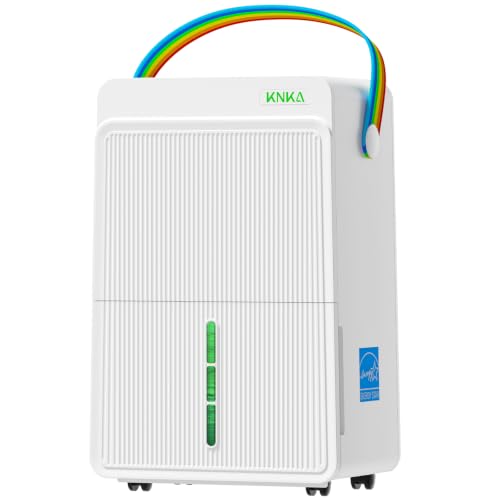
74-pint ENERGY STAR compressor unit with a 6.56 ft drain hose, 1.45 gal tank and 30–80% RH setting mode.
Check price on AmazonWhy we like it
- Longest included drain hose on this shelf
- Largest stated internal tank at 1.45 gal
- Optional external tank with its own shutoff
- Display and lights can be switched off
| Specification | Details |
|---|---|
| Type | Compressor dehumidifier, ENERGY STAR certified per listing |
| Stated capacity | 74 pints/day at 95°F and 95% RH; 56 pints/day at 86°F and 80% RH |
| Drainage | 1.45 gal tank; 6.56 ft hose; optional 2.64 gal external tank sold separately |
| Modes | Auto (50% default), Dry, and Setting mode at 30% to 80% RH |
| Noise | 40–45 dB stated |
| Model / warranty | PD30MA-20-74P; 1-year manufacturer warranty |
KNKA PD30MA-20-74P — compressor, 74 pt (95°F/95%) / 56 pt (86°F/80%), 1.45 gal tank, 6.56 ft hose, ENERGY STAR, 40–45 dB
The Same Basement-Condition Rating as the 80-Pint Units
Here is a detail worth noticing. This KNKA is sold as a 74-pint unit, yet its listing gives the same 56 pints/day at 86°F and 80% RH as the 80-pint AEOCKY and the 80-pint KNKA sibling. In cooler, more realistic air, the headline gap disappears. That is a strong argument for reading the second rating whenever a listing provides one.
Two of the 11 listings include a 6.56 ft hose, both from KNKA’s PD30MA line; every other compressor listing that states a hose length includes roughly 3.3 ft. The 1.45 gal tank is also the largest internal tank stated on the shelf, and the listing says the full-tank shutoff applies to the optional external tank too.
The listing mentions a 12-hour timer, child lock and a washable filter. It does not mention auto-defrost, which the AEOCKY and Waykar listings do, so in a room that drops below 65°F that is a gap to confirm in the manual. The stated product weight fields are inconsistent across KNKA’s listings, so do not rely on them.
Pros
- Same 56-pint cooler-condition rating as 80-pint units
- 6.56 ft hose and 1.45 gal tank
- Display can be darkened for nighttime
Cons
- No auto-defrost mentioned
- One-year warranty only
- External tank costs extra
Check KNKA PD30MA-20-74P price on Amazon
4. KNKA PD22SC-12 — Best for Mid-Size Rooms

34-pint compressor dehumidifier with a 37 dB rating, three modes and tank, hose or external-tank drainage.
Check price on Amazon$109.99 as of Nov 19, 2026 2:21 am GMT+0000 — prices change; see Amazon for current price.Why we like it
- Compressor capacity in a lighter 17.6 lb body
- Lowest stated noise among compressor listings
- Humidity LED shows level even when off
- Three drainage options, all with shutoff
| Specification | Details |
|---|---|
| Type | Compressor dehumidifier |
| Stated capacity | 34 pints/day at 95°F and 90% RH; up to 2,500 sq ft claimed |
| Drainage | 0.79 gal tank, 3.28 ft hose, or optional 2.64 gal external tank |
| Modes | Auto (50% default), Dry, Setting at 30% to 80% RH; 24-hour timer |
| Noise | 37 dB stated; sleep mode turns lights off |
| Size / weight | About 13.2 x 10.3 x 20.9 in; 17.6 lb |
KNKA PD22SC-12 — compressor, 34 pt (95°F/90%), 0.79 gal tank + hose, 30–80% RH, 37 dB, 17.6 lb, 1-yr warranty
The Smallest Compressor Unit on the General Shelf
All five compressor listings on this shelf are rated between 34 and 80 pints, and this KNKA is the smallest of them. That suits a single large room, a finished lower level or a damp laundry area, where a full 80-pint machine would cycle on and off. Its 37 dB claim is also the quietest figure stated by any compressor listing here.
ENERGY STAR’s own sizing chart puts a slightly-to-moderately damp space under 2,000 sq ft in the 20 to 30 pint range, and a very damp one in the 25 to 40 pint range. A 34-pint unit lands squarely in that window for many rooms, which is why we treat it as the mid-size pick rather than a basement machine.
The listing does not claim ENERGY STAR certification and does not mention auto-defrost. Its 2,500 sq ft coverage claim is generous for a 34-pint unit; treat it as the upper limit for a mildly damp space, not a promise.
Pros
- Quietest stated compressor listing at 37 dB
- Lighter and smaller than the 80-pint units
- Three drainage paths with full-tank shutoff
Cons
- No ENERGY STAR claim
- No auto-defrost mentioned
- Only the hot, saturated capacity rating given
Check KNKA PD22SC-12 price on Amazon
5. NineSky CT2 — Best for Small Damp Rooms

Thermoelectric dehumidifier with a stated 34 oz per day at 86°F/80% RH, 95 oz tank and auto shutoff.
Check price on Amazon$59.98 as of Nov 19, 2026 2:21 am GMT+0000 — prices change; see Amazon for current price.Why we like it
- States a daily output, unlike most tank-style units
- Large 95 oz tank for a small unit
- Shuts off if the tank is full or misplaced
- Compact 8.3 x 5.7 x 14 in body
| Specification | Details |
|---|---|
| Type | Thermoelectric (semiconductor) dehumidifier |
| Stated output | Up to 34 oz per day at 86°F and 80% RH |
| Tank | 95 oz with auto shutoff when full or misplaced |
| Noise | 40 dB or less |
| Size | About 8.3 x 5.7 x 14 in; carry handle |
| Drain hose / humidistat | Not stated in listing |
NineSky CT2 — thermoelectric, 34 oz/day (86°F/80%), 95 oz tank, auto shutoff, 40 dB or less, 7-color light
One of Only Two Tank-Style Listings That Quantify Daily Output
Six of the 11 listings are small thermoelectric units. Only two of them say how much water they remove per day: this NineSky (34 oz) and the TABYIK (16 oz). The rest give a tank size and a square-footage claim, which are not the same thing. A 95 oz tank tells you how often to empty the unit, not how fast it dries the air.
Keep the scale in mind. 34 oz is a little over 2 pints, while the compressor units here are rated from 34 to 80 pints. A thermoelectric unit is a tool for a bathroom, small bedroom or closet with a moderate moisture load, not for a damp basement. The 1,000 sq ft claim in the title is not realistic for this output.
The listing’s product-information field shows a pack size that does not match a single unit, so confirm the quantity on the order page. It does not mention a humidistat or drain hose.
Pros
- States a measurable daily output and test condition
- Big tank means fewer trips to empty
- Quiet enough for small living spaces
Cons
- About 2 pints a day, far below compressor units
- Coverage claim overstates the real capability
- No humidistat or drain hose mentioned
Check NineSky CT2 price on Amazon
6. TABYIK DH-CS01 — Best for Closets and Tiny Spaces
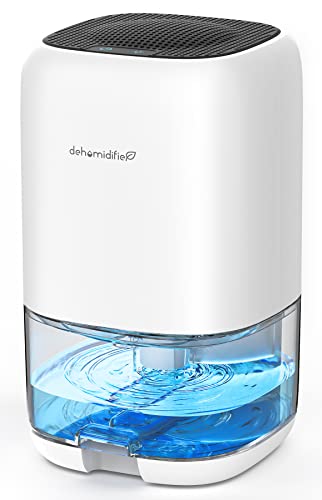
Small Peltier dehumidifier rated at 16 oz per day, 1 kWh per day or less, with a 35 oz tank and 28 dB rating.
Check price on Amazon$42.99 as of Nov 19, 2026 6:58 am GMT+0000 — prices change; see Amazon for current price.Why we like it
- States output, test condition and daily energy use
- Smallest footprint on the shelf
- Clear tank shows water level
- Two-year manufacturer warranty listed
| Specification | Details |
|---|---|
| Type | Peltier (thermoelectric) dehumidifier |
| Stated output | Up to 16 oz (450 ml) per day at 86°F and 80% RH in a closed small room |
| Energy use | No more than 1 kWh per day per listing |
| Tank / shutoff | 35 oz tank; shuts off at roughly 700 to 800 ml |
| Size / weight | About 5.9 x 5.9 x 10.1 in; 2.2 lb |
| Model / warranty | DH-CS01; 2-year manufacturer warranty |
TABYIK DH-CS01 — Peltier, 16 oz/day (86°F/80%), 1 kWh/day max, 35 oz tank, 28 dB, 280 sq ft claimed, 2-yr warranty
The Only Listing That States Its Daily Energy Use
No other listing on this shelf gives a daily energy figure. The TABYIK says it uses no more than 1 kWh a day, alongside a 16 oz daily output at a stated test condition. That combination lets a buyer judge the trade-off honestly: very small capacity, very low draw, very small footprint.
Its 280 sq ft claim is also the most modest coverage claim on the shelf, which is a point in its favor. A walk-in closet, gun safe room, small bathroom or RV is the realistic job. It is also the only thermoelectric listing on the shelf that names a warranty length.
It has no humidistat, so it simply runs until the tank fills. The listing says shutoff happens before the 35 oz tank is completely full, so real capacity between emptying is closer to 24 to 27 oz.
Pros
- Honest, modest capacity and coverage figures
- States daily energy use
- Tiny and light at 2.2 lb
Cons
- 16 oz a day suits only very small spaces
- No humidistat or continuous drain
- Shuts off before the tank is full
Check TABYIK DH-CS01 price on Amazon
How to read pints per day under the 2019 DOE test standard
Capacity is the spec that decides whether a dehumidifier solves the problem, and it is also the spec listings handle most loosely. ENERGY STAR explains that the U.S. Department of Energy finalized new dehumidifier standards that took effect in June 2019. Under the new test procedure, portable dehumidifiers are tested at 65°F rather than 80°F, to better reflect a basement. Cooler air holds less water, so a unit tested the new way reports a smaller capacity than the same unit would have under the old method. That is why a modern 50-pint unit can do the job an older 70-pint unit did.
The listings on this shelf mostly do not quote the DOE rating at all. Instead they quote a maximum at 95°F with 90% or 95% RH, which is close to saturated summer air, and in a few cases a second figure at 86°F and 80% RH. Those are manufacturer test points, not the federal rating. Read them as a ceiling. When a listing gives two numbers, the cooler one is the better guide, and when it gives only the hot number, expect noticeably less in a 65°F room.
ENERGY STAR’s sizing chart, which is based on the current ratings, is a sound starting point:
- Slightly to moderately damp (50 to 75% RH, intermittent musty smell): 20 to 30 pints for spaces under 2,000 sq ft, 30+ for larger spaces.
- Very damp (75 to 90% RH, damp spots on walls or floors): 25 to 40 pints, or 40+ for large spaces.
- Wet (90 to 100% RH, sweating walls or seepage, laundry drying): 30 to 50 pints, or 50+ for large spaces.
ENERGY STAR also notes it is better to oversize than undersize. A homeowner replacing an old unit can judge by how much water they empty each day. For more on matching the machine to the house, see our guides on how to choose a dehumidifier and on picking a dehumidifier for the whole house.
Compressor vs thermoelectric: two different classes of machine
Every listing on this shelf is either a compressor dehumidifier or a thermoelectric (Peltier, “semiconductor”) unit. They are not two flavors of the same product.
Compressor units work like a small air conditioner: a refrigerant coil chills air below its dew point, water condenses and drips into the tank, and the air is reheated slightly on the way out. They are heavier, louder and draw more power, but they are the only type on the shelf with capacities measured in tens of pints per day. All five compressor listings here include a drain hose and a humidistat.
Thermoelectric units use a solid-state chip that gets cold on one side. They are light, quiet and inexpensive to run, but the listings that state output give 16 to 34 oz a day. That is useful for a closet or small bathroom and close to useless for a basement. Square-footage claims on these units, often 1,000 sq ft, should be ignored.
There is a third type, the desiccant dehumidifier, which uses a moisture-absorbing wheel and keeps working in cold spaces. None of the 11 listings on this shelf is a desiccant unit.
ENERGY STAR and what efficiency actually means
ENERGY STAR says certified dehumidifiers use more efficient refrigeration coils, compressors and fans to remove the same amount of moisture as a similar conventional unit while using about 20% less energy. Efficiency is measured as integrated energy factor, in liters of water removed per kilowatt-hour; a higher number is better. None of the four ENERGY STAR listings on this shelf prints that number in its bullets, so the practical check is to look the model number up in the ENERGY STAR product finder.
Some listings use phrases like “Energy Star 25” or “Most Efficient” loosely. The AEOCKY listing itself warns about that, which cuts both ways: verify any efficiency claim, including that one, against the official finder before buying. A dehumidifier that runs much of the year in a damp space will use far more electricity over its life than it costs up front.
Features that matter, and a few that do not
Humidistat and setpoint range. A built-in humidistat turns the compressor on and off around a target. The EPA recommends keeping indoor humidity below 60% and ideally between 30% and 50%. Several listings note their onboard humidity readings are taken at the air inlet and may differ from a separate meter, so a cheap hygrometer elsewhere in the room is a good cross-check.
Drainage. ENERGY STAR notes that most portable units use a removable bucket with a full-bucket shutoff, and some accept a hose to a floor drain or sump. For continuous running, gravity drainage is what makes a dehumidifier practical. Our dehumidifier drain hose guide covers routing and slope.
Defrost. ENERGY STAR warns that frost can form on the coils below about 65°F and cause the compressor to cycle without removing moisture. Auto-defrost addresses that. Only two listings on this shelf mention it, the AEOCKY and the Waykar.
Noise. Stated decibel figures are not measured to any common standard in these listings, so treat them as rough. Compressor listings here claim 37 to 45 dB at their quietest settings.
Lights, aromatherapy and color modes. Several thermoelectric listings emphasize seven-color night lights. They have no bearing on moisture removal.
Safety and placement
The U.S. Fire Administration advises plugging major appliances directly into a wall outlet rather than using an extension cord, which can overheat. A compressor dehumidifier draws enough current that the same advice applies. Keep the intake and exhaust clear, keep the unit upright (several listings say to let it stand upright for 24 hours before first use), and close doors and windows to the space being dried, as the KNKA and Onsekin listings recommend.
Place the unit away from walls and furniture so air can circulate, and on a level surface so the tank float switch works. In a room with carpet or stored boxes, raise it slightly so a leak does not soak anything.
Colorado and Front Range notes
Much of the Front Range is dry for most of the year, which is exactly why a persistent damp smell in a Colorado house deserves attention. When a dehumidifier is needed here, it is usually because of a specific moisture source: a basement with poor grading or a high water table in spring, a crawl space with bare soil, a laundry room without venting, or a bathroom that never dries. A dehumidifier treats the symptom while the source is found.
Basements in particular tend to sit near or below 65°F, which is where defrost protection and the cooler-condition capacity rating matter most. Our dedicated dehumidifier for basement guide goes deeper, and for homes with a crawl space, the crawl space hub covers encapsulation and dedicated crawl-space units.
When a dehumidifier isn’t enough
If a dehumidifier fills its tank every day and the space still smells musty, or if you see staining, efflorescence on concrete, peeling paint or visible growth, the moisture source needs to be found. The EPA’s guidance is clear that the key to mold control is moisture control: fix leaks, dry wet materials within 24 to 48 hours and reduce humidity. A dehumidifier cannot fix a foundation leak, a failed gutter or a missing vapor barrier.
A home inspector can trace water entry, check grading and downspouts, and note conditions that point to hidden moisture. If you are buying or selling on the Front Range and want a second set of eyes on a damp lower level, get in touch through our contact page to connect with a vetted local inspector.
Frequently asked questions
What size dehumidifier do I need?
ENERGY STAR suggests 20 to 30 pints per day for a slightly to moderately damp space under 2,000 sq ft, 25 to 40 pints for a very damp one and 30 to 50 pints for a wet space. Larger spaces need more. It is better to oversize than undersize.
Why do new dehumidifiers have lower pint ratings than old ones?
The DOE test procedure that took effect in 2019 tests portable dehumidifiers at 65°F instead of 80°F. Cooler air holds less water, so the same machine reports a smaller capacity. A current 50-pint unit can roughly match an older 70-pint unit.
Are small thermoelectric dehumidifiers worth buying?
They are worth it for closets, small bathrooms and RVs with a modest moisture load. The listings that state output give 16 to 34 ounces a day, which is a tiny fraction of a compressor unit, so they will not dry a basement.
What humidity should a dehumidifier be set to?
The EPA recommends keeping indoor humidity below 60 percent and ideally between 30 and 50 percent. Setting a unit around 45 to 50 percent is a reasonable starting point; check with a separate hygrometer because onboard sensors read the air at the inlet.
Is an ENERGY STAR dehumidifier worth it?
Usually yes for a unit that runs for months. ENERGY STAR says certified models remove the same moisture as similar conventional units while using about 20 percent less energy. Confirm the model number in the ENERGY STAR product finder rather than relying on listing wording.
Can a dehumidifier get rid of musty smells?
A dehumidifier can reduce musty smells by lowering humidity that encourages mold and mildew. Odors from existing mold or damp materials may remain until the source is cleaned or removed and water problems are fixed.
Is it better to have a dehumidifier or an air purifier?
A dehumidifier lowers humidity, while an air purifier removes particles like dust, pollen and smoke. For damp, musty spaces, a dehumidifier addresses the root issue. For allergies to airborne particles, an air purifier helps. Some homes benefit from both.
Do dehumidifiers make a room warmer?
Yes, dehumidifiers release a small amount of heat as they run, so rooms may feel slightly warmer. Drier air can also feel more comfortable. In summer, this extra heat is usually minor compared to the comfort of lower humidity.
More Questions About Dehumidifiers
How much does it cost to run a dehumidifier?
Running a dehumidifier typically costs a modest amount per day, with industry estimates commonly showing monthly costs from a few dollars to over twenty dollars depending on size, efficiency, humidity, and electricity rates. Portable dehumidifiers draw several hundred watts while running. ENERGY STAR models remove more water per kilowatt-hour. Setting the humidistat around 50 percent instead of running continuously, and keeping doors and windows closed, reduces runtime and cost. The EnergyGuide or listing wattage times hours of use gives a rough estimate for any specific unit.
Where is the best place to put a dehumidifier?
The best place for a dehumidifier is the dampest area that needs drying, often a basement, near a laundry area, or in a central spot of an open room with good airflow around the unit. Keep it several inches from walls and furniture so air can move freely. Close windows and doors to the space so the unit is not trying to dry outdoor air. If draining by hose, place it near a floor drain or sump. Room temperature also matters, since some units work poorly in cold basements.
How long does a dehumidifier last?
A portable dehumidifier typically lasts about 5 to 10 years with proper care, and some lower-cost models fail sooner. Cleaning the filter every few weeks, keeping coils free of dust, and draining the bucket promptly help it last longer. Units used continuously in cold basements may wear faster due to frequent defrosting. Signs of failure include running constantly without collecting water, ice on coils, or unusual noises. Check warranty coverage for compressors, which can be longer than the standard warranty.
Should a dehumidifier run all the time?
A dehumidifier does not need to run all the time; it should run until the space reaches the target humidity, usually around 45 to 50 percent, and then cycle on and off using its humidistat. Running continuously can overdry the air and waste energy. In very damp basements or during humid summers, the unit may run frequently. Using continuous drainage avoids overflow when the unit runs for long periods. Fixing water leaks and improving ventilation reduces how much the dehumidifier needs to run.
References
- Dehumidifiers: Buying Guidance — ENERGY STAR (U.S. EPA)
- Dehumidifier Testing and Capacity — ENERGY STAR (U.S. EPA)
- A Brief Guide to Mold, Moisture and Your Home — U.S. Environmental Protection Agency
- Appliance and Electrical Fire Safety — U.S. Fire Administration
Dehumidifiers for damp basements
Holding relative humidity under ~50% is the single most effective way to keep mold from taking hold in a basement or crawlspace.
| Product | Why | Buy |
|---|---|---|
 hOmeLabs 50-Pint (7,000 sq ft) | Popular large-basement unit. | Amazon — $269.99 |
 Frigidaire High-Humidity | Continuous-drain option. | Amazon — $307.74 |