Best CO2 Monitor: A 2026 Buyer’s Guide
The best CO2 monitor for a home is the one that actually measures carbon dioxide instead of estimating it. That sounds obvious, but many inexpensive “air quality” gadgets show a CO2 number calculated from a VOC sensor, and that number can drift far from reality. A true CO2 meter uses a nondispersive infrared (NDIR) sensor, sometimes in a photoacoustic form, and the better listings say so plainly. CO2 is the most useful single indicator of whether a bedroom, office or basement is getting enough fresh air. Below are six NDIR monitors, each matched to a different job, followed by a buying guide on sensor types, altitude, alarm points and placement.
Part of our Indoor Air Quality Testing guide — start there for the full picture →
As an Amazon Associate we earn from qualifying purchases.
How we compared: we compared 22 current Amazon listings for indoor CO2 and air quality monitors on what each listing actually states: sensor technology, stated accuracy and range, power source, alerts, data history and app support. Sixteen of those 22 listings say they measure CO2. We did not lab-test any of these units or use them hands-on. Two further listings that surfaced in the same search were carbon monoxide alarms, which are a different device, and we set them aside. Prices and availability change often, so check the current listing before buying.
Quick picks: the best CO2 monitors by use case
| Product | Best for | Key features | Price | Buy |
|---|---|---|---|---|
| Aranet4 (SAF) | Overall cordless CO2 meter |
| $141.00as of Nov 26, 2026 1:00 pm GMT+0000 | Buy now →Check current price |
| GoveeLife H5140 | Front Range altitude, 24/7 logging |
| $59.99as of Nov 26, 2026 1:00 pm GMT+0000 | Buy now →Check current price |
| SwitchBot Meter Pro CO2 | Widest stated range |
| $48.99as of Nov 26, 2026 1:00 pm GMT+0000 | Buy now →Check current price |
| Temtop C1 | Published accuracy spec |
| $29.99as of Nov 26, 2026 1:49 am GMT+0000 | Buy now →Check current price |
| YOWEXA YEM-42-P | Simple bedroom alarm |
| $31.99as of Nov 26, 2026 1:49 am GMT+0000 | Buy now →Check current price |
| Lwyinp M08A | NDIR CO2 plus VOC and formaldehyde |
| — | Buy now →Check current price |
Prices are Amazon’s listed prices as of the time shown and change often; check Amazon for today’s price. As an Amazon Associate we earn from qualifying purchases.
The six picks, compared listing by listing
1. Aranet4 (SAF) — Best Overall Cordless NDIR CO2 Monitor
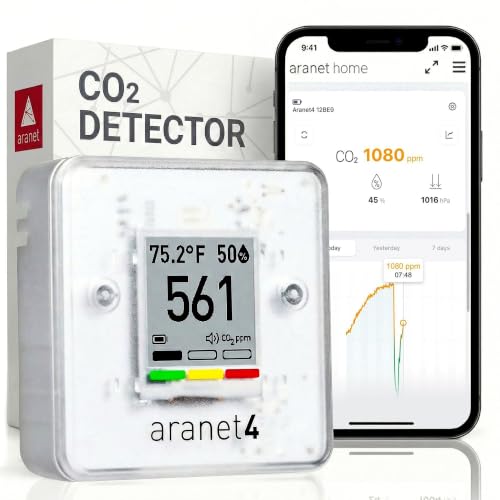
NDIR CO2 meter with an e-ink screen, optional buzzer and app history; battery life stated up to 4 years.
Check price on Amazon$141.00 as of Nov 26, 2026 1:00 pm GMT+0000 — prices change; see Amazon for current price.| Specification | Details |
|---|---|
| CO2 sensor | Nondispersive infrared (NDIR), named in the listing |
| Also measures | Temperature, relative humidity and atmospheric pressure |
| Display / alert | E-ink screen with large CO2 figure, color coding and an optional buzzer |
| Power | Battery; listing states up to 4 years of battery life, no cable needed |
| Data | Smartphone app shows up to 90 days of history as graphs |
| Size / warranty | About 2.76 x 2.76 x 0.94 in; 2-year manufacturer warranty; made in the EU |
Aranet4 TDSPC003 — NDIR CO2, temp/RH/pressure, e-ink, battery up to 4 yrs, 90-day app history, 2-yr warranty
The Longest Stated Battery Life of Any NDIR Monitor on the Shelf
Seven of the 22 listings name an NDIR or nondispersive infrared CO2 sensor. Of those seven, only three are designed to run on battery for long stretches: the Aranet4, the SwitchBot (up to 12 months) and the Temtop C1 (70 days of standby). The Aranet4’s stated figure of up to 4 years is the longest on the shelf by a wide margin, and that is a direct result of the e-ink display, which draws almost no power between updates.
Long battery life matters more than it seems. A CO2 monitor is most useful when it can sit in a bedroom, then move to a home office or a basement family room, without anyone hunting for an outlet. The Aranet4 is also one of only two listings on the shelf that measures atmospheric pressure, the other being the Airthings View Plus, which is a multi-sensor radon monitor rather than a dedicated CO2 meter.
What the listing does not say: it gives no CO2 accuracy figure or measurement range, and it does not state whether the pressure reading is used to correct the CO2 value. It also does not describe data export beyond viewing graphs in the app. Buyers who want a published accuracy number should compare pick 4.
Pros
- NDIR sensor named outright
- Longest stated battery life on the shelf
- Measures pressure as well as temperature and humidity
- Small enough to move room to room
Cons
- No accuracy or range figure in the listing
- E-ink screen has no backlight for night reading
- Does not state pressure compensation of the CO2 value
2. GoveeLife H5140 — Best for Front Range Altitude and Continuous Logging

Plug-in photoacoustic NDIR CO2 monitor with stated altitude pressure compensation, alerts and 2-year data history.
Check price on Amazon$59.99 as of Nov 26, 2026 1:00 pm GMT+0000 — prices change; see Amazon for current price.| Specification | Details |
|---|---|
| CO2 sensor | SCD4x photoacoustic NDIR; stated accuracy ±(40 ppm + 5%); 5-second refresh |
| Altitude handling | Built-in pressure compensation described as working at any altitude |
| Alerts | Buzzer, app notifications and email reports at user-set thresholds |
| Power | AC outlet only; no battery |
| Data / smart home | Up to 2 years of history; CSV export; Alexa and Google Assistant queries |
| Display | CO2, temperature, humidity and clock; tri-color light bar with day/night brightness schedule |
GoveeLife H5140 — photoacoustic NDIR, ±(40 ppm + 5%), pressure compensation, AC power, 2-yr history + CSV export
The Only Listing That States Pressure Compensation for Altitude
NDIR sensors work by counting how much infrared light CO2 molecules absorb in a small chamber. At Denver’s elevation the air is thinner, so there are fewer molecules of everything in that chamber, and a sensor that does not correct for pressure can read differently than it would at sea level. Out of 16 CO2-measuring listings on this shelf, the H5140 is the only one that says it has built-in pressure compensation. For Front Range homes, that line in the listing is worth weighing.
It is also one of three listings that publish a CO2-specific accuracy figure (the others are the Temtop C1 and the SwitchBot), and one of two that name a photoacoustic NDIR design (with the Temtop C1). The listing adds a practical note: the sensor can be recalibrated outdoors in the app if needed.
The trade-off is power. The H5140 runs from an outlet with no battery at all, which is ideal for a fixed spot like a bedroom nightstand but means it cannot be carried around a house during a walkthrough. The listing also notes that air purifiers cannot lower CO2, so it does not link to them, an honest detail many listings skip.
Pros
- Only listing to state altitude pressure compensation
- Published accuracy figure and 5-second refresh
- Two years of history with CSV export
- Three alert channels: buzzer, app and email
Cons
- No battery; outlet required
- Clock needs the app connection
- No particle or VOC sensing
Check GoveeLife H5140 price on Amazon
3. SwitchBot Meter Pro CO2 — Best Wide-Range NDIR Meter

Battery NDIR CO2 meter with a stated 400–9,000 ppm range, 1-second sampling and a 92 mm screen.
Check price on Amazon$48.99 as of Nov 26, 2026 1:00 pm GMT+0000 — prices change; see Amazon for current price.| Specification | Details |
|---|---|
| CO2 sensor | Swiss-made NDIR; stated accuracy ±50 ppm |
| Range / sampling | 400–9,000 ppm; measures every second |
| Display | 92 mm screen showing CO2, temperature, humidity, time, date and a comfort level |
| Alerts | Sound, on-screen and app alerts; app notifications need a SwitchBot Hub |
| Power | Built-in battery stated up to 12 months, with low-battery warning |
| Size / mounting | 92 x 79 x 25 mm, 154 g; wall-mount holes and adjustable stand |
SwitchBot Meter Pro CO2 W3400010 — NDIR, ±50 ppm, 400–9,000 ppm, 1-s sampling, battery up to 12 months
The Widest Stated Measurement Range on the Shelf
Only two listings state a CO2 measurement range: the Temtop C1 tops out at 5,000 ppm and the SwitchBot at 9,000 ppm. Most homes never come near either ceiling, but a wider range is useful in a garage workshop, a grow tent, a small room with a gas appliance under investigation, or a crowded space where readings spike.
It also sits in the small group of battery NDIR meters. Its stated 12 months of battery is shorter than the Aranet4’s but much longer than the rechargeable multi-sensor units on the shelf, most of which state between 4 and 20 hours of runtime. Its 1-second sampling is the fastest interval stated by any of the dedicated CO2 meters.
What it does not say: the listing does not mention pressure compensation, data export or history length. Phone notifications depend on buying a separate SwitchBot Hub, so without one, the alerts are only on the device.
Pros
- Widest stated range (400–9,000 ppm)
- NDIR sensor with published accuracy
- Up to 12 months on the built-in battery
- Wall-mount or stand placement
Cons
- App alerts need a separate hub
- No stated data export or history length
- No altitude compensation stated
Check SwitchBot Meter Pro CO2 price on Amazon
4. Temtop C1 — Best Published Accuracy Spec

Compact NDIR CO2 meter stating ±40 ppm +5% accuracy (400–2,500 ppm), 1 ppm resolution and 70-day standby.
Check price on Amazon$29.99 as of Nov 26, 2026 1:49 am GMT+0000 — prices change; see Amazon for current price.| Specification | Details |
|---|---|
| CO2 sensor | Swiss-engineered NDIR, described as photoacoustic with dual detection modes |
| Accuracy / resolution | ±40 ppm +5% of reading between 400 and 2,500 ppm; 1 ppm resolution; 5-second refresh |
| Ranges | CO2 400–5,000 ppm; temperature 14–140°F; humidity 0–99% RH |
| Power | Battery stated at 70 days standby; maker advises keeping it plugged in for real-time mode |
| Night use | Audio alerts and screen light can both be turned off |
| Warnings stated | Listing says it cannot detect carbon monoxide |
Temtop C1 — photoacoustic NDIR, ±40 ppm +5% (400–2,500 ppm), 0–5,000 ppm range, 70-day standby
The Most Complete Accuracy Statement Among the CO2 Listings
Three listings give a CO2-specific accuracy figure. The Temtop C1 goes further than the other two by saying which range the accuracy applies to (400 to 2,500 ppm), stating its resolution (1 ppm) and listing ranges for every measurement. That makes it the easiest listing on the shelf to hold to a standard.
It is also one of only two listings on the shelf that warn, in plain words, that the device does not detect carbon monoxide; the other is Temtop’s own particle monitor. That clarity matters, because two carbon monoxide alarms showed up in this CO2 search, which shows how easily the two gases get confused.
The battery claim needs a careful read. The 70-day figure is described as standby, and the maker recommends keeping the unit plugged in for real-time monitoring. Treat it as a USB-powered desk meter that can be unplugged for a short move, not a months-long cordless sensor like pick 1.
Pros
- Most detailed accuracy and range statement
- NDIR with 1 ppm resolution
- Screen and sound can be turned off for sleep
- Clear warning that it is not a CO alarm
Cons
- Best real-time mode needs USB power
- No app or stated data history
- No altitude compensation stated
Check Temtop C1 price on Amazon
5. YOWEXA YEM-42-P — Best Simple Bedroom CO2 Alarm
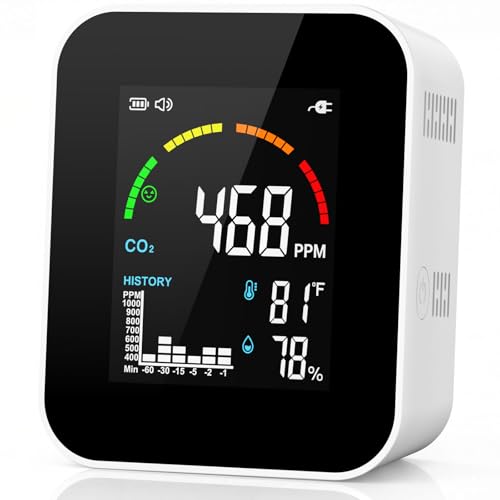
USB-powered NDIR CO2 monitor with a 24-hour history bar chart, emoticon scale and 1,000 ppm alarm.
Check price on Amazon$31.99 as of Nov 26, 2026 1:49 am GMT+0000 — prices change; see Amazon for current price.| Specification | Details |
|---|---|
| CO2 sensor | NDIR with automatic and manual calibration, temperature and aging compensation |
| Measures | CO2, temperature and humidity only |
| History | 24-hour CO2 bar graph on the device; history is lost when restarted |
| Alarm | Sounds for 10 seconds at 1,000 ppm or higher; one-press mute; can be switched off |
| Power | Designed to run on USB; battery is a backup good for up to 24 hours in power-saving mode |
| Display | 3-inch color LCD with three backlight levels and emoticons |
YOWEXA YEM-42-P — NDIR, CO2/temp/RH, 24-h on-screen history, 1,000 ppm alarm, USB power + backup battery
The Only Dedicated CO2 Meter With an On-Screen History Chart
Among the six NDIR meters in this roundup, YOWEXA’s is the only one that draws a history graph on the device itself. Every other pick that keeps history does it in a phone app. For a household that does not want another app, a glance at the bar chart in the morning shows whether the bedroom CO2 climbed overnight with the door closed.
The listing is unusually candid about limits: it says to run it on USB at all times, that the battery is only for emergencies and calibration, and that restarting clears the history. It also says it measures CO2, temperature and humidity only, and warns buyers not to mistake it for a broader air quality device.
The fixed 1,000 ppm alarm point is a ventilation cue chosen by the maker, not a safety limit. It cannot be adjusted according to the listing, only muted or turned off.
Pros
- On-device 24-hour CO2 chart, no app needed
- NDIR with aging and temperature compensation
- Adjustable backlight for bedrooms
- Candid listing about power and data limits
Cons
- History erased on restart
- Alarm threshold not adjustable
- Not meant to run on battery day to day
- No accuracy figure stated
Check YOWEXA YEM-42-P price on Amazon
6. Lwyinp M08A — Best NDIR CO2 Plus VOC and Formaldehyde
Portable 5-in-1 monitor pairing an NDIR CO2 sensor with electrochemical TVOC and formaldehyde sensors.
Check price on Amazon| Specification | Details |
|---|---|
| CO2 sensor | NDIR, named in the listing |
| Also measures | Formaldehyde (HCHO), TVOC, temperature and humidity |
| Other sensors | Electrochemical sensors for HCHO and TVOC |
| Display | Color screen that changes color when readings pass thresholds; screen-sleep option |
| Controls | Single button for power, °F/°C, sound on/off, calibration mode and screen sleep |
| Power / accuracy | Battery type and runtime not stated in listing; accuracy not stated in listing |
Lwyinp M08A — NDIR CO2 + electrochemical HCHO/TVOC, temp/RH, color-coded screen, calibration mode
One of Only Two Listings Pairing a Named NDIR Sensor With Chemical Sensing
Most multi-sensor monitors on this shelf measure CO2 but do not say how. Of the 16 CO2-measuring listings, nine never name an NDIR sensor. Only two listings combine a named NDIR CO2 sensor with VOC sensing: this Lwyinp M08A and the BREATHE Airmonitor Plus, which also adds particle sensing. The M08A is the simpler and smaller of the two.
Compare it with Lwyinp’s own 10-in-1 MT13S on the same shelf. That model adds particle readings but describes its CO2 sensing only as “dedicated intelligent sensing technology” without the word NDIR. For a buyer whose main concern is CO2, the 5-in-1 is the clearer listing.
What it does not state: runtime, battery capacity, accuracy, or any data history or app. It is a spot-check and room monitor, not a logger.
Pros
- NDIR CO2 named, unlike most multi-sensor units
- Adds formaldehyde and TVOC readings
- Color-coded screen readable from across a room
Cons
- No runtime or accuracy figures
- No app or data history
- No particle (PM2.5) sensing
Check Lwyinp M08A 5-in-1 price on Amazon
NDIR vs estimated (eCO2) sensors
This is the single most important spec on any CO2 monitor. An NDIR sensor shines infrared light through a sample of air and measures how much of the specific wavelength that CO2 absorbs. It responds to carbon dioxide directly. Photoacoustic NDIR, used in the GoveeLife H5140 and Temtop C1, is a compact variant that detects the tiny pressure pulses CO2 produces when it absorbs that light.
An estimated or “eCO2” reading works differently. A metal-oxide VOC sensor measures a mix of gases from people, cooking and cleaning products, and the device’s software converts that signal into a CO2-equivalent number. In a quiet room with one person in it, the estimate may look plausible. Spray a cleaner or light a candle and the “CO2” number can jump even though carbon dioxide has not changed, while a crowded room with few VOC sources may read too low.
On this shelf, 7 of 16 CO2-measuring listings name NDIR. The other nine use phrases like “high-precision sensor array” or “dedicated intelligent sensing technology,” or say nothing about the method. That does not prove they estimate CO2, but a listing that will not name the sensor is not one to rely on for ventilation decisions. If the box, manual or spec sheet does not say NDIR, assume it is not.
What CO2 readings mean in a home
CO2 indoors comes mostly from people breathing. It rises in closed bedrooms overnight, in home offices with the door shut, and in tight homes when the furnace fan is off. The EPA notes that when too little outdoor air enters a home, pollutants can build up to levels that cause health and comfort problems, and that inadequate ventilation fails to dilute and carry away indoor emissions. A CO2 reading is a practical proxy for that ventilation rate: when it climbs, other pollutants people and activities generate are usually climbing with it.
For scale, the NIOSH Pocket Guide lists carbon dioxide as a normal constituent of air and sets workplace exposure limits at 5,000 ppm averaged over a work shift, with 40,000 ppm listed as immediately dangerous to life or health. Home monitors typically use much lower alert points, often around 1,000 ppm, as a signal to open a window or run ventilation. Those household thresholds are comfort and ventilation cues chosen by manufacturers; they are not regulatory limits.
Patterns matter more than any single number. A bedroom that climbs steadily all night and drops quickly when a window is cracked tells you the room needs more air exchange. Our CO2 monitor for home guide walks through typical daily patterns room by room.
CO2 is not carbon monoxide
Two carbon monoxide alarms appeared in this CO2 search, which shows how easy it is to mix the two up. Carbon dioxide (CO2) is a normal product of breathing and a ventilation indicator. Carbon monoxide (CO) is a poisonous combustion gas from faulty furnaces, water heaters, gas ranges and vehicles. None of the six picks above detects carbon monoxide, and the Temtop C1 listing says so directly. Every home with fuel-burning appliances or an attached garage still needs dedicated CO alarms.
Specs that matter, and how to read them
- Sensor type: NDIR or photoacoustic NDIR, named in the listing. This outranks every other feature.
- Accuracy statement: look for a figure like ±(40 ppm + 5%) and the range it applies to. Only 3 of 16 CO2 listings here publish a CO2-specific figure.
- Range: 400–5,000 ppm covers homes; wider ranges help in garages, grow rooms and workshops.
- Calibration: NDIR sensors are usually calibrated against outdoor air. Look for a manual or outdoor calibration option, as on the GoveeLife, YOWEXA and Lwyinp units.
- Power: long-life battery for portability, or outlet power for 24/7 logging. Several units recommend USB power for real-time mode, so read the battery claim closely.
- History and export: an app with months of history, CSV export, or an on-screen chart. Without history, it is hard to see overnight patterns.
For broader comparisons that include particle and VOC sensors, see our roundup of the best air quality monitors, and for handheld use during walkthroughs, the portable air quality monitor guide.
Altitude and the Front Range
Most Front Range homes sit between roughly 5,000 and 6,500 feet. NDIR sensors respond to the number of CO2 molecules in their optical path, and at lower air pressure there are fewer molecules per volume, so an uncompensated sensor can report differently than it would at sea level. Some sensors handle this internally; others let the user enter an altitude or pressure value; many listings never mention it. On this shelf only the GoveeLife H5140 states pressure compensation, and the Aranet4 and Airthings View Plus measure pressure without saying how it is used.
Practical steps for Colorado owners: check the manual for an altitude or pressure setting, run the outdoor calibration on a calm day away from traffic and chimneys, and judge rooms against each other and against outdoor air rather than chasing an exact number. Relative trends are reliable even when absolute accuracy is uncertain.
Colorado’s dry winters create another pattern. Homes are often kept tight during heating season, windows stay shut, and bedroom CO2 can climb overnight. A monitor’s humidity reading is useful here too, since winter indoor humidity on the Front Range often runs low.
Placement and getting trustworthy readings
- Place the monitor at breathing height, about 3 to 6 feet off the floor, and away from where people sit or sleep directly beside it, since exhaled breath reads high.
- Keep it away from windows, supply vents, kitchens and fireplaces, which create misleading spikes or dips.
- Give a new or moved unit time to settle; NDIR sensors and their automatic baseline routines need a period of normal operation.
- Calibrate outdoors only when the manual allows, and only in fresh air away from vehicles and exhaust.
- Compare rooms over several days, not a single snapshot.
The EPA’s Air Sensor Toolbox explains how low-cost sensors are compared against reference-grade monitors to understand data accuracy. The takeaway for homeowners is that consumer sensors are good at showing change and comparing rooms, and less reliable for absolute values without calibration.
Using CO2 data to make decisions
A CO2 monitor earns its keep when the readings change behavior. Common fixes include cracking a bedroom window or leaving the door open overnight, running the furnace fan on a circulation setting, using bathroom and kitchen exhaust fans longer, and, in tight newer homes, checking whether a balanced ventilation system (ERV or HRV) is installed and working. Remember that air purifiers do not lower CO2; only fresh-air exchange does, as the GoveeLife listing itself points out.
When CO2 stays high despite those steps, or when it rises together with odors, headaches or condensation, the issue may be a ventilation or mechanical system problem that a monitor cannot diagnose. Our guide to home indoor air quality testing explains what a professional assessment adds.
DIY monitors vs a professional inspection
A home CO2 monitor tells you how well a room is ventilated right now. It does not test for carbon monoxide, radon, mold, combustion spillage from a water heater, or duct leakage, and it cannot identify why ventilation is poor. A home inspector evaluates the systems behind the numbers: exhaust fans that vent into the attic, blocked fresh-air intakes, backdrafting appliances and missing ventilation in finished basements. For the instruments inspectors carry for this work, see our home inspection tools guide.
Which CO2 monitor should you buy?
- Want one cordless meter that lasts years: Aranet4.
- Live at Front Range altitude and want logging plus alerts: GoveeLife H5140.
- Need a wide range for a garage, shop or grow room: SwitchBot Meter Pro CO2.
- Want the clearest accuracy specs on paper: Temtop C1.
- Want a no-app bedroom alarm with an on-screen history: YOWEXA YEM-42-P.
- Want NDIR CO2 plus formaldehyde and VOC readings: Lwyinp M08A.
More Questions About CO2 Monitors
How accurate are home CO2 monitors?
Home CO2 monitors with true NDIR sensors are typically accurate to within about plus or minus 50 ppm plus a few percent of the reading, which is good enough to guide ventilation decisions. Cheaper monitors that show estimated CO2 from a VOC sensor are much less reliable and can be far off. Accuracy depends on calibration: most NDIR monitors self-calibrate by assuming the lowest reading over several days is outdoor air, so they need occasional fresh-air exposure. Placing the monitor away from breath, windows and vents gives steadier readings.
Does high indoor CO2 cause headaches or poor sleep?
High indoor CO2 is mainly a sign of poor ventilation, and people often report stuffiness, drowsiness or reduced focus in rooms with elevated levels. Typical home readings of 1,000 to 2,000 ppm are not a poisoning risk the way carbon monoxide is, but they suggest the room needs more fresh air. Other pollutants build up in poorly ventilated rooms at the same time. Anyone with persistent headaches, breathing trouble or sleep problems should see a doctor, and should also rule out carbon monoxide with a proper CO alarm.
How do you lower CO2 levels in a bedroom?
Bedroom CO2 levels drop fastest with more outdoor air: crack a window, leave the bedroom door open, or run a bath or hallway exhaust fan. A heat recovery or energy recovery ventilator provides steady fresh air without big energy losses, especially in tight, newer homes. Running a forced-air system fan can mix bedroom air with the rest of the house. Houseplants and standard air purifiers do not meaningfully reduce CO2. A monitor helps confirm whether a change keeps readings closer to about 1,000 ppm overnight.
Is a CO2 monitor worth buying for a home?
A CO2 monitor is worth buying if you want an easy way to tell when rooms need more ventilation, especially bedrooms, home offices, nurseries and tightly sealed homes. The readings make invisible air problems visible and help decide when to open windows or run fans. It is less useful in drafty older houses where CO2 rarely builds up. Buy a model with a true NDIR sensor rather than estimated CO2. A CO2 monitor never replaces a carbon monoxide alarm, which protects against a different, life-threatening gas.
References
- NIOSH Pocket Guide to Chemical Hazards: Carbon Dioxide — Centers for Disease Control and Prevention / NIOSH
- Introduction to Indoor Air Quality — U.S. Environmental Protection Agency
- Air Sensor Toolbox — U.S. Environmental Protection Agency
- Volatile Organic Compounds’ Impact on Indoor Air Quality — U.S. Environmental Protection Agency
Frequently asked questions
What is the best type of sensor for a CO2 monitor?
An NDIR (nondispersive infrared) sensor, including photoacoustic NDIR, measures carbon dioxide directly. Cheaper devices may estimate CO2 from a VOC sensor, and those estimates can swing with cleaning sprays or cooking. If a listing does not name NDIR, treat its CO2 number with caution.
What CO2 level should trigger more ventilation at home?
Many home monitors use about 1,000 ppm as a cue to open a window or run ventilation. That is a comfort and ventilation guideline set by manufacturers, not a legal limit. For comparison, NIOSH's workplace exposure limit is 5,000 ppm averaged over a work shift.
Is a CO2 monitor the same as a carbon monoxide detector?
No. Carbon dioxide comes mostly from breathing and indicates ventilation. Carbon monoxide is a poisonous gas from combustion appliances and vehicles. A CO2 monitor will not warn you about carbon monoxide, so homes with fuel-burning appliances need separate CO alarms.
Does altitude affect CO2 monitor readings in Colorado?
It can. NDIR sensors respond to the number of CO2 molecules in their sensing chamber, and air is thinner at Front Range elevations. Look for a monitor that states pressure compensation or lets you enter altitude, calibrate it outdoors as the manual directs, and focus on trends between rooms.
Where should a CO2 monitor be placed?
Put it at breathing height in the room you want to evaluate, such as a bedroom or office, away from windows, vents, kitchens and the spot where someone sits or sleeps right next to it. Watch readings over several days to see real patterns rather than one-time spikes.
What is a normal CO2 level indoors?
Normal indoor CO2 levels in well-ventilated homes are often around 400 to 1,000 ppm. Outdoor air is roughly 420 ppm. Readings above about 1,000 ppm suggest the room needs more fresh air, and sustained readings over 2,000 ppm point to poor ventilation.
Do CO2 monitors need calibration?
Most NDIR CO2 monitors self-calibrate automatically by referencing the lowest readings over several days. Some allow manual calibration outdoors. Monitors kept in rooms that never get fresh air may drift, so occasional outdoor calibration helps keep readings trustworthy.
Can a CO2 monitor help with mold or humidity?
Many CO2 monitors also display humidity and temperature, which helps spot rooms staying above about 60 percent humidity where mold risk rises. CO2 itself does not indicate mold, but high CO2 and high humidity together often signal poor ventilation needing attention.
Want ventilation, combustion appliances and indoor air conditions looked at by a professional on the Front Range? Reach out through our contact page to connect with a vetted local inspector.