Asbestos Testing in Federal Heights, CO | InspectandTest
Asbestos was used in dozens of common building materials through the 1970s and into the 1980s, which makes Federal Heights a genuine concern, because the city’s housing skews heavily to the 1960s through 1980s, squarely within the asbestos era. This dense, older Adams County city, packed with single-family homes, condos, and apartments along the US-36 and Federal Boulevard corridor, holds a lot of stock built when asbestos products were standard. Asbestos is only dangerous when disturbed and its fibers become airborne, so the goal of asbestos testing federal heights homeowners pursue is to identify it before a remodel turns a safe material into an inhalation hazard. This page explains what to test, when, and what it costs. This summary reflects EPA and OSHA guidance current as of 2026; consult a certified professional before disturbing any suspect material.
Part of our Asbestos in the Home guide — start there for the full picture →
Is this mold, asbestos, or water damage? Get a free instant screen
Upload a clear photo of the suspect area. You'll get an instant AI screening opinion and what to do next. This is screening guidance, not a professional determination.
Screening guidance only. AI can be wrong. Confirm asbestos, mold type, or lead with lab testing or a licensed professional before acting.
Asbestos testing in Federal Heights: what to know
Asbestos testing means collecting a small sample of a suspect material under controlled conditions and sending it to an accredited lab for analysis, usually by polarized light microscopy. You cannot tell whether a material contains asbestos by looking at it, which is why lab confirmation is the only reliable answer before any work that would disturb it.
The trigger is almost always renovation. A 1970s Federal Heights home or condo being updated, new flooring, a kitchen remodel, a popcorn-ceiling scrape, is exactly when hidden asbestos becomes a live hazard. For the broader context on why mid-century and pre-1978 housing carries this risk, our guide to asbestos and lead in older homes lays out the full picture.
The key principle is that intact, undisturbed asbestos is generally not an immediate danger; the hazard appears when material is cut, sanded, scraped, or demolished and fibers go airborne. That is why testing is renovation-driven rather than a routine annual concern. A Federal Heights homeowner who plans to leave a popcorn ceiling or vinyl floor untouched faces little risk, but one about to tear into it should know what is in it first, because once fibers are released, they are invisible, odorless, and can lodge in the lungs for decades.
Why Federal Heights homes need asbestos testing
Housing age is the driver, and Federal Heights is unusually exposed because so much of its stock dates to the 1960s, 1970s, and 1980s, the peak and tail of the asbestos era. Unlike a town with a small old core surrounded by new builds, a large share of Federal Heights homes, single-family, condo, and apartment, fall within the window where asbestos products were common, which makes the city a higher-than-average candidate for pre-renovation testing.
The common materials are worth knowing. In Federal Heights homes of this era, asbestos can hide in nine-inch vinyl floor tile and its black mastic, popcorn ceiling texture, pipe and duct insulation, plaster and joint compound, cement siding, and roofing felt. A 1970s home or condo that has been updated in layers over the decades can have asbestos materials buried under newer finishes, which a renovation suddenly exposes. Popcorn ceilings, especially common in homes and multi-family units of this period, are one of the most frequent reasons Federal Heights owners test before a remodel.
The multi-family stock adds a wrinkle. Federal Heights has many condos and apartments from the asbestos era, and in a shared building a renovation that disturbs asbestos can affect neighboring units, not just the one being worked on. That makes testing before work especially important here, both for the household doing the remodel and for the building. A condo owner planning to replace flooring or scrape a ceiling should test first, because the consequences of an uncontrolled release in a shared structure reach beyond their own walls and can trigger building-wide cleanup obligations.
What a Federal Heights asbestos test covers
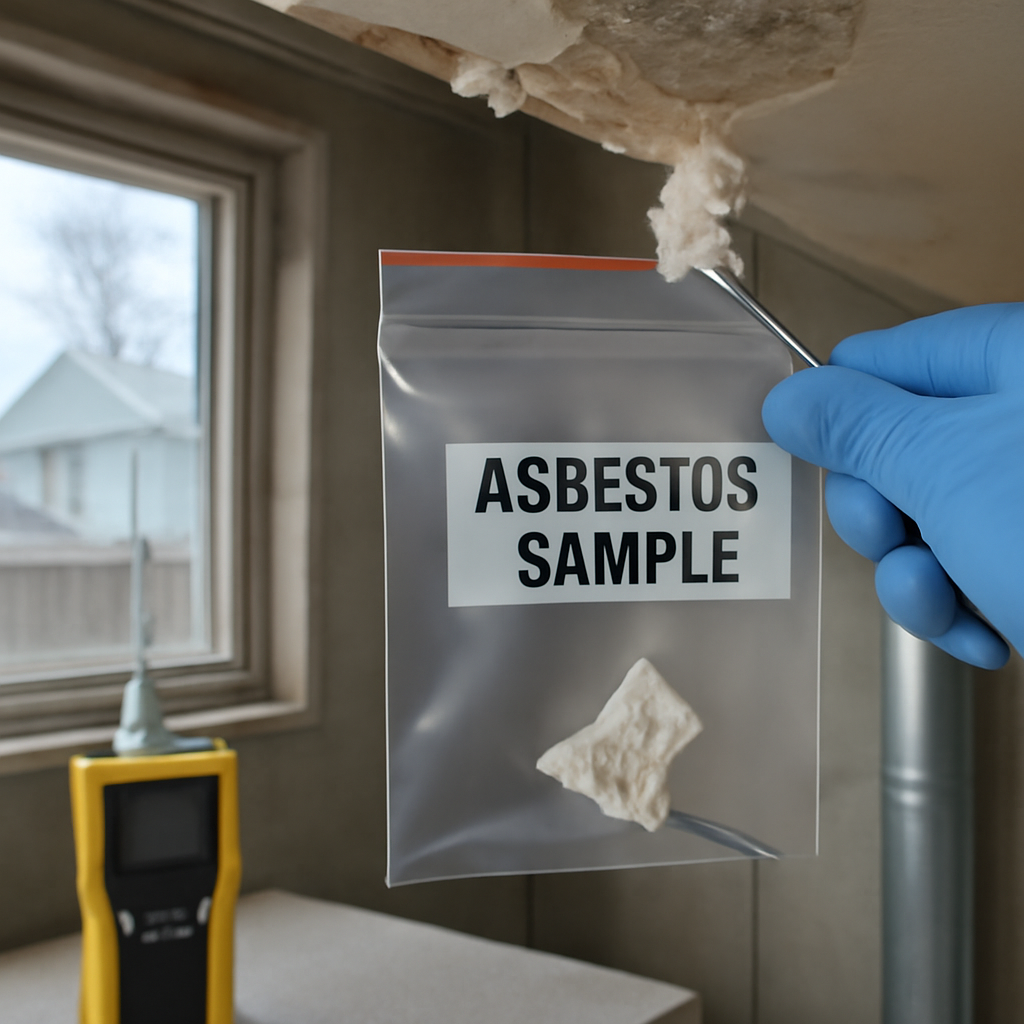
A professional samples each suspect material separately, since a single home can contain several distinct asbestos products. The inspector documents the location and condition of each material, collects a small sample using wet methods to avoid releasing fibers, and submits it to an accredited lab.
Which materials get sampled
Common targets in a 1960s-to-1980s Federal Heights home include vinyl floor tile and sheet flooring, popcorn ceiling texture, plaster and drywall joint compound, pipe and duct insulation, exterior cement siding, and roofing. Each distinct material is its own sample because one can contain asbestos while another in the same home does not. Federal Heights shares its older-housing profile with surrounding Adams County communities, so an Adams County asbestos testing overview helps frame the regional pattern.
How sampling is done safely
A trained sampler wets the material, cuts a small piece with minimal disturbance, seals it in a labeled container, and patches the spot. This wet-method approach keeps fibers from going airborne during collection, which is why DIY sampling is risky, an untrained homeowner scraping a popcorn ceiling for a sample can release more fibers than the test was meant to prevent. The accredited lab then reports the percentage and type of asbestos, which determines whether abatement is required.
Asbestos testing cost in Federal Heights
Individual asbestos samples in the Federal Heights market typically run about $30 to $75 each at the lab, while a professional inspection with sampling, where a certified inspector collects multiple samples and interprets the results, usually runs $250 to $600 depending on how many materials need testing and the home’s size.
A single-material test, say one popcorn ceiling before a remodel, sits at the low end. A whole-house or whole-unit pre-renovation survey of a 1970s Federal Heights home or condo with many suspect materials costs more because each material is sampled and analyzed separately.
The cost is small against the alternative. Disturbing asbestos without knowing it is there can contaminate a home and expose a family, or in a condo, neighbors, to fibers that carry a decades-long lung-disease and mesothelioma risk, and cleaning up an uncontrolled release costs far more than testing would have. For a few hundred dollars, a Federal Heights homeowner planning to renovate gets a clear inventory of what is safe to disturb and what needs a licensed abatement contractor, which is exactly the information that prevents an expensive and hazardous mistake. Testing before work, rather than after a problem, is always the cheaper path.
Scope drives the price more than anything. A homeowner replacing one floor needs only that floor and its mastic tested, a modest cost, while a full gut renovation of a 1970s home warrants a comprehensive survey covering flooring, ceilings, plaster, insulation, siding, and roofing. Matching the test scope to the actual planned work keeps the cost proportionate, so tell the inspector exactly what you intend to disturb and let them sample accordingly rather than defaulting to the largest survey.
What happens if asbestos is found
A positive result does not always mean immediate removal. If the material is intact and will not be disturbed, the safest course is often to leave it in place and manage it. If your renovation will disturb it, Colorado regulation requires that abatement above certain quantities be handled by a state-certified asbestos contractor using containment, negative air pressure, and proper disposal. A homeowner should never sand, scrape, or demolish confirmed asbestos material themselves, and in a Federal Heights condo or apartment, the stakes are higher because a release can reach neighboring units. The test result is what lets you make that call correctly, by telling you which materials are safe to work around and which require a licensed professional before the project goes forward.
Popcorn ceilings and the swamp-cooler connection
Two features come up again and again in Federal Heights homes of this era, and both intersect with asbestos. Popcorn or acoustic ceiling texture was applied widely in 1960s-through-1980s homes and multi-family units, and texture from this period can contain asbestos. Scraping a popcorn ceiling is one of the most common renovation tasks Federal Heights owners undertake, and it is precisely the kind of dry, abrasive work that sends fibers airborne if the texture is asbestos-containing. Testing a ceiling-texture sample before scraping is the single most important pre-renovation step for many homes here.
Evaporative coolers, very common across the city’s older stock, add an indirect concern. The water and humidity a swamp cooler introduces can degrade nearby materials over time, and ductwork and surrounding finishes in older homes may include asbestos-containing products. While the cooler itself is not the hazard, any renovation that opens up ducting, ceilings, or wall cavities around it should treat the disturbed materials as suspect until tested. For a Federal Heights homeowner, the takeaway is to think about asbestos before any project that breaks into older surfaces, ceilings, floors, ducts, or insulation, rather than discovering the question mid-scrape, when fibers may already be in the air.
Colorado regulations and disclosure
Colorado regulates asbestos through the CDPHE Air Pollution Control Division, which sets abatement and disposal rules and requires certified contractors for projects above defined thresholds. The state’s Seller’s Property Disclosure asks sellers to report known asbestos, so a documented test result becomes part of any Federal Heights transaction. For renovation, the practical rule is to test before disturbing any pre-1980 material.
Disclosure and regulation work together here. A Federal Heights seller of a 1970s home or condo who has tested can disclose accurate information and avoid a surprise during the buyer’s inspection, while a buyer planning to renovate should test before closing or before demolition so the project budget reflects any abatement. Because the state enforces contractor certification and disposal rules, and because so much of the city’s stock falls in the asbestos era, attempting to skip testing and quietly remove suspect material is both a health risk and a regulatory one, which is why the documented test is the responsible starting point.
Neighborhoods and areas served
Asbestos testing demand in Federal Heights spans the city’s older stock: the original single-family neighborhoods, the Hidden Lake area, and the many condo and apartment developments along the Federal Boulevard corridor, most of which date to the asbestos era. Service typically extends to adjacent Westminster, Thornton, Northglenn, and Denver, where similar mid-century stock is common. A neighboring asbestos testing in Northglenn guide covers a comparable inner-ring city.
Because so much of Federal Heights falls within the asbestos era, the testing question here is less about whether a home is old enough and more about what a planned project will disturb. A family scraping a 1970s popcorn ceiling or replacing vinyl floor in a condo should test those specific materials first. Knowing your home’s build decade, almost always within the asbestos window in this city, makes pre-renovation testing a default rather than an exception before you start any project that breaks into older surfaces.
How to choose a Federal Heights asbestos testing provider
Use a certified asbestos inspector who samples with wet methods, submits to an accredited lab, and interprets the results in light of your renovation plans. A good provider tells you plainly which materials are safe to leave alone and which need a certified abatement contractor, rather than pushing removal of everything.
Confirm the lab is accredited and ask whether the inspector is independent of any abatement company, since a tester who also sells removal has an incentive to over-find. A trustworthy Federal Heights provider explains the difference between manage-in-place and abatement, gives you the written lab report, and points you to a certified contractor only when the material genuinely needs removal. That separation between testing and removal keeps the diagnosis honest, which matters in a city where so many homes are testing candidates.
Ask about turnaround and documentation. A useful asbestos test ends with a written lab report naming each material, its asbestos content and type, and a recommendation. For a renovation on a deadline, ask about rush lab options, and for a real-estate transaction or a condo project, make sure the report is something you can hand to a buyer, contractor, or HOA. That documentation is part of what you are paying for, and it is what makes the result usable in a negotiation, a permit application, or an abatement bid.
References
- Asbestos in the home and renovation — U.S. Environmental Protection Agency
- Asbestos exposure standards — Occupational Safety and Health Administration
- Colorado asbestos regulation and certification — Colorado Department of Public Health and Environment
Frequently asked questions
Which Federal Heights homes are most likely to contain asbestos?
A large share, because the city's stock skews heavily to the 1960s through 1980s, within the asbestos era. Single-family homes, condos, and apartments of that period are all candidates for pre-renovation testing.
Can I tell if a material contains asbestos by looking at it?
No. Asbestos cannot be identified visually. A small sample must go to an accredited lab for microscopy. That lab confirmation is the only reliable way to know before disturbing any suspect material.
How much does asbestos testing cost in Federal Heights?
Individual lab samples run about $30 to $75 each, while a professional inspection with sampling typically runs $250 to $600 depending on how many materials need testing and the home's size.
Why does asbestos matter more in a Federal Heights condo?
In a shared building, a renovation that disturbs asbestos can affect neighboring units, not just yours. Testing before work protects the whole building and can prevent a release that triggers wider cleanup obligations.
What happens if asbestos is found in my Federal Heights home?
If it is intact and undisturbed, it can often be managed in place. If your project will disturb it, Colorado requires a certified contractor for abatement above set quantities. Never remove it yourself.
Because so much of Federal Heights was built in the asbestos era, testing before you renovate protects your family and, in shared buildings, your neighbors. To connect with a vetted local asbestos inspector, reach out through our contact page.