Asbestos Test: A Plain-Language Explainer for Homeowners

An asbestos test is, in the simplest terms, a lab analysis of a small piece of suspect building material to determine whether it contains asbestos and at what percentage. The test itself is performed in a NVLAP-accredited or AIHA-LAP-accredited laboratory using polarized light microscopy (PLM) for bulk samples or transmission electron microscopy (TEM) for higher-resolution analysis. The hard part is rarely the test — it is knowing what to test, when to test it, and what to do with the results. This guide summarizes EPA, OSHA, and CDC guidance current as of 2026 along with public-domain laboratory protocols. Consult your physician for any health symptoms and a certified abatement professional for removal decisions. The focus here is the broad explainer: what an asbestos test is, why it exists, and how the workflow has settled into its current form.
Part of our Asbestos in the Home guide — start there for the full picture →
Is this mold, asbestos, or water damage? Get a free instant screen
Upload a clear photo of the suspect area. You'll get an instant AI screening opinion and what to do next. This is screening guidance, not a professional determination.
Screening guidance only. AI can be wrong. Confirm asbestos, mold type, or lead with lab testing or a licensed professional before acting.
What an asbestos test actually is
An asbestos test is a sample-and-analyze process. A small piece of suspect material is collected, sealed in a labeled bag, and shipped to an accredited lab. The lab examines the sample under a microscope using established protocols and produces a written report identifying any asbestos found, the type (chrysotile, amosite, crocidolite, anthophyllite, tremolite, actinolite), and the percentage by weight or volume. Materials with greater than 1% asbestos are regulated as asbestos-containing materials (ACM) under EPA and OSHA standards.
The test does not measure airborne fibers. It does not measure exposure. It does not tell you whether the material is friable or whether it has been disturbed. Those are separate questions answered by air sampling, condition assessment, and exposure-history analysis. The test answers only one question: does this specific piece of material contain asbestos?
For the broader risk context — why this matters for pre-1978 and pre-1990 homes — the overview of asbestos and lead in older housing walks through the historical use and current regulatory landscape.
Why asbestos tests exist: the historical context
Asbestos was used heavily in residential and commercial construction from roughly 1920 to the late 1980s, with peak use 1950 to 1980. The fibers were prized for fire resistance, insulation properties, and tensile strength. Common products included pipe insulation, ductwork insulation, vinyl floor tiles, asphalt floor tiles, joint compound, drywall, popcorn ceiling texture, asbestos cement siding (Transite), asbestos cement pipe, vermiculite attic insulation (often containing tremolite asbestos), roofing felt, and various adhesives.
The health risks of asbestos exposure became clear in the 1960s and 1970s through epidemiological studies of asbestos workers. The EPA banned several specific uses in 1973, 1975, 1977, and 1978, and most remaining residential uses were phased out by the late 1980s. The 1986 Asbestos Hazard Emergency Response Act (AHERA) created the federal framework for school inspections and trained inspectors. The 1989 EPA Asbestos Ban and Phase-Out Rule was partially overturned in court, which is why some asbestos-containing products technically remained legal even into the 1990s, though manufacturers had largely stopped using asbestos by then.
The result: any home built before 1990, and especially before 1980, has a meaningful probability of containing ACM in one or more locations.
The two test methods: PLM and TEM
Two analytical methods dominate residential asbestos testing.
Polarized Light Microscopy (PLM)
PLM is the standard method for bulk samples (pieces of solid material). It uses polarized light to identify asbestos fibers based on their optical properties. PLM is fast, inexpensive, and reliable for materials with greater than 1% asbestos content. Most $35 mail-in DIY kits use PLM. Turnaround is typically 5 business days for standard service or 24 to 48 hours for rush.
Transmission Electron Microscopy (TEM)
TEM uses an electron beam to image samples at much higher resolution than PLM. It is required by EPA AHERA for school inspections and is used for clearance testing (verifying air quality after abatement work). TEM is also useful for materials in the 0.25% to 1% range where PLM may be ambiguous. Turnaround is similar to PLM but the cost is higher — typically $150 to $300 per sample.
For homeowner triage, PLM is generally adequate. TEM is appropriate for clearance testing after abatement and for low-content edge cases. The sibling asbestos testing guide walks through how to choose between methods.
The DIY versus professional decision
The asbestos test market has settled into two distinct workflows. DIY mail-in kits ($30 to $50 per sample) are appropriate for non-friable materials in good condition where the homeowner can collect the sample safely and chain-of-custody is not required. Professional sampling ($300 to $600 for a small inspection, $500 to $1,200 for AHERA-style comprehensive work) is appropriate when:
- The material is friable (crumbles when crushed by hand)
- Vermiculite attic insulation is involved
- The work is for a real-estate transaction
- The homeowner is uncomfortable with safe sample collection
- Multi-sample comprehensive inspection is needed
The EPA AHERA-trained inspector is the gold standard for chain-of-custody work. Industrial hygienists with CIH (Certified Industrial Hygienist) credentials are also qualified for residential sampling.
Sample collection done safely
Whether DIY or professional, safe sample collection follows the same principles:
- Wet the suspect material thoroughly with water containing a few drops of dish soap (this prevents fiber release)
- Cut a small piece (quarter-sized) using a sharp utility knife
- Place it directly into a sealed plastic bag, label with location and date
- Use a P100 or N95 respirator, disposable gloves, and disposable clothing
- Mist the area before, during, and after collection
- Dispose of disposable items as if they were ACM
The EPA emphasizes that DIY sample collection should not be attempted on friable materials. A friable material is one that, when dry, can be crumbled, pulverized, or reduced to powder by hand pressure. Old pipe insulation, vermiculite, deteriorating popcorn ceilings, and damaged drywall all qualify and warrant professional sampling.
Reading the lab report
A typical asbestos test report contains:
- Sample ID and location description
- Method used (PLM, TEM, or both)
- Asbestos types identified (or “none detected”)
- Percentage by weight or volume
- Other components identified (cellulose, fiberglass, mineral wool)
- Lab accreditation and analyst signature
- Chain-of-custody documentation (if applicable)
Results greater than 1% asbestos are regulated as ACM. Results below 1% but above 0.25% are sometimes called “trace” and warrant precautionary handling. Results below 0.25% are typically reported as “none detected” or “below detection limit.”
What to do with positive results
The EPA generally recommends one of three approaches for confirmed ACM:
- Leave it alone. If the material is in good condition, undamaged, and won’t be disturbed, leaving it alone is often the best option. The EPA emphasizes that intact, undisturbed ACM in good condition does not pose a meaningful health risk.
- Encapsulate. For materials at moderate risk of disturbance, sealing them with appropriate paint or coating prevents fiber release. This is common for popcorn ceilings and pipe insulation.
- Remove. For materials that must be disturbed during renovation or that are already damaged, hire a licensed abatement contractor. DIY removal of ACM is illegal in many jurisdictions and unsafe everywhere.
Cost expectations
Test costs in 2026:
- DIY single-sample mail-in kit: $30 to $50
- DIY 3-5 sample multi-pack: $80 to $150
- Professional sampling (1-3 samples): $300 to $600
- AHERA-style comprehensive inspection: $500 to $1,200
- TEM analysis (per sample): $150 to $300
- Air clearance testing (post-abatement): $200 to $400
For Front Range homeowners, sibling guides like the asbestos testing kits buyer’s guide compare specific kit options and labs accepted by Colorado contractors.
Why test results matter even when leaving material alone
One of the more useful side benefits of an asbestos test is that the documented result follows the home. A confirmed-negative test on a popcorn ceiling tells future contractors, future buyers, and future homeowners that the material was tested and confirmed asbestos-free, which can save hundreds of dollars in unnecessary precautions during future renovation. A confirmed-positive test, paradoxically, is also useful — it documents the presence of the material so future work can be planned with appropriate precautions rather than encountered as a surprise mid-project.
For Front Range homeowners, keeping a small folder with all asbestos and lead test results, dates, lab accreditation information, and photos of the sampled materials is genuinely useful documentation. It accompanies the home through future transactions and avoids redundant testing.
The relationship between testing and abatement
Testing and abatement are different services performed by different professionals. Testing identifies whether a material contains asbestos. Abatement removes or contains the material. Most abatement contractors prefer to receive a documented test result before scoping the work, both for cost estimation and because the abatement plan depends on what type of asbestos is present and at what percentage. Skipping the testing step and going straight to abatement is sometimes done in clear-cut cases (visible vermiculite, obvious friable pipe insulation) but generally is not recommended because it can over-scope the work or miss adjacent materials that should also be addressed.
More Questions About Asbestos Tests
Can a doctor test a person for asbestos exposure?
No routine blood or urine test confirms past asbestos exposure, but a doctor can evaluate lung health and look for signs related to asbestos. Evaluations may include a medical history, a physical exam, chest imaging, and lung function tests.
Asbestos-related conditions often develop many years after exposure, so imaging may look normal for a long time. Anyone concerned about past exposure from work or renovations should discuss it with a doctor, who can decide what monitoring is appropriate. An asbestos test of building materials is different, since it identifies asbestos in materials rather than in people.
What materials should be tested for asbestos first?
Materials that will be disturbed by planned work, or that are already damaged, should be tested for asbestos first. Common priorities include popcorn ceilings, vinyl floor tiles and mastic, joint compound, pipe and duct insulation, and vermiculite attic insulation.
Damaged or crumbling materials take priority because they can release fibers more easily. For renovations, materials in the work area matter most, such as flooring in a kitchen remodel or ceiling texture in a room being updated. Testing everything at once is rarely necessary; focusing on materials affected by the project keeps costs reasonable.
Can an asbestos test be done on soil?
Yes, soil can be tested for asbestos, but it uses different methods than bulk building material tests and is less common for homeowners. Soil testing is typically used around demolished buildings, areas with asbestos debris, or regions with naturally occurring asbestos in rock and soil.
Sampling soil properly requires planning, since asbestos may be unevenly distributed. Some labs offer specialized soil analysis methods. Homeowners concerned about debris from old siding or a removed shed may find visual inspection and cleanup more practical. For naturally occurring asbestos concerns, local environmental agencies can provide guidance.
Do asbestos tests need to be repeated over time?
No, an asbestos test of a specific material does not need to be repeated, because asbestos content does not change. A positive or negative result for a given ceiling texture or floor tile remains valid for as long as that material stays in place.
What can change is the condition of the material. Intact material may become damaged over time, which raises the risk of fiber release. Periodic visual checks of known asbestos materials are worthwhile. New tests are needed for materials not previously sampled, or when renovation exposes materials hidden behind walls or under floors.
References
- EPA asbestos program and homeowner resources — U.S. Environmental Protection Agency
- OSHA asbestos worker protection standards — Occupational Safety and Health Administration
- NIOSH asbestos health information — Centers for Disease Control and Prevention
- CDPHE asbestos program for Colorado — Colorado Department of Public Health and Environment
Frequently asked questions
What is an asbestos test?
It is a lab analysis of a small piece of suspect building material to determine whether it contains asbestos. Labs use polarized light microscopy (PLM) for most bulk samples and transmission electron microscopy (TEM) for higher-resolution analysis.
How much does an asbestos test cost in 2026?
A DIY mail-in kit costs $30 to $50 per sample including lab analysis. Professional sampling runs $300 to $600 for a small inspection. Comprehensive AHERA-style inspections run $500 to $1,200.
How long do asbestos test results take?
Standard service is typically 5 business days from when the lab receives the sample. Rush options at $75 to $150 extra return results in 24 to 48 hours.
Is one sample enough?
For casual triage, one sample of a homogeneous material is generally adequate. For comprehensive assessment under EPA AHERA, three samples per homogeneous surfacing area, two per thermal system insulation, and one per miscellaneous material is the standard.
Can asbestos testing be done on a rental home by a tenant?
Tenants usually need landlord permission before sampling building materials for asbestos, since sampling removes part of the property. Tenants concerned about damaged materials can report the condition in writing and request testing. Many landlords arrange testing through a certified inspector, especially before repairs.
Is an asbestos test required to sell a house?
An asbestos test is not generally required to sell a house in the US. Sellers who already know a material contains asbestos should typically disclose it under state rules. Buyers may request testing during the inspection period, especially for older homes with suspect materials or planned renovations.
Can an asbestos test detect all six types of asbestos?
Yes, standard asbestos lab tests can identify all regulated asbestos types, including chrysotile, amosite, crocidolite, tremolite, actinolite, and anthophyllite. Lab reports usually list the type and estimated percentage of each detected asbestos fiber. Chrysotile is the most commonly found type in residential building materials.
Front Range homeowners deciding between a DIY kit and a professional sampling visit can reach out through our contact page for a quick read on which path matches the property and the planned project scope.
Asbestos test kits
Asbestos can only be confirmed by a lab. A mail-in kit gets you a sealed sample container and accredited analysis — never sand or disturb suspect material first.
| Product | Why | Buy |
|---|---|---|
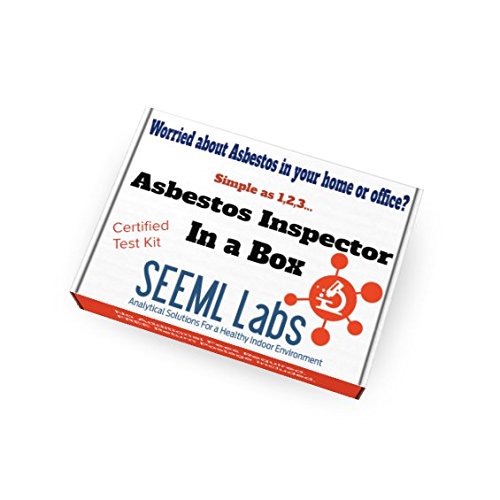 Asbestos Test Kit (mail-in lab) | Includes PPE + sealed mailer. | Amazon — $22.00 |
 Pro-Lab Asbestos Test Kit | Widely available; lab fee separate. | Amazon — $63.99 |