AirGradient ONE
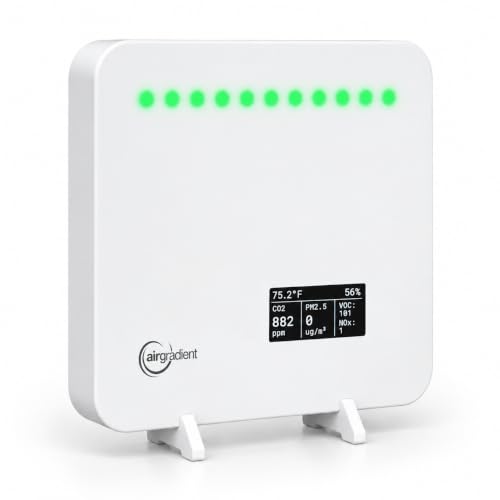
The AirGradient ONE (model I-9PSL-DE) is an indoor air monitor that tracks PM2.5, carbon dioxide, TVOCs, nitrogen oxides (NOx), temperature and humidity.
The AirGradient ONE (model I-9PSL-DE) is an indoor air monitor that tracks PM2.5, carbon dioxide, TVOCs, nitrogen oxides (NOx), temperature and humidity. It suits data-minded homeowners, smart-home tinkerers and anyone who wants to verify ventilation or wildfire-smoke filtering with trustworthy numbers. What sets it apart is transparency: the listing names every sensor module inside, each unit is individually calibrated for PM2.5 with a digital test report, and the hardware and firmware are open source, with Home Assistant support and a dashboard that needs no subscription.
Specifications
| Specification | Details |
|---|---|
| Model | I-9PSL-DE |
| Measurements | PM2.5, CO2, TVOC, NOx, temperature, relative humidity |
| Sensor modules | SenseAir NDIR (CO2), Plantower PMS5003 (particles), Sensirion SGP41 (TVOC/NOx), Sensirion SHT40 (temp/RH) |
| Calibration | Chamber-tested; individual PM2.5 calibration with digital report |
| Display | 1.3-inch OLED plus 11-LED color bar |
| Software | Free dashboard, API and mobile app; Home Assistant certified; Homey support; open-source firmware |
| Power / mounting | USB-C with 6.6-ft cable and US adapter; tabletop feet or wall/junction-box mount |
| Warranty | 1-year manufacturer limited |
AirGradient ONE I-9PSL-DE — PM2.5, NDIR CO2, TVOC, NOx, temp/RH; named sensor modules; per-unit PM2.5 calibration; open source, no subscription
How It Compares
The Only Monitor Here That Tracks NOx and Names Every Sensor Module Inside
Only 10 of the 20 similar listings are air monitors; the rest are books, protein bars, vitamins and a hair treatment that matched the word “one.” Among those 10, five measure both particles and CO2 like the AirGradient (Lwyinp, YNAK, BREATHE and two ZEMEOLLO listings), and none of them lists a NOx reading. BREATHE and Aranet4 identify their CO2 sensors as NDIR, but no other listing names the specific make of each sensor the way AirGradient does, which matters because sensor quality largely decides accuracy in this category.
The listing also cites outside validation: AIRLAB Microsensors Challenge awards for PM2.5 and multi-pollutant accuracy, a Wirecutter top pick, a Consumer Reports recommendation and RESET Air accreditation. No other monitor on this shelf cites third-party test results. It is also the only listing describing open-source firmware, local control and Home Assistant certification, while Kidde gates some of its insights behind an optional paid subscription.
The trade-offs are practical ones. Aranet4 runs for up to four years on batteries and BREATHE gives about six hours of portable use, while the AirGradient needs a USB power source. The listing also does not mention altitude or pressure compensation for its CO2 reading, a detail worth checking at Front Range elevations; Aranet4 measures atmospheric pressure directly.
Who It’s For — and Who Should Skip It
It fits buyers who want defensible numbers: checking whether a new furnace filter or portable purifier actually lowers PM2.5 during smoke events, confirming that a tight new build gets enough fresh air, or feeding readings into Home Assistant automations.
Skip it for portable spot checks around the house, since it needs a cable, or if a simple green/yellow/red answer is all that is wanted. It does not measure carbon monoxide or radon, so it cannot replace listed CO alarms or a radon test.
Using It at Home
- Mount at breathing height in a bedroom or main living area, away from the kitchen and supply vents, so readings reflect the room rather than one draft.
- Watch CO2 overnight. Climbing readings in a closed bedroom point to weak ventilation; cracking a window or running an ERV/HRV should bring it down.
- Use smoke season as a test. When Colorado wildfire smoke arrives, compare indoor PM2.5 before and after upgrading to a MERV-13 furnace filter or running a purifier.
- Note NOx spikes when cooking. A jump while a gas range runs is a cue to use the range hood every time.
- Test radon separately. Much of the Front Range has elevated radon, and no particle or gas monitor here detects it.
If PM2.5, VOC or CO2 levels stay elevated without an obvious cause, or a musty smell accompanies high humidity, request an indoor air quality inspection to track down the source.
Pros
- Named, well-known sensor modules including NDIR CO2
- Per-unit PM2.5 calibration with test report
- Only monitor here measuring NOx
- Open source, Home Assistant certified, no subscription
Cons
- Needs USB power; no battery operation listed
- Small 1.3-inch display
- No CO or radon sensing
- Altitude compensation not stated in listing
Related Guides
- Best air quality monitors
- Best CO2 monitors
- Choosing a home air quality monitor
- Air quality monitors and radon
As an Amazon Associate we earn from qualifying purchases. Product details come from the current Amazon listing; we have not lab-tested this unit, and prices and availability change.
$295.00 as of Oct 23, 2026 10:01 am GMT+0000
Prices change often — check the live price on Amazon. As an Amazon Associate we earn from qualifying purchases.