White Mold Removal: Identifying and Treating It Right
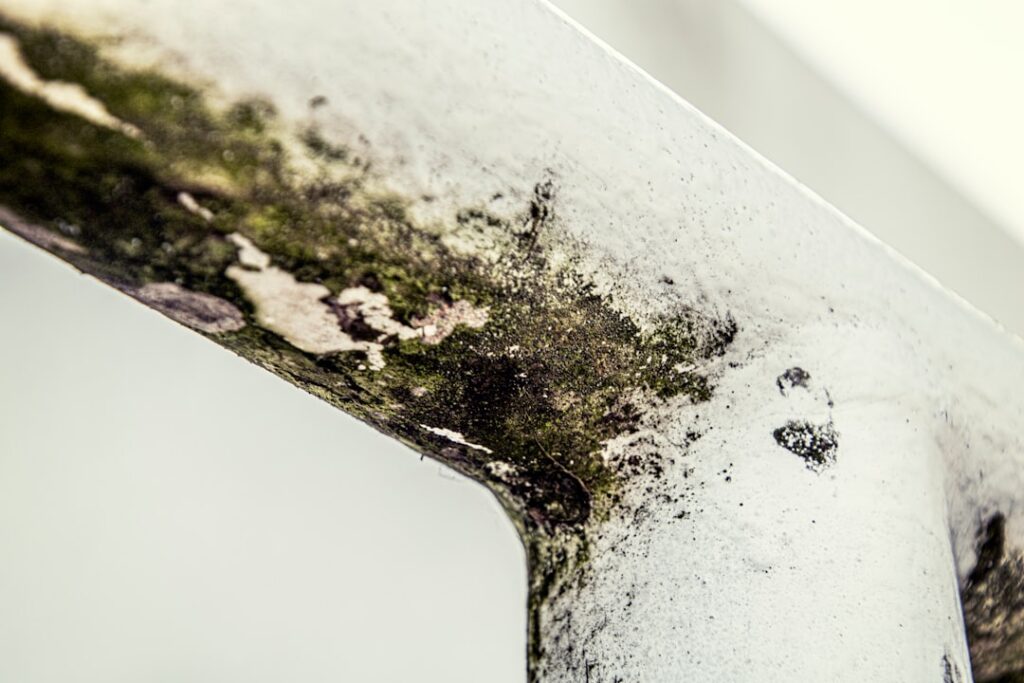
White mold removal trips up homeowners because two completely different things look the same to the eye. Real white mold — usually early-stage Aspergillus or Penicillium colonies before they develop their final color — is biological growth that requires remediation. Efflorescence — mineral salt deposits left behind when water evaporates through concrete or masonry — looks identical from across the room but is not mold at all and requires a completely different response. Distinguishing the two is the first move on any white-mold investigation, and there is a quick test that resolves it. This guide summarizes EPA and CDC guidance current as of 2026 — consult a certified mold inspector for testing decisions and your physician for symptom evaluation.
Part of our Mold Removal & Remediation guide — start there for the full picture →
Is this mold, asbestos, or water damage? Get a free instant screen
Upload a clear photo of the suspect area. You'll get an instant AI screening opinion and what to do next. This is screening guidance, not a professional determination.
Screening guidance only. AI can be wrong. Confirm asbestos, mold type, or lead with lab testing or a licensed professional before acting.
White Mold vs. Efflorescence: The Quick Test
Spray water directly on the suspect deposit. Efflorescence is water-soluble; it dissolves and disappears within seconds. White mold does not dissolve; the water beads on the colony surface or is absorbed into the underlying substrate without the deposit going away. This single test resolves the identification question in under a minute.
There are secondary differences worth knowing too. Efflorescence is crystalline and slightly sparkly under direct light, often appearing on concrete walls, brick mortar joints, and basement floors. White mold is fuzzy, sometimes cottony, and grows on porous materials like wood, drywall paper, and stored cardboard boxes. Efflorescence does not have an odor; active white mold often has a faint musty smell up close. Efflorescence appears in patterns that follow moisture migration through masonry (streaks down a foundation wall, rings on a basement floor); white mold appears in patterns that follow substrate (a square on a drywall corner, a fuzzy patch on a wooden joist).
White Mold Is Real and Does Require Remediation
Once the water test confirms biological growth, white mold falls under the standard EPA mold remediation framework. The species most commonly responsible for white-appearing colonies in residential settings include early-stage Aspergillus species (which often start white and darken to green, brown, or black as they mature), early-stage Penicillium (which usually turns blue-green but can appear white in initial growth), and a handful of less common species including some Cladosporium variants.
White mold is allergenic and can produce mycotoxins under certain conditions, depending on the species. The growth response criteria are the same as for any other mold: size, substrate, moisture source, and occupant sensitivity. Under 10 square feet on non-porous surfaces with a clear moisture source is generally DIY scope; larger areas or vulnerable occupants warrant professional remediation. The CDC’s broader mold guidance applies — remove the growth, fix the moisture, verify with re-observation over the following weeks.
Where White Mold Typically Appears
White mold has a few characteristic locations that homeowners encounter regularly. Basement wood framing is the most common — the back side of stud cavities, the underside of subfloor, joist faces in unfinished basements. The conditions in many basements (cool surfaces, elevated humidity, abundant cellulose substrate) favor white-stage Aspergillus growth before colonies mature to darker colors. Stored cardboard boxes in damp storage areas often develop white surface growth before the homeowner notices. Books and paper goods in humid spaces grow surface white mold within months of being stored. Crawlspace wooden surfaces — joists, beams, plywood subfloor — frequently host white mold when humidity sits above 60%.
The pattern is consistent: porous surfaces in cool, humid spaces, often unseen until the homeowner enters the area for an unrelated reason. The mold inspection hub covers how inspectors evaluate crawlspaces and basements for these issues, including the moisture meter readings and visual cues they use.
The Removal Process for White Mold
For confirmed white mold under 10 square feet on accessible surfaces with no vulnerable occupants present, DIY removal follows a standard sequence. PPE first: N95 respirator, nitrile gloves, sealed goggles, disposable Tyvek coveralls if the area is large. Containment if the affected area is over a few square feet — plastic sheeting at the room entrance and a fan venting outward to prevent spore spread.
HEPA vacuum the surface first to remove loose spores before introducing moisture. Standard shop vacuums without HEPA filtration broadcast spores back into the room and should not be used. After HEPA vacuuming, apply hydrogen peroxide 3% or an EPA-registered antimicrobial generously to the surface. Allow ten minutes of dwell time. Scrub gently with a soft brush to disrupt the colony without damaging the substrate. Wipe with disposable cloths and bag immediately. Apply antimicrobial a second time, allow drying.
For porous materials more than two square feet affected by white mold — cardboard boxes, books, particleboard furniture, paper-faced insulation — the EPA recommends discarding rather than attempting cleanup. The colony has typically penetrated the material in ways surface treatment cannot reach.
White Mold on Wood Framing
White mold on wood framing is one of the most common scenarios homeowners encounter in unfinished basements and crawlspaces. The response depends on how deeply the colony has penetrated.
Surface white mold on intact wood — visible fuzzy patches with the wood structurally sound underneath — typically responds well to HEPA vacuuming, antimicrobial treatment, and light sanding to remove residual discoloration. The wood remains sound and serviceable after treatment.
White mold with associated wood discoloration that does not sand out, or with soft or punky areas, indicates that fungal decay has begun penetrating the wood structurally. This is no longer a mold cleanup issue alone — it is potentially a structural repair issue that warrants a contractor with framing experience. The decision criteria are usually how deep the discoloration goes and whether the wood loses material when probed with a sharp tool.
Verifying that drying targets are met before closing up any enclosed space is critical. Wood moisture content should read below 16% on a meter pressed firmly against the framing. Sealing up a crawlspace or finishing a basement wall while the framing is still wet is a guaranteed recipe for regrowth.
White Mold on Stored Materials
Cardboard boxes, books, paper records, and clothing stored in damp areas develop white mold on a predictable schedule when humidity stays above 60% for extended periods. The response depends on the value of the items.
Low-value items — old packaging, miscellaneous paper, cardboard boxes — should be discarded rather than cleaned. The labor cost and spore-release risk of attempting cleanup exceeds the replacement value, and the mold may have penetrated the porous material in ways surface cleaning cannot address.
Higher-value items — important documents, books, photographs — can sometimes be salvaged by specialty document restoration firms that use freeze-drying and controlled-environment recovery. Costs vary but typically run $50 to $200 per item for documents and several hundred to several thousand for collections.
Clothing affected by white mold can usually be salvaged by washing in hot water with detergent and one cup of borax or white vinegar. Air dry in sunlight if possible. Items that still smell musty after washing should be discarded.
Preventing White Mold Regrowth
White mold prevention centers on humidity control. The EPA’s recommended indoor humidity range is 30 to 50% relative humidity. In basements and crawlspaces, hitting that target may require a dedicated dehumidifier sized to the space — typically 50 to 70 pint capacity for an average basement, 30 to 50 pint for a finished room. Crawlspace encapsulation with vapor barrier and a dedicated dehumidifier has become a common Front Range upgrade for homes with chronic crawlspace moisture.
Beyond humidity, address discrete moisture sources: foundation drainage, gutter discharge, plumbing leaks, condensation on cold surfaces. Improving insulation on cold exterior walls reduces condensation. Improving ventilation in enclosed storage areas reduces humidity accumulation. Each intervention removes a precondition for regrowth.
The Crawlspace Special Case
Crawlspaces deserve their own discussion because they are responsible for a disproportionate share of white mold cases in Front Range homes. The combination of ground-source moisture, limited ventilation, abundant wood surfaces, and homeowner neglect (most people enter their crawlspace once a decade if that) creates ideal conditions for white-stage Aspergillus and Penicillium growth on joists, sheathing, and any stored materials.
The current best-practice approach for chronically moist crawlspaces is encapsulation rather than the older ventilation strategy. Encapsulation involves sealing the ground with a heavy-duty vapor barrier (typically 12 to 20 mil reinforced polyethylene), sealing wall vents, insulating the walls rather than the floor above, and conditioning the space with a dedicated dehumidifier or a small HVAC supply line. The result is a crawlspace that runs at the same humidity as the rest of the home and stops being a mold-friendly environment.
Costs for crawlspace encapsulation in the Front Range region in 2026 typically run $4,000 to $12,000 depending on square footage, accessibility, and the condition of existing framing. The expense is significant but often pays back through avoided remediation costs, improved energy performance (less moisture in the air means easier dehumidification in the conditioned space above), and improved indoor air quality. Existing white mold in a crawlspace should be remediated before encapsulation, not sealed over.
What a Professional White-Mold Inspection Includes
If white mold has been identified or suspected and the homeowner is considering professional help, a typical mold inspection visit includes a visual walk-through of affected and adjacent areas, moisture meter readings on suspect substrates, sometimes thermal imaging to find hidden moisture, an interview about the home’s water history and ventilation systems, and sometimes air or surface sampling depending on the scope. The deliverable is a written report identifying scope, recommended remediation approach, and any underlying moisture issues that need to be addressed first. Front Range pricing for a basic mold inspection with one air sample runs about $300 to $500 in 2026; multi-sample protocols with multiple rooms run $600 to $1,000.
When to Call a Professional
White mold scope that warrants professional remediation includes affected areas over 10 square feet, growth inside finished wall cavities, growth on HVAC components, growth across multiple connected spaces (basement plus crawlspace, multiple rooms), or growth in homes with vulnerable occupants. Front Range pricing in 2026 for basement or crawlspace white-mold remediation typically runs $2,000 to $8,000 depending on scope, including any required substrate replacement and post-remediation verification.
An inspector with a moisture meter, thermal camera, and borescope can also identify the underlying moisture source when it is not obvious from visual inspection alone. The hiring guide covers how to verify contractor credentials before signing a remediation contract.
References
- A Brief Guide to Mold, Moisture, and Your Home — U.S. Environmental Protection Agency
- Basic Facts About Mold and Dampness — Centers for Disease Control and Prevention
- Mold Remediation in Schools and Commercial Buildings — U.S. Environmental Protection Agency
- Mold Inspection Guidance — International Association of Certified Home Inspectors
Frequently asked questions
Is white mold dangerous?
White mold is biologically active and can trigger allergic and irritant respiratory responses in sensitized individuals. Some species (early-stage Aspergillus) can produce mycotoxins under specific conditions. It should be treated under the same remediation framework as any other mold growth, with severity scaled to size and occupant sensitivity.
How do I know if it is mold or efflorescence?
Spray water on the deposit. Efflorescence dissolves within seconds because it is water-soluble mineral salt. White mold does not dissolve and may have a fuzzy texture, faint musty smell, and appearance on porous materials rather than masonry.
What kills white mold?
Hydrogen peroxide 3% or EPA-registered antimicrobials work well on non-porous surfaces and lightly affected wood. Porous materials with white mold penetration (cardboard, paper, particleboard) usually need to be discarded rather than cleaned. Address the moisture source or the colony returns.
Can I clean white mold on basement wood myself?
For affected areas under 10 square feet on intact wood with proper PPE, yes. HEPA vacuum first, apply antimicrobial, scrub gently, dry the area, and confirm wood moisture content stays below 16%. Larger areas or compromised wood warrant professional handling.
How long does it take for white mold to come back?
If the moisture source is not corrected, white mold typically returns within weeks to a few months in the same location. Permanent prevention requires humidity control to 30-50%, source-moisture correction, and sometimes encapsulation of crawlspaces or improvements to basement drainage.
Front Range homeowners finding white growth in basements or crawlspaces can get in touch here to be connected with a qualified local inspector who can confirm whether it is mold or efflorescence and outline next steps.
Mold removal & cleanup picks
For a small, contained patch (under ~10 sq ft) these EPA-friendly removers handle surface mold. Larger or recurring growth warrants a professional assessment first.
| Product | Why | Buy |
|---|---|---|
 RMR-86 Instant Mold Stain Remover RMR-86 Instant Mold Stain Remover | Fast-acting on stains; ventilate and wear PPE. | Amazon — $29.99 |
 Concrobium Mold Control Concrobium Mold Control | No-bleach formula that also helps prevent regrowth. | Amazon — $11.26 |
 Mold Armor Mold & Mildew Remover Mold Armor Mold & Mildew Remover | Widely stocked bathroom/surface remover. | Amazon — $22.98 |