What Does Radon Do to Your Body: A Plain-Language Guide
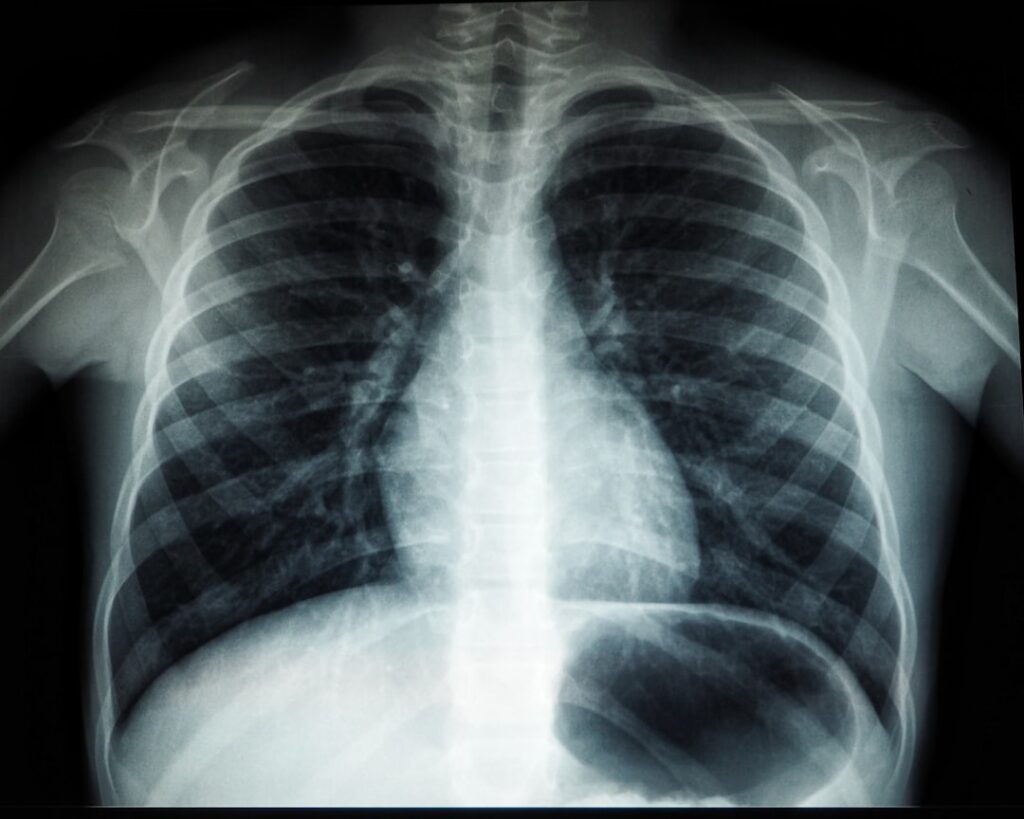
Radon does not produce immediate symptoms in most people. Persistent cough, shortness of breath, chest pain, or unexplained weight loss can be late-stage indicators of radon-caused lung cancer — but these appear only after years of exposure, not as a warning sign. The question “what does radon do to your body” therefore has two layers: a personal-risk-assessment layer that depends on your specific exposure profile, and a population-level cellular-biology layer that determines the long-term cancer risk for everyone exposed. This guide focuses on the personal layer — how your age, smoking status, home occupancy patterns, and your home’s tested levels combine to determine the actual risk radon poses to you. This guide summarizes EPA and CDC guidance current as of 2026 — consult a certified radon professional for testing and your physician for symptom evaluation.
Part of our Radon Levels guide — start there for the full picture →
What does radon do to your body in personal terms
Radon enters your body through inhalation. Once inside your lungs, radon and its short-lived radioactive decay products — polonium-218 and polonium-214 — emit alpha radiation as they decay. Alpha particles cannot penetrate skin, but inside the lung they directly damage the DNA of bronchial epithelial cells. Over years of repeated daily exposure, accumulated DNA damage can drive the cellular mutations that initiate lung cancer.
The risk this poses to you specifically depends on four personal factors: your age (younger exposure provides more years for cancer development), your smoking status (smoking multiplies radon risk dramatically), the amount of time you spend in your home (basement-dwellers and homebound individuals face higher cumulative dose), and the radon concentration in your home (which only testing can determine). EPA’s lifetime lung cancer risk estimates assume 70 years of exposure at a given concentration — your actual risk depends on how closely your situation matches that assumption. The broader radon testing in Colorado pillar resource covers the testing process.
Personal risk factor one: your age at exposure
Lung cancer from radon exposure typically develops 10 to 30 years after the cumulative dose threshold is reached. A 35-year-old exposed to elevated indoor radon for 20 years has 50 to 70 years of remaining life expectancy during which a cancer initiated by that exposure could develop and progress to clinical detection. A 70-year-old exposed to the same elevated levels for the same 20 years has dramatically less remaining life expectancy — the math of cancer latency means the older exposed individual may not live long enough for the cancer to manifest.
This does not mean radon exposure is unimportant for older adults — it absolutely is. It means that exposure during early adulthood and middle age carries the greatest risk amplification, because the latency window has the most years to play out. Children exposed in long-term residential settings face risk that compounds over an entire lifetime ahead of them. For homeowners with young children, the urgency of testing and remediation is correspondingly higher.
Personal risk factor two: your smoking status
Smoking and radon interact multiplicatively rather than additively. The combined risk of radon and tobacco smoke is greater than the sum of the individual risks. EPA estimates that for a smoker, every additional picocurie per liter of long-term home radon exposure adds roughly the same lung-cancer risk as smoking several additional cigarettes per day on average — though the precise quantification depends on the exposure-response model used.
The practical implication: a current smoker living in a home with 8 pCi/L indoor radon faces dramatically higher absolute lung cancer risk than either a non-smoker in the same home or a smoker in a low-radon home. CDC and EPA recommendations consistently emphasize that smokers should treat radon mitigation with particular urgency given the synergistic risk amplification. Former smokers — those who have quit but who accumulated significant cigarette exposure — also face elevated radon-related risk, though the risk gradient declines with years since cessation.
The non-smoker radon-cancer reality
Non-smokers are not immune. EPA attributes approximately 21,000 U.S. lung cancer deaths annually to radon exposure, of which roughly 2,900 occur in people who have never smoked. Radon is the leading cause of lung cancer in lifetime non-smokers. The risk gradient is lower than for smokers but real. A non-smoker in a home with persistently elevated radon over decades carries a measurable lifetime lung cancer risk that mitigation can dramatically reduce. The general body-effects guide covers the cellular mechanism in more detail.
Personal risk factor three: your home occupancy time
EPA’s lifetime lung cancer risk estimates assume the exposed individual spends approximately 70 percent of their time at home — a population-average occupancy pattern. Individuals whose actual home time differs significantly from that assumption face correspondingly different risk.
Adults working away from home 50 hours per week have lower home time than the population average. Adults working remotely or running businesses from home have higher home time. Retirees, homebound individuals, and stay-at-home parents have substantially higher home time. Children under school age have very high home time. Each of these patterns shifts the effective radon dose accordingly. A retiree spending 90 percent of waking hours at home in a 6 pCi/L environment faces meaningfully higher cumulative exposure than a working professional spending 50 percent of waking hours at home in the same environment.
Basement occupancy is the other major occupancy variable. Indoor radon concentrations are typically highest in the basement and decrease as you move up through the building. Individuals who sleep in basement bedrooms, work from basement offices, or spend recreational hours in basement living spaces face higher exposure than those whose time is concentrated on upper floors. Multi-level testing — measuring radon on every floor of a home — provides better resolution on actual exposure than a single ground-floor or basement reading.
Personal risk factor four: your home’s tested radon level
The fourth and most controllable factor is your specific home’s measured indoor radon concentration. EPA’s action level of 4 pCi/L is the threshold at which mitigation is unambiguously recommended. EPA additionally recommends consideration of mitigation for indoor levels between 2 and 4 pCi/L given the documented health-risk gradient that continues below the action level. Levels above 10 pCi/L warrant urgent attention.
Most of the Colorado Front Range sits in EPA Radon Zone 1 — the highest-risk geographic zone for indoor radon. CDPHE radon program data indicates that roughly 50 percent of Front Range homes tested show indoor radon levels at or above the EPA action level. Geographic location alone is therefore not a useful predictor for an individual home — every Front Range home should be tested regardless of neighborhood, age, or foundation type. Two adjacent houses can have dramatically different radon levels based on local soil geology and the specific foundation pathways for soil-gas entry.
How the four factors combine into your personal risk
Personal radon risk is the product of these four factors, not any single one. A 25-year-old non-smoker working away from home in a 3 pCi/L environment faces lower lifetime risk than a 55-year-old smoker working from home in a 6 pCi/L environment, even though the elevated-radon individual is older. The point is not to memorize a specific risk number — it is to understand which factors amplify or dampen risk so that mitigation decisions can be made appropriately.
For most Front Range households, testing is the necessary first step. A radon test costs $15 to $50 for a do-it-yourself short-term kit or $150 to $300 for a professional test conducted as part of real-estate due diligence. The test result determines whether mitigation is needed, and the mitigation cost — typically $1,000 to $2,500 for standard sub-slab depressurization on the Front Range — is small relative to the cumulative health risk over decades of unmitigated exposure. The radon poisoning explainer covers the broader terminology debate.
What radon does not do to your body
Radon does not cause headaches, nausea, dizziness, fatigue, joint pain, skin reactions, or any other acute symptom in the concentrations typically found in residential settings. Many homeowners encounter web content claiming these symptoms — that content typically conflates radon with carbon monoxide or with general indoor air-quality issues. Acute symptoms from low-level indoor radon do not occur because the radiation dose from typical home concentrations, while sufficient to drive long-term cancer risk, is far below the dose that would cause acute tissue damage.
If you experience persistent respiratory symptoms — chronic cough, shortness of breath, chest pain, unexplained weight loss — those symptoms warrant evaluation by your physician for the wide range of possible causes (which can include lung cancer at later stages, but also asthma, COPD, infection, allergies, and many other conditions). They are not a radon early-warning system. The diagnostic pathway for symptoms is medical evaluation; the diagnostic pathway for radon is air testing.
What to do based on your personal risk profile
The universal first step is testing. For Colorado Front Range homeowners, testing should be considered standard residential maintenance — not an optional add-on. If testing reveals levels at or above 4 pCi/L, mitigation is unambiguously indicated. Levels between 2 and 4 pCi/L warrant case-by-case decision based on personal risk factors — a non-smoking adult might choose to retest annually rather than mitigate, while a household with young children or a current smoker should consider mitigation at the lower threshold.
Post-mitigation, conduct follow-up testing every two years to confirm continued system performance. Any major renovation that disturbs foundation seals or modifies the building envelope should trigger re-testing. New homeowners should test within the first year of occupancy regardless of prior owner test results, because seasonal patterns and changes in HVAC operation can shift indoor radon concentrations measurably.
The cellular mechanism: what alpha radiation does to lung tissue
When inhaled radon decays in the lung, it produces alpha particles — heavy charged particles consisting of two protons and two neutrons. Alpha particles have very short range (a few centimeters in air, less than the thickness of a sheet of paper in tissue), but their energy density along that short path is high. An alpha particle traversing a few cells delivers far more ionizing energy per cell than the same energy delivered by gamma rays or beta particles, which spread their energy over longer paths.
The high energy density per cell makes alpha radiation particularly effective at producing DNA double-strand breaks — the type of damage most likely to drive carcinogenic mutations if the cell’s repair machinery fails to fix it correctly. Bronchial epithelial cells lining the airways receive most of the alpha dose from inhaled radon decay products. Over years of cumulative dose, accumulated unrepaired or misrepaired DNA damage in these cells can drive the multi-step mutational sequence that ultimately produces lung cancer.
How radon-induced cancers differ from tobacco-induced cancers
Lung cancers attributable to radon and lung cancers attributable to tobacco smoke share many clinical features and are not easily distinguishable in an individual case. Both produce similar histological cancer types (squamous cell, adenocarcinoma, small cell), and both develop in similar locations in the airways. The dose-response model used by EPA to estimate radon-attributable cancers therefore relies on population-level epidemiology rather than case-by-case attribution.
What does distinguish radon-attributable cancer is its prominence in never-smokers. EPA attributes approximately 2,900 of the 21,000 annual U.S. radon-related lung-cancer deaths to never-smokers. In never-smokers, radon is the leading known cause of lung cancer. The numbers underscore why testing matters across smoking status — a never-smoker in a high-radon home faces meaningful absolute risk that mitigation can directly reduce.
Symptoms that warrant medical evaluation versus radon testing
Two separate diagnostic pathways apply to two separate questions. Persistent respiratory symptoms — chronic cough lasting more than three weeks, shortness of breath disproportionate to exertion, chest pain, unexplained weight loss, persistent fatigue — warrant medical evaluation by your physician. These symptoms can have many causes (asthma, COPD, infection, allergies, lung cancer at advanced stages) and require clinical workup including imaging and possibly biopsy for accurate diagnosis.
Concern about radon exposure — based on home location, foundation type, or knowledge of pre-existing test results — warrants air testing rather than medical evaluation. A radon test costs $15 to $50 for a do-it-yourself kit or $150 to $300 for professional testing. The air test answers the radon question directly, and any indicated mitigation can proceed independently of any clinical evaluation. Symptoms and exposure are independent diagnostic tracks; do not assume that the absence of symptoms means low exposure, and do not assume that mild symptoms mean radon exposure is the cause. The radon poisoning explainer covers the misleading terminology issue in more detail.
References
- EPA radon health risk and mitigation guidance — U.S. Environmental Protection Agency
- CDC radon exposure prevention resources — Centers for Disease Control and Prevention
- CDPHE Colorado radon program guidance — Colorado Department of Public Health and Environment
Frequently asked questions
What does radon do to your body in the short term?
Nothing detectable in most cases. Radon does not produce acute symptoms at the concentrations typically found in homes. The health risk is long-term lung cancer development over years to decades of exposure, not immediate illness.
How does smoking interact with radon risk?
Smoking and radon interact multiplicatively. Smokers face dramatically higher absolute lung cancer risk from radon exposure than non-smokers in the same home. EPA and CDC recommend that smokers treat radon mitigation with particular urgency.
Does your age at exposure matter?
Yes. Lung cancer from radon typically develops 10 to 30 years after the cumulative dose threshold is reached. Exposure during early adulthood and middle age has the most years for cancer to develop, making mitigation more urgent for younger occupants and households with children.
What is the radon action level?
EPA's action level is 4 picocuries per liter (pCi/L). Mitigation is unambiguously recommended at or above 4 pCi/L. EPA also recommends consideration of mitigation between 2 and 4 pCi/L given the continued health-risk gradient below the action level.
Front Range homeowners concerned about indoor radon can reach out through our contact page for a referral to a certified radon professional for testing and mitigation guidance.
Test your home for radon
Radon is invisible and odorless, so a test is the only way to know your level. A short-term kit gives a first reading in days; a digital monitor tracks it over time.
| Product | Why | Buy |
|---|---|---|
 AirChek Charcoal Radon Test Kit AirChek Charcoal Radon Test Kit | Lab fee usually included; EPA short-term protocol. | Amazon — $21.95 |
 First Alert RD1 Radon Test Kit First Alert RD1 Radon Test Kit | Widely stocked; 48-hour charcoal test. | Amazon — $16.98 |
 Airthings Corentium Home Airthings Corentium Home | Digital monitor with a long-term average. | Amazon — $142.99 |