Thermal Imager Fluke: Product Class Overview for Buyers
When a buyer types “thermal imager Fluke” into a search engine, they are usually trying to match a specific model number to a specific job — an electrician troubleshooting a panel, a maintenance lead spec’ing equipment for a refinery survey, an inspector evaluating whether the brand’s pocket unit fits a residential workflow. Fluke is widely recognized as a category leader in industrial and electrical thermal imaging, with a product line that spans from pocket-sized models to high-resolution professional handhelds. This guide walks through the brand’s product class at a category level, covering what each tier targets, what resolution and sensitivity look like across the line, and how the brand fits into the broader thermal imaging market.
Part of our Thermal Imaging for Homes guide — start there for the full picture →
What thermal imager product classes does Fluke sell?
The brand’s lineup has historically been organized into a few clear families. The PTi-series sits at the pocket-sized entry point, designed for electricians and field technicians who want a thermal tool that fits in a tool belt pouch. The Ti-series occupies the working professional middle, with models that have served as the industry’s default electrical-troubleshooting handheld for years. The TiX and Ti500 families address the higher-resolution end, intended for predictive maintenance teams, building diagnostic professionals, and industrial reliability engineers. Each tier corresponds to a different price band, resolution class, and feature set, and buyers should match the tier to the deliverable rather than buying up or down the line by default.
Pocket-class: the PTi120 family
The pocket tier in the brand’s lineup is anchored by the PTi120. It is a credit-card-thick body with a small color display, intended to live in an electrician’s belt pouch and come out quickly when a thermal check makes sense. Sensor resolution sits at 120 by 90 native pixels, with manufacturer image enhancement options to render the display larger. Thermal sensitivity (NETD) is rated around 60 mK or better — enough to spot a warm breaker, an overheating contactor, or a starter motor that has just started to fail.
The use case is field troubleshooting, not formal inspection. An electrician on a service call can pull the unit out, scan a panel, identify the suspect breaker, and move on. The output is not a court-defensible thermography report; it is a working diagnostic. ASHI training materials position pocket-class thermal as a “find the problem fast” tool that gets paired with a higher-resolution camera if formal documentation is required.
Working-professional class: the Ti-series
The Ti-series is the brand’s bread-and-butter line. Models like the Ti300 and Ti400 have been carried by electricians, HVAC technicians, and industrial maintenance staff for years. Resolution in this class sits at 320 by 240 native pixels with image-fusion features that overlay thermal data on a visible-light image, making it easier for the user to identify which physical object is producing the heat signature. NETD is typically rated at 50 mK or better.
Radiometric capture is standard at this tier, meaning every pixel of the saved file carries a temperature value that can be re-measured later. Report software for structured PDF output is part of the package. NFPA-referenced electrical maintenance standards on infrared surveys assume a camera class roughly equivalent to this tier when used in a formal preventive-maintenance program, and ASHRAE building-diagnostic protocols use the same baseline for envelope work on commercial structures.
High-resolution class: the Ti500, TiX, and Ti500-PRO families
The top of the brand’s commercial line uses 640 by 480 native sensors, with NETD ratings below 50 mK and laser-distance integration for accurate spot-size measurement. The Ti500, TiX580, and similar models are the tools that industrial reliability teams reach for when documenting a substation survey, a steam-trap audit, or a process-equipment thermography report under load. Interchangeable lenses — wide-angle for envelope work, telephoto for distance shots — are commonly part of the kit.
Predictive maintenance programs at industrial facilities frequently standardize on this resolution class because the imagery survives both internal review and outside-auditor scrutiny. NFPA 70B’s recommended practice for electrical equipment maintenance treats infrared thermography of this class as a recognized diagnostic technique, and ASHRAE’s commissioning and building-diagnostic procedures use cameras at this resolution for envelope verification on larger structures.
How resolution drives the tier choice
Across every brand in the thermal market, sensor resolution sets the price floor. Within the Fluke product class specifically, the climb from 120 by 90 to 320 by 240 to 640 by 480 corresponds to roughly an order-of-magnitude price increase at each step. Buyers picking between tiers should anchor on the deliverable. A field electrician documenting nothing formal stays in the pocket class. A maintenance technician producing reports for an internal preventive-maintenance program lives in the Ti-series middle. A reliability engineer producing audit-ready reports needs the high-resolution class.
The mechanics of how the underlying sensor resolves temperature are the same across the line — long-wave infrared striking a microbolometer array, converted into a digital signal, mapped to a false-color palette. Our plain-language thermal imaging physics walkthrough covers the physics in detail, and the brand’s spec sheets at each tier are best read against that baseline.
Where the brand fits in the broader market
The brand has earned its reputation in industrial and electrical thermography, where its strengths are durability, calibration consistency, and integration with the rest of its multimeter and electrical-test product ecosystem. For purely residential building diagnostics, several other brands compete strongly in the same tiers — buyers should not assume the brand is the only credible option for an envelope scan or moisture mapping. For electrical troubleshooting on commercial gear, the brand’s name recognition and accessory ecosystem give it a working advantage that buyers in those fields cite often.
The broader home inspection tools landscape includes thermal imagers as one sensor in a kit alongside moisture meters, anemometers, and combustion analyzers. Thermal alone does not diagnose; it points to anomalies that the inspector confirms with a second tool.
What to ask before buying any tier
The buying conversation starts with resolution but does not end there. Buyers should ask whether the model captures full radiometric data per pixel (Tier 2 and above), whether report-export software is included or subscription-based, whether the lens is fixed or interchangeable, what the NETD rating is at the standard 30-degree-Celsius reference, what the calibration interval is, and whether the unit is rated for the environmental conditions the buyer will work in (dust ingress, temperature range, drop rating).
Lens choice matters more than buyers expect at the high-resolution tier. A telephoto attachment is essential for substation work where the photographer cannot approach energized gear. A wide-angle is useful in tight residential interiors. A macro is helpful in electronics inspection. Each lens adds significant cost.
How the brand compares for the Fluke buyer specifically
Buyers searching by the brand name are usually committed to it for a reason — existing tool-belt brand standardization, an employer’s tool-buying policy, or a workflow that already pulls data into the brand’s analysis software. For those buyers, the practical question is which model in the lineup matches the work. Field electricians end up at the PTi120 most often. Building-envelope inspectors and HVAC techs typically choose a Ti-series model. Industrial reliability teams go straight to the Ti500 class or above.
For buyers who are open to comparison shopping, the practical move is to compare the brand’s tier against the equivalent tier from competing manufacturers — same native resolution, same NETD rating, same lens options — and weigh price, availability of factory recalibration in the buyer’s region, and ecosystem fit with existing tools.
Renting versus buying across the lineup
For homeowners and inspectors who only occasionally need a Ti-series or Ti500-class camera, renting beats buying. National rental shops carry the working-professional tier at roughly $80 to $150 per day. Below about 15 use-days per year, renting wins on total cost. The trade-off is that the rental unit may not be the specific model the user trained on, and rental cameras sometimes ship without the buyer’s preferred lens. Above 15 days a year of active use, ownership starts to make sense, and the calibration discipline of an owned unit usually produces more consistent data than a rotating rental fleet.
Field workflow patterns for each tier
Pocket-class units in the field belong to electricians and service technicians who pull them out reactively — a customer reports an issue, the tech investigates, the pocket camera helps localize. The workflow is fast and qualitative. There is no formal capture-and-document pipeline. Mid-tier working professional handhelds operate in a different workflow: scheduled scans, structured capture, radiometric files annotated in software, structured PDF reports delivered to clients. High-resolution cameras operate in still a different workflow: longitudinal databases by equipment tag, multi-image stitching across large scenes, integration with asset-management platforms, and traceable calibration documentation in every report.
For buyers choosing a tier, the workflow question matters as much as the specs. A reactive troubleshooter who buys a high-resolution unit because the spec sheet looked impressive will rarely use the advanced features and will end up paying for capability they do not employ. A predictive-maintenance program lead who tries to save money with a working-professional handheld and then cannot integrate the files into the asset-management system will end up replacing the unit within a year. The deeper context on how the brand’s tier fits in the broader thermal market is in our companion Fluke infrared camera overview.
Lens and accessory considerations by tier
Pocket-class units have a single fixed lens by design — there is no lens ecosystem. Mid-tier working professional models also typically ship with a fixed lens; the buyer evaluates whether the standard field of view fits the typical work distance. High-resolution Tier 3 cameras open up the interchangeable-lens ecosystem, where the choice of telephoto, wide-angle, or macro lens shapes what the camera can effectively measure at different working distances.
Common practical lens choices: a telephoto attachment for substation surveys where the operator cannot approach energized switchgear; a wide-angle attachment for envelope work in tight residential interiors; a macro attachment for printed-circuit-board inspection in electronics maintenance contexts. Each lens typically adds $1,000 to $3,000 to the kit. Buyers operating across diverse work environments should plan the lens budget alongside the camera body purchase.
Calibration cadence and recurring cost
All tiers of the brand’s cameras require periodic recalibration to maintain rated accuracy claims. Cal intervals run 12 to 24 months depending on model and use environment, with cal cost in the $200 to $500 range per service. The unit is typically out of service for several weeks during cal. Owners operating formal predictive-maintenance programs frequently keep a backup unit or arrange cal scheduling around audit cycles.
When a professional thermographer is the better answer
For one-time scans — a single suspected hidden roof leak, a one-off electrical hotspot investigation, an envelope audit before a renovation — paying a certified thermographer for a focused visit usually beats buying any tier. Front Range thermographers typically charge $150 to $400 for residential work and more for commercial. The certified professional brings interpretation along with the hardware, and interpretation is where thermal imaging actually pays off.
More Questions About Fluke Thermal Imagers
Are Fluke thermal imagers good for HVAC work?
Yes, Fluke thermal imagers are widely used in HVAC work to check duct leaks, register airflow, refrigerant line temperatures, coil performance, and motor or bearing heat. Rugged bodies and long battery life suit daily service calls.
Entry and mid-range models usually cover residential HVAC needs, while higher-resolution models help on large commercial systems and rooftop units. Pairing the imager with temperature clamps and pressure gauges gives a fuller picture than thermal images alone.
Do Fluke thermal imagers work with Fluke Connect?
Many Fluke thermal imagers work with the Fluke Connect system, which links compatible meters and cameras through a mobile app for sharing readings and images. This lets a technician combine thermal images with electrical or temperature measurements in one record.
Compatibility depends on the model and its wireless features, so check the specific imager. Some features may require an account or subscription, and older models may have limited support as the platform updates.
How durable are Fluke thermal imagers on job sites?
Fluke thermal imagers are known for durability on job sites, with many models drop-tested to around 2 meters and rated for dust and water resistance. Rubberized housings and sturdy lens covers suit construction and industrial work.
Durability still has limits. Lens scratches, cracked screens, and impact damage happen with heavy use. Using a holster, lanyard, and lens cap, and storing the imager in its case between jobs, keeps it working longer.
Can a Fluke thermal imager be used for home energy audits?
Yes, a Fluke thermal imager can be used for home energy audits, especially models with good thermal sensitivity that reveal small temperature differences across walls and ceilings. Auditors often pair the imager with a blower door to exaggerate air leaks.
For energy work, sensitivity and a manual span setting matter more than very high temperature ranges. Resolution of at least about 160 by 120 helps, and more resolution makes whole-room images clearer.
References
- ENERGY STAR: Seal and Insulate — U.S. Environmental Protection Agency (ENERGY STAR)
- InterNACHI infrared certification — InterNACHI
- NFPA 70B recommended practice for electrical maintenance — National Fire Protection Association
- ASHRAE building diagnostic technical resources — ASHRAE
- ASHI inspector resources — American Society of Home Inspectors
Frequently asked questions
Which Fluke model is best for a working home inspector?
Ti-series models in the 320 by 240 resolution class are the typical fit for residential inspection. They produce radiometric files that survive defect-disclosure conversations and include report software.
Is the PTi120 enough for electrical troubleshooting?
For field-troubleshooting electricians who just need to find the hot breaker quickly, yes. For documenting a formal infrared survey on industrial gear, it is not enough.
What is NETD and why does it matter on a Fluke spec sheet?
NETD is noise-equivalent temperature difference — the smallest temperature change the sensor can distinguish. Lower is better. Working-professional models target 50 mK or below.
Should I rent or buy a Fluke thermal imager?
If you use thermal less than about 15 days per year, renting wins on total cost. Above that, owning starts to make sense because of calibration consistency and immediate availability.
Do Fluke thermal imagers have interchangeable lenses?
Some higher-end Fluke thermal imagers support interchangeable lenses, such as wide-angle and telephoto options. Entry and pocket models usually have fixed lenses. Interchangeable lenses add cost but help for large spaces or distant electrical equipment.
Can Fluke thermal imagers be calibrated by third parties?
Fluke thermal imagers can be calibrated by Fluke service centers and some accredited third-party labs. Using an accredited lab keeps calibration records valid for quality systems. Check that the lab has the right equipment for thermal imagers before sending one.
Is a Fluke thermal imager worth it for a homeowner?
A Fluke thermal imager is usually more than most homeowners need. The brand's strengths are durability and professional features for daily use. Occasional home checks can be done with a lower-cost camera or rental, saving money for the actual repairs.
Thermal imaging cameras
Infrared cameras reveal hidden moisture, missing insulation, and air leaks. Phone-attachment models are the budget entry point; standalone units have higher resolution.
| Product | Why | Buy |
|---|---|---|
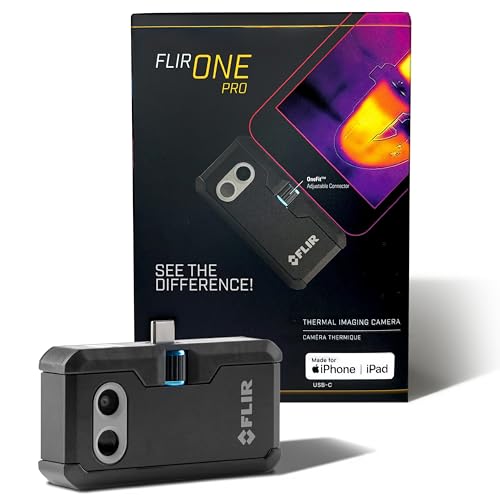 FLIR ONE Pro (phone) | Plugs into iPhone/Android; inspector favorite. | Amazon — $296.65 |
 Topdon TC001 | High-res phone module at a low price. | Amazon — $249.00 |
 FLIR C5 Compact | Standalone pocket camera with Wi-Fi. | Amazon — $593.99 |