Teslong Borescope: What Homeowners Need to Know
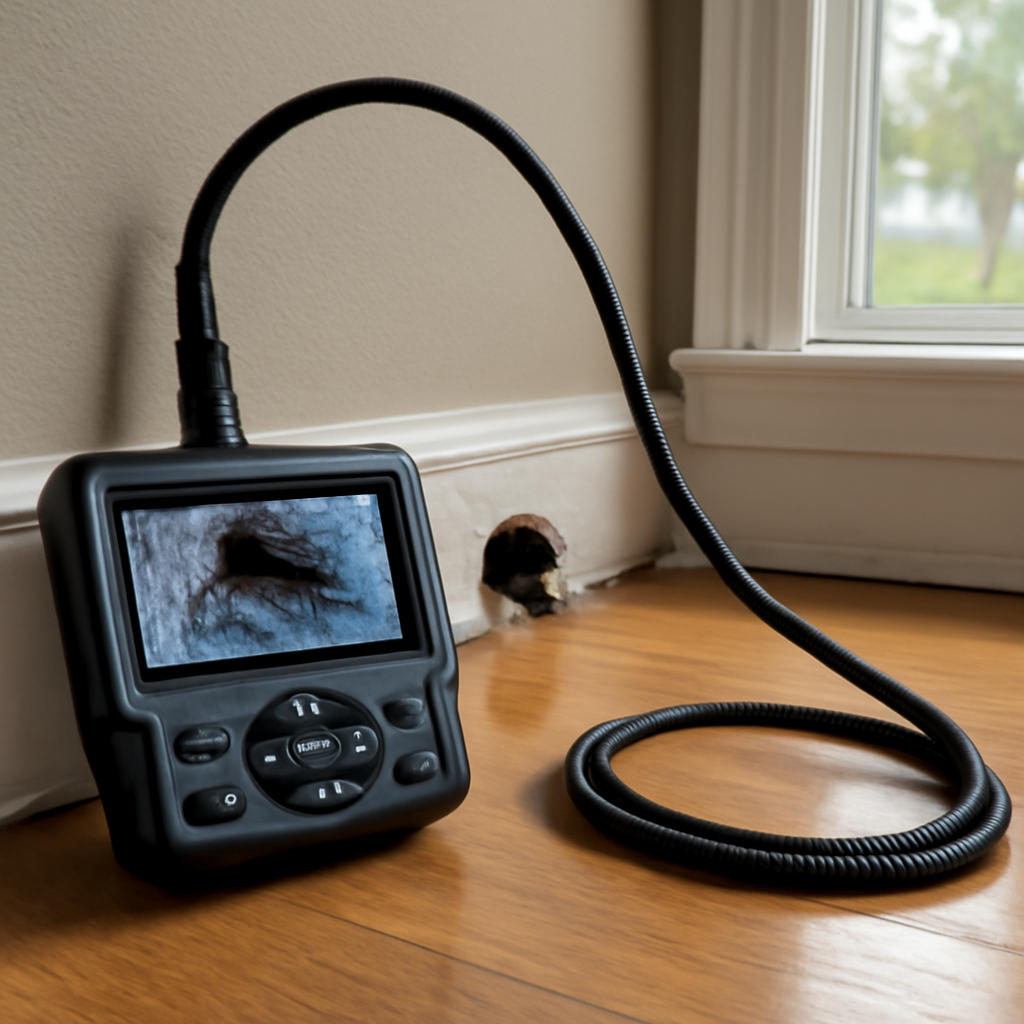
Teslong is one of the most-recognized consumer borescope brands in the U.S. market, with a product line spanning USB endoscopes for basic visual inspection through articulating dual-lens cameras for more demanding diagnostic work. The brand sits in a different market position than professional sewer-scope and industrial-borescope manufacturers like Milwaukee and Ridgid — Teslong products are designed for DIY homeowners, hobbyist mechanics, and entry-level professional use rather than the daily-use commercial market. This guide walks through the Teslong lineup, appropriate use cases, the limitations that homeowners should understand before relying on Teslong for serious diagnostic work, and how the consumer-tier borescope category relates to professional sewer-camera and industrial-borescope work.
The Teslong Product Lineup
The Teslong NTS500 is the brand’s flagship articulating borescope — a handheld dual-lens borescope with 4.5-inch screen, articulating camera head that bends in two directions, dual front and side cameras, and 1080p video recording. Pricing typically runs $200-300. The NTS500 is positioned as the premium consumer Teslong product for users who want articulation capability and integrated screen viewing.
The Teslong MS450 is a competing dual-lens model with simpler controls and a slightly lower price point ($150-250). The MS450 lacks articulation but includes the dual front/side camera arrangement that lets users inspect down a pipe and to the side simultaneously.
The Teslong USB endoscope line (various model numbers) targets the entry-level consumer market with USB cameras that plug into a smartphone or laptop for image display. These run $30-80 and provide basic inspection capability without integrated screens. For the broader walkthrough on borescope and adjacent diagnostic tools in home inspection, the home inspection tools hub covers buyer decisions across borescopes, thermal cameras, and moisture meters.
Articulation Capability and Why It Matters
Articulation — the ability to steer the camera head through a pipe or cavity — is the single most important capability differentiator in the borescope category. Non-articulating borescopes go where they’re pushed; the user can’t redirect the camera once it’s inside a pipe. Articulating borescopes can be steered around bends, oriented toward specific surfaces, and held in position for detailed inspection.
For straight-pipe inspections (looking down a drain to identify a clog at a specific depth), non-articulating borescopes work fine. For complex inspections (navigating sewer-line bends, exploring engine cylinders, threading through wall cavities with obstacles), articulating borescopes are dramatically more capable. The Teslong NTS500’s articulation puts it in a different use-case category than the MS450 or USB endoscope models despite the apparently similar form factor.
Common Homeowner Use Cases
Teslong borescopes serve several useful homeowner diagnostic scenarios. Drain and pipe inspection — looking down a clogged kitchen drain or shower drain to identify hair clogs, mineral buildup, or foreign objects before deciding whether DIY drain-cleaning or a plumber call makes sense. In-wall electrical and plumbing inspection through small drilled holes — checking what’s behind a wall before cutting or drilling for a renovation. Attic and crawl-space inspection through small access points without committing to full crawl entry. Automotive engine inspection — looking down spark plug holes to assess cylinder condition without engine disassembly. Ear inspection (Teslong markets specific medical-style models for this), pipe and grill cleaning checks, and HVAC ductwork visual inspection.
For all of these scenarios, the consumer-tier Teslong tools deliver adequate image quality at price points well below professional-grade alternatives. The NTS500 or MS450 are typically sufficient; the USB endoscope models work for less demanding scenarios.
What Teslong Borescopes Can’t Do
Several common inspection scenarios exceed Teslong’s appropriate use cases. Long sewer-line inspections (50+ feet from cleanout to street, navigating multiple bends) typically need professional sewer cameras with stiffer push rods, higher-power lighting, and self-leveling cameras. Teslong cables are flexible enough for short residential pipe runs but lose stiffness past 25-30 feet, making longer push-throughs frustrating or impossible.
Long-distance industrial borescopes (looking deep into machinery, jet engine inspection, large-pipe internal scanning) need professional tools with rigid extension and high-output lighting. Teslong’s lighting is adequate for short distances but inadequate for deep cavity inspection where ambient light doesn’t reach.
Documented professional inspections requiring chain-of-custody video records, GPS tagging of inspection points, or integration with sewer-camera locating systems need professional-tier tools (Milwaukee M-Spector, Ridgid SeeSnake) that include locator transmitters and software designed for documentation workflows. Teslong borescopes can record video but don’t include the integrated locating and documentation features that professional sewer-scope work requires.
Consumer vs Professional Borescope Pricing Tiers
The borescope market has clear pricing tiers that map to capability differences. Entry consumer borescopes ($30-80) include basic USB endoscopes with limited resolution and no articulation. Mid-tier consumer borescopes ($100-300) include integrated screens, articulation on some models, dual-lens configurations, and basic video recording — the Teslong NTS500 and MS450 sit here. Entry professional borescopes ($300-800) add longer cable lengths, better lighting, and ruggedized construction. Mid-tier professional sewer scopes ($800-3,000) add locator transmitters and integrated reporting software. High-end industrial borescopes ($3,000-15,000+) include high-resolution dual cameras, advanced articulation, and specialized configurations for specific industries.
Teslong’s positioning at the mid-tier consumer level means the brand serves homeowners and hobbyists well but doesn’t compete in the professional sewer-scope or industrial-borescope markets. Users who need professional capability should plan to pay 5-20x more for tools designed for that workflow.
Image Quality and Resolution
The Teslong NTS500’s 1080p video recording is competitive with many professional borescopes at much higher price points. Image quality on small-pipe inspection (1-4 inch diameter) is generally adequate for identifying clogs, corrosion, pipe condition, and major foreign objects. Image quality degrades on larger cavity inspection where the camera can’t get close enough to subjects for detail capture.
Lighting on the NTS500 includes adjustable LED brightness around the camera head, which helps in dark pipe interiors. The lighting’s reach is limited compared to professional sewer cameras with higher-output LED arrays — practical viewing distance from the camera head is roughly 6-12 inches depending on surface reflectivity.
Connection Options and Compatibility
Teslong borescopes connect to display devices through several configurations depending on model. Integrated-screen handheld units (NTS500, MS450) don’t require external display devices — the screen is built into the handle. USB endoscope models connect via USB-A, USB-C, or Lightning depending on variant; users buying for specific phones should verify connector match before purchase.
WiFi-enabled Teslong models stream to a free smartphone app, which decouples the camera from the device’s physical connector. WiFi adds flexibility but introduces signal-reliability concerns in basements, crawl spaces, and metal-walled environments where signal can drop unexpectedly. For mission-critical inspection scenarios where image capture must complete reliably, wired connections beat WiFi.
How Borescopes Fit in Home Inspection
InterNACHI’s home inspection training covers borescope use as a supplementary tool for inspecting wall cavities, attic and crawl-space sections that resist direct entry, and concealed plumbing and electrical components. The Teslong consumer-tier tools fit this role adequately for occasional inspector use; working inspectors who use borescopes daily often upgrade to professional tools for ruggedness and feature depth.
ASHI Standards of Practice don’t require borescope use during home inspections, but include the option as part of “additional services” that inspectors can offer. For inspectors building out an enhanced service offering, the Teslong NTS500 at the $200-300 price point fits the kit-expansion math better than $1,500+ professional tools. For sibling reading on adjacent diagnostic tools, the infrared home inspection camera overview covers thermal imaging that often complements borescope work in residential diagnostics.
Pipe-Diameter Compatibility
Most Teslong borescope camera heads measure 5.5-10mm in diameter, which fits comfortably down most residential pipes (typically 1.25-inch or larger). The smallest Teslong cameras (5.5mm) fit through 3/4-inch holes drilled in walls for in-cavity inspection. The larger camera heads (8-10mm) include more powerful LED lighting and higher-resolution sensors but limit access to smaller openings.
For specialized applications — ear inspection, very small cavity inspection, fine mechanical assemblies — sub-5mm camera heads from specialty manufacturers may be needed. Teslong’s range covers the great majority of home-inspection and DIY scenarios but doesn’t extend into the extra-fine medical or precision-mechanical territory.
Limitations Working Around the Cable
The Teslong cable length on standard models is 3-5 meters. Extension cables are available for some models. Cable length is one of the more frequent purchase regrets because users underestimate how much length disappears around bends and obstacles. A 5-meter cable navigating a sewer-line with multiple 90-degree bends often loses 30-50% of its effective straight-line reach to the geometry.
Cable stiffness is also a consideration. Teslong cables are flexible enough to navigate residential plumbing bends but lose pushability past 5-7 meters. For longer push-throughs, semi-rigid professional cables work better. Users planning long sewer-line inspections should rent professional tools rather than fight cable limitations with consumer borescopes.
Battery Life and Operational Concerns
The Teslong NTS500 includes an internal rechargeable battery that runs 3-5 hours of continuous use. The USB endoscope models draw power from the connected device (smartphone or laptop) and don’t have separate battery concerns. The MS450 and similar handheld models have battery life similar to the NTS500.
For occasional homeowner use, battery life is rarely a concern. For working inspectors completing multiple jobs in a day, battery management requires either spare batteries, USB battery packs for charging during transit, or a workflow that recharges between jobs.
When to Buy Versus When to Rent
For homeowner DIY users facing a one-time inspection need (a specific drain clog, a wall renovation, an automotive cylinder check), tool-rental shops sometimes carry borescopes at $25-50 per day, though the rental market for borescopes is less mature than for thermal cameras or moisture meters. For occasional homeowner use (one or two scans per year), purchasing an entry-level Teslong USB endoscope at $30-50 often beats rental for total cost. For frequent users, the NTS500’s articulation capability justifies the higher purchase price.
Working inspectors and professionals who use borescopes weekly or daily should evaluate the Teslong tools against professional alternatives — the Teslong tools may serve adequately for some inspector workflows, but heavy professional users typically benefit from upgrading to professional-tier tools after the first year of use.
One additional consideration: the borescope is often the second or third tool in a coordinated inspection kit. Pairing the borescope with a moisture meter (to verify whether visible water in a pipe corresponds to actual cavity moisture) and a thermal camera (to identify the heat or cold patterns that indicate where to look) produces dramatically better diagnostic outcomes than relying on any single tool alone. The complementary-tool perspective often justifies the Teslong purchase even for users who weren’t sure whether they needed a borescope as a standalone instrument.
Front Range homeowners and inspectors find borescopes particularly useful for the in-wall plumbing and electrical scenarios that come up frequently in mid-century housing renovations across Denver, Boulder, and surrounding markets. Older homes often have plumbing and wiring that doesn’t match documented plans, and a quick borescope check through a small drilled hole before any major demolition saves both time and unnecessary drywall damage.
References
- InterNACHI Inspector Library and Training Resources — International Association of Certified Home Inspectors
- ASHI Standards of Practice — American Society of Home Inspectors
- ICC International Code Council Residential Standards — International Code Council
- DOE Home Energy Audit Guidance — U.S. Department of Energy
Borescopes & inspection cameras
A borescope lets you see inside walls, ducts, drains, and crawlspaces without opening anything up.
| Product | Why | Buy |
|---|---|---|
 DEPSTECH Wireless Borescope DEPSTECH Wireless Borescope | Wi-Fi to your phone; semi-rigid cable. | Amazon — $48.99 |
 Teslong Dual-Lens Borescope Teslong Dual-Lens Borescope | Side + front view; good for ducts. | Amazon — $159.99 |
 Ridgid micro CA-150 Ridgid micro CA-150 | Rugged handheld with screen. | Amazon — $295.05 |