Sprinkler Timer: Smart Controllers, Schedules and Water Use
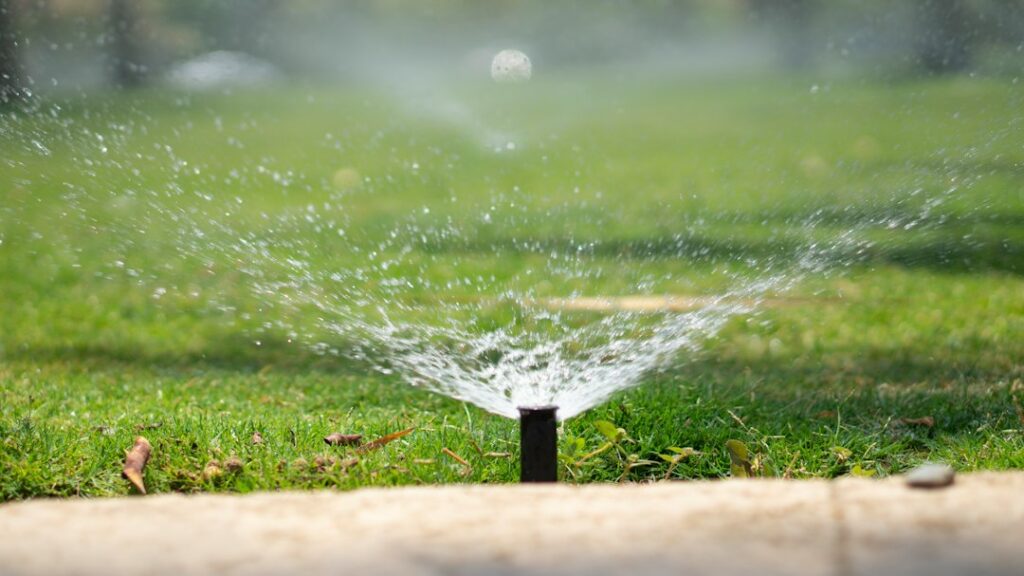
The controller on the garage wall decides how much water a yard gets, when it gets it, and whether it keeps running through a rainstorm. A sprinkler timer that was programmed once by the builder and never touched again is one of the most common reasons lawns are overwatered in spring and fall and underwatered in July. Along Colorado’s Front Range, where many water providers set watering-day rules and summer water rates climb, the controller is also where most of the savings in an irrigation system can be found. This guide explains how conventional clock timers and smart controllers differ, what the EPA WaterSense label means for controllers, how rain and soil moisture sensors fit in, how to build a schedule that works with local restrictions, how zones and wiring work, what to do in winter, and what replacement controllers typically cost.
Part of our Plumbing & Water guide — start there for the full picture →
What a Sprinkler Timer Does
A sprinkler timer, more formally called an irrigation controller, is the brain of an automatic system. It sends a low-voltage signal, typically 24 volts AC, through field wires to the electric valves for each zone. When a valve receives the signal, it opens and the heads or drip emitters on that zone run. When the signal stops, the valve closes.
Every controller stores at least three pieces of information for each program:
- Watering days. Specific days of the week, odd or even dates, or an interval such as every third day.
- Start times. When the program begins. Most controllers allow several start times per program, which makes cycle-and-soak watering possible.
- Run times. How long each zone runs, usually in minutes.
Most controllers also offer a seasonal adjustment, sometimes labeled “water budget,” that scales all run times up or down by a percentage. That single setting is one of the most useful and least used features on conventional timers. Many controllers also include a rain delay, a sensor input terminal and a master valve or pump start circuit.
Conventional Clock Timers vs Smart Controllers
Conventional Clock-Based Timers
A conventional timer runs the same schedule until someone changes it. If it is set for a hot July and nobody adjusts it, it keeps watering at July levels through a cool, rainy September. The U.S. Environmental Protection Agency’s WaterSense program notes that homes with clock-timer-controlled irrigation systems use about 50 percent more water outdoors than homes without irrigation systems, and that a system can waste even more if it is programmed incorrectly. A clock timer is not inherently wasteful; the waste comes from schedules that are not adjusted to weather and seasons.
Smart Controllers
Smart controllers adjust watering automatically based on conditions. WaterSense labels two types:
- Weather-based irrigation controllers, which, as EPA describes them, use local weather and landscape conditions to tailor watering schedules.
- Soil moisture-based irrigation controllers, also called soil moisture sensors, which EPA says monitor moisture levels in the soil to prevent irrigation when water is not needed.
Many weather-based controllers connect to Wi-Fi and pull local weather data; others use an on-site weather sensor. They typically ask for information about each zone, such as plant type, soil type, sun exposure, slope and head type, and use that to calculate run times that change with the weather.
What the WaterSense Label Means
EPA states that to earn the WaterSense label, irrigation controllers are independently certified to meet specific WaterSense criteria for efficiency and performance. Controllers that use both weather and soil moisture data must be certified under both specifications to carry the label. Not every product marketed as “smart” carries the label, so check for the WaterSense mark or the product listing before buying, especially when a utility rebate depends on it.
EPA states that replacing a standard clock-based controller with a WaterSense labeled irrigation controller can save an average home up to 15,000 gallons of water annually. EPA frames that benefit around proper installation, programming and maintenance. A smart controller set up with the wrong soil type or head type will make confident but wrong decisions.
Best Sprinkler Timers: our top 3 picks
| Product | Best for | Key features | Price | Buy |
|---|---|---|---|---|
| Orbit B-hyve 8-zone indoor | Smart in-ground controller |
| $95.60as of Nov 19, 2026 10:32 pm GMT+0000 | Buy now →Check current price |
| Orbit 57896 6-station | Non-smart in-ground controller |
| $55.49as of Nov 19, 2026 10:32 pm GMT+0000 | Buy now →Check current price |
| Orbit B-hyve XD 4-port | Smart hose timer, multiple beds |
| $72.98as of Nov 19, 2026 10:32 pm GMT+0000 | Buy now →Check current price |


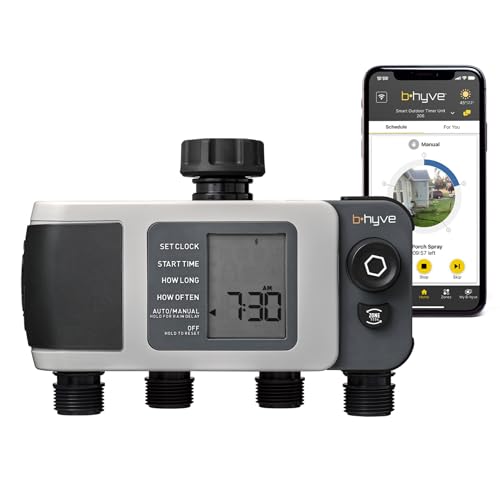
Prices are Amazon’s listed prices as of the time shown and change often; check Amazon for today’s price. As an Amazon Associate we earn from qualifying purchases.
Rain Sensors and Soil Moisture Sensors
Sensors can be added to many conventional timers, giving part of the benefit of a smart controller without replacing it.
Rain Sensors
A rain sensor mounts on a gutter, fence or eave where it is exposed to open sky. When it collects a set amount of rain, it interrupts the controller’s signal to the valves so scheduled watering is skipped. As it dries, watering resumes. Wireless models avoid running wire from the sensor to the controller. Some sensors also include a freeze sensor that shuts off watering when temperatures drop near freezing, which is useful on the Front Range in spring and fall, when cold snaps can glaze sidewalks with irrigation water.
Soil Moisture Sensors
A soil moisture sensor is buried in the root zone of a representative area and measures how wet the soil is. If moisture is above a set threshold, the controller skips watering. EPA’s WaterSense program labels soil moisture-based controllers as one of its two controller categories. Sensor placement matters: a sensor in a shady corner or near a downspout will not represent a sunny slope.
Common Sensor Problems
- A rain sensor mounted under an eave or tree that never gets wet.
- A sensor bypass switch left in the bypass position after a repair.
- Dead batteries in wireless sensors.
- Soil sensors buried at the wrong depth or disturbed by aeration.
Scheduling Around Colorado Watering Rules
Many Front Range water providers have set watering-day limits, time-of-day restrictions or seasonal rules at various times, particularly during drought years. Rules vary by provider and can change from year to year, so check the current rules for the specific address with the local water utility before programming a controller. EPA’s WaterSense guidance also recommends contacting the local water utility to find out how much and when to water.
A few scheduling principles work well under most rules:
- Water early. WaterSense recommends avoiding watering in the middle of the day when the sun evaporates much of the water before it reaches plants. Early morning watering also reduces wind drift.
- Use cycle-and-soak. Clay-rich soils and slopes, common along the Front Range, cannot absorb water as fast as spray heads apply it. WaterSense describes cycle-and-soak as breaking runtimes into shorter intervals with breaks so water can soak into the soil. Multiple start times on the same day accomplish this.
- Adjust seasonally. WaterSense notes that irrigation schedules should be adjusted with seasonal changes. A conventional timer’s seasonal adjustment percentage is an easy way to do this monthly.
- Measure output. WaterSense suggests placing a few empty tuna cans around a lawn, timing how long it takes to collect a half inch of water, and using that as a starting run time.
- Separate spray, rotor and drip. Each needs very different run times, which is why they belong on separate zones.
WaterSense also notes that a landscape typically requires about one inch of water a week including rainfall, though that varies by location, weather and plants. On the Front Range, the local Cooperative Extension service and water providers often publish seasonal guidance more specific to the region.
Zones, Wiring and Installation
Controllers are sold by the number of stations, meaning the number of zones they can operate. Common residential models range from four to more than a dozen stations, and some are modular so stations can be added. When replacing a controller, choose one with at least as many stations as the existing system has zones, plus a spare or two.
How the Wiring Works
Each zone valve has two wires from its solenoid. One wire from every valve connects to a shared common wire that runs back to the controller’s common terminal. The other wire from each valve runs back to its own numbered station terminal. A master valve or pump start relay, if present, has its own terminal. Before disconnecting an old controller, photograph the wiring and label each wire.
Indoor vs Outdoor Models
Indoor controllers typically plug into a standard outlet through a transformer and are meant for garages and basements. Outdoor models are housed in weather-resistant enclosures and are often hardwired. Smart controllers that rely on Wi-Fi need a reliable signal where they are mounted, which can be a problem in detached garages.
When Zones Do Not Work
If a single zone will not run, the cause is often the valve solenoid or the wire to that valve. If several zones fail at once, the shared common wire is a frequent culprit. A multimeter can help check whether the controller is sending voltage and whether the solenoid’s resistance is within the manufacturer’s range. Our guide to sprinkler system repair covers valve and wiring diagnosis in more detail.
Low-voltage controller wiring is generally manageable for homeowners, but any work on line-voltage connections for hardwired outdoor controllers or pump circuits is better left to a licensed electrician.
Winter Settings and Winterizing
Once the system is blown out in fall, the controller should not be left trying to run zones against closed valves and empty pipes. Most controllers have an “off” or “rain” mode that keeps the program memory while stopping watering, and many smart controllers have a seasonal shutdown setting. Some homeowners unplug the controller entirely; if so, check whether the controller has non-volatile memory or a backup battery so programs are not lost.
Leaving a controller active after a blowout can cycle valves without water, which offers no benefit, and running water into a system that has not been drained can cause freeze damage. Our guide to sprinkler winterization covers the full fall shutdown sequence, including protecting the backflow device. For details on the backflow assembly itself, see the guide to the irrigation backflow preventer.
In spring, set the clock and date, check the backup battery, verify the program, and run each zone manually to watch for broken heads. Our guide to sprinkler head replacement covers the most common spring repair.
Choosing a Replacement Controller
Controllers usually get replaced for one of three reasons: the old one failed, the owner wants smart features, or a utility rebate makes an upgrade attractive. A short checklist helps avoid buying the wrong unit.
- Station count. Count the wired zone terminals on the existing controller, not the number of programs, and buy at least that many stations.
- Master valve or pump start. If the old controller uses a master valve or a pump relay terminal, confirm the new one supports it.
- Sensor input. Check that existing rain, freeze or soil sensors are compatible, or plan to replace them.
- Mounting location. Indoor or outdoor rating, access to power and, for Wi-Fi models, signal strength at the wall.
- Label and rebate. Look for the WaterSense label if a rebate is involved, and save the receipt and model number.
- Usability. A controller that is easy to adjust is more likely to be adjusted. Some owners prefer a simple dial and buttons; others prefer an app.
Setup is where much of the value is won or lost. For a smart controller, take time to enter accurate zone information: which zones are lawn spray, lawn rotor, shrub drip or trees; whether each area is sunny or shaded; whether the soil is clay, loam or sand; and whether the zone is sloped. Many Front Range yards have clay soil and slopes that call for cycle-and-soak settings. After the first few weeks, walk the yard. Soggy areas, runoff onto sidewalks or browning in one zone are signals to refine the inputs rather than to switch the controller back to a fixed schedule.
For a conventional timer, the most effective habit is a monthly adjustment, usually through the seasonal percentage setting, plus a quick look after heavy rain. Even a simple timer, adjusted regularly, can avoid much of the waste associated with set-and-forget programming.
Sprinkler Timer Costs
Prices depend on station count, features, brand, connectivity and whether installation is DIY or professional. The ranges below are broad and hedged.
| Item | Rough range | Notes |
|---|---|---|
| Basic conventional timer | Often under $100 | Indoor models at the lower end |
| WaterSense labeled smart controller | Often around $100 to $300+ | Station count and features affect price |
| Rain or freeze sensor | Often under $100 | Wireless models cost more |
| Soil moisture sensor system | Wide range | Depends on number of sensors and controller compatibility |
| Professional installation and programming | Often a service call plus labor | Higher if wiring repairs are needed |
EPA notes that some utilities offer rebates for WaterSense labeled controllers, and several Front Range water providers have offered such programs. Rebate rules commonly require the labeled product and sometimes proof of installation, so check before buying. The overall payback depends on how much the old schedule was overwatering in the first place.
Controllers and Drip Zones
Drip zones run much longer than spray zones because emitters apply water slowly. On a smart controller, drip zones should be set up with the correct emitter type and plant type so the controller’s calculations make sense. On a conventional timer, drip zones often work best on their own program with fewer, longer watering days. Our guide to drip irrigation covers layout and maintenance for those zones.
Sprinkler Timers and Home Purchases
Home inspectors rarely program or evaluate an irrigation controller as part of a standard inspection, and a winterized system may not be testable at all. For buyers, practical steps include asking the seller for the controller’s make and model, any app login transfer for smart controllers, a zone map and service history. Many smart controllers are tied to the previous owner’s account, which needs to be released before a new owner can register it.
Checking the controller is also a quick way to learn how the property was watered. A conventional timer with long daily run times on every zone hints that the soil around the foundation may have been kept wet for years. For more on what a general inspection covers and how to choose an inspector, see our guide to hiring a home inspector and the plumbing and water hub.
More Questions About Sprinkler Timers
How long should each sprinkler zone run?
A typical lawn spray zone runs about 10 to 20 minutes per cycle, while rotor zones often need 20 to 45 minutes because rotors apply water more slowly. The right time depends on nozzle type, soil, slope, sun exposure and the season.
A simple catch-cup test helps: place cans across a zone, run it for 15 minutes and measure the water. Many lawns need roughly 1 inch per week in summer, less in spring and fall. Local watering restrictions and utility guidance should override any general rule.
What is cycle and soak on a sprinkler timer?
Cycle and soak is a sprinkler timer setting that splits a zone’s run time into shorter cycles with pauses in between, so water soaks into the soil instead of running off. It is especially useful on slopes and clay soils.
For example, instead of running a zone for 18 minutes straight, the timer might run it three times for 6 minutes with about 30 to 60 minutes between cycles. Many smart controllers calculate this automatically from soil type and slope settings entered during setup.
Does a smart sprinkler controller need Wi-Fi to work?
Most smart sprinkler controllers need Wi-Fi for weather-based scheduling, app control and remote changes, but many will keep running a stored schedule if the connection drops. Without internet, they lose weather adjustments and remote access until the link returns.
Check signal strength at the controller location before buying, especially in garages. A Wi-Fi extender can help. Some models also support local control or a manual mode at the unit, which is useful during outages or when a contractor services the system.
Why does my sprinkler timer reset after a power outage?
A sprinkler timer that resets after a power outage usually has a dead or missing backup battery, or is an older model that stores its program in volatile memory. Many timers use a 9-volt or coin battery to keep the clock and schedule during outages.
Replace the backup battery annually and re-enter the schedule if needed. Newer controllers typically store programs in nonvolatile memory and only lose the time, which smart models restore from the internet. Frequent resets with no outages can point to a failing power transformer.
References
- WaterSense Labeled Controllers — U.S. Environmental Protection Agency
- Watering Tips — U.S. Environmental Protection Agency, WaterSense
- Sprinkler Spruce-Up — U.S. Environmental Protection Agency, WaterSense
- WaterSense Outdoors — U.S. Environmental Protection Agency
Frequently asked questions
What is the difference between a sprinkler timer and a smart controller?
A conventional sprinkler timer runs a fixed schedule until someone changes it. A smart controller adjusts watering automatically using local weather data or soil moisture readings. EPA labels both weather-based and soil moisture-based controllers that meet its WaterSense criteria.
How much water can a smart sprinkler controller save?
EPA states that replacing a standard clock-based controller with a WaterSense labeled controller can save an average home up to 15,000 gallons of water annually. Actual savings depend on how much the previous schedule overwatered and on correct setup.
Should I turn off my sprinkler timer in winter?
Yes. After the system is blown out, set the controller to off or rain mode, or unplug it if programs are retained. Running zones against a drained system does no good and can lead to freeze damage if water is reintroduced.
Why will one zone on my sprinkler timer not turn on?
A single dead zone usually points to the valve solenoid or the wire to that valve. If several zones fail together, check the shared common wire. A multimeter can confirm whether the controller is sending voltage to the station.
What time of day should sprinklers run?
Early morning is generally best. WaterSense recommends avoiding midday watering because the sun evaporates much of the water, and local water providers may set specific allowed hours or days.
How often should sprinklers run per week?
Many lawns do best with deep watering two to three days per week rather than short daily cycles, which encourage shallow roots. In hot, dry periods, frequency may need to rise. Always follow local watering-day restrictions, and adjust seasonally rather than leaving summer settings in place year round.
Can a sprinkler timer control drip irrigation?
A standard sprinkler timer can control drip irrigation zones, since drip runs through the same type of valve. Drip zones need much longer run times, often 30 to 90 minutes, and usually a pressure regulator and filter after the valve. Keep drip and spray heads on separate zones.
What is the rain delay setting on a sprinkler timer?
The rain delay setting pauses scheduled watering for a set number of days, commonly 24 to 72 hours, while keeping the program saved. It is useful after storms or during cool, cloudy spells. Smart controllers can apply rain delays automatically from local weather forecasts or a rain sensor.
Buying a home with a smart controller, a winterized system and no zone map? Reach out to us and we can help you find an inspector who flags overwatering near the foundation, drainage problems and backflow damage worth asking the seller about.