Radon Air Testing: What Homeowners Need to Know
Radon air testing measures the concentration of radon gas dissolved in indoor air, distinct from soil-gas measurement under the slab or water-radon testing for well systems. Air testing is the form of radon measurement that matters most to homeowners because indoor air is what they actually breathe. The protocols, devices, and acceptance criteria are well-defined by AARST and NRPP standards. This guide walks through residential radon air testing in detail: what it measures, how it differs from soil-gas measurement, the devices used, and the acceptance criteria. EPA, CDPHE, and AARST guidance current as of 2026 — consult a physician for health concerns and a certified professional for mitigation decisions.
Part of our Radon Levels guide — start there for the full picture →
What Radon Air Testing Measures
Radon air testing measures the activity concentration of radon-222 in indoor air, reported in picocuries per liter (pCi/L) in the United States or becquerels per cubic meter (Bq/m3) in metric-system jurisdictions. The conversion is 1 pCi/L = 37 Bq/m3.
The measurement captures the average concentration over the test duration. For short-term tests (48 hours to 7 days), the result is a snapshot of recent conditions. For long-term tests (90 days to 12 months), the result is an integrated average across seasonal variation. For continuous radon monitors (CRMs), the result is a continuous time-series of hourly readings plus an overall average.
What air testing does not measure is soil-gas concentration directly, water-radon concentration, or radon-decay-product (radon daughter) airborne activity. Daughter products like polonium-218 and polonium-214 are responsible for most of the lung-dose risk from radon exposure, but residential testing typically measures the parent radon-222 because it is easier to quantify reliably and correlates strongly with daughter-product exposure under normal home conditions.
Air Testing vs. Soil-Gas Testing
Two adjacent measurement categories sometimes get confused with air testing. Soil-gas testing measures radon concentration in the soil under the slab or in sub-slab voids; this is a diagnostic test used by mitigation contractors during system design, not a homeowner test. Sub-slab depressurization system performance evaluation uses soil-gas measurements to confirm the system is pulling air from the right place.
Water radon testing measures radon dissolved in well water; this is relevant for homes on private wells with high-radon source aquifers. Water radon at concentrations above roughly 10,000 pCi/L in water can contribute meaningfully to indoor air radon when the water is aerated by showering or dishwashing. Most municipal water systems do not have significant radon contributions because surface-water sources release radon during treatment.
For typical residential testing scenarios, indoor air radon is the question. The other two categories come up in specialized contexts. The radon sampling methodology overview covers the distinctions between passive, continuous, and grab methods.
CRM-Based Air Testing Protocols
Continuous radon monitors are the preferred device class for professional radon air testing because they produce time-stamped hourly data, calibration is documented, and tampering is detectable. AARST and NRPP standards for real-estate measurement require either a CRM or two side-by-side passive devices providing duplicate measurements.
Professional-grade CRMs include the Sun Nuclear 1027 and 1029, the Radalink AirCat, the Femto-Tech Radonview, and the Aircheck Lucas-cell devices. These run $1,000 to $3,000 and undergo annual calibration at certified facilities. Consumer-grade CRMs from Airthings, Ecosense, and Radonova use solid-state silicon detectors at lower price points ($150 to $300) and provide adequate accuracy for ongoing monitoring even when not regulatory-grade.
CRM placement follows the standard protocol: lowest livable level, 20 inches to 6 feet above floor, 4 inches minimum from interior walls, 3 feet from exterior doors and windows, 1 foot minimum from heating/cooling sources. The device is left in place for a minimum of 48 hours under closed-house conditions. At the end of the test, hourly data is downloaded and analyzed for tampering patterns (window-open events, device-move events) that would invalidate the result.
Passive Device Air Testing
Passive devices include charcoal canisters (short-term), alpha-track detectors (long-term), and electret ion chambers (short or long-term). All three measure radon air concentration; the difference is the physics of measurement.
Charcoal canisters absorb radon gas into activated charcoal during the exposure window. After exposure, gamma-emitting radon decay products in the charcoal are measured by gamma spectroscopy at the lab. Results convert to integrated pCi/L over the exposure period. The 3.8-day half-life of radon-222 limits useful exposure to roughly 7 days; longer exposures lose absorbed radon to back-diffusion.
Alpha-track detectors use a piece of polycarbonate or CR-39 film inside a small chamber. Alpha particles from radon decay etch tracks into the film. The lab counts tracks per square centimeter and converts to integrated pCi/L. Alpha-track works for 90 days to 12 months — much longer integration windows than charcoal.
Electret ion chambers use a charged polymer disk whose charge drops at a rate proportional to ambient radon. The lab measures pre- and post-deployment charge and computes the average concentration. Electrets serve both short and long-term applications depending on disk type.
AARST and NRPP Air-Testing Standards
Two AARST consensus standards govern radon air testing protocols. AARST MAH-2019 covers home radon measurement, including placement, duration, closed-house conditions, and data quality. AARST MAMF-2017 covers multifamily building radon measurement at apartment-level granularity. Both standards reference EPA Protocols 402-R-93-003 (real-estate) and 402-R-92-003 (general) as foundational documents.
NRPP certification testing covers these standards in coursework and exam content. An NRPP-certified Measurement Specialist demonstrates working knowledge of the AARST standards before earning the credential. Buyers and homeowners can rely on NRPP-certified professionals to follow these protocols correctly.
Front Range Air Testing Considerations
Colorado homes face several conditions that affect air testing logistics. Winter heating drives strong sub-slab pressure differentials, pulling more radon into the home. Winter results are typically 30 to 50 percent higher than summer results in Front Range homes. A summer-only test that comes back at 3.5 pCi/L might exceed 5.0 pCi/L in winter.
CDPHE estimates that roughly half of Colorado homes test at or above the 4.0 pCi/L action level. Douglas, Elbert, Jefferson, and Boulder counties report some of the highest residential averages. Newer construction in these counties is required to include radon-resistant features (passive vent stack, vapor barrier, sealed sump cover), but passive features alone do not always achieve sub-action-level results — fan activation is often needed. The radon testing pillar guide covers Colorado-specific context in detail.
Front Range homeowners running their own air tests should aim for winter testing windows when results will reveal the worst-case condition. A high winter test reliably indicates a high annual average; a low summer test does not reliably indicate the home is safe.
Acceptance Criteria for Air Test Results
The EPA action level is 4.0 pCi/L. At or above this level, EPA recommends mitigation. Between 2.0 and 3.9 pCi/L, EPA recommends considering mitigation. Below 2.0 pCi/L, no immediate action is recommended.
The World Health Organization sets a more conservative action level at 2.7 pCi/L (100 Bq/m3) in its 2009 Handbook on Indoor Radon. Some U.S. health authorities suggest aiming for the WHO threshold rather than the EPA threshold because no level of radon is safe and lower targets reduce long-term lung-cancer risk. The decision is the homeowner’s, balancing the mitigation cost against the marginal risk reduction.
Post-mitigation air testing confirms the installed system is working. A successful mitigation typically drops levels below 2.0 pCi/L; an excellent mitigation drops levels below 1.0 pCi/L. AARST mitigation standards (SGM-SF-2017 for single-family homes) require post-mitigation testing to validate system performance.
AARST MAH-2019 Standard for Home Testing
The American Association of Radon Scientists and Technologists publishes the consensus measurement standards that the U.S. radon industry uses for home testing. AARST MAH-2019, the standard for measurement of radon in homes, defines the protocols that professional and consumer testing should follow to produce defensible results. The EPA radon resource references AARST consensus standards as the methodological basis for the industry-wide approach to home radon measurement, and most state regulatory programs reference MAH-2019 directly in their certification requirements for radon measurement professionals.
MAH-2019 covers four core areas. The first is measurement methodology: which device classes are appropriate for which testing objectives, including short-term, long-term, continuous, and integrated measurement approaches. The second is device placement: the minimum distances from walls, floors, ceilings, windows, and HVAC components, plus the breathing-zone height requirement that puts the device at occupant respiration level. The third is exposure duration: the minimum 48 hours for short-term testing, the recommended 90 to 365 days for long-term testing, and the specific protocols for real-estate transactions that combine duration with continuous-monitor data logging. The fourth is environmental conditions during the test: the closed-house requirements, the HVAC operation expectations, the temperature and humidity bounds within which the test produces valid results, and the documentation that establishes the conditions were met.
For Colorado homeowners, MAH-2019 compliance matters because real-estate transactions in many counties expect a NRPP-certified or NRSB-certified measurement professional to follow the standard during inspection-period testing. CDPHE radon information directs consumers to certified professionals for transactional testing, and the certification programs require demonstrated knowledge of AARST consensus standards including MAH-2019. Homeowners conducting DIY testing benefit from understanding the standard even though they are not formally bound by it, because following the standard’s protocols produces results that are more directly comparable to professional measurements during any future negotiation.
Continuous Radon Monitor (CRM) Operation
The continuous radon monitor is the device class that has come to dominate professional and increasingly consumer testing because it captures information that passive devices cannot. A CRM contains a sensor (typically a pulsed ionization chamber or scintillation cell) that detects alpha particles from radon and its short-lived decay products in real time, plus electronics that integrate the count rate over fixed intervals (usually one hour) and store the data internally. The result file is not a single concentration number but a time series of hourly readings across the entire test window.
The information content of an hourly time series is substantially higher than the single-number output of a charcoal canister. Hourly data reveals diurnal variation patterns: typical homes show higher radon overnight when occupant activity is low and HVAC cycles less frequently, and lower radon during midday when door openings and pressure changes flush some of the accumulated gas. The time series also reveals the closed-house condition status throughout the test. If a window is opened or a door is left ajar during the test window, the hourly data shows a sharp dip during the event, and the report flags the period as a possible protocol violation. This tamper detection capability is one of the reasons AARST and NRPP recommend CRMs for real-estate testing where the result will support a financial decision.
Modern AARST and NRPP-listed CRMs include inclinometers that detect device movement, temperature sensors that confirm the test occurred in conditioned space, and humidity sensors that flag conditions outside the validated operating range. The certificate that the device generates after the test window includes the hourly time series, the average concentration over the test, the minimum and maximum hourly readings, the date and time of any flagged events, and the device serial number with calibration date. This level of documentation is what allows the result to function as a defensible record during contingency negotiations, post-mitigation verification, and any future disclosure dispute. The cost of consumer-grade CRMs has dropped substantially over the past decade, with several models now available below $200 that produce reports comparable in detail to professional service.
References
- EPA Radon Information — U.S. Environmental Protection Agency
- CDPHE Radon Resource — Colorado Department of Public Health and Environment
- CDC Radon Topic — Centers for Disease Control and Prevention
- American Lung Association Radon Resource — American Lung Association
Frequently asked questions
What is the difference between radon air testing and soil-gas testing?
Air testing measures radon concentration in indoor air, which is what homeowners breathe. Soil-gas testing measures radon in the soil under the slab and is used by mitigation contractors during system design. Air testing is the standard residential test; soil-gas is a diagnostic.
Should I use a CRM or a passive device for air testing?
For real-estate transactions, CRM is preferred because the time-stamped hourly data reveals tampering and provides defensible documentation. For routine homeowner-occupied testing, passive devices are cheaper and adequately accurate. Long-term alpha-track is best for annual-average characterization.
Does Colorado require radon air testing?
Colorado does not require homeowners to test, but new construction is required to include passive radon-resistant features under the residential code. Many real-estate transactions include radon testing as a standard inspection add-on because Front Range radon levels are high statewide.
What is the WHO recommended radon level?
The World Health Organization recommends 2.7 pCi/L (100 Bq/m3) as the action threshold in its 2009 Handbook on Indoor Radon. This is more conservative than the EPA's 4.0 pCi/L. Some homeowners use the WHO threshold for greater risk reduction.
Front Range homeowners ready to coordinate professional air testing or post-mitigation verification can reach out through our contact page.
Test your home for radon
Radon is invisible and odorless, so a test is the only way to know your level. A short-term kit gives a first reading in days; a digital monitor tracks it over time.
| Product | Why | Buy |
|---|---|---|
 AirChek Charcoal Radon Test Kit | Lab fee usually included; EPA short-term protocol. | Amazon |
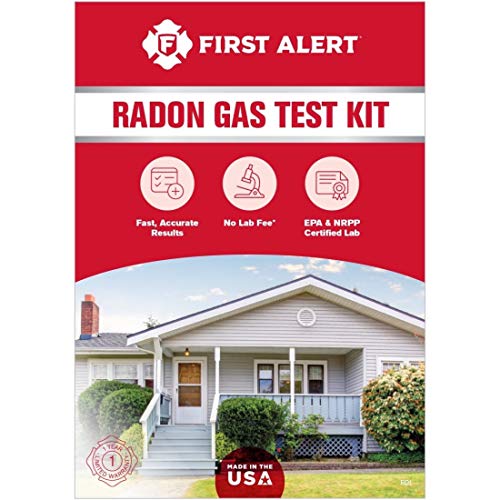 First Alert RD1 Radon Test Kit | Widely stocked; 48-hour charcoal test. | Amazon — $17.95 |
 Airthings Corentium Home | Digital monitor with a long-term average. | Amazon — $142.99 |