Mold Testing in Morgan County, Colorado
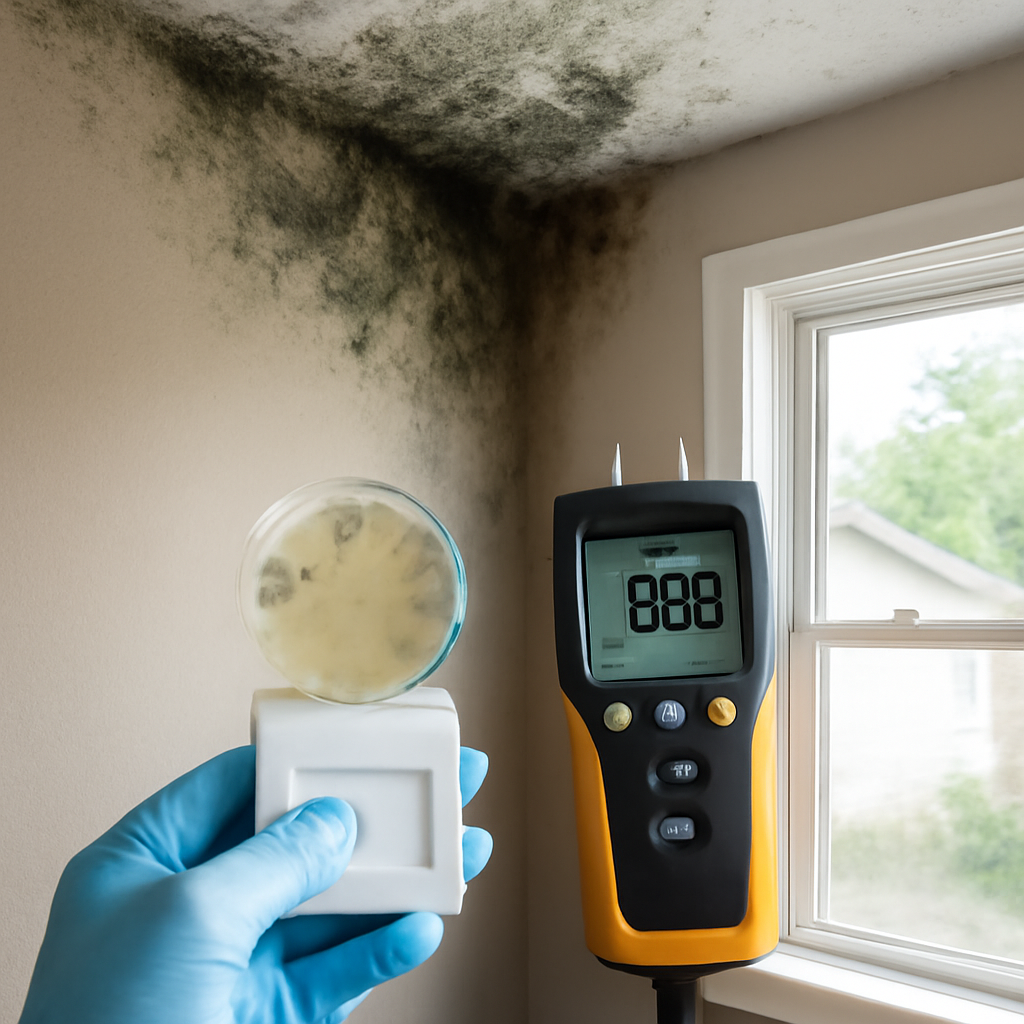
Mold testing morgan county homeowners look for usually comes after a musty basement smell lingers or a visual inspection finds a suspect area that needs lab confirmation. Morgan County is a far-eastern-plains agricultural county along the South Platte River and I-76, well east of the Front Range metro at roughly 4,300 feet, with an economy built on farming, feedlots, and food processing. Its housing leans toward older small-town and farmhouse stock in Fort Morgan, Brush, and the surrounding farmland. This page is a county-level hub: it covers what testing measures, how sampling works near the river, local costs, and links to our related Morgan County service pages. This summary reflects EPA and CDC guidance current as of 2026; consult a certified professional for testing decisions and your physician for any health symptoms.
Is this mold, asbestos, or water damage? Get a free instant screen
Upload a clear photo of the suspect area. You'll get an instant AI screening opinion and what to do next. This is screening guidance, not a professional determination.
Screening guidance only. AI can be wrong. Confirm asbestos, mold type, or lead with lab testing or a licensed professional before acting.
Mold testing in Morgan County: what to know
Mold testing collects air or surface samples and sends them to a laboratory to identify spore types and concentrations. It is distinct from a mold inspection, the visual and moisture-based assessment that finds active growth and its water source. The two work together: an inspection locates the problem, and testing quantifies what is in the air or on a surface so a homeowner can act on data rather than a guess.
Across Morgan County, testing is most useful when a basement smells musty but no growth is obvious, or when a buyer wants documentation before closing on an older river-proximity home. Because the South Platte high water table keeps many basements damp, indoor air can carry elevated spores that an air sample will detect even when seepage is hidden behind finishes. An outdoor baseline sample gives the lab the comparison it needs, since some spore presence is normal everywhere and only an elevated indoor reading relative to outside points to an indoor source.
For the underlying science of spore counts and what lab results mean, our plain-language mold inspection and testing hub walks through the fundamentals. This page stays focused on how testing plays out in Morgan County’s older housing, where high groundwater, aging basements, and evaporative coolers all influence what a sample picks up.
Why Morgan County homes need mold testing
The high water table drives the need. Homes along the South Platte and within the irrigated farmland around Fort Morgan, Brush, and Wiggins can sit over groundwater close to the surface, which keeps basement walls damp and supports hidden growth. When that growth is behind drywall or under flooring, an air test in the basement is the most reliable way to confirm whether the space holds an elevated spore load.
Older basements complicate detection. The pre-1978 stone, block, and early-concrete foundations common in the Fort Morgan and Brush downtowns admit groundwater more readily than modern walls, and growth in these older, often-finished basements can spread before anyone sees it. Surface sampling on a suspect wall paired with an air sample tells the lab whether the spores in the air match the growth on the surface, strengthening the case for a targeted remediation.
Evaporative coolers add a seasonal variable. Swamp coolers common in the hot, dry summers raise indoor humidity, and an over-run cooler combined with an already-damp basement can push moisture high enough to support growth. Testing in both the living space and a suspect basement helps separate a genuine air-quality concern from normal seasonal spore levels, which is exactly the question a lab analysis can answer where the naked eye cannot.
What a Morgan County mold test covers
A typical testing visit pairs an outdoor baseline sample with one or more indoor samples taken in the rooms of concern, then sends them to an accredited laboratory that compares the indoor spore types and counts against the outdoor control.
Air sampling and the baseline comparison
Air sampling draws a measured volume of air through a collection cassette that traps spores for the lab to count and identify. In an older Fort Morgan basement, a sample compared to an outdoor control reveals whether the below-grade space holds an elevated, distinct spore profile that points to a hidden, water-fed source. The baseline matters because spore counts shift with weather, irrigation, and season in the river valley.
Surface and tape-lift sampling
When a visible stain or suspect material is present, a surface or tape-lift sample confirms whether it is active mold and identifies the genus. In a Brush basement, a tape lift from a damp foundation wall can verify that a stain is mold rather than mineral efflorescence left by evaporating groundwater, which changes whether remediation is even needed.
Mold testing cost in Morgan County
Mold testing in the Morgan County market typically runs about $300 to $600 for a standard package of an outdoor baseline plus two indoor air samples, including laboratory analysis. Additional samples, surface tape lifts, or post-remediation clearance testing add to the total, generally $75 to $150 per added sample depending on the lab. Older homes with full basements in Fort Morgan and Brush may need more sample points to cover a finished lower level and any crawlspace.
Rural travel can add a modest trip charge for outlying communities like Wiggins, Snyder, and Log Lane Village. Many homeowners bundle testing with a visual inspection so a single visit covers both finding the problem and quantifying it, which spreads the trip cost across two services and gives a more complete report before a purchase deadline.
Colorado regulations and disclosure
Colorado does not license mold testers or set a mandatory residential mold standard, so the value of a test rests on using an accredited laboratory and a clear, defensible sampling method. For real-estate transactions, Colorado’s Seller’s Property Disclosure asks sellers to report known mold and water-damage history, and lab-backed testing gives both parties objective data when a question arises during the contingency period.
Because there is no state license, ask whether samples go to an accredited lab and whether the report includes the outdoor baseline, the spore types found, and the counts rather than a simple pass or fail. In a river-valley county where groundwater is a recurring cause, that documentation pairs naturally with a moisture inspection that distinguishes hydrostatic seepage from a plumbing leak, since the cause determines what a remediation must address.
Communities and areas served across Morgan County
Testing demand turns up county-wide, and the housing pattern shifts with each community. In Fort Morgan, the county seat and largest town, older downtown homes with full basements near the South Platte are the most common setting for seepage-driven sampling. Brush shares that older-stock, river-proximity profile. Wiggins, along I-76 to the west, mixes newer growth with farm properties, while Snyder, Log Lane Village, and the Riverside corridor add rural and agricultural housing where crawlspace and well-plumbing moisture drive sampling decisions.
Coverage extends along the South Platte and I-76 toward the Weld and Adams county lines to the west. Across all of these, the county’s EPA Radon Zone 1 status means below-grade air quality is already a concern, so many homeowners pair mold testing with a radon test in the same visit; our companion page on mold inspection in Morgan County explains how the visual assessment and the lab sampling fit together. For nearby live coverage to the west, our mold testing in Brighton page details a comparable South Platte community in adjacent Adams County.
Seasonal testing patterns across Morgan County
Spore levels in the river valley shift with the irrigation and runoff calendar, which is why the outdoor baseline is essential in this county. During the irrigation season and after spring runoff, the high water table feeds basement seepage and outdoor spore counts rise, so indoor samples must be read against a higher outdoor control. A test that ignores the seasonal baseline can misread normal summer spore levels as an indoor problem, making the control sample central to an accurate result.
Winter testing tells a different story. As Fort Morgan and Brush homes seal up against the cold eastern-plains winter, indoor humidity from daily living has nowhere to escape, and condensation on cold basement surfaces can support growth that an air sample will detect. With outdoor spore counts low in winter, an elevated indoor reading stands out clearly, making the heating season a useful window for confirming a suspected below-grade source.
Summer adds the evaporative-cooler variable. Swamp coolers raise indoor humidity to keep homes comfortable, and an over-run cooler can lift moisture high enough to support surface growth in a closed room. Testing helps a homeowner decide whether a musty basement is a genuine air-quality issue or simply elevated humidity from groundwater and cooling, since the lab data distinguishes spore presence from the dampness a hygrometer alone would show.
How river-valley conditions shape sampling
The defining feature of Morgan County mold testing is the high water table, and it shapes where samples are taken. On a river-proximity property, the basement is the priority sampling location because that is where groundwater seepage feeds growth, so an air sample there read against indoor and outdoor controls reveals whether the below-grade space is contributing spores to the living area above.
Older foundations raise the sampling value. The pre-1978 stone and block foundations in the Fort Morgan and Brush downtowns are more permeable and crack-prone, so a basement sample in one of these homes is more likely to show an elevated reading tied to chronic dampness. Pairing the lab result with notes on the foundation type and the sump system gives a fuller picture than the spore counts alone.
Crawlspaces matter on farm properties. Many rural and older homes near Wiggins, Snyder, and the outlying farmland sit over crawlspaces where ground moisture and a high water table can support growth that never appears upstairs until it becomes severe. A crawlspace air sample, read against an indoor and an outdoor control, tells a homeowner whether that hidden space is feeding spores into the home, which a living-space sample alone would miss.
Reading the lab report on a Morgan County home
A mold testing report can look intimidating, but its structure is straightforward once a Morgan County homeowner knows what to read. The report lists each sample location, the total spore count, and the spore types identified, then compares the indoor counts against the outdoor baseline. The comparison is the heart of the analysis: if a Fort Morgan basement sample shows a count and spore profile clearly above the outdoor control, that points to an indoor source feeding the air, whereas counts in line with outside usually reflect normal infiltration rather than a hidden colony.
Spore type carries as much weight as the number. Some genera are associated with chronically wet building materials, which is exactly the condition a high-water-table basement creates, and finding such an indoor-dominant genus at elevated levels in a Brush basement gives a homeowner a stronger basis for action than a high count of a common outdoor mold drifting in through doors. A good provider explains which findings are meaningful and which are background, so the data drives a sensible decision rather than alarm over normal river-valley spore levels.
Post-remediation clearance testing is the report’s final role. After a remediation addresses a confirmed source, such as sealing a foundation and correcting a sump on a river-proximity home, a clearance test verifies that indoor spore levels have returned to a normal range relative to outside. For a Morgan County buyer, a clearance report documenting that a prior basement problem was resolved is exactly the objective record that settles a question during a transaction, which is why testing bookends a remediation rather than appearing only at the start.
How to choose a Morgan County mold testing provider
Ask whether samples go to an accredited laboratory, whether an outdoor baseline is always collected, and whether the report lists spore types and counts rather than a single verdict. A provider who understands the South Platte high water table, older downtown foundations, and crawlspace sampling on farm properties is interpreting Morgan County conditions correctly. Be cautious of anyone who sells testing as a standalone product without a visual assessment to guide where the samples should go.
For a home purchase, coordinating testing with a full inspection gives one report that both locates the moisture source and quantifies the spores, which fits the older, river-proximity reality of much of Morgan County’s housing. That combination gives buyers objective data and a clear cause before a contract deadline.
References
- Mold testing and sampling guidance — U.S. Environmental Protection Agency
- Mold and your health — Centers for Disease Control and Prevention
- Colorado mold guidance for residents — Colorado Department of Public Health and Environment
If a musty basement near the South Platte has you wondering what is in your Morgan County home’s air, lab-backed testing turns a guess into data. To connect with a vetted local mold professional before a purchase deadline, reach out through our contact page.