Mold Assessment Near Me: How to Choose a Service
When a musty smell, a water stain, or visible spots prompt a search for “mold assessment near me,” the goal is usually to find out how bad the problem really is before spending money on cleanup. A mold assessment is the diagnostic step — locating moisture, mapping the extent of growth, and recommending a plan — and choosing the right assessor matters as much as choosing the right remediation crew. Picking well protects you from both overspending and missing a hidden problem. This guide summarizes EPA and CDC guidance current as of 2026 and is informational only — consult your physician about symptoms and a certified professional for testing and remediation decisions.
Part of our Types of Mold guide — start there for the full picture →
Is this mold, asbestos, or water damage? Get a free instant screen
Upload a clear photo of the suspect area. You'll get an instant AI screening opinion and what to do next. This is screening guidance, not a professional determination.
Screening guidance only. AI can be wrong. Confirm asbestos, mold type, or lead with lab testing or a licensed professional before acting.
What a mold assessment near you actually includes
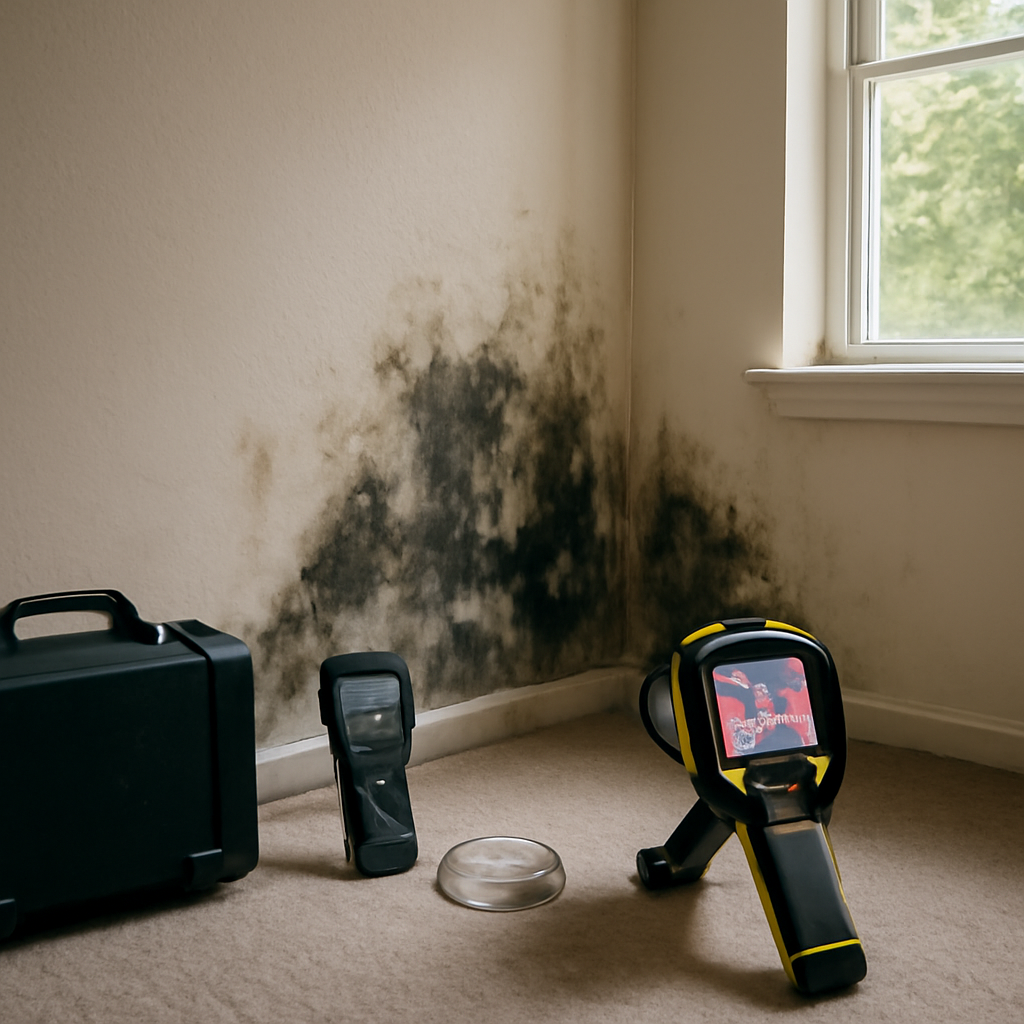
A mold assessment is an evaluation, not a cleanup. A qualified local assessor inspects the property, identifies and traces moisture sources, documents the extent and location of any growth, and produces a written report with recommendations. Many assessments include moisture readings, thermal imaging to find hidden dampness, and sometimes air or surface sampling sent to a laboratory.
The assessment answers the questions remediation depends on: Where is the mold? How much is there? What is feeding it? Is it in the HVAC system or hidden behind walls? Without that information, a remediation contractor is guessing. For surface mold under about 10 square feet with an obvious moisture source, the EPA notes a homeowner can often skip formal assessment and simply clean it. Assessment earns its cost when the problem is larger, hidden, recurring, or disputed. The overview at our mold inspection and testing hub describes what sampling can and cannot prove.
Assessment versus remediation: why the separation matters
This is the single most important concept when hiring. An assessment diagnoses the problem; remediation fixes it. The two roles can create a conflict of interest when one company performs both, because a firm that gets paid to remove mold has an incentive to find as much of it as possible during its own assessment.
Many experts and some state regulations recommend keeping the roles separate: hire an independent assessor to evaluate and write a scope, hire a separate remediation contractor to execute it, then use the independent assessor again for clearance testing to confirm the work succeeded. This arrangement gives you an unbiased opinion at the start and an unbiased verification at the end. For smaller, clearly visible problems the separation may be unnecessary, but for large or contested jobs it provides real accountability. Our guide to choosing a mold detection company explains how independent assessment keeps the process honest.
What a mold assessment costs
Pricing varies by region, property size, and whether laboratory sampling is included. Industry estimates put a basic visual assessment with moisture readings in roughly the $300 to $600 range. Adding air sampling typically pushes the total to about $450 to $1,000 or more, depending on the number of samples and lab fees. Larger homes, multiple problem areas, or complex hidden-moisture investigations cost more.
Some companies offer “free” mold assessments — usually remediation firms hoping to win the cleanup job. A free assessment from a company that profits from finding mold carries an obvious bias, so weigh that against the savings. A paid, independent assessment with no stake in the remediation outcome generally produces more trustworthy findings. Always get the scope and price in writing before scheduling.
When you actually need an assessment
Not every situation calls for a professional assessment. Consider one when:
A persistent musty smell has no visible source, suggesting hidden growth. Mold keeps returning after cleaning, pointing to an unaddressed moisture problem. Growth covers a large area or appears in multiple rooms. There has been flooding, a major leak, or sewage backup. You are buying a home and want to know its condition before closing. A real estate transaction, insurance claim, or landlord-tenant dispute requires documented findings. Or household members have unexplained respiratory symptoms that improve away from home.
For a small, visible patch on a hard surface with an obvious cause, you can usually skip assessment and clean it yourself following the steps in our guide on how to remediate mold.
Types of mold sampling and what each shows
If an assessor recommends sampling, it helps to understand what each method actually measures so you can judge whether it is worth the cost.
Air sampling. Pulls a measured volume of air through a collection device to capture spores, then compares indoor counts to an outdoor baseline taken the same day. Elevated indoor counts relative to outdoors can indicate hidden growth. Air sampling is most useful when there is a musty smell but no visible source.
Surface sampling (swab or tape lift). Collects material from a suspect spot to confirm whether a visible growth is mold and, at a lab, what genus it is. This confirms a suspicion but does not measure how much is airborne.
Bulk sampling. Sends a piece of the actual material — a chunk of drywall or carpet — to the lab. Useful when deciding whether a material must be removed.
The EPA does not recommend routine sampling in most homes, because if you can see or smell mold, you already know to remove it and fix the moisture regardless of species. Sampling adds value mainly for hidden-source investigations, clearance verification after remediation, and documented disputes. Be cautious of an assessor who pushes extensive sampling before doing any moisture investigation — that often signals an upsell rather than a real diagnostic need.
What a good assessment report looks like
The deliverable is the whole point of paying for an assessment, so know what a strong one contains. A useful report includes a description of the areas inspected, photographs of findings, moisture readings and thermal images where taken, lab results if samples were collected, a clear statement of the suspected moisture source, an estimate of the extent and location of growth, and specific, prioritized recommendations. It should distinguish what must be removed from what can be cleaned, and it should give you enough detail to solicit apples-to-apples remediation bids.
A weak report is vague — “mold present, remediation recommended” with no extent, no moisture source, and no specifics. That kind of report mainly serves to justify a sales pitch. If you cannot hand the document to three remediation contractors and get comparable quotes from it, it is not doing its job.
How to vet a local mold assessor
The quality of an assessment depends heavily on who performs it. Use this checklist for any “near me” candidate.
Independence. Prefer assessors who do not also profit from remediation, or who clearly separate the two functions. This is the biggest single factor in getting an unbiased report.
Credentials. Look for relevant training and certifications, and check whether your state licenses or registers mold assessors. Some states, such as Florida and Texas, regulate the profession; others do not.
Methodology. A good assessor explains how they will investigate — moisture mapping, thermal imaging, and sampling only where it adds value. Be cautious of anyone who leads with expensive sampling before identifying moisture.
Written report. Confirm you will receive a clear written report with findings, photos, moisture data, lab results if applicable, and specific recommendations.
Lab accreditation. If samples are taken, ask whether they go to an accredited laboratory.
Reviews and references. Read recent local reviews and ask for references from similar assessments.
Red flags when choosing an assessment service
A few signals should give you pause. Be wary of a company that uses fear-based “toxic black mold” language to pressure immediate, expensive action — the CDC and EPA both downplay species-specific toxicity alarmism and emphasize that all significant indoor mold should simply be removed and the moisture fixed. Be skeptical of a “free assessment” that exists mainly to sell a large remediation contract, of sampling pushed before any moisture investigation, of refusal to provide a written report, and of vague recommendations that lack specifics. Quality assessment is methodical and calm, not a sales pitch.
What you do with the results
A useful assessment hands you a plan: the moisture sources to fix, the extent of growth, which materials must be removed, and how to verify success. With that report, you can solicit remediation bids on an apples-to-apples scope and avoid the vague flat-rate quotes that lead to surprise charges. After remediation, the same independent assessor can perform clearance testing to confirm the area is clean and dry. This bookended approach — independent assessment, separate remediation, independent clearance — is the gold standard for larger jobs.
Assessment for real estate transactions
One of the most common reasons to order an assessment is a home purchase or sale, and the dynamics differ from a routine homeowner concern. A buyer who notices staining, a musty smell, or evidence of past water during a general home inspection may want a focused mold assessment before closing, since a standard home inspection identifies visible moisture concerns but does not typically include mold sampling or a remediation scope. The assessment gives the buyer a documented basis to negotiate repairs, request a price adjustment, or walk away.
For sellers, a clean independent assessment can preempt buyer concerns, while a documented remediation with clearance testing reassures buyers that a past problem was properly resolved. In a transaction, independence matters even more than usual: a report from a party with no stake in selling remediation, and clearance testing performed by someone other than the crew that did the work, carries the most weight with the other side and their inspector. Keep the report, lab results, and remediation invoices together as a package to hand over at closing.
What the assessment cannot do
Setting expectations prevents disappointment. An assessment cannot prove your home is “mold-free” — spores exist everywhere, indoors and out, so no realistic test returns zero. It cannot diagnose health conditions; only a physician can connect symptoms to an environment. It cannot, in most cases, definitively prove a specific mold species caused a specific illness, because the science linking species to general-population illness is weaker than marketing suggests. And a single air sample is a snapshot that can vary with weather, ventilation, and recent activity, so one elevated or normal reading is interpreted alongside the visual and moisture findings rather than treated as a verdict. A good assessor frames results in this honest context rather than overselling certainty.
Front Range considerations
Colorado’s dry climate keeps general mold pressure lower than in humid regions, but it does not remove the need for assessment. Basement seepage, plumbing leaks, winter window condensation, and summer monsoon moisture against poorly graded foundations all create localized growth that can hide behind finished walls. Local assessors should still follow the same standards — independence, moisture mapping, written reports, and accredited labs — and the dry air can make subsequent structural drying faster once a source is found and fixed.
When to call a professional
Schedule a professional mold assessment when a musty odor has no visible source, when growth is large or recurring, after flooding or sewage, during a real estate transaction, or when occupants have ongoing respiratory symptoms. Prioritize independent assessors who provide written reports, use accredited labs, and do not pressure you with toxicity scare tactics. Comparing two or three vetted local options on independence and methodology — not on price or free offers alone — gives you the most reliable diagnosis.
References
- Mold Cleanup in Your Home — U.S. Environmental Protection Agency
- A Brief Guide to Mold, Moisture and Your Home — U.S. Environmental Protection Agency
- About Mold and Health Effects — Centers for Disease Control and Prevention
- Mold and Dampness Indoors — American Lung Association
If you want an independent read on a possible mold problem before committing to remediation, Front Range homeowners can connect with a vetted local inspector through our contact page.