How Do You Tell If Black Mold Is Making You Sick
Only a physician can diagnose whether mold exposure is causing illness in a specific person. No checklist, online quiz, or home test can answer that question. Anyone with symptoms they suspect are related to mold should see a physician for clinical evaluation — diagnosis requires a clinician with access to the patient’s history, exam findings, and appropriate testing. This article paraphrases EPA, CDC, and NIEHS guidance on residential mold and is written for homeowners; it is not medical advice. The home-side question — how to identify whether mold is present in the home, where it is, and how to address it — is what the rest of this guide covers. The medical and home-side questions are separate and should both be pursued in parallel.
Part of our Black Mold & Your Health guide — start there for the full picture →
Is this mold, asbestos, or water damage? Get a free instant screen
Upload a clear photo of the suspect area. You'll get an instant AI screening opinion and what to do next. This is screening guidance, not a professional determination.
Screening guidance only. AI can be wrong. Confirm asbestos, mold type, or lead with lab testing or a licensed professional before acting.
The separation that matters
“Is mold making me sick?” combines two questions that should be answered separately. The first is medical: do my symptoms match a mold-related diagnosis as evaluated by a clinician? The second is environmental: is there mold in my home, and if so, where? The medical question requires a physician. The environmental question is what homeowners can investigate directly. Conflating them leads to two errors — assuming symptoms are mold-related without medical evaluation, or assuming the home is fine without inspection. Both errors delay resolution.
Home-side identification — the visible signs
EPA’s homeowner mold guide emphasizes visual identification as the primary detection method. The visible signs of indoor mold:
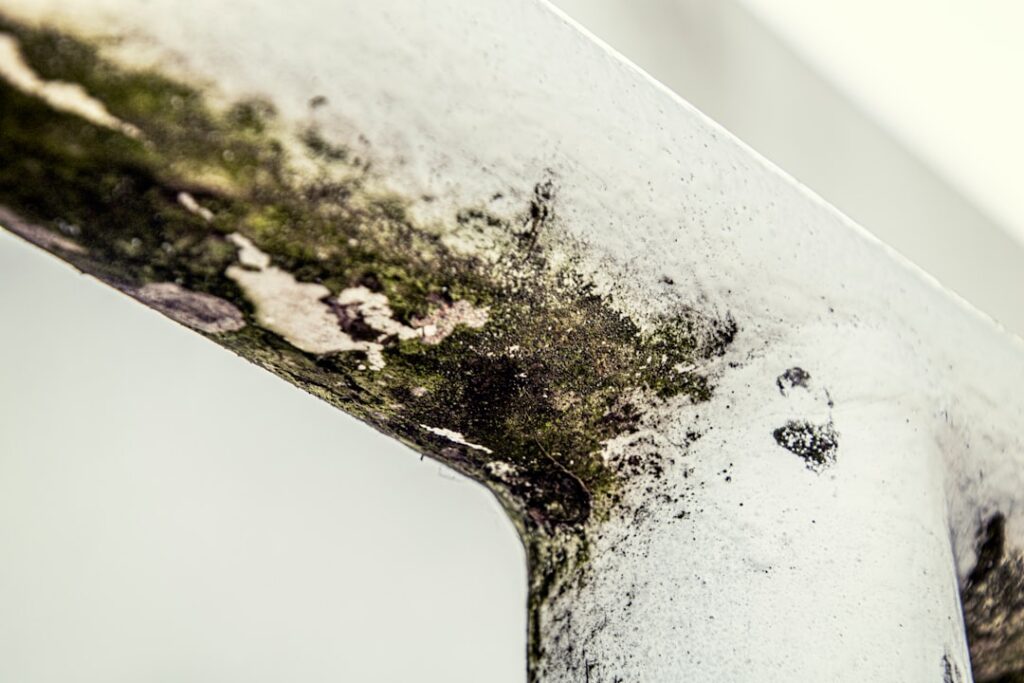
- Direct visible growth — colonies on drywall, ceiling tile, baseboards, window sills, grout, caulk, or HVAC components. Colors range from black through green, brown, white, pink, and orange depending on species.
- Discoloration suggesting subsurface growth — yellowish or brownish staining on drywall or paint, often with a wavy edge pattern indicating moisture movement.
- Peeling paint or wallpaper caused by moisture beneath the surface coating.
- Warped baseboards, cupped flooring, or buckled drywall from sustained moisture exposure.
- Efflorescence (white crystalline deposit) on basement walls and floors, indicating moisture has been carrying minerals through the substrate.
- Visible water staining on ceilings, walls, or floors from current or past leak events.
Where to look
Front-line locations for visible mold are bathrooms (grout, caulk, fan grilles, behind toilets), kitchens (under sinks, behind dishwashers and refrigerators), laundry areas (washer hoses, dryer venting), basements (perimeter walls, floor seams, sump areas), attics (under roof penetrations, around vents), and HVAC components (return interior, supply register interiors, evaporator coil). The in-batch piece on where to find black mold covers location patterns in detail.
Home-side identification — the olfactory signs
Musty or earthy odor is the second-strongest indicator of indoor mold. The smell comes from microbial volatile organic compounds (mVOCs) released as colonies metabolize substrate. Important characteristics of the mold smell:
- It localizes — strongest near the colony, weaker elsewhere in the home.
- It intensifies after rain, after HVAC operation cycles, or when humidity rises.
- It is distinct from the “dusty” smell of long-closed rooms or the “wet basement” smell of high humidity without mold.
- It often persists even after surface cleaning if the colony is in a hidden cavity.
Homeowners doing systematic inspection should walk room-by-room sniffing along walls at floor and ceiling levels. The HVAC return is another high-yield location — turn the system on briefly and smell the air at the closest supply register.
Home-side identification — moisture history
The third leg of home-side identification is moisture history. Mold cannot establish without sustained moisture, so any documented past wetness in the home is a candidate location.
- Plumbing leak history — supply lines, drains, ice maker lines, dishwasher hoses, water heater.
- Roof leak history — ice dam damage, flashing failures, shingle damage from hail.
- Basement seepage history — perimeter drainage events, sump failures, hydrostatic pressure through cracks.
- HVAC events — condensate drain backups, coil drain pan failures, blower-cabinet condensation.
- Appliance events — refrigerator water-line drips, washer hose ruptures.
- Storm and weather events — wind-driven rain infiltration, snow accumulation against walls.
The Front Range pattern is that small leaks dry out faster than humid-climate equivalents but still produce colonies if the leak was prolonged or hidden. Any documented past event within the previous 12 months is a candidate location for inspection.
Tools beyond eyes and nose
When visible inspection is inconclusive, instrument-based detection is the next layer:
- Pin-type moisture meters read substrate moisture content; readings above ~18 percent for wood framing indicate mold-supporting conditions.
- Pinless capacitance moisture meters identify subsurface dampness without piercing the surface.
- Infrared thermography highlights temperature differentials suggesting hidden moisture behind walls.
- Inspection cameras on flexible cables fit through small access holes to view wall cavity interiors.
- Hygrometers measure indoor relative humidity; readings above 60 percent for sustained periods support growth.
The parent guide on mold inspection and testing covers tool-based detection in depth.
Air sampling — limits and uses
Some homeowners ask whether air sampling can confirm whether mold is present or affecting them. EPA and CDC both note that air sampling has limited diagnostic value because spore counts vary dramatically with location, time of day, weather, HVAC operation, and recent surface disturbance. A single sample is rarely informative. Paired indoor-outdoor sampling provides comparison context but does not confirm causation of any specific symptom.
Air sampling is most useful in three scenarios: post-remediation verification that cleanup was effective, litigation or insurance documentation, and physician-directed environmental assessment as part of a specific clinical evaluation. The companion piece on [black mold in air](https://inspectandtest.net/guides/black-mold-in-air/) covers protocols and limits in more detail.
What the home-side investigation can and cannot tell you
The home investigation can tell you whether mold is present in the home, roughly where it is, and how much. It can identify the moisture source feeding it and the materials that need remediation. It can document conditions for medical, insurance, or transaction purposes. It cannot tell you whether a specific person’s symptoms are caused by that mold; that determination requires medical evaluation.
This is why the two workstreams run in parallel. A home investigation can confirm “yes, there is significant indoor mold” without resolving the medical question, and vice versa.
If the home investigation finds nothing visible
When systematic visual inspection, moisture-meter survey, HVAC interior check, and hidden-cavity inspection all turn up no mold, three possibilities deserve consideration:
- The home is clear. Symptoms may be caused by another household exposure (dust mites, pet dander, fragrances, chemical sensitivities) or by something unrelated to the home entirely. The physician’s evaluation continues with broader differentials.
- Hidden growth remains undetected. Some colonies require destructive investigation to confirm. Selective demolition in highest-suspicion areas, guided by moisture-meter data and infrared imaging, may be warranted.
- Source has been eliminated but exposure history matters. A colony that existed and was remediated months ago might still leave a clinical question about past exposure, which is a physician’s territory.
If the investigation finds visible mold
Once visible mold is confirmed, the response is straightforward: identify the moisture source, repair it, remove the affected materials, clean adjacent surfaces, verify drying, document the work. EPA’s homeowner workflow handles non-porous patches under approximately ten square feet; larger or HVAC-involved cases warrant professional remediation per the IICRC S520 standard. The in-batch piece on [remedies for mold exposure](https://inspectandtest.net/guides/remedies-for-mold-exposure/) covers the remediation workflow in detail.
Documentation supports physician coordination
For households in which medical evaluation is ongoing alongside home investigation, documentation matters for both. Photographs of any visible mold, moisture-meter readings, HVAC interior photos, dates of past leak events, and any contractor reports together form an environmental record. The CDC notes that environmental documentation is useful clinical context even though it does not by itself diagnose any condition. A treating physician can incorporate the documentation into the broader clinical evaluation.
Front Range investigation patterns
Three Front Range patterns produce the most home-investigation findings. Older Denver and Boulder county homes with bathrooms lacking proper exhaust ventilation show shower-area colonies on tile, grout, and ceiling drywall. Mid-century homes with attic-vented bath fans show roof-deck mold above bathrooms. Homes with finished basements in Adams, Jefferson, and Douglas counties show perimeter-wall colonies behind drywall along the bottom 12 inches. Inspection priorities should follow these patterns.
Tools homeowners can rent versus tools that require expertise
Several inspection tools are available to homeowners at home-improvement stores or rental outlets, but their useful range varies with operator expertise.
- Hygrometer: $15-$50 retail. Anyone can read indoor relative humidity directly.
- Pin-type moisture meter: $30-$150 retail. Direct readings are straightforward to interpret with the user manual; readings above ~18 percent on wood indicate mold-supporting conditions.
- Pinless capacitance moisture meter: $40-$200 retail. Useful for surveys but interpretation requires comparing readings across known-dry and suspected areas.
- Inspection cameras with flexible cables: $50-$300 retail. The hardware is accessible; getting useful images through small access holes requires practice.
- Infrared thermography: entry-level smartphone modules at $200-$500; professional handheld units at $1,500-$5,000. Smartphone modules can identify gross temperature differentials; meaningful interpretation requires knowledge of building science and pattern recognition.
- Air sampling cassettes: $50-$200 per cassette plus $50-$150 per lab analysis. Sample collection seems straightforward but proper protocol — flow rates, sample duration, control samples — affects interpretation significantly.
Homeowners can productively use hygrometers and basic moisture meters. The other tools generally provide more value in the hands of an experienced inspector who can correlate readings with building configuration and historical context. The parent guide on [mold inspection methodology](https://inspectandtest.net/mold-inspection/) covers the tool-based assessment in more detail.
Sequence for a productive home investigation
A homeowner doing a productive systematic investigation might follow this sequence over a Saturday:
- Begin with a hygrometer reading in each room. Note any rooms above 50 percent indoor RH.
- Walk each room slowly with a flashlight, looking at baseboards, window sills, ceiling-to-wall transitions, and around plumbing fixtures.
- Smell along walls at floor and ceiling level for musty or earthy odor.
- Open under-sink cabinets in kitchens, bathrooms, and laundry areas; flash the cabinet interior for staining.
- Remove HVAC return grilles and supply registers; flash the duct interior.
- Walk the basement perimeter; note any staining or efflorescence on walls and floor seams.
- Inspect crawlspaces where present; note floor framing condition and any standing moisture.
- Climb into the attic; flash the underside of roof decking, especially around penetrations.
- Take pin-type moisture meter readings in any suspect areas; record numbers for later comparison.
- Document findings with photographs and notes; identify which areas warrant follow-up.
The investigation typically takes 2-4 hours for a typical single-family home and yields a clear picture of where mold is and where it isn’t.
When self-investigation should escalate
Several thresholds in the homeowner investigation indicate professional involvement is appropriate:
- Visible mold larger than approximately ten square feet on accessible surfaces.
- Suspected hidden growth in inaccessible wall, ceiling, or floor cavities.
- HVAC duct interior contamination visible through register removal.
- Households with immune-compromised occupants or individuals with significant respiratory disease.
- Persistent musty odor despite no visible source after systematic inspection.
- Documentation requirements for medical evaluation, insurance, or real estate transactions.
- Any colony associated with sewage or contaminated water (Category 3 water per IICRC S500).
These thresholds reflect both safety concerns (larger colonies require containment expertise) and verification concerns (documented professional remediation supports downstream uses better than informal homeowner work).
References
- Mold Cleanup in Your Home — U.S. Environmental Protection Agency
- About Mold — Centers for Disease Control and Prevention
- Mold — National Institute of Environmental Health Sciences
- Mold and Dampness — American Lung Association
Frequently asked questions
How can I tell if mold is making me sick?
Only a physician can make that determination. The home-side question — is there mold in the home — is separate and can be investigated through visual inspection, moisture surveys, HVAC interior checks, and hidden-cavity inspection.
What does indoor mold smell like?
Musty or earthy, distinct from the dusty smell of closed rooms. The smell localizes near colonies and intensifies after rain, HVAC cycles, or humidity increases. Hidden colonies often produce odor even when surfaces appear clean.
Is there a reliable home test?
Visual inspection paired with moisture-meter readings is the EPA-aligned baseline. Air sampling has limited diagnostic value per EPA and CDC; spore counts vary too much with sampling conditions for single samples to be reliably interpreted.
What if I find no visible mold but still have symptoms?
The home may be clear of mold even if symptoms persist — many household exposures produce similar reactions. The physician's evaluation continues with broader differentials. Selective demolition is warranted only when moisture-meter data strongly suggests hidden growth.
Front Range homeowners seeking systematic home investigation for suspected indoor mold can reach a vetted local inspector through our contact page.