How to Tell If Something Is Black Mold: Plain Guide
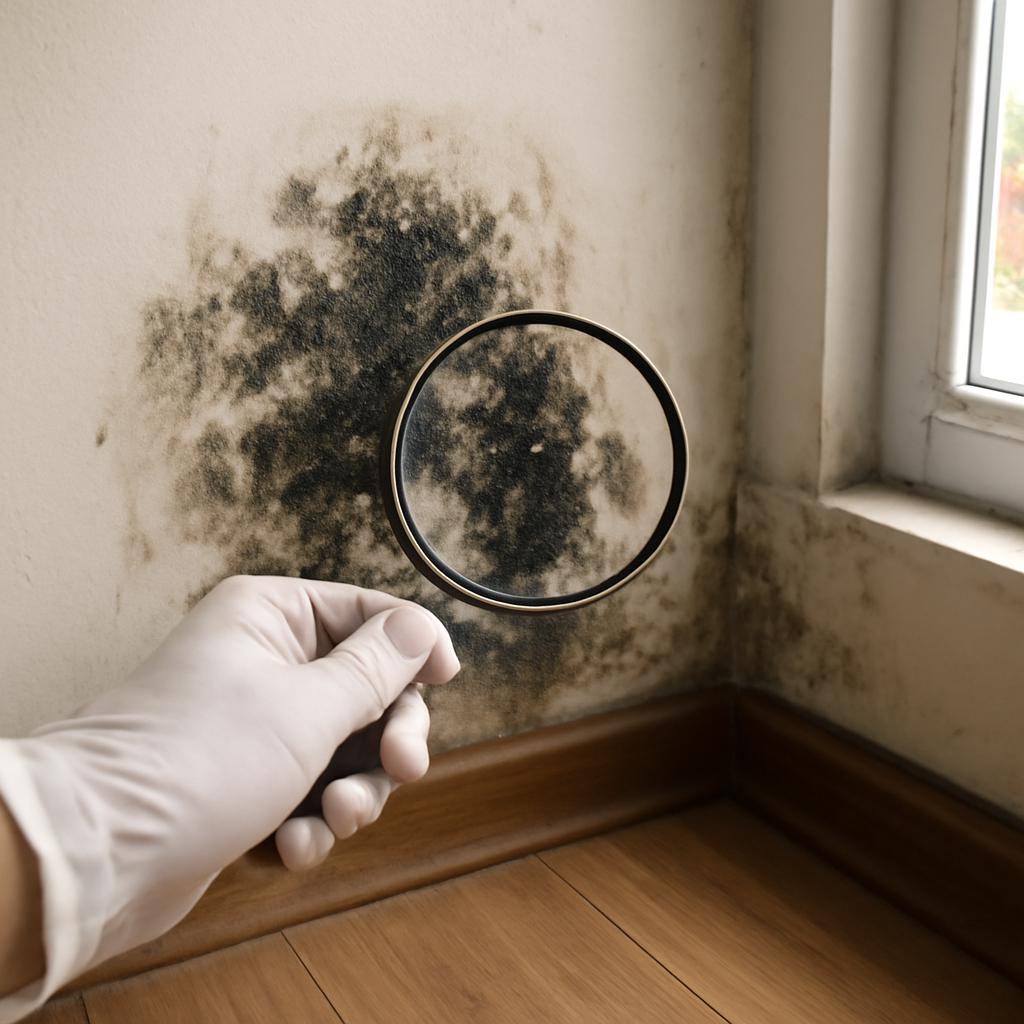
Homeowners ask how to tell if something is black mold when they spot a dark patch and the internet has already convinced them it might be the dangerous species. The honest answer requires reading several cues at once — color, texture, growth pattern, moisture history, and odor — and resisting the urge to confirm or deny a species by sight alone. This guide summarizes EPA and CDC guidance current as of 2026 and walks through how to decide what response a dark patch actually deserves. Consult your physician for symptoms and a certified professional for testing decisions.
Part of our Black Mold & Your Health guide — start there for the full picture →
Is this mold, asbestos, or water damage? Get a free instant screen
Upload a clear photo of the suspect area. You'll get an instant AI screening opinion and what to do next. This is screening guidance, not a professional determination.
Screening guidance only. AI can be wrong. Confirm asbestos, mold type, or lead with lab testing or a licensed professional before acting.
How can a homeowner tell if a patch is black mold?
The short answer is that you cannot confirm a species without lab analysis. The Environmental Protection Agency is explicit on this point — visual identification alone does not establish whether dark growth is Stachybotrys chartarum, Cladosporium, Aspergillus, or another genus. What homeowners can do is build a probability picture using several factors at once. Color is the weakest signal. Growth pattern, moisture context, and texture are stronger.
If the patch is on a chronically damp cellulose surface, has a slimy or wet sheen, follows a clear water-staining line, and sits in a poorly ventilated area with a musty odor, the probability that it is Stachybotrys is higher than for a flat dark patch on shower grout in a frequently used bathroom. Even then, lab confirmation is the only certain answer.
What visual cues suggest black mold rather than other mold?
Stachybotrys colonies tend to be greenish-black to deep black, with a slimy or wet sheen when active and a powdery look when dry. The growth pattern almost always tracks a sustained moisture source. Patches are commonly irregular and may show a slightly raised, almost rubbery texture compared with the flat appearance of Cladosporium. Active colonies often release a strong musty odor caused by microbial volatile organic compounds.
That description overlaps with other dark molds. Cladosporium is more common and can also appear black, especially on grout and caulk. Aspergillus colonies often look powdery and may darken with age. The Centers for Disease Control and Prevention notes that color and texture overlap heavily across genera. The strongest single cue is context — what surface is it on, how long has it been wet, and is there a chronic leak nearby.
Texture differences worth checking
Surface mildew rubs off easily with a damp cloth. Active mold growth leaves a stain, smears when wiped, and often regrows within days if the underlying moisture is not corrected. Tannin extractives on softwoods can appear dark and mold-like but rub off as dust. The way a patch responds to a clean cloth is one of the simplest early tests.
What moisture context points to black mold?
Stachybotrys needs sustained near-saturating moisture on cellulose for at least a week before colonization. That points to chronic-leak situations rather than intermittent humidity. Slow plumbing leaks, ground water intrusion through foundation walls, roof leaks that have run for weeks, HVAC condensate pan overflows, and chronically high relative humidity above about 60 percent are the most common triggers. The EPA lists these conditions as the primary residential moisture sources to address.
In Colorado, swamp coolers feeding humid air into unconditioned basements during summer, foundation seepage during snowmelt, and HVAC return-cavity moisture issues are common Front Range triggers. Our overview of how to tell black mold from regular mold at home details the moisture history cues that shift the probability picture.
Can a home test kit confirm black mold?
Most consumer test kits are limited in what they actually tell a homeowner. Petri-dish settle plates collect whatever happens to fall during the exposure period. They do not produce concentration data, and the genera that grow on a generic agar plate are not necessarily what is present at a problem area. Some kits send samples to a lab for genus-level identification, which is more useful but still depends on where the sample was taken.
A trained mold assessor will use targeted methods. Tape lifts on visible growth. Swabs in suspect cavities. Air samples paired with outdoor reference samples taken the same day. The outdoor baseline is what makes an indoor air sample interpretable. Stachybotrys spores are heavy and tend to stay close to the source, so a clean air sample does not always rule out hidden growth.
When testing actually pays off
Testing is worth its cost in three specific cases. First, a real estate transaction where the buyer or seller needs documentation. Second, occupant health concerns where indoor air quality is suspected. Third, post-remediation clearance verification by an independent assessor. For everyday surface patches, the EPA and CDC both recommend visible cleanup over species identification.
What size patch should change the response?
The EPA’s residential mold guidance uses about 10 square feet as a practical threshold. Patches under that size on hard or semi-porous surfaces can be cleaned by a homeowner using detergent and water, with N95 mask, gloves, and goggles. Larger patches, growth tied to a structural moisture source, repeated regrowth, or growth on structural framing warrant a professional remediator with containment and HEPA filtration.
Some assessors prefer containment for any suspected Stachybotrys regardless of size because of spore dispersal during demolition. The decision is more about containment than chemistry. Detergent removes biomass on both Cladosporium and Stachybotrys. The difference is whether plastic-sheeted containment is set up before scrubbing begins.
What odor signals point to black mold?
Active colonies of many species produce a musty, earthy odor. The smell is caused by microbial volatile organic compounds, and it tends to be stronger in poorly ventilated spaces. A persistent musty smell in a basement, closet, or behind cabinets is a reasonable trigger to look behind baseboards, inside wall cavities, and at HVAC return chambers. Smell is not species-specific — Cladosporium, Aspergillus, Penicillium, and Stachybotrys all produce mVOCs.
Smell reduction after a dehumidifier run does not mean remediation. Dried colonies often smell less but still hold viable spores. The biomass remains until physically removed.
What should homeowners do once they suspect black mold?
Do not disturb the patch immediately. Take photographs. Note the surface type, the size, and any visible water-source clues. Identify and correct the moisture source before any cleanup. Our mold inspection hub walks through how assessors approach the question and how it differs from remediation contractor visits.
For DIY cleanup of small patches, detergent and water with N95 protection, gloves, and goggles is the EPA-recommended starting point. Bleach is the wrong tool on porous surfaces. After cleaning, the surface should dry below about 16 percent moisture content on a pin or pinless meter before painting or sealing. If growth returns or if the patch is larger than 10 square feet, escalate to a certified assessor.
How does context narrow the identification?
A dark patch on a chronically damp basement framing member sits in a different probability bracket than the same patch on bathroom grout. Context matters more than color in narrowing the possibilities. The Environmental Protection Agency recommends combining visual inspection with moisture history, surface type, and ventilation conditions when deciding whether a patch warrants species testing.
Walk through the room with the patch in mind. Is there a known leak history? Is the surface cellulose-rich — drywall, wood, paper-faced insulation, vinyl wallpaper backing, carpet padding? Is the area poorly ventilated? Does humidity routinely climb above 60 percent? Each yes shifts the probability toward Stachybotrys. Each no shifts it toward more common species like Cladosporium.
What does a professional assessor look for?
Certified mold assessors combine the same visual cues homeowners use with moisture mapping, thermal imaging, and targeted sampling. They start with a walk-through that documents visible growth and obvious moisture sources. Then they map moisture readings across walls, floors, and ceilings — looking for hidden patches with elevated readings. Thermal imaging helps locate areas with evaporative cooling that suggests active moisture. Sampling decisions follow the mapping rather than preceding it.
The assessor-versus-remediator distinction matters here. An assessor’s job is to identify the problem accurately. A remediator’s job is to fix it. Combining the two roles in a single contractor creates an incentive misalignment — the same person who tells you what is wrong also tells you how much it costs to fix. Separating assessment and remediation produces cleaner scopes.
When to call a professional
Engage a certified mold assessor when the visible patch exceeds 10 square feet, when occupants have asthma or immune compromise, when growth recurs after cleaning, when a real estate transaction needs documentation, or when there is suspected cavity growth that cannot be inspected without partial demolition. Use the InterNACHI mold standard of practice as a vetting baseline. Prefer assessors who do not also sell remediation for the same job — that separation of duties is the cleanest protection against inflated scopes.
The Colorado Department of Public Health and Environment publishes general guidance on indoor air quality and on choosing qualified contractors. Front Range homes with finished basements and swamp-cooler setups face moisture-source questions more often than dry-climate homes elsewhere in the country.
References
- Mold cleanup in your home — U.S. Environmental Protection Agency
- Stachybotrys chartarum facts — Centers for Disease Control and Prevention
- Mold inspection standards of practice — InterNACHI
- Mold and indoor air quality — National Institute of Environmental Health Sciences
Frequently asked questions
Can I confirm black mold just by looking?
No. The Environmental Protection Agency states that visual identification alone cannot determine a mold species. Color, texture, and growth pattern provide probability cues, but lab analysis of a surface or air sample is the only definitive way to confirm Stachybotrys.
Are home mold test kits useful?
Most consumer settle-plate kits collect whatever happens to fall during exposure and do not produce reliable concentration data. Lab-analyzed swab or tape-lift kits are better, but a trained assessor who pairs indoor and outdoor samples produces more interpretable results.
What size patch counts as DIY territory?
EPA guidance permits homeowner cleanup for patches under about 10 square feet on hard or semi-porous surfaces, using detergent, water, N95 protection, gloves, and goggles. Larger patches, recurring growth, or growth on structural framing call for a professional remediator.
Does a musty smell prove black mold?
No. Many mold species produce microbial volatile organic compounds that create a musty odor. The smell is a useful trigger to investigate, but it does not identify the species. Visual inspection plus moisture-history review still leads the decision.
Homeowners along the Front Range trying to read a suspicious patch can connect with a vetted local inspector through our contact page for an independent assessor visit before any cleanup begins.