Healthful Home 5-Minute Mold Test: What to Know
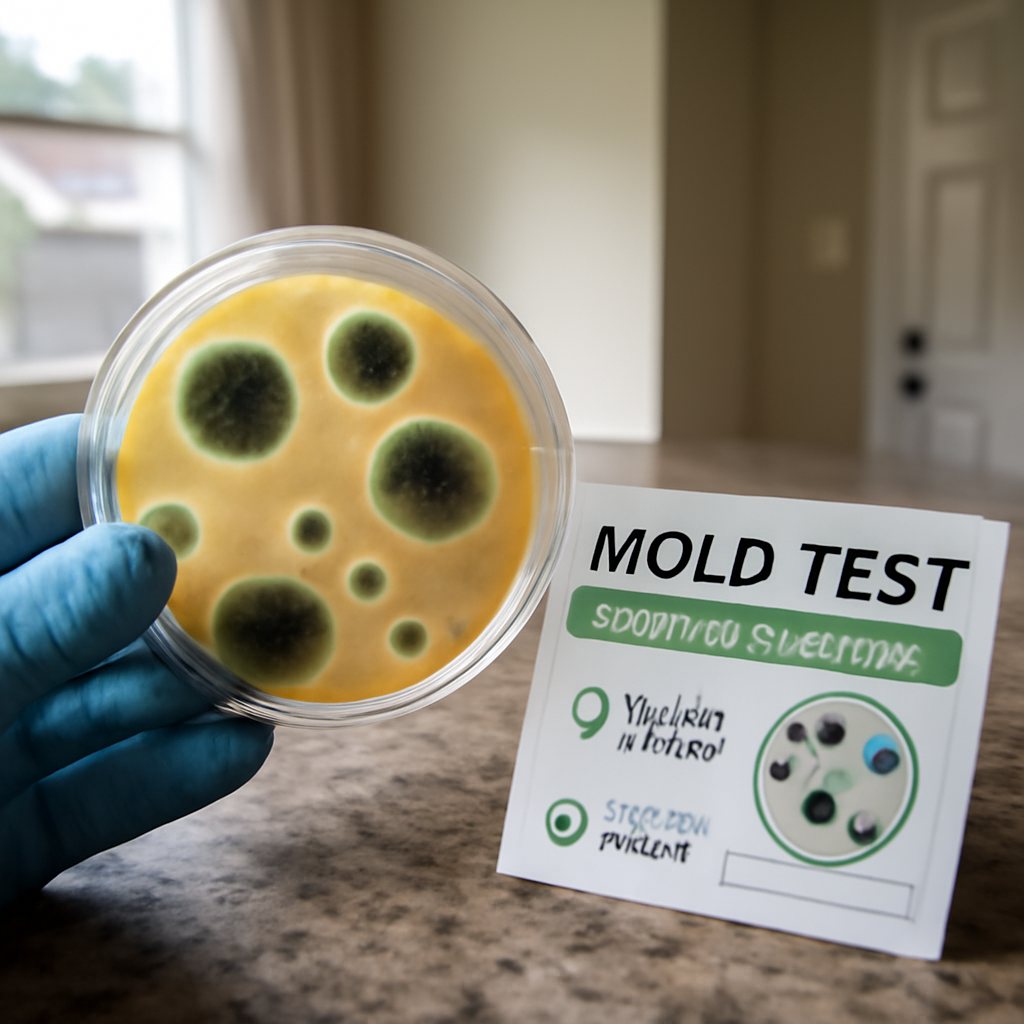
Rapid at-home kits promise answers in minutes, and the Healthful Home 5-minute mold test is one of the better-known examples marketed to worried homeowners. The appeal is obvious: a quick reading without waiting on a lab. Understanding what a rapid antigen-style mold test actually measures — and what it cannot tell you — keeps expectations realistic before you spend money or make decisions about your home. This guide summarizes EPA and CDC guidance current as of 2026 — consult your physician about symptoms and a certified professional for testing and remediation decisions.
Part of our Black Mold & Your Health guide — start there for the full picture →
Is this mold, asbestos, or water damage? Get a free instant screen
Upload a clear photo of the suspect area. You'll get an instant AI screening opinion and what to do next. This is screening guidance, not a professional determination.
Screening guidance only. AI can be wrong. Confirm asbestos, mold type, or lead with lab testing or a licensed professional before acting.
What the Healthful Home 5-Minute Mold Test Is
The Healthful Home 5-minute mold test is a rapid lateral-flow test designed to detect mold antigens on a surface or in dust, returning a result in roughly five minutes rather than the days a lab culture requires. You collect a sample with a swab, mix it with the supplied solution, apply it to a test strip, and read lines similar to the format of a home pregnancy or rapid illness test. A control line confirms the test ran; a test line indicates detection of mold proteins.
The selling point is speed and simplicity. There is no shipping, no lab fee, and no waiting. That convenience comes with real limitations, though, and the EPA’s longstanding position is that sampling is generally not necessary if mold is visible — the appropriate response is to clean it up and fix the moisture regardless of what a test says. For context on how home kits fit into the bigger picture, the overview of home mold test kits compares the main types.
It is worth being clear about what “5-minute” describes. The five minutes refers only to the strip’s read time once you have prepared the sample, not to a complete assessment of your home. Collecting a meaningful sample, deciding where to swab, and interpreting the result thoughtfully take longer and require judgment the strip cannot supply. The speed is genuine, but it applies to a narrow step in a much larger question about whether you have a moisture problem and where it is.
How the Rapid Test Works
Lateral-flow tests rely on antibodies that bind to specific mold antigens. When you swab a surface and apply the prepared sample to the strip, any target antigens present travel along the strip and bind at the test line, producing a visible mark. The control line shows the test functioned correctly.
The five-minute speed is the key difference from culture-based methods. A petri-dish test, by contrast, requires incubating a sample for days to grow visible colonies, and a lab analysis of a tape or air sample can take a week or more. The trade-off is depth of information. A rapid strip gives a presence-style reading; it does not grow, count, or identify species the way a laboratory can. The guide on mold petri dish tests explains the slower culture approach for comparison.
What the Results Mean
A positive result indicates the test detected mold antigens in your sample. A negative result suggests it did not detect them at the test’s sensitivity threshold. Neither result tells you how much mold is present, what species it is, whether the level is unusual for an indoor environment, or where a hidden problem might be.
Mold spores exist in virtually every indoor and outdoor environment, so detecting some mold is normal and expected. That is part of why the EPA does not publish a safe indoor spore “threshold” — there is no federal standard for acceptable mold counts in homes. A positive rapid test, then, is not by itself proof of a problem requiring remediation, and a negative test does not guarantee a home is mold-free, particularly if you sampled the wrong spot or a hidden area went untouched.
Accuracy and Limitations
Rapid home tests are best understood as screening tools, not diagnostic instruments. Several limitations apply:
- No quantification. The strip does not measure concentration, so it cannot distinguish normal background mold from a serious infestation.
- Sampling error. Results depend entirely on where you swab. Mold hidden inside walls, under flooring, or in ductwork can be missed entirely.
- No species identification. The test does not tell you which mold is present, information a lab provides.
- Surface dependence. A single swab samples a tiny area and may not represent the room.
The EPA’s guidance is consistent: if you can see or smell mold, you have your answer and should clean it up and address moisture, rather than relying on a test result to decide. Testing is more useful when growth is suspected but not visible, and even then professional sampling generally yields more reliable, interpretable data than a consumer strip.
There is also the matter of false reassurance, which can be the most costly limitation. A homeowner who runs a rapid test, gets a negative line, and concludes the house is fine may stop looking — even though the strip only sampled one small spot and could easily have missed mold inside a wall, under flooring, or in the HVAC system. A test that discourages further investigation when a real problem exists is worse than no test at all. For that reason, a negative rapid result should never override the evidence of a musty smell, visible staining, or symptoms that track with time at home.
How to Collect a Useful Sample
If you do use a rapid test, the quality of the result depends almost entirely on how you sample. Follow the kit’s instructions precisely, since deviating from the swab technique or solution volume can skew the reading. Choose the spot deliberately: a surface that looks suspicious, a damp area, or a location near a musty smell gives more meaningful information than a random clean wall.
Avoid contaminating the swab by touching its tip or setting it down, and take the sample when conditions are representative rather than right after heavy cleaning, which can temporarily suppress surface growth. Recognize, too, that a single swab samples a tiny area; one strip cannot characterize a whole room, let alone a whole house. If you genuinely want to understand a suspected hidden problem, multiple samples or a professional assessment with paired indoor and outdoor sampling will tell you far more than one rushed swab ever could.
Rapid Strips vs. Petri Dishes vs. Professional Sampling
Putting the rapid test alongside its alternatives clarifies where it sits. A rapid lateral-flow strip gives a fast presence-style reading and nothing more — no count, no species, no growth. It is the quickest and usually the least informative option.
A culture or settling-plate kit, by contrast, grows what lands on it over several days, so you can sometimes see and roughly compare colony growth, and a lab can identify what grew if you pay for analysis. That depth costs days of waiting. A professional assessment is different again: an assessor collects paired indoor and outdoor air samples with calibrated equipment, sends them to an accredited lab, and interprets the results against the outdoor baseline that makes indoor numbers meaningful. Each step up the ladder trades speed for reliability and interpretability. The right choice depends on the question. For idle curiosity about a visible spot, a strip may suffice; for a decision that affects a purchase, a health concern, or a remediation budget, professional sampling is the sound choice.
When a Rapid Test Helps and When It Does Not
A five-minute test can offer reassurance or a quick flag in limited situations — for example, checking a surface that looks suspicious before deciding whether to investigate further. It is inexpensive and fast, which suits casual curiosity.
It is the wrong tool, however, for several common scenarios. If mold is visible, skip the test and clean. If you smell a persistent musty odor but see nothing, a single surface swab is unlikely to find hidden growth inside a wall cavity. If a household member has health symptoms, a strip cannot connect mold to those symptoms — that is a conversation for a physician. And for real estate transactions or insurance documentation, professional assessment carries far more weight. The broader picture of testing options sits in the mold inspection hub.
Home buyers sometimes reach for a rapid kit during an inspection period, hoping for quick reassurance, but this is exactly where the tool is weakest. A single strip cannot survey a whole house, document a problem credibly for negotiation, or satisfy a lender or insurer. If mold is a real concern during a purchase, a professional mold assessment produces the kind of documented, interpretable findings that hold up in a transaction. Relying on a five-minute strip for a decision that large risks both a false sense of security and a missed problem that surfaces after closing.
Smarter Next Steps After Testing
Whatever a rapid test shows, the productive actions are the same. If you can see mold, remove small surface areas yourself with detergent, water, and protective gear, and call a professional for areas over roughly ten square feet. Then find and fix the moisture: leaks, high humidity, condensation, and poor ventilation all feed growth.
Keep indoor relative humidity below about 50 percent, which in Front Range homes often means running a dehumidifier in basements and crawl spaces. Dry wet materials within 24 to 48 hours. If you suspect hidden mold behind walls or in ducts, a professional inspection pairing moisture readings with a visual survey is more informative than any home strip. A test result is a starting point, not a verdict.
It can help to reframe what you are actually trying to learn. The underlying question is rarely “is there any mold,” because some mold exists in nearly every indoor environment. The real questions are whether there is unusual growth, where the moisture feeding it comes from, and whether it is affecting health. A rapid strip speaks to none of those directly. Spending your energy on finding and fixing moisture — checking under sinks, around windows, and in the basement — addresses the cause, while a test only ever describes a symptom at a single point.
When to Call a Professional
Bring in a professional when mold is widespread, when you smell musty odors but cannot locate the source, when occupants have asthma or weakened immune systems, or when the test result leaves you unsure how to proceed. Certified assessors use calibrated equipment, collect representative samples, and send them to accredited labs for species identification and counts.
A professional can also locate hidden moisture and growth a surface swab will never reach. For health questions, a physician is the right resource. Using a rapid test as a first glance is fine, but for decisions that affect your home or health, professional input is the reliable path.
A reasonable way to think about the money is to weigh the test’s cost against the cost of a wrong conclusion. A few dollars on a strip is trivial, but acting on a misleading result — ignoring a real problem after a false negative, or tearing into a wall after a meaningless positive — can be expensive. When the stakes are low, a strip is harmless curiosity. When the stakes are real, the modest cost of a professional assessment buys data you can actually act on, which is usually the better value despite the higher upfront price.
More Questions About the 5-Minute Mold Test
Where can you buy a 5-minute mold test kit?
Five-minute mold test kits are typically sold at home improvement stores, hardware stores and online retailers, often alongside other DIY mold and air-quality kits. Availability varies by store and region, so checking stock before visiting saves a trip.
Kits are usually inexpensive compared with professional sampling. Before buying, check what the kit actually reports: a rapid strip shows whether mold material is present on a surface, but does not identify species or count spores. Buyers who need lab identification or air sampling should look for kits that include lab analysis, or call a qualified inspector.
Can a 5-minute mold test detect mold in the air?
No, a 5-minute rapid mold test checks a swabbed surface or visible material, not the air. It answers whether a particular spot contains mold, not whether a room’s air carries elevated spores.
Air testing uses a different approach, such as pump-driven spore traps analyzed by a lab, often compared against an outdoor sample. Settle plates sold with some DIY kits catch whatever lands in an open dish, which is hard to interpret. When air quality is the concern, especially after a leak or with musty odors, a qualified mold inspector is the more useful step.
Does a 5-minute mold test identify black mold?
No, a 5-minute mold test does not identify black mold or any specific species. Rapid strips are designed to show a positive or negative for mold material on the swabbed surface.
Identifying species requires a lab, typically using a tape-lift or swab sample examined under a microscope or cultured. For most homeowners, species identification is not needed, because health agencies recommend removing any indoor mold growth and fixing its moisture source regardless of type. Species data matters more in real estate disputes, insurance claims or medical situations where a doctor asks for it.
What should you do after a positive 5-minute mold test?
After a positive 5-minute mold test, the next step is to find and fix the moisture source and remove the mold. Small areas, roughly under 10 square feet, can usually be cleaned by a homeowner with gloves, an N-95 mask and detergent.
Larger areas, growth inside walls or HVAC systems, or contamination after sewage or flood water call for a professional remediation company. Anyone with health symptoms or a condition that makes mold exposure riskier should talk with a doctor. Recheck the area after cleanup and watch for regrowth, which signals the moisture problem is still active.
References
- Should I Test for Mold? — U.S. Environmental Protection Agency
- About Mold and Health — Centers for Disease Control and Prevention
- A Brief Guide to Mold, Moisture and Your Home — U.S. Environmental Protection Agency
- Mold and Your Health — Colorado Department of Public Health and Environment
Frequently asked questions
Is the Healthful Home 5-minute mold test accurate?
It is a rapid screening tool that detects mold antigens in a swabbed sample. It does not measure how much mold is present, identify species, or find hidden growth, so it should be treated as a quick screen rather than a definitive lab result.
Do I need a mold test if I can already see mold?
Generally no. The EPA advises that if mold is visible, you should clean it up and fix the moisture source rather than spend money testing. Sampling is more useful when growth is suspected but not visible.
What does a positive rapid mold test mean?
It means the test detected mold antigens in your sample. Because mold is present in nearly all indoor air, a positive result is not automatically proof of a problem, and it does not indicate the amount or type of mold.
Should I trust a negative result from a 5-minute test?
Not fully. A negative result reflects only the small area you swabbed at the test's sensitivity. Hidden mold inside walls or ducts can be missed, so a negative test does not guarantee a mold-free home.
How much does a 5-minute mold test cost?
A 5-minute rapid mold test kit typically costs much less than professional mold testing, often in the range of a typical household cleaning product. Professional mold inspections with lab sampling commonly run several hundred dollars. Compare what each option reports before choosing.
Can a rapid mold test give a false positive?
Yes, rapid mold tests can show positives from ordinary settled dust that contains normal background mold, since mold spores are present almost everywhere. A positive on a visibly clean surface does not necessarily mean active growth. Pair results with a visual check and moisture readings.
Is professional mold testing better than a home kit?
Professional mold testing gives more useful results than a home kit when the problem is hidden, disputed or health-related, because inspectors combine moisture mapping, visual inspection and lab sampling. A home kit is mainly a quick screening tool for a specific visible spot.
If a home test left you unsure and you are on the Front Range, get in touch through our contact page to connect with a vetted local inspector for a clearer assessment.