Garage Door Insulation: Kits vs. Insulated Doors and R-Value

Garage door insulation means adding a thermal layer to the panels of an existing door, usually with a foam-board or reflective kit, or replacing the door with a factory-insulated model that has foam built between steel skins. For a detached garage that is never heated, it rarely pays back in energy savings. For an attached garage that shares a wall or a bedroom ceiling with the house, a better door can make that space noticeably warmer, steadier and quieter. The garage door is often the largest uninsulated, leaky surface on a Front Range house, and it is opened and closed several times a day. This guide covers how kits compare with insulated doors, what R-value numbers do and do not tell you, why weatherstripping often matters more than the panel itself, how added weight affects springs and openers, and what a home inspector looks at. It summarizes general guidance current as of 2026; manufacturer instructions and local code take priority for any specific door.
Part of our Crawl Space & Attic Guide guide — start there for the full picture →
Is Garage Door Insulation Worth It?
The honest answer depends on how the garage is used and how it connects to the house. Insulating the door is most worthwhile when:
- The garage is attached and shares a wall, a ceiling or a floor with living space. A bonus room over the garage is the classic example of a room that is always too cold in January and too hot in July.
- The garage is used as a workspace, home gym or hobby room, and someone runs a space heater or a ductless unit out there.
- The door is a thin, single-layer steel or uninsulated wood door and the rest of the garage walls are already insulated. The door is then the weak link.
- The water heater, laundry or a freezer lives in the garage, and keeping the space above freezing protects pipes and equipment.
It is less worthwhile when the garage is detached, the walls and ceiling are bare framing, or the door is already an insulated sandwich-style model in good shape. In those cases, money is usually better spent on the wall between the garage and the house, the ceiling under a bonus room, or air sealing. ENERGY STAR notes that the EPA estimates homeowners can save an average of 15% on heating and cooling costs by air sealing and adding insulation in attics, floors over crawl spaces and basements. The garage door is not on that list for a reason: it sits outside the conditioned envelope in most homes.
That framing helps set expectations. An insulated garage door improves the garage. It improves the house mainly by reducing how cold or hot the buffer space next to the living area gets. Our broader guide to garage insulation walks through the walls, ceiling and the shared wall in more detail.
How an Attached Garage Loses and Gains Heat
A garage behaves like a large, poorly sealed room bolted onto the house. Heat moves through it in three main ways.
Conduction through the door panels
A plain steel panel is a thin sheet of metal. It conducts heat readily, so on a 10-degree morning the inside face of the door is nearly as cold as the outside face. In summer, a dark door facing west can become hot to the touch and radiate heat into the garage for hours after sunset. Insulation slows that transfer.
Air leakage around the edges
Most of the heat a garage loses often goes out through gaps, not through the panels. The bottom seal flattens and cracks over time, concrete slabs settle and slope, and the perimeter stop molding along the jambs and header pulls away. Gaps between sections of a sectional door also leak. A door with a high R-value panel but a worn bottom seal can still let in a steady stream of cold air.
The shared wall and ceiling
Whatever temperature the garage settles at becomes the outdoor temperature for the shared wall, the door into the house and any ceiling below a bedroom. A garage that stays at 40 degrees instead of 15 degrees reduces the temperature difference across those surfaces, and that is where most of the comfort benefit for the house comes from.
Front Range weather amplifies all of this. Dry air, strong sun at altitude and big day-to-night temperature swings mean a garage door may go from frosty at dawn to sun-baked by mid-afternoon. Chinook winds along the foothills can push cold air through every gap. A door that seals well matters at least as much here as a door with a big number on the label.
Best Garage Door Insulation Kits: our top 3 picks
| Product | Best for | Key features | Price | Buy |
|---|---|---|---|---|
| Matador SGDIK002 | Best overall for pan-style doors |
| $142.49as of Nov 12, 2026 11:18 am GMT+0000 | Buy now →Check current price |
| BEEST FULLSTOP Gold double | Complete two-car upgrade |
| $159.99as of Nov 12, 2026 11:18 am GMT+0000 | Buy now →Check current price |
| EPS foam 8-pack | Highest R-value stated per inch |
| $279.98as of Nov 12, 2026 11:18 am GMT+0000 | Buy now →Check current price |
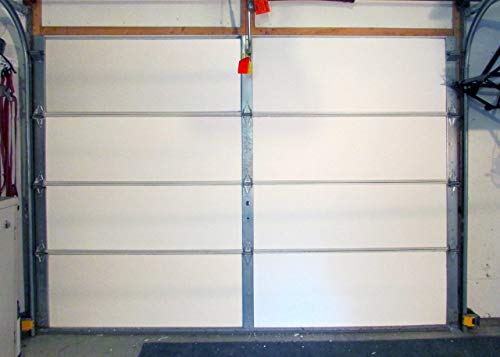


Prices are Amazon’s listed prices as of the time shown and change often; check Amazon for today’s price. As an Amazon Associate we earn from qualifying purchases.
Understanding R-Value on Garage Doors
R-value is a measure of a material’s resistance to heat flow. ENERGY STAR describes it simply: the higher the R-value, the better the thermal performance of the insulation. For walls and attics, it is a reliable comparison tool. For garage doors, it needs some caution.
- Manufacturers do not all calculate it the same way. Some publish a value for the insulated core at its thickest point. Others publish a calculated value for the whole section. A door listed as R-16 by one brand is not always directly comparable to an R-12 from another.
- The weakest points control real-world performance. Section joints, the steel edges of each panel, windows in the top section and the perimeter seals all conduct or leak more than the insulated center.
- Construction type matters more than the number. A two-layer door has a steel skin with foam or a vinyl-backed blanket on the inside. A three-layer or sandwich door encloses the insulation between two steel skins. Sandwich doors are generally sturdier, quieter and better sealed between sections.
- Polyurethane and polystyrene behave differently. Injected polyurethane foam bonds to the skins and adds stiffness. Polystyrene panels are usually cut and inserted, so they insulate well for their thickness but do not bond the door together in the same way.
For context, ENERGY STAR’s retrofit table for the region that includes most of the Front Range (zones 6, 5 and 4C) recommends R60 for an uninsulated attic and R15 to R19 for basement or crawlspace walls, based on the 2021 International Energy Conservation Code. A garage door never approaches those levels, and it does not need to. Most insulated residential garage doors fall somewhere in the single digits to the high teens, and a kit on an existing door usually lands at the low end of that range.
Insulation Kits for an Existing Door
Retrofit kits are popular because they cost a fraction of a new door and install in an afternoon. They come in a few main types.
Rigid foam panel kits
Expanded polystyrene (EPS) or extruded polystyrene (XPS) panels are cut to fit the recessed pockets of each door section and held in place with friction, clips or adhesive. Many come with a white or foil facing. They give the most insulation per dollar of the common kit types. They work best on doors with deep, regular pan-style sections where the panels can be pressed in snugly.
Reflective or radiant-barrier kits
These are thin rolls of foil bonded to bubble wrap or a thin foam core. They work mainly by reflecting radiant heat, which helps on a sun-baked door in summer. Their published R-values often assume an air space in front of the foil, so real performance against winter conduction is modest. They are light, which is a real advantage on older doors with tired springs.
Fiberglass batt kits
Some kits use vinyl-faced fiberglass blankets cut to size and pinned to the panels. They fill irregular panels reasonably well but can sag, absorb moisture if the facing tears and shed fibers if disturbed. Our guide to fiberglass insulation covers how the material performs when it stays dry and when it does not.
What kits do well and where they fall short
A kit can make the inside face of the door feel less like a cold sheet of metal and soften noise from rain, hail and the street. It does nothing about leaks between sections or at the edges, it does not stiffen a flimsy door, and it adds weight. On a door that is already dented, rusting at the bottom or binding in the tracks, a kit is putting new material on an old problem.
A practical installation checklist for kit buyers:
- Weigh the door before and after, or at least estimate the added weight from the kit packaging.
- Keep the panels clear of hinges, rollers, struts, the lock bar and the opener arm bracket.
- Avoid covering any labels the manufacturer requires to remain visible, such as spring warnings.
- Check the door’s balance after installation, as described below.
- Replace the bottom seal and perimeter weatherstripping at the same time.
Replacing With a Factory-Insulated Door
A new insulated door is the bigger investment, but it solves more than one problem at once. It usually comes with new sections, new tracks and hardware, springs sized to its weight, a fresh bottom seal and, often, new perimeter weatherstripping. Sandwich-construction doors are stiffer, so they resist wind deflection and dents from basketballs and hail better than single-layer steel.
Replacement tends to make more sense when:
- The existing door is single-layer steel with visible rust, cracked panels or failing section joints.
- The door is very old wood with rot at the bottom section.
- The springs, cables or tracks are worn and due for replacement anyway.
- The garage is being converted into a workshop or partly conditioned space.
- The homeowner wants windows in the door without giving up much performance, since insulated glass options are typically offered on insulated models.
Typical cost ranges
Prices vary widely by door size, construction, style, local labor and whether a new opener is included. As a rough, typical national picture, a do-it-yourself kit for a single or double door often runs from under one hundred dollars to a few hundred dollars. A professionally installed insulated replacement door commonly runs from roughly one thousand dollars for a basic single-car steel sandwich door to several thousand dollars for a double-car door with windows, a carriage-house style or high-performance polyurethane core. Removal and disposal of the old door, new springs, upgraded tracks and opener replacement all add cost. Get two or three written quotes that list the construction type, insulation material, published R-value and how it was calculated, spring type and warranty.
Springs, Openers and Safety When Adding Weight
This is the part of garage door insulation that people skip, and it is the most important. A sectional garage door is balanced by torsion springs above the door or extension springs along the horizontal tracks. The springs, not the opener, do most of the lifting. Adding even 10 or 20 pounds of insulation can upset that balance.
When the door is out of balance:
- The opener works harder, runs hotter and wears out sooner.
- The door may drift down when it should stay half-open, or creep up.
- The auto-reverse force setting on the opener may need adjustment, which should never be done just to make a heavy door move.
- Cables and bottom brackets carry more load.
A simple balance check: with the door closed, pull the emergency release to disconnect the opener, then lift the door by hand to about waist height and let go. A balanced door stays roughly in place. A door that falls or shoots up needs spring adjustment. Torsion springs hold a great deal of stored energy, and adjusting or replacing them is a job for a trained garage door technician, not a weekend project. After any change, test the opener’s photo-eye safety sensors and auto-reverse according to the opener manufacturer’s instructions. The sensors should sit a few inches above the floor on each side of the opening, face each other squarely and stop and reverse the door when the beam is broken. Inspect the lift cables at the bottom brackets for fraying while you are there.
Weatherstripping: The Cheap Fix That Often Matters Most
Before deciding between a kit and a new door, look at the seals. On many Front Range garages, the biggest gains come from:
- A new bottom seal. Vinyl or rubber bulb and T-style seals slide into a retainer on the bottom section. If the retainer is bent or corroded, it can be replaced too.
- A threshold seal glued to the slab, which helps where the concrete has settled and sloped away from the door.
- Perimeter stop molding with a flexible flap along the jambs and header.
- Section seals on doors whose design allows them.
To find leaks, stand inside the closed, dark garage on a sunny day. Every line of daylight is an air path. A lit incense stick held near the edges on a windy day will show drafts. Seal the visible gaps first, then decide whether panel insulation is still worth it. Many of the same principles apply to other hard-to-seal openings; our guide to attic door insulation covers a similar problem at the attic hatch.
Carbon Monoxide and the Garage-to-House Connection
Insulating and sealing a garage changes how air moves through it, which is a reason to think about what is in that air. The EPA lists automobile exhaust from attached garages among the sources of carbon monoxide in homes, along with back-drafting gas water heaters and furnaces. Carbon monoxide is colorless and odorless. A tighter garage is not dangerous on its own, but it makes the separation between the garage and the house more important.
- Never warm up a car in a closed garage, sealed or not.
- Never run a portable generator, pressure washer or other engine-driven tool inside a garage. The CPSC warns against using generators inside homes or garages even with doors and windows open.
- Keep the door between the garage and the house closed and its weatherstripping in good shape.
- Seal penetrations in the shared wall and ceiling, such as gaps around pipes and wires.
- If a gas water heater or furnace is in the garage, have its venting and combustion air checked after any major sealing work.
- Install CO alarms in the home as the CPSC recommends: on every level and outside sleeping areas, and test them regularly.
Front Range Considerations
Several local conditions are worth factoring into the decision:
- Hail. Hail is common along the Front Range, and a single-layer steel door dents easily. A sturdier sandwich-construction door resists cosmetic damage better than a kit-insulated thin door, which is one more reason replacement sometimes wins.
- Sun and UV. Intense sun at altitude degrades vinyl seals and fades finishes faster. Plan on replacing bottom seals more often than the packaging might suggest.
- Freeze-thaw and slab movement. Garage slabs crack and settle, leaving gaps under the door that a standard seal cannot close. A threshold seal or slab repair may be needed.
- Snow and meltwater. Snow tracked in on vehicles melts on the slab. Insulation does not cause moisture problems on its own, but foil-faced panels and fiberglass kits should stay dry and clear of the bottom section where water splashes.
- Plumbing in the garage. Many Front Range homes have a water heater, hose bib supply or laundry lines in or next to the garage. Keeping the garage above freezing protects them. Our guide to pipe insulation covers protecting exposed lines.
What a Home Inspector Looks For
The ASHI Standard of Practice directs inspectors to inspect garage vehicle doors and garage vehicle door operators. Within a visual inspection, a home inspector may note:
- Damaged, dented or rusted sections, especially the bottom panel
- Missing, torn or flattened bottom seals and daylight at the edges
- Insulation kits that interfere with hinges, rollers or the opener arm
- A door that does not stay balanced or moves unevenly
- Photo-eye sensors that are missing, mounted too high or do not trigger reversal
- An opener that does not reverse when the door meets resistance
- Worn cables, loose brackets or springs that appear broken
- The condition of the door between the garage and the house, including whether it closes and latches
An inspector does not usually report the R-value of a garage door or confirm how a kit was installed, and does not adjust springs. Concerns are typically referred to a garage door contractor.
How to Decide: A Simple Sequence
- Confirm whether the garage is attached and what rooms share a wall or ceiling with it.
- Check the door’s condition, balance and safety features first. Repairs come before upgrades.
- Replace the bottom seal and perimeter weatherstripping, and close obvious gaps.
- Insulate the shared wall and the ceiling under any bonus room if they are bare or thin.
- If the door is sound but uninsulated, consider a light rigid-foam kit, then have the balance checked.
- If the door is worn, dented or due for new springs anyway, price a factory-insulated replacement.
Buying a house with an attached garage and a cold room above it? Inspectors routinely flag garage door safety and air-sealing issues that are easy to miss on a showing. Our insulation and crawl space guides cover the rest of the building envelope.
References
- Recommended Home Insulation R-Values — ENERGY STAR
- Why Seal and Insulate? — ENERGY STAR
- Carbon Monoxide’s Impact on Indoor Air Quality — U.S. Environmental Protection Agency
- Carbon Monoxide Information Center — U.S. Consumer Product Safety Commission
- ASHI Standard of Practice for Home Inspection — American Society of Home Inspectors
Frequently asked questions
Does insulating a garage door really make a difference?
It makes the most difference in an attached garage that shares a wall or ceiling with living space, or one used as a workshop. In a detached, unheated garage the energy savings are usually small. Sealing gaps around the door often matters as much as the panel insulation itself.
What R-value should a garage door have?
There is no single target. Insulated residential doors commonly range from the single digits into the high teens, and manufacturers calculate the number differently. Compare construction type, insulation material and seal quality, not only the published R-value.
Is a garage door insulation kit as good as an insulated door?
Usually not. A kit adds insulation to the panels but does not seal section joints, stiffen the door or come with springs matched to the new weight. It can still be a reasonable low-cost upgrade on a door that is in good condition.
Will insulation make my garage door too heavy?
It can. Even a light kit adds weight, which can throw the door out of balance and strain the opener. After installing a kit, check whether the door stays in place when lifted halfway by hand, and have a garage door technician adjust the springs if it does not.
Should the garage door be insulated before the wall to the house?
In most homes the shared wall and any ceiling below a bonus room are the higher priority, because they separate the garage from living space. Insulate and air seal those first, then consider the door if the garage itself still runs too cold or hot.
Want a second set of eyes on the garage, door hardware and shared walls before you buy? Contact our team to connect with a Front Range home inspector.