FLIR Thermal Gun: Pistol-Grip Handheld Category Guide

The phrase “FLIR thermal gun” describes a pistol-grip handheld thermal camera with a trigger-style operator interface, named after the brand that popularized the form factor. In practice the term has slid into generic use across the handheld-thermography market the way “Sharpie” stands in for any permanent marker. This guide treats the term generically — a category guide to pistol-grip handheld thermal cameras across all manufacturers — without recommending one specific make. Several major manufacturers (FLIR, Seek, Hikmicro, Teledyne, Fluke) ship products in this form factor at price tiers ranging from roughly $250 to $5,000, and the buying decision rests on resolution, sensitivity, and intended use rather than badge.
Part of our Thermal Imaging for Homes guide — start there for the full picture →
What a Pistol-Grip Thermal Handheld Is
A pistol-grip thermal gun is a self-contained handheld camera with a small color display on the back, a thermal sensor (microbolometer) behind a germanium lens on the front, an internal lithium-ion battery, and a one-handed trigger or capture button. The form factor evolved from electrical-test-instrument design, where one-handed operation lets the technician hold a meter probe in the other hand. The category overlaps significantly with what manufacturers also call “handheld thermal cameras” — the gun shape is one of several housings within the broader handheld category.
The defining trait is operator interface. The trigger captures still images or starts a video clip; thumb buttons cycle palettes and adjust span. Most pistol-grip units favor speed of capture over fine-tuned scientific measurement, which makes them well-suited for electrical-panel scans, HVAC checkouts, and rapid building walks.
Typical Uses for the Form Factor
Electrical-Panel Scanning
The most common professional use. An electrician walks the line of breakers in a panel, captures a thermal frame, and looks for any breaker glowing hotter than its peers. A loose connection or overloaded circuit shows up as a 10-20°F hotter junction. The U.S. Department of Energy and OSHA guidance recognize thermographic electrical inspection as a standard preventive-maintenance technique.
HVAC and Ductwork Spot-Checks
A handheld gun used to find duct leaks, missing register-boot insulation, and uneven supply-air distribution. The temperature delta across a ducted system on heating or cooling cycle makes thermal patterns obvious — a cold spot on a supply trunk usually marks an uninsulated section in an unconditioned crawl space.
Insulation and Air-Leak Surveys
For energy audits, the imager visualizes air infiltration around windows, rim joists, attic hatches, and electrical-outlet penetrations. Pairing the imager with a blower door amplifies the temperature delta and makes leaks easier to find. ASHRAE methodology recommends a temperature differential of at least about 10°F across the building envelope for confident interpretation.
Plumbing-Leak Detection
Cold-water lines passing behind drywall sometimes produce visible temperature shadows. A leak in a slab can show as a warm or cool circle on the floor depending on water temperature. Thermal imaging localizes the suspect area; a moisture meter or a direct probe confirms.
How the Major Brands Stratify the Category
Several manufacturers compete in the pistol-grip handheld segment. Treating the category at feature level rather than badge:
Entry Tier ($250-$600)
Detector resolution typically 80×60 to 120×90, NETD around 80-120 mK, fixed-focus lens, simple iron and grayscale palettes. Adequate for spot-checking obvious problems at close range. Most homeowner buyers should stop here unless documentation is needed.
Mid Tier ($600-$1,500)
Resolution 160×120 to 240×180, NETD 50-80 mK, picture-in-picture visual-light overlay, multiple palettes, basic radiometric output. The sweet spot for home inspectors who include thermal as a value-add to standard inspections.
Professional Tier ($1,500-$5,000)
Resolution 320×240 to 640×480, NETD 30-50 mK, interchangeable lenses, full radiometric output with on-camera annotation, Wi-Fi to mobile apps, GPS tagging. Used by certified thermographers for documentation work and litigation-grade reporting.
Specialty Lines
Test-instrument manufacturers ship pistol-grip thermal cameras with integrated multimeters or clamp meters for the electrical-contracting trade. These units price in the $1,500-$3,500 range and include features like Bluetooth pairing to a mobile dashboard.
Specifications That Actually Matter
Three numbers separate a usable unit from a frustrating one. Detector resolution determines the smallest object the imager can resolve at a given distance — 160×120 minimum for ceiling work from 8 feet away. NETD determines how subtle a temperature anomaly can be detected — 60 mK or better for moisture work, where dry and wet zones may differ by less than a degree. Accuracy, typically ±2°C or ±2% of reading, determines how much trust to place in absolute temperature values for documentation.
Field of view and the option to swap lenses matter for specialty work. A wide-angle lens (40°+ horizontal) covers more wall per frame but compresses detail; a narrow lens (12-15°) magnifies but needs more frames per area. For most homeowner and home-inspector work the stock lens (around 24°) is the right choice.
Radiometric vs non-radiometric output is the dividing line between consumer and professional grade. Radiometric files store a temperature value at every pixel, which lets a thermographer re-analyze in desktop software, adjust emissivity, and produce report-grade thermograms. Non-radiometric units record only the rendered JPEG — fine for personal use, inadequate for evidentiary reporting.
What a Pistol-Grip Handheld Does Not Replace
A handheld thermal gun complements but does not replace other inspection tools. Pin-type and pinless moisture meters give direct moisture readings that the thermal imager only implies. Borescopes inspect inside wall cavities directly. Combustion analyzers measure flue-gas composition. A trained inspector uses the thermal gun as the rapid-screening tool that prioritizes where to apply other instruments. For broader context on the toolkit see the parent home inspection tools guide and our thermography gun overview.
Where the Pistol-Grip Form Factor Falls Short
One-handed pistol-grip units shine in stand-up rapid scanning. They are less suited to overhead work where the operator has to look up at a small rear display while holding the camera over their head. For attic and roof underside work, a smartphone-attached module with a tilting screen or a tripod-mounted unit with remote viewing can be easier. Pistol-grip cameras also lack the precision focus and frame-averaging features of higher-end fixed-mount thermography systems, which matters for measurement-grade work on electrical switchgear.
Operator Interface Details Across the Category
Within the pistol-grip handheld category, several interface details differ across products and matter for daily use. Single-shot capture vs continuous video — most units offer both, but the toggle method and video duration limits vary. Voice annotation — a few professional units let the operator record a short voice note attached to each image, which speeds up field workflow. Laser pointer alignment — some models include a visible laser that helps the operator confirm exactly which point in the scene the temperature crosshair is measuring. Touchscreen vs button-only controls — touchscreens are faster for menu navigation but harder to operate with gloves on, which matters on cold-weather inspections.
Mobile-app pairing has become a standard feature. Most modern pistol-grip units pair with a tablet or phone via Wi-Fi, displaying the live image on a larger screen and saving battery on the rear LCD. For overhead and crawl-space work, mobile pairing is often the difference between a usable unit and an awkward one.
Hail-Damage Inspections on the Front Range
One specifically regional application worth flagging: hail damage assessment on Colorado Front Range homes. The region sees significant hail events most spring and summer seasons, and asphalt-shingle roofs sustain bruise damage that often does not produce visible leaks for months or years. Thermal imaging can sometimes reveal moisture intrusion patterns in the deck beneath bruised shingles. The technique is not a replacement for direct roof inspection by a roofer or roof-specialty inspector, but it adds value in a market where insurance-claim documentation matters for many transactions.
How to Choose a Unit Without Brand Bias
Two questions narrow the field quickly. First, what is the working distance? Close-range electrical-panel work needs only 80×60-120×90 resolution. Whole-ceiling attic work needs 160×120 minimum. Rooftop survey work from 30+ feet needs 320×240. Second, does the work require documentation? If yes, radiometric output is mandatory, which jumps the budget into the $1,500+ tier. If no, mid-tier non-radiometric is fine.
InterNACHI training material recommends a 160×120 minimum for any inspector planning to advertise thermal-imaging services as part of a paid inspection, regardless of brand. Below that resolution, the imager produces too many ambiguous patterns to support written findings.
Training Matters More Than the Hardware
A pistol-grip thermal gun in the hands of an untrained operator routinely misreads thermal bridges as moisture, reflective surfaces as cold spots, and HVAC duct chases as missing insulation. The InterNACHI Infrared Certified credential is one of several training paths recognized by the inspection trade. For homeowners who plan only occasional self-use — winter air-leak hunts, electrical-panel spot checks — formal certification is overkill, but reading the camera manual cover-to-cover is essential.
Cold-Weather Operation on the Front Range
Many handheld thermal imagers list operating-temperature ranges that exclude the coldest Front Range winter mornings. A unit rated to -10°C may shut down or refuse to start on a -20°C January morning. For inspectors working winter schedules in Colorado, this matters. Keep the camera inside the warm vehicle until immediately before use; allow it to acclimatize gradually rather than going abruptly from -20°C to a +20°C indoor space, which can cause condensation on the lens and detector. Cold-rated professional units exist but command premium pricing. For most Front Range winter work, planning around the operating temperature range is sufficient.
Documentation Practices for Inspection Reports
When a thermal image appears in an inspection report, several pieces of context need to accompany it. Date and time of capture confirm conditions. Camera model and resolution indicate the diagnostic capability. Indoor and outdoor ambient temperatures at capture time establish the thermal differential available. Emissivity setting documents the operator’s calibration choice. A paired visible-light image gives the report reader visual context. Without these supporting elements, a thermal image in a report is incomplete documentation and may not support the inspector’s stated findings if disputed later. ASHRAE technical resources on thermography recommend documenting these variables consistently across all thermal images in a report.
Common Beginner Mistakes With Pistol-Grip Units
New thermal-imager operators typically make three predictable mistakes during their first months of use. The first is using too wide a span, which flattens the image and hides the very anomalies the operator is hunting. Practice with tighter spans until the eye learns the patterns. The second is ignoring emissivity, taking measurement-grade readings on shiny surfaces (polished metal ducts, aluminum window frames) without compensation and reporting the resulting low readings as real. The third is interpreting every cold spot as a leak, missing the thermal-bridge patterns that normal stud framing produces. These mistakes resolve with practice and feedback; the InterNACHI Infrared Certified course explicitly addresses each one.
References
- ENERGY STAR: Seal and Insulate — U.S. Environmental Protection Agency (ENERGY STAR)
- Infrared thermography certification — InterNACHI
- Building diagnostics standards — ASHRAE
- Electrical safety standards — OSHA
Frequently asked questions
Is a thermal gun the same as a thermal camera?
Functionally yes — a thermal gun is a pistol-grip form factor within the broader handheld thermal camera category. The trigger-style operator interface is the main difference from a tablet-style or phone-attached unit. The underlying sensor and physics are identical.
What resolution thermal gun do I need for home use?
For occasional electrical-panel and air-leak checks, 80x60 to 120x90 is sufficient and runs $250-$600. For paid inspection work, 160x120 is the trade-recognized minimum. For documentation work, 320x240 or higher with radiometric output.
Can a thermal gun replace a moisture meter?
No. The thermal gun reveals temperature patterns that imply moisture but does not measure water content. Always confirm a suspected leak with a pin-type or pinless moisture meter before drawing conclusions.
Does a thermal gun work through walls?
No. The sensor detects surface temperature on the side facing the camera. Patterns visible on the surface suggest what may be happening behind it, but the imager does not see through drywall, wood, or insulation.
Thermal imaging cameras
Infrared cameras reveal hidden moisture, missing insulation, and air leaks. Phone-attachment models are the budget entry point; standalone units have higher resolution.
| Product | Why | Buy |
|---|---|---|
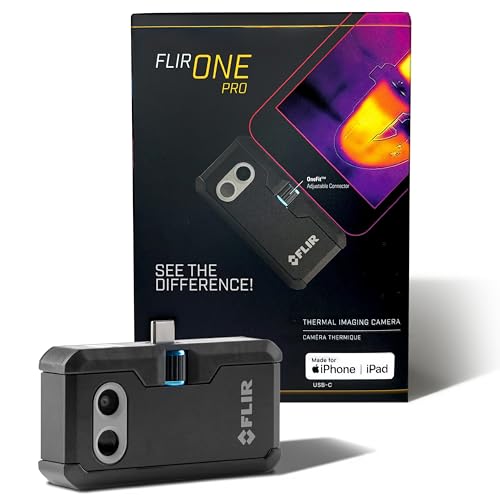 FLIR ONE Pro (phone) | Plugs into iPhone/Android; inspector favorite. | Amazon — $349.00 |
 Topdon TC001 | High-res phone module at a low price. | Amazon — $262.99 |
 FLIR C5 Compact | Standalone pocket camera with Wi-Fi. | Amazon — $649.00 |