Extension Cords: Gauge, Ratings and Fire Risks at Home

Almost every home has a drawer or garage shelf full of cords: thin brown ones from a holiday light set, a heavy orange one for the lawn mower, a white flat cord that once ran behind a bookcase. They look interchangeable, but an extension cord is a small piece of electrical wiring with a specific capacity, and using the wrong one can overheat it. The U.S. Consumer Product Safety Commission warns that extension cords can overheat and cause fires when used improperly, usually from overloading. This guide explains wire gauge and amperage ratings, the difference between indoor and outdoor cords, why space heaters and major appliances should never run through a cord, how to spot a damaged cord, and when a permanent outlet is the better answer. It summarizes CPSC and U.S. Fire Administration guidance current as of 2026; electrical work belongs with a licensed electrician.
Part of our Home Electrical guide — start there for the full picture →
How to Choose a Safe Extension Cord
The short answer: choose a cord that is listed by a recognized testing laboratory, rated for at least the load being plugged into it, marked for outdoor use if it will be used outdoors, and only as long as the job requires. Use it temporarily, and unplug it when it is not in use.
The CPSC publication Household Extension Cords Can Cause Fires recommends checking that cords are listed by a recognized national testing laboratory such as Underwriters Laboratories (UL), Intertek (ETL) or CSA, and says extension cords should be at least 16 AWG unless they are 18 AWG with fuse protection. The agency also says extension cords should only be used temporarily. That last point is easy to forget. A cord that has powered the same lamp for five years is functioning as permanent wiring, which it was never designed to be.
Understanding Gauge and Amperage Ratings
Wire size in the U.S. is measured in American Wire Gauge, or AWG. The numbering runs backward: a smaller number means a thicker conductor. A 12 AWG cord has heavier copper than a 14 AWG cord, which is heavier than 16 AWG. Thicker wire carries more current with less heating and less voltage drop.
CPSC notes that the wire size is imprinted on the cord’s surface. A typical marking reads something like “16/3,” meaning 16-gauge conductors and three wires (hot, neutral and ground). A two-conductor cord such as “18/2” has no ground.
Typical ratings by gauge
The exact rating depends on cord length, insulation type and the manufacturer, so the label on the cord or its packaging is the authority. As a general orientation:
- 18 AWG: light-duty cords for lamps, clocks and small electronics. Often rated well under 10 amps.
- 16 AWG: light to medium duty. Common for general household and short outdoor cords, typically rated around 10 to 13 amps.
- 14 AWG: medium duty, often rated around 15 amps at moderate lengths. Common for power tools and longer outdoor runs.
- 12 AWG: heavy duty, often rated 15 amps or more, used for high-draw tools and long runs.
- 10 AWG: extra heavy duty, used for some contractor equipment and long, high-draw runs.
Length matters because resistance adds up. A 100-foot cord of a given gauge will drop more voltage and heat more under load than a 25-foot cord of the same gauge. Many manufacturers list a lower amp rating for longer cords. Buying the shortest cord that reaches is both safer and better for motors, which can run hot on low voltage.
Matching the cord to the load
Every appliance or tool lists its draw in amps or watts, usually on a nameplate. At standard household voltage, watts divided by 120 gives an approximate amp figure. A 1,500-watt load, for example, draws roughly 12.5 amps. Add up everything that will be plugged into the cord and compare the total to the cord’s rating. CPSC advises not overloading a cord beyond its capacity and checking that capacity on the cord’s tag or packaging.
CPSC also describes a simple warning sign: if any part of an extension cord is hot while in use, it may be overloaded. Overheating can occur at the plug, at the socket or along the entire length of the cord.
Best Extension Cords: our top 3 picks
| Product | Best for | Key features | Price | Buy |
|---|---|---|---|---|
| POWGRN 50 ft 12/3 | Heavy-duty outdoor loads |
| $49.99as of Nov 11, 2026 12:27 pm GMT+0000 | Buy now →Check current price |
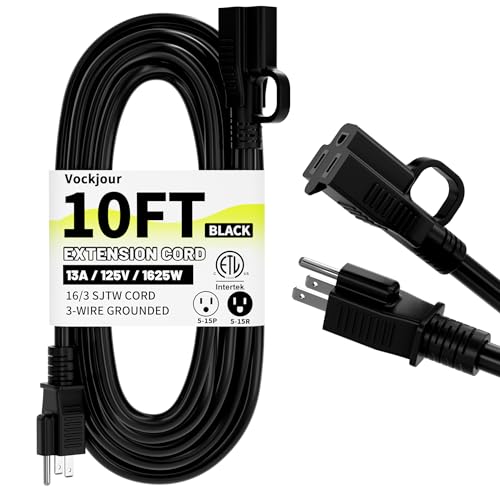
| Vockjour 10 ft 16/3 | Short outdoor runs |
| $7.29as of Nov 11, 2026 12:27 pm GMT+0000 | Buy now →Check current price |
| HUANCHAIN 50 ft 16/3 | Long runs for light loads |
| $23.99as of Nov 11, 2026 12:27 pm GMT+0000 | Buy now →Check current price |


Prices are Amazon’s listed prices as of the time shown and change often; check Amazon for today’s price. As an Amazon Associate we earn from qualifying purchases.
Indoor vs Outdoor Extension Cords
Indoor cords have thinner insulation and are not designed for sunlight, moisture, temperature swings or abrasion on concrete. Outdoor cords use tougher jackets, often rubber or thermoplastic compounds, and are marked for outdoor use. CPSC says to use an extension cord outdoors only if it is marked for outdoor use. Common jacket markings include a “W,” which indicates the cord is rated for outdoor use.
Front Range conditions are hard on cords. High-altitude sunlight degrades plastic jackets faster, freeze-thaw cycles stiffen insulation, and snowmelt can leave cords sitting in water on driveways. An outdoor-rated cord that has turned brittle or cracked should be retired, not taped.
Outdoor cords should plug into a receptacle protected by a ground-fault circuit interrupter, or GFCI, which cuts power if current leaks to ground, such as through water or a person. Our guide to outdoor outlets covers weatherproof covers and GFCI protection for exterior receptacles. If the outdoor receptacle keeps tripping or will not reset, the troubleshooting guide for a GFCI outlet that is not working explains common causes, including moisture in cord connections.
Outdoor use habits that reduce risk
- Keep cord-to-cord connections off the ground and out of puddles.
- Do not run cords through windows or doors that can pinch them.
- Bring cords indoors when the job is finished rather than leaving them exposed all season.
- Never staple or nail a cord to a fence, deck or siding.
Never Use Extension Cords with Space Heaters or Major Appliances
Space heaters are one of the clearest cases where an extension cord does not belong. A typical portable electric heater on its high setting draws a large share of a standard circuit’s capacity for hours at a time. CPSC’s portable heater safety guidance says never to power a heater with an extension cord or power strip and never to run the heater’s cord under rugs or carpeting. It also says that if the heater’s cord or plug is hot, the heater should be disconnected, and if any part of the outlet is hot, a certified electrician should be contacted.
Front Range winters bring plenty of space heater use in basements, garages and drafty rooms. If a heater cannot reach a wall outlet, the safer answer is to move the heater or add an outlet rather than reaching for a cord. Our article on space heater safety covers clearances, tip-over switches and placement.
The U.S. Fire Administration extends similar advice to major appliances. USFA says to always plug major appliances, such as refrigerators, stoves, washers and dryers, directly into a wall outlet and never use an extension cord with a major appliance, because the cord can overheat and start a fire. Window air conditioners, dehumidifiers and microwaves are other high-draw devices that generally belong on a wall receptacle; check each manufacturer’s instructions.
Damaged and Unsafe Cords
CPSC lists several ways cords become hazardous and what to do about each. Damaged cords can cause fires, and hot plugs and sockets are often caused by deteriorated connections to the cord’s wires. The agency advises looking for visible signs of excessive wear or damage to the plug, sockets or insulation and replacing damaged cords. Replacement, not repair, is the recommended course: CPSC says never to alter a cord to change its length or make inadequate repairs such as taping damaged insulation, and never to trim, cut or alter the plug blades.
Warning signs worth checking on every cord in the house:
- Cracked, cut, flattened or brittle jackets.
- Exposed copper anywhere along the length.
- Bent, loose or missing ground pins.
- Discoloration or melting at the plug or connector.
- Plugs that fit loosely in the outlet or fall out easily.
- Cords that feel warm to the touch during normal use.
- Homemade splices or electrical tape repairs.
CPSC also recommends discarding older cords that lack important safety features, including safety closures, polarized blades and a large plug face that covers the outlet slots and is easy to grasp. Unlisted or counterfeit cords are a separate concern; CPSC warns that cords not listed by a nationally recognized testing laboratory can cause fires or electrical shocks.
Placement problems
Where a cord runs matters as much as its condition. CPSC advises against running cords under carpets, through doorways or under furniture, where they can be crushed or overheat without anyone noticing. USFA gives the same advice, adding that cords should not be placed where they can be damaged or pinched. CPSC also recommends keeping young children away from extension cords and unplugging cords when not in use, because a plugged-in cord is energized and can overheat if shorted.
Electrical Fires by the Numbers
USFA’s appliance and electrical fire safety page reports that in 2021, an estimated 24,200 residential building electrical fires were reported to U.S. fire departments, causing an estimated 295 deaths, 900 injuries and over $1.2 billion in property loss. USFA’s ten-year trend data for residential building electrical malfunction fires shows an estimated 23,700 fires, 305 deaths, 800 injuries and about $1.5 billion in dollar loss in 2023.
These figures cover all electrical malfunction fires in homes, not extension cords alone, and USFA does not break out a cord-specific share on those pages. They are a reminder that electrical distribution equipment, including cords, outlets and wiring, is a meaningful fire source in American homes.
Specialty Cords, Reels and Accessories
Beyond the basic single-outlet cord, the market offers many variations. Each has a place, and each has its own limits.
Multi-outlet cords
Cords with three outlets at the end, or a row of outlets along a block, make it easy to plug in several devices. The cord’s rating still applies to the total load, however many outlets there are. Three outlets on a 16 AWG cord do not triple its capacity.
Cord reels
Retractable and hand-crank reels keep long cords tidy in garages and workshops. Many reel manufacturers warn that a cord left tightly wound on the reel while carrying a heavy load can build up heat, because the coiled wire cannot shed it easily. Check the reel’s instructions; some list one rating for a fully unwound cord and a lower one for a partly wound cord.
Cords with built-in GFCI protection
Portable GFCI cords and adapters add shock protection where the receptacle itself is not GFCI-protected, such as at some older garages and exterior walls. They are useful for temporary work, but they do not replace bringing the receptacle up to current standards.
Lighted ends and locking connectors
Lighted plug ends show at a glance that a cord is energized, which helps on job sites and in dark crawl spaces. Locking connectors hold two cords together so they do not pull apart, which reduces the temptation to tie knots in the cords.
Storing and Retiring Cords
Cords last longer when they are stored loosely coiled, out of direct sun and away from sharp edges, chemicals and vehicle tires. Hanging cords on a wide hook rather than wrapping them tightly around an elbow avoids kinks that weaken the conductors over time.
A once-a-year sort through the cord drawer is a reasonable habit. Cords that are cracked, missing a ground pin, unlabeled, very old or of unknown origin can simply go to an electronics recycler. Replacing a handful of questionable cords costs far less than dealing with the damage one of them could cause.
Permanent Alternatives to Extension Cords
When a cord stays in the same place for months, it is a signal that the room needs more receptacles. A licensed electrician can usually add an outlet on an existing circuit or run a new circuit where the load requires it. Common situations include:
- Home offices and entertainment walls with too few receptacles.
- Garages and workshops where tools are run on long cords.
- Exterior walls where holiday lights, fountains or tools need power.
- Kitchens where countertop appliances are bunched on one receptacle.
Older homes in Denver, Aurora and Colorado Springs often have two-slot receptacles or worn outlets that no longer grip plugs firmly, which encourages adapters and cords. The guide to outlet replacement explains when a worn or ungrounded receptacle should be replaced and what options exist. For charging stations, a USB outlet can reduce the tangle of adapters, and the companion guide to power strips and surge protectors covers when a strip is appropriate and when it is not.
What Home Inspectors Note About Cords
Home inspectors do not test individual cords, but heavy reliance on extension cords is a common observation in inspection reports. Inspectors look for cords used as permanent wiring, cords run through walls, ceilings or doorways, cords stapled to framing, appliances such as refrigerators or freezers on extension cords, and cords powering garage door openers or sump pumps in place of a proper receptacle. These conditions often point to a shortage of outlets or a circuit that is already overloaded.
An inspector may recommend that a licensed electrician evaluate and add receptacles where needed. Buyers can learn more about how electrical systems are evaluated in our electrical inspection guides, and the main resource on hiring a home inspector explains what is and is not included in a standard inspection.
Extension Cord Costs
Prices change with gauge, length, jacket material and features, so these are general 2026 ranges:
- Light-duty indoor cords (16 or 18 AWG, short): often a few dollars to around $15.
- Medium-duty outdoor cords (14 or 16 AWG, 25 to 50 feet): commonly about $15 to $40.
- Heavy-duty outdoor cords (12 or 10 AWG, 50 to 100 feet): often $40 to $120 or more.
- Adding a new receptacle on an existing circuit: frequently a few hundred dollars from an electrician, depending on access and wall finishes.
- Running a new dedicated circuit: typically more, often several hundred dollars to over a thousand depending on distance and panel capacity.
Compared with the potential cost of a cord-related fire, a properly rated cord or a new outlet is a modest expense.
References
- Household Extension Cords Can Cause Fires — U.S. Consumer Product Safety Commission
- 7 Highly Effective Portable Heater Safety Habits — U.S. Consumer Product Safety Commission
- Appliance and Electrical Fire Safety — U.S. Fire Administration
- Residential Building Electrical Malfunction Fire Trends (2014-2023) — U.S. Fire Administration
Frequently asked questions
What gauge extension cord do I need?
Check the amp or watt rating of everything you plan to plug in and pick a cord rated above that total. CPSC says household cords should be at least 16 AWG unless they are 18 AWG with fuse protection. Longer runs and higher loads call for thicker 14 or 12 AWG cords.
Can I plug a space heater into an extension cord?
No. CPSC says never to power a portable heater with an extension cord or power strip. Plug the heater directly into a wall outlet and do not run its cord under rugs.
Can I use an indoor extension cord outside?
No. CPSC advises using a cord outdoors only if it is marked for outdoor use. Outdoor cords have tougher jackets, and they should plug into a GFCI-protected receptacle.
Is it safe to leave an extension cord plugged in permanently?
CPSC says extension cords should be used only temporarily and unplugged when not in use. If a cord stays in place for months, have an electrician add a receptacle instead.
Why is my extension cord getting hot?
CPSC identifies a hot cord as a warning sign of possible overload or damage. Unplug it, check the cord's rating against the load and inspect it along its length. Replace damaged cords rather than repairing them.
Counting extension cords in every room of a home you are considering? Contact us to connect with a Front Range inspector who can flag outlet shortages and wiring concerns.