Cost of Radon Testing: 2026 DIY and Professional Pricing Guide

The cost of radon testing in 2026 ranges from $15 for the cheapest DIY charcoal-canister kit to $300 for full professional continuous-radon-monitor (CRM) testing during a real-estate transaction. The price gap reflects very different things — the lab fee, the inspector’s labor, the equipment calibration, and the regulatory documentation. The right test for a given homeowner depends on what question is being asked and what the result will be used for. This guide summarizes EPA, CDPHE, and NRPP/NRSB measurement-professional guidance current as of 2026 for general homeowner education only — consult a certified measurement professional for testing tied to real-estate transactions or post-mitigation verification.
Part of our Radon Levels guide — start there for the full picture →
What Does Radon Testing Cost?
Four pricing tiers cover most homeowner scenarios. DIY short-term charcoal-canister kits cost $15 to $30 including lab analysis and produce a result in 5 to 10 business days. DIY long-term alpha-track kits cost $20 to $50 and need 90+ days of deployment before mailing to the lab. Consumer continuous electronic detectors (AirThings, RadonEye, Ecosense) cost $150 to $400 as a one-time hardware purchase with no per-test fee. Professional CRM testing by a NRPP- or NRSB-certified measurement professional costs $150 to $300 per test, typically run for 48 hours with documented closed-house conditions.
Each tier serves a different purpose. The $15 charcoal kit is the right tool for an initial baseline screening. The $20 alpha-track kit is the right tool for confirming an annual average after an ambiguous short-term result. The $200 consumer detector is the right tool for ongoing monitoring after baseline testing is complete. The $200 professional CRM test is the right tool for any real-estate transaction or any high-stakes decision requiring documented chain-of-custody. None is universally “best” — the cost difference reflects what the test is documenting, not just measurement accuracy.
DIY Short-Term Charcoal-Canister Testing
The most common consumer radon test. A small plastic canister containing activated charcoal sits in the lowest occupied level of the home for 2 to 7 days with windows and doors closed. Radon gas adsorbs onto the charcoal during the deployment period. The homeowner seals the canister, fills out a chain-of-custody card, and mails it to the lab. The lab gamma-counts the canister within the post-deployment validity window and returns a result in 5 to 10 business days.
Costs are dominated by the lab fee. Most kits are priced at $15 to $30 including return shipping and lab analysis. Some state radon programs — including Colorado’s — offer free or discounted test kits to residents through the CDPHE radon program. Free kits typically cover a single test per household and may be available with a small administrative fee or no charge. The free radon test kit sources guide covers current Colorado availability.
DIY Long-Term Alpha-Track Testing
For homeowners whose short-term test came back ambiguous (between 2 and 8 pCi/L), a long-term alpha-track test provides a more accurate annual average. A small plastic disc containing a sensitive polycarbonate film is deployed for 90 to 365 days in the same location. Alpha particles emitted by radon decay etch tracks in the film, and the lab counts those tracks under microscopy to derive a long-term average concentration.
Alpha-track kits run $20 to $50 including lab analysis. The longer deployment averages out the short-term variability that charcoal canisters can’t capture — seasonal changes, weather events, day-to-day ventilation differences. For a homeowner planning to make a mitigation decision based on the result, the long-term test is meaningfully more informative than a single short-term result in the ambiguous range. EPA recommends a long-term follow-up whenever a short-term result lands between 2 and 8 pCi/L. The DIY radon test guide covers both options in more depth.
Consumer Continuous Electronic Detectors
For homeowners who want ongoing radon awareness rather than a single test result, a continuous electronic detector is a one-time hardware purchase. AirThings, RadonEye, and Ecosense are the dominant 2026 brands. Pricing runs $150 to $400 depending on model and feature set; there’s no recurring lab fee. The unit displays running radon averages over multiple windows (1-day, 7-day, all-time) and most pair with smartphone apps for historical-trend visualization.
Operating cost-per-year is essentially zero once purchased. The lifetime of consumer detectors is generally 5 to 10 years, after which the internal sensor calibration drifts and replacement is recommended. Per-year amortized cost works out to roughly $20 to $40 for a unit with a 7-year service life. For homeowners testing once a year with disposable kits, the consumer detector breaks even within 5 to 10 years. The best radon detector buyer guide covers brand-by-brand specifications.
Professional CRM Testing
For real-estate transactions, post-mitigation verification, or any setting where documented chain-of-custody matters, professional CRM testing is the standard. A NRPP- or NRSB-certified measurement professional deploys a calibrated continuous radon monitor (Sun Nuclear, AlphaGUARD, Femto-Tech) in the lowest occupied level of the home for a minimum 48-hour test period under documented closed-house conditions. The unit logs hourly readings; the certified professional retrieves it, downloads the data, and produces a written report.
Costs run $150 to $300 in most Colorado metros. The price reflects the inspector’s labor (two site visits — deploy and retrieve), the calibrated equipment, the regulatory documentation (chain-of-custody, closed-house verification), and the written report. Real-estate transaction testing typically falls in the $200 to $250 range when bundled with a general home inspection. The Front Range radon inspection cost guide covers detailed local pricing.
What Drives Price Variation Within Each Tier
Three factors. Geography — Front Range metros (Denver, Boulder, Fort Collins, Colorado Springs) tend to price professional CRM testing at $200 to $250, while smaller markets sometimes run higher due to inspector travel time. Bundling — radon testing added to a general home inspection during real-estate due diligence is usually cheaper than standalone testing, because the inspector is already on site. Number of test locations — a multi-story home or a home with separate units (ADU, basement apartment) typically requires multiple test points, with each additional CRM running $75 to $150.
Consumer detector pricing varies primarily by feature set. Entry-level units (AirThings Corentium Home, RadonEye RD200) sit at $150 to $200. Mid-tier units with smartphone app integration and additional environmental sensors (AirThings Wave Plus, Ecosense EcoQube) sit at $200 to $300. Professional-grade consumer units (AirThings View Radon, Ecosense RadonEye Pro) sit at $300 to $400.
Cost-Effectiveness by Use Case
Three rules of thumb. For a one-time baseline test in a long-occupied home, the $15 charcoal kit is the most cost-effective starting point. For real-estate due diligence, $200 professional CRM testing is the right call — the chain-of-custody and closed-house documentation are part of what you’re paying for. For ongoing awareness in a home with prior elevated readings or recent mitigation, the $200 to $300 consumer detector amortizes to lower per-year cost than repeated annual kit testing.
None of these costs are large compared to the potential downstream costs. A radon mitigation system in Colorado runs $1,200 to $2,500 installed. The lifetime medical cost of radon-related lung cancer — and the years of life lost — vastly exceeds any testing or mitigation expense. EPA’s longstanding position is that radon mitigation is one of the most cost-effective public-health interventions available to homeowners, with a per-life-saved cost meaningfully lower than many other indoor air quality interventions. For broader context on the testing-and-mitigation budget, the Colorado radon testing pillar guide covers the full framework.
Free and Reduced-Cost Test Options
The CDPHE Colorado Radon Program periodically offers free or low-cost test kits to Colorado residents through the state’s radon program. Availability varies by year and funding. Some counties (Boulder, Jefferson, Denver, Larimer, and others) supplement the state program with locally funded kits. The state and county programs typically use the same charcoal-canister chemistry as commercial kits — the cost difference is administrative, not technical. The American Lung Association also distributes test kits at reduced cost during periodic National Radon Action Month campaigns (January).
More Questions About Radon Testing Costs
How long does a radon test take?
A short-term radon test takes about 2 to 7 days, with 48 hours being the minimum for most real estate tests, while a long-term test runs 90 days or more. Results from a mailed DIY kit add several more days for lab analysis.
Short-term tests require closed-house conditions, with windows and exterior doors kept shut except for normal entry, starting 12 hours before the test. Long-term tests give a better picture of the yearly average because they capture seasonal swings. Many homeowners start with a short-term test and follow up with a long-term test when the result is borderline.
When is the best time of year to test for radon?
Radon can be tested at any time of year, but winter testing often shows higher levels because homes stay closed and heating draws more soil gas inside. A test that is low in summer may not reflect winter conditions.
Short-term tests should avoid severe storms and unusually high winds, which can skew results. A long-term test that spans several months, including part of the heating season, gives the most representative average. Many state programs encourage testing in January, during National Radon Action Month, and discounted kits are often available then.
How often should a home be retested for radon?
EPA guidance suggests retesting a home for radon every two years, after a mitigation system is installed, and after major renovations or changes to the foundation, HVAC or living space. Homes with low initial results should still be retested over time.
Radon levels can change as foundations settle, soil conditions shift, and new rooms are finished in basements. Homeowners with mitigation systems should also retest after fan replacement or system repairs. A continuous digital monitor makes ongoing checks easy, while lab-analyzed kits provide a clear documented result.
How much does it cost to test well water for radon?
Testing well water for radon typically costs about $25 to $100 for a lab-analyzed sample, depending on the lab and whether it is part of a larger water panel. Radon in water is mainly a concern for homes on private wells.
Samples must be collected carefully so radon does not escape before analysis, so following the lab’s bottle and shipping instructions is essential. Homes with high radon in water may also have higher radon in air from showering and washing. Testing both water and air gives the full picture before choosing a treatment system.
What should you do if a short-term radon test is high?
If a short-term radon test shows 4 pCi/L or higher, EPA guidance recommends a follow-up test before deciding on mitigation, unless the result is very high. The follow-up can be another short-term test or a long-term test.
Averaging two short-term tests gives a more reliable basis for a decision than a single result. In a real estate transaction, buyers often rely on one professional test because of time limits. If the average remains at or above the action level, homeowners should contact a certified radon mitigation contractor for an estimate.
References
- EPA Radon page and Citizen’s Guide — U.S. Environmental Protection Agency
- CDPHE Colorado Radon Program and free test kit information — Colorado Department of Public Health and Environment
- CDC radon health information — Centers for Disease Control and Prevention
- American Lung Association radon information and reduced-cost testing — American Lung Association
Frequently asked questions
How much does a basic radon test cost?
DIY short-term charcoal-canister kits cost $15 to $30 including lab analysis. DIY long-term alpha-track kits cost $20 to $50. Both produce mailable lab results. The Colorado CDPHE radon program periodically offers free or reduced-cost kits to state residents.
What does professional radon testing cost?
NRPP- or NRSB-certified professional CRM testing runs $150 to $300 in most Colorado metros, typically deployed for 48 hours with documented closed-house conditions. Real-estate transactions usually bundle radon at $200 to $250 when added to a general home inspection.
Is a consumer radon detector worth the money?
For ongoing monitoring after baseline testing — yes. A $200 to $400 unit amortizes to roughly $20 to $40 per year over a 7-year service life, which is comparable to annual disposable kit costs. For a one-time threshold test, a $15 to $30 charcoal kit is more cost-effective.
Why do real-estate transactions cost more than DIY testing?
Real-estate radon testing pays for chain-of-custody documentation, certified-professional labor (two site visits), calibrated equipment traceable to NIST standards, and closed-house verification — none of which DIY tests provide. The documentation is what most real-estate contracts and lender requirements actually need.
Do radon test results expire for a home sale?
Radon test results do not formally expire, but buyers usually want a recent test because radon changes with seasons, renovations and system condition. Many buyers will accept results within about two years from a documented professional test. A mitigation system should have a recent post-installation test.
Are DIY radon test kits accurate?
DIY radon test kits from certified labs are generally accurate when the instructions are followed exactly. Placement, closed-house conditions and prompt mailing to the lab affect results. A kit that sits too long before shipping, or is placed near drafts, can give misleading numbers.
Where should a radon test kit be placed?
A radon test kit should be placed in the lowest lived-in level of the home, at least 20 inches above the floor and away from drafts, exterior walls, kitchens, bathrooms and sump pits. Basements used as living space are the usual location.
Front Range homeowners scheduling a radon test alongside a general home inspection can reach out through our contact page for connection to a vetted inspector.
Test your home for radon
Radon is invisible and odorless, so a test is the only way to know your level. A short-term kit gives a first reading in days; a digital monitor tracks it over time.
| Product | Why | Buy |
|---|---|---|
 AirChek Charcoal Radon Test Kit | Lab fee usually included; EPA short-term protocol. | Amazon — $21.95 |
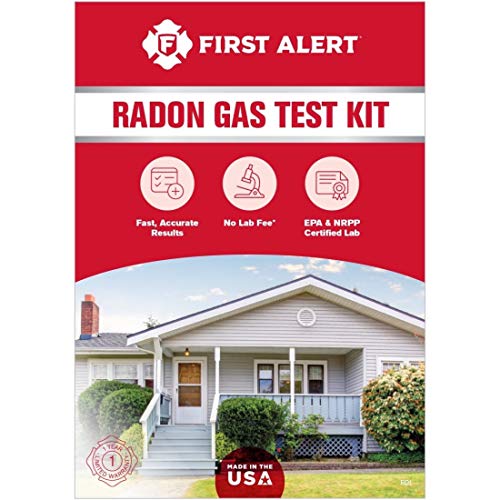 First Alert RD1 Radon Test Kit | Widely stocked; 48-hour charcoal test. | Amazon — $17.95 |
 Airthings Corentium Home | Digital monitor with a long-term average. | Amazon — $146.14 |