Borescope Lens: Probe Diameter, Field of View, and Articulation
“Borescope lens” usually refers to the camera head at the tip of the probe — the optical assembly that gathers the image, including the actual lens elements, the sensor behind them, the LED ring around them, and sometimes a second side-view camera. For a homeowner buying or comparing borescopes, lens specs are the single most consequential spec set after probe length. This guide walks through what each lens specification means in practice, where the trade-offs are, and how to read product listings to know what you are getting.
Part of our Home Inspection Tools guide — start there for the full picture →
Borescope lens specs that matter for residential use
Six lens-related specs determine whether a borescope works for a given inspection task.
1. Probe and lens diameter
The diameter of the probe at the lens tip determines what spaces it fits into. Common diameters and their use cases:
- 3.9mm — automotive engine cylinders, very tight HVAC ductwork, between-stud gaps without drilling access; lowest image quality due to small sensor
- 5.5mm — small access holes in drywall, narrow plumbing access, common automotive use; good image quality balance
- 7mm — standard residential wall-cavity inspection through 3/8″ holes; best value-per-image-quality for homeowner use
- 8mm — slightly larger access required but allows fuller sensor; popular in mid-tier residential products
- 9mm — drain interior inspection through cleanouts, larger access holes required
Smaller is not always better. Smaller probes mean smaller sensors and smaller lenses, which reduces light-gathering ability and image quality.
2. Field of view (FOV)
Listed in degrees, measured diagonally across the image. Common values:
- 50–60 degrees — narrow; good for detailed close inspection but requires repositioning to scan an area
- 70–85 degrees — standard residential FOV; balances detail and area coverage
- 120+ degrees — wide-angle; covers more area but distorts at edges; useful for tight cavity work
For wall-cavity inspection, 70–85 degrees works well. For drain interior scanning, wider FOV speeds up the survey.
3. Focal range
The depth at which subjects are in sharp focus. Most fixed-focus borescope lenses are optimized for 1–4 inches of subject distance, which suits the typical use case where the camera is inside a confined space. Auto-focus borescope lenses exist but add cost and rarely match the consistency of well-designed fixed-focus units.
4. Aperture and low-light performance
Rarely listed explicitly. What matters in practice is image quality in dim spaces, which depends more on the LED lighting than the lens aperture. Look for adjustable LED brightness; “f-number” or aperture specs are rare on consumer borescopes.
5. Waterproofing rating
IP67 is standard for residential borescope lenses, meaning the lens and probe are dust-tight and survive immersion to 1 meter for 30 minutes. IP68 ratings exist for products marketed for deeper or longer water use. Drain inspection, tank interiors, and any plumbing work needs IP67 minimum.
6. Replaceable lens options
Professional-tier borescopes (Klein ET450, FLIR VS70, some Milwaukee units) accept interchangeable lens heads. Common swap options:
- Side-view 90-degree adapter for looking at probe-side surfaces
- Magnifying lens cap for close-detail work
- Mirror tip for indirect viewing in tight spots
- Different focal-length lenses for closer or farther subjects
Consumer-tier units typically have fixed lenses with snap-on plastic accessories that approximate these functions.
Single vs dual-camera lens systems
Mid-tier products often advertise “dual-camera” designs. Two configurations exist:
Front + side dual lens
Two separate camera sensors at the tip: one looking forward through the probe axis, one looking 90 degrees off to the side. Useful for inspecting pipe interiors where the wall surface is parallel to the probe direction. Adds maybe $20–$50 to the price.
Switchable front + side single lens
A single rotating prism redirects the image path. Mechanically more fragile but optically equivalent. Less common in residential products.
For most homeowner use, a single front-facing camera works. The dual-camera feature pays off mainly for plumbing and drain work where pipe-wall inspection matters.
Articulation: tip movement vs lens position
Articulating tips are not lens features per se but they change where the lens points. Two configurations:
- Two-way articulation — tip bends up and down with a joystick on the display unit; useful for navigating drain bends
- Four-way articulation — tip bends in all directions; more useful for industrial inspection than residential work
Articulation adds $200–$500 to the total price. For residential use without significant pipe work, articulation is rarely worth the cost. The cluster guide on borescope prices covers the cost breakdown.
Reading product listings for lens specs
Listings often emphasize headline numbers — megapixels, LED count, probe length — over specs that actually drive image quality. Things to verify in product details:
- Native vs interpolated resolution — many cheap sensors interpolate to claim higher MP
- Whether the FOV spec is diagonal or horizontal — diagonal is the standard but some listings hide this
- Whether IP67 covers the full probe or only the lens tip
- Whether LEDs are adjustable or fixed brightness
- Frame rate at maximum resolution — 30 fps at 1080p is the practical floor for smooth video
Lens limitations to expect
All consumer borescope lenses share a set of limitations that no amount of spec-shopping resolves:
- Fixed wide-angle distortion — straight edges curve at frame edges; routine for wide-FOV lenses
- Limited dynamic range — bright spots near the lens overwhelm darker areas; this is a sensor limitation more than lens
- Close-focus optimization — subjects beyond about 12 inches lose sharpness on fixed-focus lenses
- Lens fogging in humid environments — common when moving from cool space to warm humid space; wipe with dry cloth, give time to equalize
- Scratches from contact with rough surfaces — probe tips on construction-grade borescopes carry sacrificial covers; consumer-grade do not
Maintenance to protect the lens
- Wipe the lens with a lint-free cloth before each use
- Avoid contact with sharp drywall edges when entering access holes
- For drain or plumbing use, rinse the probe with clean water after each insertion and dry before storage
- Store coiled at the manufacturer’s recommended minimum bend radius — tighter coils stress the cable and the lens-to-probe junction
- Replace sacrificial tip covers (on pro models) when scratched rather than continuing to use scratched optics
When the lens determines the right tool choice
If a homeowner’s primary use case is one of these specific scenarios, the lens spec drives the decision:
- Tight-space automotive (cylinder bores, intake manifolds) — 5.5mm with high-LED ring
- Wall cavity inspection through small patchable holes — 7–8mm with 70-degree FOV
- Drain interior scanning — 8–9mm with dual-camera or wide-FOV single
- HVAC plenum and duct inspection — articulating tip, brighter LED array
- Tank and vessel interior — IP68 rating, sealed probe assembly
For the broader tool selection picture, see our home inspection tools pillar and the cluster guides on borescopes with cameras and Amazon borescope buying.
Common lens-related buyer regrets
- Buying a 9mm probe and finding it cannot fit through the access hole the inspection needs
- Buying a 3.9mm probe and finding the image too dim and noisy for practical use
- Buying a narrow-FOV lens and finding the scanning process tedious
- Buying without checking waterproofing rating and damaging the probe on first drain inspection
- Buying based on megapixel claim and finding the actual image quality unimpressive
When to call a professional
Sewer lateral inspection benefits from professional push-camera lenses with sonde locator rings — features that allow surface-locating the camera position for excavation marking. Consumer borescope lenses cannot replicate that capability. HVAC duct work beyond accessible plenums also typically requires longer rigid push cables that consumer-grade probes cannot match.
Lens cleaning and field care
The lens is the most exposed and most damageable part of a borescope. Care practices that extend useful life:
- Wipe with a clean microfiber cloth before each use to clear smudges and dust
- Avoid paper towels — fibers scratch lens coatings
- For stubborn residue, lens cleaning solution (the kind sold for eyeglasses) is safer than alcohol on coated lenses
- After drain or plumbing use, rinse with clean water and dry completely before storage
- Inspect the lens after each use for scratches; small scratches degrade image quality progressively
- Store the probe with the tip protected — many cases include a foam slot specifically for the tip
Compatibility considerations across brands
Lens and probe components are generally proprietary. Cross-brand compatibility:
- Most consumer borescope probes are not interchangeable across brands
- Some pro-tier brands offer probe lengths and tip types within their own ecosystem
- Generic snap-on accessory tips (magnetic, hook, mirror) often work across brands of similar probe diameter
- Replacement probe parts are best sourced from the original manufacturer
This affects long-term ownership planning. Investing in a brand with a broader probe and accessory ecosystem makes more sense for buyers expecting heavy use over multiple years.
Lens fogging mitigation
Lens fogging happens when moving the probe from a cool space into a warm humid environment, or vice versa. Practical mitigation:
- Equalize temperature before use — give the probe 5–10 minutes in the inspection environment
- Anti-fog wipes or sprays (the kind sold for eyeglasses or scuba masks) work on borescope lenses with caveats; test on a small area first
- Wipe with a dry microfiber and give time to re-equilibrate
- Avoid breathing on the lens before insertion
- In persistent-fog environments, schedule the inspection after temperature equilibrium
Lighting interaction with lens performance
The LED ring around the lens is part of the optical system in practice. Image quality depends on:
- LED intensity matched to subject distance
- Even illumination across the field of view
- No glare from LED light reflecting off the lens housing back into the image
- Color temperature of LEDs affecting how surfaces render
Adjustable LED brightness is the most useful single feature for managing lighting-lens interaction. Subjects close to the probe tip need lower light to avoid blowout; subjects farther away need higher intensity.
Common lens-related field problems and fixes
Glare washout on shiny surfaces
Bright LEDs reflect off polished metal, glass, or wet surfaces. Mitigation: reduce LED brightness; approach the surface at an oblique angle rather than head-on; or use a polarizing filter accessory if available.
Out-of-focus close subjects
Fixed-focus lenses optimized for 1–4 inches of subject distance struggle with subjects right at the lens or beyond 12 inches. Mitigation: position the probe to put the subject in the optimal range; consider macro-lens accessories for very close work.
Image distortion at frame edges
Wide-FOV lenses curve straight edges at the frame periphery. Not a defect — inherent to wide-angle optics. Mitigation: position the subject in the frame center for the cleanest image; understand that diagonal lines are not actually curved.
Color cast in dim environments
Low-light shooting often produces a warm or cool color cast depending on the LED spectrum. Mitigation: most apps allow color temperature adjustment in playback.
Specifications worth getting in writing
Before buying, the product page or specification sheet should clearly state:
- Native sensor resolution (not interpolated)
- Probe diameter and length
- Field of view in degrees, with axis specified (diagonal vs horizontal)
- IP rating with coverage scope (probe-only vs full unit)
- LED count, individual or grouped, and adjustability
- Frame rate at maximum resolution
- Storage format (SD card type, internal memory, app-only)
- Connectivity types (USB-C, Lightning, Wi-Fi)
- Battery life specification with usage condition
- Warranty period and what is covered
Listings that hide any of these specs warrant skepticism.
Pre-purchase test scenarios
If buying from a retailer that allows in-store handling (Home Depot, Lowes, Harbor Freight), useful tests before purchase:
- Image quality in store lighting (typically poor for borescope work)
- Display brightness and color accuracy
- Button feedback and ergonomics
- Cable flexibility and coiling behavior
- Battery indication accuracy
- Charging port type and accessibility
Many specs only reveal themselves through physical handling that online buying does not permit.
When the lens spec limits the use case
Specific scenarios where a chosen lens spec turns out to be the wrong choice:
- 3.9mm probe with marginal lighting for residential drywall inspection — buyer wishes for 7mm
- 9mm probe attempting to fit through a 3/8″ drill hole — buyer drills bigger hole or returns the unit
- Narrow 50-degree FOV when scanning wide drain interiors — buyer wishes for 85-degree
- Wide 130-degree FOV when capturing close detail of a wire splice — buyer wishes for narrower
- Front-only single camera when inspecting pipe walls parallel to probe — buyer wishes for dual or side
Matching lens specs to anticipated use cases avoids these regret patterns. The cluster guides on borescopes with cameras and Amazon borescope considerations cover the broader buying context.
Lens technology evolution
Trends visible in 2026 product launches:
- Higher pixel density on smaller sensors closing the budget-vs-pro image quality gap
- Better LED systems with focused beams reducing washout
- Improved waterproofing extending IP ratings to IP68 at lower price points
- Dual-camera designs becoming standard in mid-tier products
- Articulation costs slowly coming down through volume manufacturing
For buyers willing to wait, the next 12-24 months will likely bring more capability per dollar.
More Questions About Borescope Lenses
Can a scratched borescope lens be fixed?
A scratched borescope lens usually cannot be repaired by the owner, because the lens or its protective window is tiny and sealed into the camera head. Light surface scuffs may cause minor haze that gentle cleaning will not remove. Some professional borescopes allow the lens window or camera head to be replaced through manufacturer service, and replaceable-tip models can swap the damaged part. For budget borescopes, replacing the unit often costs about the same as a repair. Storing the probe with a tip cover prevents most scratches.
Why is the borescope image blurry?
A blurry borescope image is most often caused by the lens being too close to or too far from the subject for its fixed focus range, a dirty or fogged lens, or poor lighting that forces the camera to use a slow, noisy exposure. Check the focus distance in the specifications and move the probe to that range. Clean the lens with a soft cloth or lens wipe. Adjust LED brightness to reduce glare. If the image stays blurry, water may have entered the camera head.
Why does a borescope lens fog up?
A borescope lens fogs up when it moves from a cool space to a warmer, humid one, causing moisture to condense on the lens, such as going from an air-conditioned room into a hot attic, or from a cold garage into a steamy drain. Fogging usually clears within a few minutes as the tip warms. Letting the probe adjust to the space before inspecting, or warming it slightly in a hand, helps. Fog that appears inside the lens and does not clear suggests a failed seal.
Can a borescope lens see through murky water?
A borescope lens cannot see clearly through murky water, because suspended particles scatter the LED light and block the view, much like headlights in fog. In clear water, a waterproof probe can show detail at close range. Lowering the LED brightness often reduces glare. In drains and sumps, flushing clean water through first, or letting debris settle, can improve visibility. When water is too cloudy, a professional camera with stronger lighting or a different inspection approach may be needed.
References
- ENERGY STAR: Seal and Insulate — U.S. Environmental Protection Agency (ENERGY STAR)
- InterNACHI home inspection tools overview — International Association of Certified Home Inspectors
- ASHI Standards of Practice on tool-based inspections — American Society of Home Inspectors
- ICC residential code references — International Code Council
Frequently asked questions
What is the best borescope lens diameter for home inspection?
7mm to 8mm balances image quality with reasonable access-hole size. 5.5mm fits tighter spaces with somewhat reduced image quality. 9mm gives the best image but requires larger access holes to patch.
Does a wider field of view always mean a better lens?
No. Wider FOV covers more area per shot but introduces distortion at frame edges. 70–85 degree FOV is the practical residential sweet spot. Wide-angle 120+ degrees is for tight cavity work where coverage matters more than detail.
What does IP67 mean on a borescope lens?
Dust-tight and survives immersion to 1 meter for 30 minutes. This is standard for residential borescopes and covers the typical use cases including drain interior inspection.
Are replaceable borescope lenses worth the price?
For working inspectors and trade professionals who use the tool weekly, yes — different lens heads serve different inspection types. For occasional homeowner use, fixed-lens products with snap-on accessory tips cover most needs at much lower cost.
Do borescope lens coatings matter?
Borescope lens coatings can reduce glare and reflections from the probe's LEDs, which improves contrast in shiny pipes and metal parts. Manufacturers rarely list coating details on budget models, so judge image quality through sample photos and reviews instead.
Is a wide-angle or narrow-angle borescope lens better?
A wide-angle borescope lens shows more of a cavity at once and helps with orientation, while a narrower lens shows more detail on a small target with less edge distortion. For general home use, a moderately wide field of view is the most versatile choice.
Does a borescope lens need a protective cap?
A protective cap or tip cover helps keep a borescope lens from getting scratched in storage or while carrying the probe in a toolbox. Remove it before inspecting. Many kits include one, and replacing a lost cap is far cheaper than replacing a scratched camera head.
Borescopes & inspection cameras
A borescope lets you see inside walls, ducts, drains, and crawlspaces without opening anything up.
| Product | Why | Buy |
|---|---|---|
 DEPSTECH Wireless Borescope | Wi-Fi to your phone; semi-rigid cable. | Amazon — $29.99 |
 Teslong Dual-Lens Borescope | Side + front view; good for ducts. | Amazon — $119.99 |
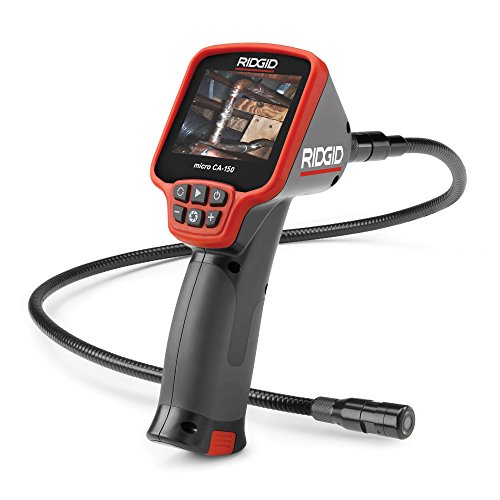 Ridgid micro CA-150 | Rugged handheld with screen. | Amazon — $303.22 |