Best Soil Moisture Meter: A 2026 Buyer’s Guide
If you want one answer for the best soil moisture meter, it is a long-probe analog meter that reaches below the dry surface layer into the root zone, needs no batteries and gives an instant reading. On the current Amazon shelf, the XLUX T9178 Long Probe fits that description best, and its listing has the most useful instructions of any meter we compared. The four alternatives below cover the cases where it is not the right fit: a known probe length for garden beds, a 2-pack for house and yard, the clearest color dial, and a digital meter for people who want numbers. In a semi-arid climate with watering limits, a meter earns its keep by telling you when a scheduled watering can be skipped.
Part of our Moisture Meters & Water Damage Detection guide — start there for the full picture →
As an Amazon Associate we earn from qualifying purchases.
How we compared: we compared 13 current Amazon listings for soil moisture meters on what each listing states: power source, probe length, reading method, display, insertion instructions and warnings. Nine are single-function analog meters (7 distinct designs, since two XLUX designs also sell as 2-packs) and 4 are multi-function meters that add pH, light, temperature or fertility. We did not lab-test any meter or use one hands-on. Prices and availability change often, so check the current listing before buying.
Quick picks: the best soil moisture meters
| Pick | Best for | Key spec | Key detail |
|---|---|---|---|
| XLUX T9178 Long Probe | Best overall | Battery-free, extended probe | Probe stated as 5.5 in longer than standard; loose-media guidance |
| Hathdia Soil Moisture Meter | Garden beds with a known reach | Battery-free, 7.6 in probe | Longest absolute probe length stated |
| XLUX T10-OR 2-Pack | One meter indoors, one outdoors | Two meters, 10-scale dial | Only orange housing on the shelf |
| Dr.meter S10 | Clearest color dial | Battery-free, 10-scale dial | Red, green and blue bands named in listing |
| YAMRON 4-in-1 | Digital readout | Backlit LCD, 4 x AAA | Only listing that says to average 5 test spots |
The best soil moisture meter, plus four alternatives
1. XLUX T9178 Long Probe — Best Soil Moisture Meter Overall

Battery-free long-probe meter that reads deep soil instantly; listing explains corrosion and loose-media errors.
Check price on Amazon$14.99 as of Oct 12, 2026 4:29 am GMT+0000 — prices change; see Amazon for current price.| Specification | Details |
|---|---|
| Power | None required; needle responds on insertion |
| Probe | Single probe, stated as 5.5 in (14 cm) longer than regular styles |
| Display | Large analog dial with three zones and 10 scale marks |
| Time limit | Remove within 5 minutes; listing says the metal tip will gradually corrode |
| Media guidance | Pack loose perlite, pumice, bark or orchid mix around the probe to avoid false zero |
| Size / model | 40 cm size; about 0.29 lb; model T9178 |
XLUX T9178 — battery-free, extended single probe, 3-zone 10-scale dial, 5-minute limit, loose-media guidance
The Most Complete Instructions of Any Soil Meter Listed
A soil moisture meter is only as good as the way it is used, and the T9178 listing is the one that tells you how to use it properly. It is one of 3 listings (all XLUX) that say directly the metal tip will corrode if left in soil, and the only one of the 13 that explains the most common false reading: in airy media, the probe loses contact and the needle stays at zero even when the material is damp. Its fix, firming the media around the probe, is the kind of practical guidance most listings skip.
The extended probe is the other reason it ranks first. In outdoor containers, raised beds and deep planters, the top two inches dry out fast in Front Range sun and wind while the root zone can still hold plenty of water. A probe that reaches deeper reads the layer that actually decides whether to water.
What the listing leaves out: an absolute probe length (only the 5.5 inch extension is given), the probe material, and any statement on accuracy in heavy clay. It also warns against very hard soil, so water or loosen a test spot first in compacted ground. The same meter is sold in a 2-pack on this shelf if you want two.
Pros
- Extended probe reads below the dry surface layer
- Only listing that explains loose-media false readings
- Battery-free and instant
- Available as a single or a 2-pack
Cons
- Absolute probe length not stated
- Not for hard or compacted soil
- Spot-check only; cannot stay in the ground
2. Hathdia Soil Moisture Meter — Best for Garden Beds With a Known Probe Length
Battery-free meter with a stated 7.6 in probe for pots, beds and lawn checks; avoid stones on insertion.
Check price on Amazon| Specification | Details |
|---|---|
| Power | None required |
| Probe | Single probe, stated as 7.6 in long |
| Display | Analog pointer; scale marks not stated in listing |
| Intended use | Potted plants, garden, farm and lawn |
| Warnings | Soil only; keep the probe off stones; wipe after use |
| Model | FD-EP-230201-1767; about 1.97 x 11.42 in |
Hathdia FD-EP-230201-1767 — battery-free, 7.6 in single probe, analog pointer, garden and lawn use
The Only Listing That Gives a Probe Length Above 7 Inches as a Hard Number
Of the 7 single-function designs, only two give an absolute probe length in the listing text: the Censinda at 6.7 inches and this Hathdia at 7.6 inches. The XLUX T9178 is probably longer, but you have to infer it. If you are planning around a known depth, such as checking whether water from a drip line is reaching 6 to 8 inches down in a vegetable bed, the Hathdia is the meter whose reach you can count on before it arrives.
The listing frames the meter for potted plants, garden, farm and lawn, and its specific warning to keep the probe off stones fits Colorado’s rocky garden soil better than the generic “hard soil” caveat others use.
The trade-offs: no description of the dial scale, no stated time limit for leaving the probe in, and a model number that reads like a factory part code. It is the better pick only if a stated probe length matters to you more than the T9178’s guidance.
Pros
- Longest absolute probe length stated (7.6 in)
- Lawn and garden use named
- Battery-free
Cons
- Dial scale not described
- No stated insertion time limit
- Factory-style model number
3. XLUX T10-OR 2-Pack — Best for Keeping One Meter Indoors and One Outdoors

Two orange XLUX meters with 3-zone, 10-scale dials; easy to spot in a garden bed or tool bucket.
Check price on Amazon$15.99 as of Oct 12, 2026 4:29 am GMT+0000 — prices change; see Amazon for current price.| Specification | Details |
|---|---|
| Quantity | Two meters |
| Power | Not stated in listing bullets; analog dial design |
| Display | Large dial, three zones, 10 scale marks |
| Time limit | Remove within 5 minutes; tip will corrode if left in |
| Warnings | No very hard soil; no water or liquids; wipe after use |
| Size / model | About 10.24 x 2.36 x 1.38 in; model T10-OR#2 |
XLUX T10-OR#2 — two meters, orange housing, 3-zone 10-scale dial, 5-minute limit, soil only
The Only High-Visibility Orange Housing on the Shelf
Two of the 13 listings are XLUX 2-packs. This one pairs the standard-length T10 dial with an orange housing; every other meter on the shelf with a stated color is green or white. Orange is easy to find when a meter gets set down in a bed of greens or tossed in a garden bucket, which is exactly where a second meter tends to live.
The dial and instructions match the other standard XLUX listings: three zones, 10 scale marks, remove within 5 minutes, wipe after use. Splitting a pair between the houseplants and the garden avoids carrying soil indoors on one probe and keeps both meters within reach.
This listing’s bullets do not mention batteries, probe length or probe material, though its single-meter T10 sibling names a stainless probe. Expect the standard probe to be too short for deep planters; choose the long-probe 2-pack instead if your containers are large.
Pros
- Two meters in one listing
- Orange housing is easy to spot outdoors
- Clear 5-minute and corrosion warnings
Cons
- Probe length and material not stated
- Power source not stated in bullets
- Standard-length probe is short for deep beds
4. Dr.meter S10 — Best Color Dial for Shared Households
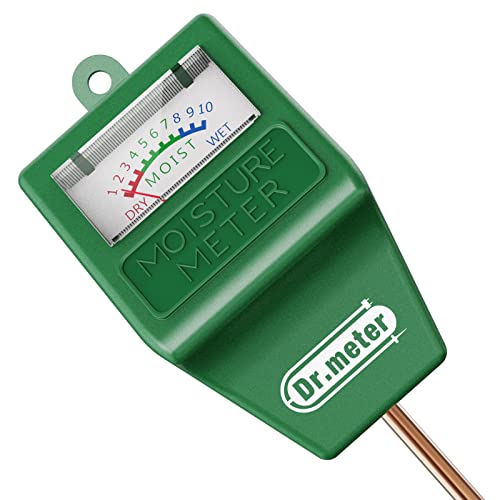
Battery-free single-probe meter with a 10-scale dial whose red, green and blue bands are named in the listing.
Check price on Amazon$9.99 as of Oct 12, 2026 4:29 am GMT+0000 — prices change; see Amazon for current price.| Specification | Details |
|---|---|
| Power | None required |
| Probe | Single probe; length not stated in listing |
| Display | 10 scale marks with red, green and blue color bands |
| Intended use | Garden, farm, lawn and houseplants |
| Warnings | Soil only; avoid rocks and extremely hard soil; clean after each use |
| Model | S10; about 0.17 lb |
Dr.meter S10 — battery-free, single probe, 10-scale red/green/blue dial, lawn and garden use
The Only Listing That Names Its Dial Colors
Three analog listings mention color on the dial. The S10 is the only one that names the bands and their order: red, then green, then blue. In a household where several people water the garden, “water when the needle is in the red” is a rule nobody has to interpret.
The listing names garden, farm, lawn and houseplants, and like 6 of the 13 listings it warns against hard soil. It does not state a probe length, so plan on it for beds and containers rather than deep tree or shrub roots.
It also omits the specific time limit and corrosion warning that XLUX gives. Assume the same rule applies to every battery-free probe: read, remove, wipe.
Pros
- Named color bands are easy to share
- Battery-free
- Lawn and garden use stated
Cons
- Probe length not stated
- No stated time limit in soil
- Avoid rocky or compacted ground
5. YAMRON 4-in-1 — Best Digital Soil Moisture Meter

Backlit digital meter for moisture, pH, temperature and light; listing says to average readings from 5 spots.
Check price on Amazon$32.98 as of Oct 12, 2026 4:29 am GMT+0000 — prices change; see Amazon for current price.| Specification | Details |
|---|---|
| Readings | Soil moisture, pH, soil temperature, sunlight intensity |
| Display | Large backlit LCD; head tilts from 0 to 45 degrees |
| Power | 4 x AAA batteries, not included; low-battery alert |
| Method | Insert about 4 in (10 cm), wait 10 seconds; average at least 5 spots |
| Warnings | Water dry, hard soil and wait 10 minutes before testing; no liquids |
| Size / model | About 11.8 x 2 x 2 in; 0.26 lb; part CYT-SM-US01 |
YAMRON CYT-SM-US01 — 4-in-1, backlit LCD, 4xAAA, 10 cm insertion, 10 s read, 5-spot averaging, tilting head
The Only Listing That Tells You to Average Multiple Test Spots
Two of the 13 listings are digital: this YAMRON and a Buladeke 7-in-1. They are also the only two that need batteries (4 AAA each, not included). The YAMRON stands out for its method: it is the only listing on the shelf that tells you to take readings from at least 5 locations and average them. That is sound practice for any soil meter, analog or digital, because moisture varies a lot across a single bed.
The tilting head, which angles up to 45 degrees so you can read the screen without bending over, is unique to this listing and practical in a garden. The backlit screen also helps early or late in the day, away from the midday hours WaterSense advises avoiding for watering.
The caveats are real. The listing says to pre-water dry, hard soil and wait 10 minutes before testing, which defeats the purpose of checking whether dry soil needs water; it works best in soil that is already workable. Its insertion depth is fixed at about 4 inches, shallower than the long analog probes. The pH and light readings are covered in our separate look at multi-function meters.
Pros
- Digital backlit readout
- Only listing that recommends 5-spot averaging
- Tilting head for easy reading
- Adds soil temperature, useful for planting timing
Cons
- Needs 4 AAA batteries, not included
- Asks you to pre-water dry, hard soil before testing
- Fixed 4 in depth is shallower than long analog probes
Choosing a soil moisture meter: the specs that matter
Probe reach
Reach decides what layer you are measuring. Roots of most vegetables and annual flowers sit in the top 6 to 8 inches; shrubs and young trees go deeper. A short probe in a raised bed reads the driest layer and tells you to water when you do not need to. That is why the long-probe XLUX ranks first and why a stated probe length, as on the Hathdia, is worth having. Only 3 of the 7 single-function designs on the shelf give any probe-length figure in the listing text.
Analog vs digital
Eleven of the 13 listings are analog dial meters; two are digital. Analog meters are instant and maintenance-free but read on a relative scale. Digital meters give a number and a backlit screen but need batteries and, per both listings, a short wait after insertion. Neither type on this shelf reports a calibrated volumetric water content.
Sensor type
Battery-free meters read conductivity between the probe and the soil. That makes them sensitive to fertilizer salts and to air gaps, and the probe surface slowly degrades, which is why XLUX gives a 5-minute limit. None of the 13 listings describes a capacitive sensor, the powered design that reads moisture through the soil’s electrical properties and tends to drift less. If you need long-term stability, that is a different, pricier category than this shelf.
Durability
Probes bend on stones. Clear a path with a thin rod in rocky or compacted ground, never twist the meter by its head, and wipe the probe dry after every reading.
For building materials rather than soil, the instrument and the scale are entirely different; see our guides to the moisture meter probe types used on wood and drywall and to moisture meter calibration.
Using a soil meter under Colorado watering limits
The Front Range is semi-arid, and many local water providers set seasonal watering days or limits. The EPA’s WaterSense program says a landscape typically needs about one inch of water a week including rainfall, that the amount varies with local weather and plants, and that your local utility or Cooperative Extension office can advise on how often to water. It also warns that watering too frequently can drown plants or produce shallow roots, and that clay-rich soils and slopes benefit from splitting runtime into shorter cycles so water soaks in instead of running off.
A meter turns that guidance into a decision on each allowed watering day:
- Test three to five spots in each zone, at root depth, the evening before your watering day.
- If most spots read in the moist band, skip or shorten the cycle.
- If spots read dry near the surface but moist at depth, water less often and longer to drive roots down.
- After watering, check again a few hours later. If the meter still reads dry at depth, the water is running off; try cycle-and-soak.
The same logic is built into automated systems. The EPA describes soil moisture-based irrigation controllers that skip scheduled irrigation when plants do not need water, and estimates a WaterSense labeled model can save an average home with an automatic irrigation system more than 15,000 gallons a year. A handheld meter is the manual version: you are the controller. The EPA also notes homes with clock-timer irrigation use about 50 percent more water outdoors than homes without irrigation systems, so a quick meter check before each cycle is worth the minute it takes.
If you plan to supplement with rain barrels, the EPA notes some states limit rainwater collection and advises checking with your state water agency first; Colorado is one of the states with rules on it.
What a home inspector looks at that a soil meter cannot
Soil moisture matters to a house as much as to a garden. Persistently wet soil against a foundation, sprinkler heads spraying siding, and downspouts emptying into planting beds all push water toward the structure. The EPA lists sprinkler systems among common sources of moisture that lead to indoor mold growth. A soil meter can confirm a bed by the foundation stays wet, but it cannot tell you whether that water is reaching the basement, whether grading slopes the right way, or whether a crawl space is damp. Those are jobs for a home inspection moisture meter in trained hands, along with the rest of the home inspection toolkit.
If you are buying or selling on the Front Range and want drainage, irrigation overspray and foundation moisture evaluated, contact us to connect with a vetted local inspector.
References
- Watering Tips — U.S. Environmental Protection Agency, WaterSense
- Soil Moisture-Based Irrigation Controllers — U.S. Environmental Protection Agency, WaterSense
- Sprinkler Spruce-Up — U.S. Environmental Protection Agency, WaterSense
- Mold Course Chapter 1: Introduction to Molds — U.S. Environmental Protection Agency
Frequently asked questions
What is the best soil moisture meter overall?
Based on what current listings state, the XLUX T9178 Long Probe is the strongest all-round choice: it is battery-free, its probe is stated as 5.5 inches longer than standard so it reads below the dry surface layer, and its listing explains corrosion limits and how to avoid false readings in loose media.
Are digital soil moisture meters better than analog ones?
Not necessarily. Digital meters give a numeric, backlit reading but need batteries and a short wait, and the two on this shelf ask you to pre-moisten very dry, hard soil before testing. Analog meters are instant and battery-free. Both read relative moisture rather than a calibrated water content.
How deep should a soil moisture meter go in a garden bed?
Read at root depth, usually 6 to 8 inches for vegetables and annuals and deeper for shrubs. Test several spots per bed and average them; moisture varies across even a small area.
Can a soil moisture meter help with watering restrictions?
Yes. Checking root-zone moisture before each allowed watering day lets you skip or shorten cycles when soil is still moist. The EPA notes that soil moisture-based irrigation controllers save water by skipping irrigation when plants do not need it, and a handheld meter applies the same idea manually.
Can a soil moisture meter be left in the ground?
Not the battery-free analog type. XLUX listings state the probe should come out within 5 minutes because the tip corrodes. For continuous monitoring, look at irrigation-controller soil sensors instead of handheld meters.
Wondering whether irrigation and grading are sending water toward a Front Range foundation? Reach out through our contact page to connect with a vetted local inspector.
Moisture meters for home inspection
Pin meters read deep but leave marks; pinless meters scan surfaces non-destructively. Many inspectors carry both.
| Product | Why | Buy |
|---|---|---|
 Klein Tools ET140 Pinless Klein Tools ET140 Pinless | Non-destructive scanning; affordable. | Amazon — $49.14 |
 General Tools MMD4E General Tools MMD4E | Best-selling pin meter for drywall/wood. | Amazon — $39.98 |
 Lignomat Mini-Ligno Lignomat Mini-Ligno | Trusted by woodworkers; species-calibrated. | Amazon — $99.00 |