Best Non-Contact Voltage Tester (2026): 7 Pens Compared

The best non contact voltage tester is the one you trust enough to use every time and understand well enough not to over-trust. A voltage pen beeps and glows near an energized AC conductor, which makes it the fastest screening tool for outlets, switches, cords and fixtures. It does not measure voltage, it does not detect DC, and under the wrong conditions it can stay silent next to a live wire. Below are seven picks from the current Amazon shelf, from Fluke’s self-testing pens to dual-range Klein and KAIWEETS models and a GFCI tester kit, then a guide to sensitivity ranges, CAT ratings, the test-before-touch routine and why a pen never replaces a meter.
Part of our Home Inspection Tools guide — start there for the full picture →
As an Amazon Associate we earn from qualifying purchases.
How we compared: we compared 13 current Amazon listings for non-contact voltage testers and tester kits on what each listing states: detection range, single or dual sensitivity, self-test or operational indicator, CAT rating, alerts, display, extra functions such as flashlights or infrared thermometers, drop rating and warranty. We did not test any device. Prices and availability change often, so check the current listing before buying.
Quick picks: the best non-contact voltage testers by use
| Product | Best for | Key features | Price | Buy |
|---|---|---|---|---|
| Fluke 1AC II VoltAlert | Best overall, self-testing pen |
| $36.23as of Oct 20, 2026 10:44 pm GMT+0000 | Buy now →Check current price |
| Klein NCVT3P | Dual range for low-voltage work |
| $24.98as of Oct 20, 2026 10:44 pm GMT+0000 | Buy now →Check current price |
| Klein NCVT1P | Simple pocket pen |
| $15.98as of Oct 20, 2026 10:44 pm GMT+0000 | Buy now →Check current price |
| Klein NCVT7 | Signal-strength display |
| $24.98as of Oct 20, 2026 10:44 pm GMT+0000 | Buy now →Check current price |
| KAIWEETS HT100s | Budget dual range with LCD |
| $11.98as of Oct 20, 2026 6:34 pm GMT+0000 | Buy now →Check current price |
| Klein NCVT-4IR | HVAC work with IR thermometer |
| $38.83as of Oct 20, 2026 10:44 pm GMT+0000 | Buy now →Check current price |
| Klein RT250KIT | Pen plus GFCI tester kit |
| $39.97as of Oct 20, 2026 10:44 pm GMT+0000 | Buy now →Check current price |
Prices are Amazon’s listed prices as of the time shown and change often; check Amazon for today’s price. As an Amazon Associate we earn from qualifying purchases.
The seven picks, compared listing by listing
1. Fluke 1AC II VoltAlert — Best Overall Self-Testing Pen

Pocket non-contact voltage tester with continuous self-test, 90 to 1000V AC detection and a CAT IV rating.
Check price on Amazon$36.23 as of Oct 20, 2026 10:44 pm GMT+0000 — prices change; see Amazon for current price.Why we like it
- Continuous self-test confirms the pen is working
- Tip glows red and beeps on detection
- CAT IV rating named in the title
- Audible or silent mode
- 2-year warranty
| Specification | Details |
|---|---|
| Detection range | 90 to 1000V AC (or 200 to 1000V AC version) |
| Self-test | Continuous |
| Alerts | Red glowing tip and beeper; silent mode available |
| Safety rating | CAT IV (voltage level not stated in listing) |
| Low-voltage range | None; does not detect below 90V |
| Warranty | 2 years |
Fluke 1AC II — 90–1000V AC, continuous self-test, red tip + beeper, silent mode, CAT IV, 2-yr warranty
One of Two Listings That Describe a Continuous Self-Test
The scariest failure of a voltage pen is a dead battery or a broken sensor that looks exactly like “no voltage.” Two listings on the shelf, both Fluke (the 1AC II and the 2AC), describe a continuous self-test that tells you the pen is working before you trust its silence. Klein’s pens address the same problem differently, with a green LED that shows the tester is operational.
The 1AC II’s detection starts at 90V AC, so it ignores low-voltage doorbell, thermostat and irrigation wiring. That is a deliberate choice: fewer false alerts from induced voltage on line-voltage work, but no help on 24V circuits. For low-voltage work, choose a dual-range pen like pick 2 or pick 5.
It is one of only a few listings that name a CAT rating at all. The title says CAT IV but does not give the voltage level; Fluke’s packaging does. Like every pen here, it detects AC only.
Pros
- Continuous self-test
- CAT IV rating
- Defined 2-year warranty
Cons
- No low-voltage range
- No flashlight
- CAT voltage level not stated in listing
Check Fluke 1AC II VoltAlert price on Amazon
2. Klein Tools NCVT3P Dual Range Pen — Best Dual Range for Low-Voltage Work

Dual-range pen detecting 12 to 1000V or 70 to 1000V AC, with flashlight, green ready LED and CAT IV 1000V.
Check price on Amazon$24.98 as of Oct 20, 2026 10:44 pm GMT+0000 — prices change; see Amazon for current price.Why we like it
- Selectable 12V or 70V low threshold
- CAT IV 1000V rating stated
- Green LED shows tester is operational
- Flashlight works independently of detection
| Specification | Details |
|---|---|
| Detection range | 12–1000V AC or 70–1000V AC, selectable |
| Low-voltage systems named | Security, entertainment, communications, environmental control, irrigation |
| Status / alerts | Green operational LED; flashing red and beep on detection |
| Safety rating | CAT IV 1000V |
| Extras | Flashlight; auto power-off; pocket clip |
| Warranty | See manufacturer website |
Klein NCVT3P — dual range 12/70–1000V AC, CAT IV 1000V, green ready LED, flashlight, auto-off
The Highest Stated Rating Among the Dual-Range Pens
Six listings offer two or more sensitivity settings: the NCVT3P, two KAIWEETS products, VENLAB, MXCOIRTP and the Klein RT250KIT, which bundles this same pen. The NCVT3P is the only dual-range pen in the group that states CAT IV 1000V; KAIWEETS claims CAT IV at 600V.
The dual range is genuinely useful in a house. The 12V setting finds thermostat, doorbell and sprinkler controller wiring; the 70V setting ignores much of the low-level induced voltage that makes sensitive pens chirp near dead wires bundled with live ones. Switching ranges is the fastest way to sort a real live conductor from a ghost reading.
Klein does not list a warranty term, only a reference to its website. The flashlight is handy in a dark basement panel area, and the listing notes it works whether or not detection is on.
Pros
- Selectable 12V or 70V threshold
- CAT IV 1000V
- Operational LED and flashlight
Cons
- No continuous self-test described
- Warranty not stated in listing
- Sensitive mode can false-alert
Check Klein NCVT3P price on Amazon
3. Klein Tools NCVT1P — Best Simple Pocket Pen

Single-range 50 to 1000V AC pen with green ready LED, red flash and beep, auto power-off and 6.6 ft drop protection.
Check price on Amazon$15.98 as of Oct 20, 2026 10:44 pm GMT+0000 — prices change; see Amazon for current price.Why we like it
- One button, one range, little to misread
- Green LED shows it is operating
- Drop-rated to 6.6 feet
- Listing names tamper-resistant outlet limits
| Specification | Details |
|---|---|
| Detection range | 50 to 1000V AC |
| Status / alerts | Green operational LED; red flash and beep on detection |
| Durability | 6.6 ft (2 m) drop protection |
| Power | Auto power-off |
| Weight | About 0.05 lb |
| CAT rating | Not stated in listing |
Klein NCVT1P — single range 50–1000V AC, green ready LED, red + beep, auto-off, 2 m drop
The Only Listing That Admits a Tamper-Resistant Outlet Limitation
The NCVT1P is also the pen Klein bundles in its 80025 outlet tester kit. Its listing contains a detail every voltage pen buyer should know: it says it detects voltage in non-tamper-resistant outlets. Tamper-resistant receptacles, standard in newer homes, have shutters that keep the pen tip far from the contact, so a pen may stay silent at a live outlet. No other listing on the shelf mentions this.
The 50V lower limit sits between Fluke’s 90V and the 12V setting of dual-range pens. It catches 120V and 240V circuits without chirping at most doorbell wiring. It is also the only pen on this shelf with a stated drop rating, 6.6 feet.
It does not state a CAT rating, which is the main reason it ranks below the NCVT3P. For a homeowner who wants one pen in a kitchen drawer, it is the simplest well-documented option.
Pros
- Simple single range
- Operational LED
- Drop protection stated
Cons
- No CAT rating stated
- No low-voltage setting
- Can miss live tamper-resistant outlets
Check Klein NCVT1P price on Amazon
4. Klein Tools NCVT7 — Best Signal-Strength Display

12 to 1000V AC pen with LCD bar graph, 3-color LED tip and alert rate that tracks signal strength.
Check price on Amazon$24.98 as of Oct 20, 2026 10:44 pm GMT+0000 — prices change; see Amazon for current price.Why we like it
- LCD bar graph shows relative signal strength
- 3-color tip: green, blue, red
- Beep rate rises as signal increases
- Backlit display
| Specification | Details |
|---|---|
| Detection range | 12 to 1000V AC |
| Display | Backlit LCD bar graph of signal strength |
| LED tip | Green = no voltage; blue = low signal; red = high signal |
| Audible alert | Rate tracks the bar graph |
| Weight | About 0.1 lb |
| CAT rating | Not stated in listing |
Klein NCVT7 — 12–1000V AC, backlit LCD signal bar graph, 3-color tip, proportional beep
Signal Strength Helps Separate a Live Conductor From a Neighbor
Three listings show signal strength on a screen: the NCVT7, KAIWEETS HT100s and the KAIWEETS kit pen. The NCVT7 pairs its bar graph with a three-color tip, so you can read strength without looking at the screen. That helps trace which cable in a bundle is energized, since the reading climbs as the tip moves toward the live conductor.
Strength is relative, not a voltage reading. A weak blue signal near a dead wire bundled with live ones is common, and a strong red reading does not tell you whether a circuit is 120V or 240V. A meter does that.
The listing does not state a CAT rating or a self-test, and the single wide range (12V and up) means more chirps from induced voltage than a 70V setting would give.
Pros
- Bar graph and 3-color tip
- Proportional audible alert
- Backlit screen
Cons
- No CAT rating stated
- Single sensitive range only
- No flashlight mentioned
Check Klein NCVT7 price on Amazon
5. KAIWEETS HT100s — Best Budget Dual Range With LCD

Dual-range 12V/70V to 1000V AC pen with LCD bar graph, live and neutral indication, flashlight and CAT ratings.
Check price on Amazon$11.98 as of Oct 20, 2026 6:34 pm GMT+0000 — prices change; see Amazon for current price.Why we like it
- Dual range with adjustable sensitivity
- States CAT III 1000V and CAT IV 600V
- Screen turns red above 90V
- Low-battery indicator and auto-off
| Specification | Details |
|---|---|
| Detection range | 12–1000V AC or 70–1000V AC |
| Display | LCD bar graph and percentage; red/green screen |
| Safety rating | IEC CAT III 1000V, CAT IV 600V; double insulated |
| Alerts | Red tip and beep; high-voltage warning above 90V |
| Power | Low-power indicator below 2.5V; auto-off after 5 minutes |
| Support | 36-month after-sale service |
KAIWEETS HT100s — dual range 12/70–1000V AC, LCD bar graph, CAT III 1000V / CAT IV 600V, flashlight, auto-off
The Most Detailed Spec Sheet Among the Budget Pens
Five listings come from lesser-known brands: KAIWEETS (two), Neoteck, VENLAB and MXCOIRTP. The HT100s states the most: both a CAT III 1000V and a CAT IV 600V rating, a low-battery threshold of 2.5 volts, a five-minute auto-off and a high-voltage warning above 90V. Neoteck states CAT III 600V; VENLAB and MXCOIRTP state no rating.
The listing says the screen turns red for a live wire and green for a neutral. Treat that cautiously. A non-contact pen distinguishes strong from weak fields, and a neutral that carries current on a shared or miswired circuit can read live. Use a meter or receptacle tester to confirm polarity.
A low-battery indicator matters on budget pens, which usually lack a self-test. Without one, a weak battery is a silent failure.
Pros
- Dual range with LCD strength display
- CAT ratings stated
- Low-battery warning
Cons
- Live/neutral indication can mislead
- No continuous self-test
- Ratings not independently certified per listing
Check KAIWEETS HT100s price on Amazon
6. Klein Tools NCVT-4IR — Best for HVAC Work

12 to 1000V AC voltage pen with built-in IR thermometer (-22 to 482 F), 4:1 spot ratio and laser pointer.
Check price on Amazon$38.83 as of Oct 20, 2026 10:44 pm GMT+0000 — prices change; see Amazon for current price.Why we like it
- Voltage pen and IR thermometer in one
- Reads -22 to 482 F
- Laser pointer targets the measurement spot
- Detects low-voltage control wiring
| Specification | Details |
|---|---|
| Detection range | 12 to 1000V AC |
| Thermometer | Infrared, -22 to 482 F (-30 to 250 C), selectable F/C |
| Distance-to-spot | 4:1 |
| Targeting | Laser pointer |
| Designed for | HVAC applications |
| Warranty / CAT | 1-year manufacturer; CAT rating not stated |
Klein NCVT-4IR — 12–1000V AC NCV + IR thermometer -22 to 482 F, 4:1 ratio, laser pointer, 1-yr warranty
The Only Pen With a Second Measurement Built In
Other pens add a flashlight. The NCVT-4IR is the only listing that adds a real measurement: an infrared thermometer. For furnace, heat pump and air conditioner work, that means checking a 24V control circuit and then reading supply register temperature or a hot breaker face without changing tools.
The 4:1 distance-to-spot ratio is small, meaning the measured spot grows quickly with distance. Hold it close to small targets. Infrared readings on shiny metal, like a breaker bus or copper pipe, read low unless the surface is painted or taped.
The listing names a 1-year manufacturer warranty but no CAT rating.
Pros
- Two tools in one pocket
- Low-voltage detection for controls
- Laser targeting
Cons
- No CAT rating stated
- Small 4:1 spot ratio
- Single sensitive range
Check Klein NCVT-4IR price on Amazon
7. Klein Tools RT250KIT — Best Pen Plus GFCI Tester Kit
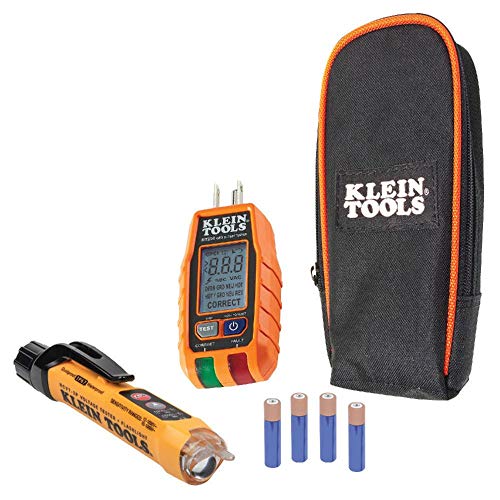
Kit pairing the NCVT3P dual-range pen with an RT250 GFCI tester that shows voltage, trip time and wiring faults.
Check price on Amazon$39.97 as of Oct 20, 2026 10:44 pm GMT+0000 — prices change; see Amazon for current price.Why we like it
- Includes the dual-range NCVT3P pen
- GFCI tester shows trip time on an LCD
- Detects open neutral and open ground
- Case and batteries included
| Specification | Details |
|---|---|
| Pen | NCVT3P, 12–1000V or 70–1000V AC; flashlight |
| Receptacle tester | RT250 with backlit LCD voltage reading |
| GFCI test | Displays time required to trip |
| Fault detection | Common wiring faults including open neutral and open ground |
| In the box | Pen, tester, case, instructions, batteries |
| Warranty | See manufacturer website |
Klein RT250KIT — NCVT3P pen + RT250 GFCI tester with LCD voltage, trip time, open neutral/ground detection
The Only Kit That Reports GFCI Trip Time
Three listings pair a pen with a receptacle tester: this RT250KIT, Klein’s 80025 kit (RT210 plus NCVT1P) and the KAIWEETS KIT02. The RT250 is the only receptacle tester among them that displays how long a GFCI takes to trip, and Klein says it specifically detects open neutral and open ground faults.
That combination fits a pre-purchase walkthrough or a rental turnover: the pen screens switches and fixtures, while the plug-in tester checks every receptacle’s wiring and every GFCI’s response. Our guide to what open ground means on an outlet tester explains the most common result.
A plug-in tester cannot detect every fault, such as a bootleg ground where neutral is jumpered to ground, so treat results as a screen. The pen here is the same NCVT3P as pick 2, with the same strengths and limits.
Pros
- GFCI trip time display
- Open neutral and ground detection
- Includes the NCVT3P pen
Cons
- Plug-in testers miss some faults
- Warranty not stated in listing
- Overlaps with pick 2 if you own that pen
Check Klein RT250KIT price on Amazon
What a non-contact voltage tester can and cannot do
A pen senses the electric field around an energized AC conductor. That makes it fast and safe for screening, but it has firm limits.
| Can do | Cannot do |
|---|---|
| Show that AC voltage is likely present near the tip | Measure how much voltage is present |
| Trace a live cable in a bundle | Detect DC voltage, such as batteries or solar strings |
| Check a cord, switch or fixture quickly | Reliably see through metal conduit, armored cable or metal boxes |
| Screen breakers and receptacles before work | Prove a circuit is de-energized and safe to touch |
False negatives come from dead or weak batteries, shielded or metal-sheathed cable, tamper-resistant outlet shutters, holding the pen in an insulated grip, or setting the threshold too high. False positives come from induced or “phantom” voltage on dead conductors run next to live ones. That is why the professional routine always ends with a meter.
Test before touch: the routine
- Check the tool. OSHA requires workplace test instruments to be visually inspected for defects before use and removed from service if damaged. Look for cracks in the housing and test the battery.
- Prove it on a known live source. Hold it to an outlet you know is energized and confirm it alerts.
- Turn off and lock out the circuit. OSHA’s guidance on controlling electrical hazards says the first step before inspection or repair is to turn the current off at the switch box and padlock the switch in the off position.
- Screen with the pen. Check every conductor in the box, not just the one you plan to touch.
- Verify with a meter. OSHA’s rules for working on de-energized parts require a qualified person to use test equipment to verify that circuit elements are de-energized, including checking for induced voltage or backfeed. A contact meter is the tool for that.
- Prove the tool again. Re-check on the known live source so a failure mid-test cannot fool you.
Our voltage testers guide compares pens with contact testers and meters, and our electrical voltage tester guide covers two-lead testers.
Choosing range and ratings
- Line voltage only: A 50V or 90V threshold (Klein NCVT1P, Fluke) ignores low-voltage wiring and gives fewer ghost alerts.
- Low-voltage work: A 12V setting finds thermostat, doorbell and irrigation control wiring. Dual range lets you switch back to a higher threshold for line voltage.
- CAT rating: Only a minority of listings state one. OSHA requires workplace test instruments to be rated for the circuits they connect to; a stated CAT III or CAT IV rating suits panel areas.
- Self-test or ready light: A continuous self-test (Fluke) or a green operational LED (Klein) addresses the dead-pen problem.
Battery care and everyday habits
Most pens run on two AAA cells, and a weak battery is the most common reason a pen goes quiet next to a live wire. A few habits keep that from happening:
- Replace batteries on a schedule rather than waiting for a low-battery warning, especially on pens without a self-test.
- Store the pen away from heat and out of a freezing truck or garage; cold weakens alkaline cells.
- Hold the pen by its body, not the insulated clip end, so it has a reference to you; some pens lose sensitivity when held only by the tip area.
- Keep the tip clean and uncracked. A cracked housing is a reason to retire the tool.
- Learn your pen’s ghost behavior on a dead cable next to a live one, so you can recognize induced voltage when it happens.
None of this changes the rule that a meter has the final word before hands touch copper.
Front Range notes
Newer and recently remodeled Front Range homes commonly have tamper-resistant receptacles, which can defeat a pen at the outlet face. Test at the cord or the cable instead, or use a plug-in tester. Dry winter air also builds static on clothing and tool bodies, which some sensitive pens pick up as brief alerts; switch to a higher threshold to confirm.
When to call an electrician
A pen tells you when to stop, not how to fix anything. NFPA advises calling a qualified electrician for frequent breaker trips or blown fuses, a tingling feeling when touching an appliance, discolored or warm outlets, a burning or rubbery smell, flickering or dimming lights, or sparks from an outlet. NFPA’s broader advice is to have all electrical work done by a qualified electrician and to have a home inspected when buying or remodeling.
Inspectors carry voltage pens alongside receptacle testers; ASHI’s article on essential inspection tools calls electrical testers vital for identifying hazards. See our inspection tools hub for the full kit, or contact us to connect with a vetted local inspector.
Frequently asked questions
What is the best non-contact voltage tester?
A pen with a self-test or operational indicator, a stated CAT rating and the right detection range for your work is the best choice. The Fluke 1AC II adds a continuous self-test; the Klein NCVT3P adds a selectable 12V low range and a CAT IV 1000V rating for low-voltage and line-voltage work.
Are non-contact voltage testers reliable?
They are reliable as a quick screen but not as proof that a circuit is dead. They can miss voltage behind metal conduit, in shielded cable, at tamper-resistant outlets or when the battery is weak, and they can false-alert on induced voltage. Always verify with a contact meter before touching conductors.
Can a non-contact voltage tester detect DC voltage?
No. Every tester compared here detects AC voltage only. Batteries, solar panels and many low-voltage power supplies produce DC, which requires a multimeter or a contact voltage tester rated for DC.
What voltage range should a non-contact tester have?
For household 120V and 240V circuits, a threshold of 50V to 90V reduces false alerts. For thermostat, doorbell and irrigation wiring, a 12V low range is needed. Dual-range pens offer both, letting you switch thresholds to confirm a reading.
Does a non-contact voltage tester replace a multimeter?
No. A pen only indicates that AC voltage may be present. A multimeter measures actual voltage and verifies that circuits are de-energized. OSHA workplace rules require test equipment to verify circuits are de-energized before work, which is a meter's job.
References
- 1910.333 Selection and Use of Work Practices — Occupational Safety and Health Administration
- 1910.334 Use of Equipment — Occupational Safety and Health Administration
- Controlling Electrical Hazards — Occupational Safety and Health Administration
- Electrical Safety in the Home — National Fire Protection Association
- Essential Tools of the Trade — American Society of Home Inspectors