Best Moisture Meter for Hardwood Flooring: A 2026 Buyer’s Guide
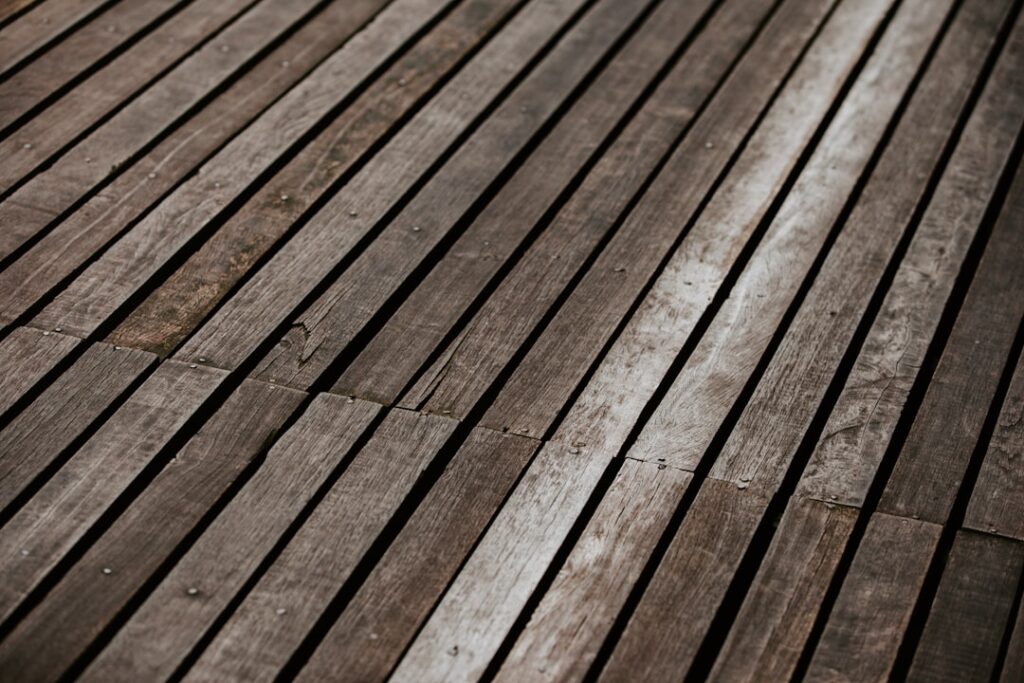
A moisture meter for hardwood flooring has two jobs before a single board is nailed down: confirming the flooring has acclimated to the house, and confirming the subfloor is dry enough to receive it. Get either wrong and the floor tells you months later, with gaps in winter or cupping and crowning after a wet spell. The best meter for this work reads finished boards without marking them, offers a hardwood setting or species correction, and makes it easy to take and compare dozens of readings. This guide ranks six meters for flooring acclimation and subfloor checks, then walks through a practical testing routine.
Part of our Moisture Meters & Water Damage Detection guide — start there for the full picture →
As an Amazon Associate we earn from qualifying purchases.
How we compared: we compared 17 current Amazon listings for wood and building moisture meters (nine pinless, five pin-type and three pin-and-pinless combinations) on what each listing actually states: hardwood modes or species groups, stated ranges and accuracy, sensing depth, temperature readout, memory functions and power. We did not lab-test any meter or handle any unit, and two pinless listings are the same RDINSCOS MT28 model under different titles. A plant soil probe returned by the same searches was set aside. Prices and availability change often, so check the current listing before buying.
Quick picks: the best moisture meters for hardwood flooring
| Pick | Best for | Key spec | Key detail |
|---|---|---|---|
| General Tools MM8 | Scanning finished hardwood | Hardwood 0–35%, 3/4 in depth | Separate hardwood and softwood settings |
| POROMETISTO WT01PRO | Acclimation logging | Pin 1.5–60% (±2.0%) + pinless | Ambient temperature readout; Max/Min |
| RDINSCOS MT35P | Rechargeable scan-and-confirm | Pin + pinless, 1200 mAh | Adjustable alarm threshold |
| Proster PST050 | Species-matched board samples | 0–99.9%, 0.5% accuracy stated | Named species incl. walnut, maple, ash |
| Povlen MT510-Y | Density-adjusted pinless reads | 4 modes incl. hardwood | Density grade adjustment; red alert over set value |
| coczow PM6811A | Subfloor panels and joists | Wood 2.0–75.0%, 6 scales | Max/Min memory to find the wettest spot |
The six picks, compared listing by listing
1. General Tools MM8 — Best Pinless Meter for Finished Hardwood

Pinless meter with separate hardwood and softwood settings, hardwood range 0–35%, reading to 3/4 inch.
Check price on Amazon$58.32 as of Oct 5, 2026 6:12 pm GMT+0000 — prices change; see Amazon for current price.| Specification | Details |
|---|---|
| Sensing method | Pinless, non-marring; auto-calibrating |
| Settings | Separate drywall, masonry, softwood and hardwood settings |
| Ranges | 0 to 35% hardwood; 0 to 53% softwood; relative for wallboard and masonry |
| Depth | Up to 3/4 in (19 mm) |
| Display / alerts | Backlit white LCD digits, 3-color LED bar graph, audible alert, out-of-range alarm |
| Power / weight | 9V with low-battery alert; 0.34 lb listed; warranty not stated in listing |
General Tools MM8 — pinless, hardwood 0–35%, softwood 0–53%, 3/4 in depth, 4 settings, LED bar + beep, 9V
One of Two Listings That State a Hardwood Moisture Range in Percent
Six of the 12 pinless-capable listings on this shelf (pinless meters plus combos) name a hardwood mode. Only two of those six, the MM8 and its General Tools sibling the MMD7NP, put a number on it: 0 to 35% for hardwood. The others either give no range or state that their pinless readings are relative values.
For flooring, that difference is the whole point. Installation instructions are written in percent moisture content, and a pinless meter that reports hardwood readings in percent can be compared with them directly, without holes in prefinished boards. The MM8 and MMD7NP share the same ranges and 3/4-inch depth; the MM8 gets the nod here for its separate per-material settings and the ergonomic handle described in the listing, which helps when taking a hundred readings on your knees.
The limits are worth knowing. There is no species correction beyond the hardwood/softwood split, so dense exotics and soft hardwoods will read differently from oak. A 3/4-inch read depth on a 3/4-inch solid board also picks up whatever is underneath, so lift a board or read a stack, not boards lying on a damp subfloor. Our guide to moisture meters for hardwood floors covers depth effects in more detail.
Pros
- States a hardwood range in percent
- No marks on prefinished boards
- Audible alert and LED bar for fast sweeps
Cons
- No species correction beyond hardwood/softwood
- Reads through thin boards into what lies beneath
- Warranty not stated in listing
2. POROMETISTO WT01PRO — Best for Acclimation Logging

Pin and pinless meter with six modes, pin range 1.5–60% at ±2.0%, ambient temperature readout and Max/Min.
Check price on Amazon$54.99 as of Oct 5, 2026 6:12 pm GMT+0000 — prices change; see Amazon for current price.| Specification | Details |
|---|---|
| Sensing method | Pinless sensor for scanning plus probe pins for direct readings |
| Modes | Pinless: drywall, masonry, softwood, hardwood (relative 0–100); pins: wood and masonry |
| Pin range / accuracy | 1.5 to 60%, ±2.0% stated |
| Ambient readout | Temperature, 14 to 140°F (±4°F); humidity named in title but no range given |
| Functions | Color screen, color and beep alerts, Max/Min, hold, silent mode, one-touch zero, 15-minute auto-off |
| Power / support | Three 1.5V alkaline batteries included; 1-year free replacement |
POROMETISTO WT01PRO — pin + pinless, 6 modes, pins 1.5–60% ±2%, ambient temp, Max/Min, hold, zero cal, 3 batteries
One of Two Meters That Read Room Temperature, and the Only One Promising Humidity Too
Acclimation is the flooring matching the room it will live in, so the room’s conditions matter as much as the boards. Two of the 17 listings display ambient temperature, this WT01PRO and the LASELION MS03, and the WT01PRO is the only one whose title also names humidity. That combination makes it the closest thing on the shelf to a single acclimation kit.
A caveat: the bullets give a temperature range and accuracy but no humidity range or accuracy, so treat the humidity function as unconfirmed until the manual is in hand, and keep a dedicated hygrometer as the reference. The pin side is the meter’s strongest spec, a stated ±2.0% across 1.5 to 60%. Only three of the 17 listings state any accuracy figure, and the other combo that does, the MS03, states ±4%.
Max/Min memory, which four listings here mention in some form, makes it quick to find the wettest board in a carton. The one-touch zero step before measuring is a sensible habit for pinless work.
Pros
- Ambient temperature readout for acclimation records
- Pin accuracy stated at ±2.0%
- Pinless hardwood mode plus pins for confirmation
- Max/Min, hold and one-touch zero
Cons
- Humidity named in title but not specified
- Pinless readings are relative (0–100), not percent
- Short 1-year replacement term
3. RDINSCOS MT35P — Best Rechargeable Scan-and-Confirm Meter
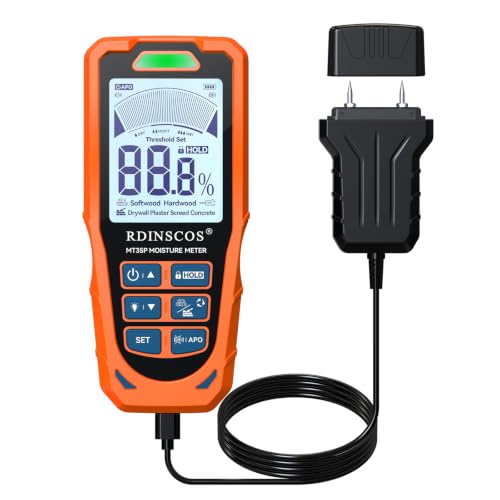
Rechargeable pin and pinless meter with 2.9-inch backlit screen, adjustable alarm and up to 8 hours per charge.
Check price on Amazon$40.00 as of Oct 5, 2026 6:12 pm GMT+0000 — prices change; see Amazon for current price.| Specification | Details |
|---|---|
| Sensing method | Pinless scanning plus pins for closer readings |
| Uses named | Walls, wood, flooring and concrete; relative moisture readings |
| Alarm | User-set threshold; red LED and buzzer |
| Display | 2.9-inch backlit LCD; hold button |
| Power | 1200 mAh lithium, USB charging, up to 8 hours per charge |
| Ranges / modes / warranty | Not stated in listing |
RDINSCOS MT35P — pin + pinless, 2.9 in backlit LCD, adjustable alarm, mute, USB rechargeable 1200 mAh (~8 hr)
The Only Combination Meter Here With a Rechargeable Battery
Three listings on this shelf combine pins and a pinless pad. The MT35P is the only one of the three that states a rechargeable battery; the WT01PRO runs on alkaline cells and the MS03 does not say. Four of the 17 listings are rechargeable in total, and the other three are pinless-only.
The scan-then-confirm workflow suits flooring well: sweep the subfloor and a sample of boards with the pad to find outliers, then pin-test those spots, on the back or tongue of a board where holes will never show. A user-set alarm threshold means the meter can be set to beep when a reading passes the limit in the flooring manufacturer’s instructions.
The listing is light on numbers. It gives no ranges, no material modes and no accuracy, and describes its readings as relative. Treat it as a comparison tool and pair it with a known-dry reference board.
Pros
- Only rechargeable combo on the shelf
- Adjustable alarm with mute
- Large 2.9-inch backlit screen
Cons
- No ranges, modes or accuracy stated
- Relative readings only, per listing
- Warranty not stated
4. Proster PST050 — Best Pin Meter for Species-Matched Board Samples

Pin meter, 0–99.9%, 0.5% stated accuracy, four species groups naming walnut, beech, ash, maple and birch.
Check price on Amazon$15.85 as of Oct 5, 2026 6:12 pm GMT+0000 — prices change; see Amazon for current price.| Specification | Details |
|---|---|
| Sensing method | Pin-type, integrated 10 mm electrodes |
| Range / accuracy | 0 to 99.9%; 0.1% resolution; 0.5% accuracy stated |
| Species groups | Four modes covering about 28 named species |
| Flooring woods named | Walnut (A); beech (B); ash, elm, maple (C); birch, pine (D) |
| Functions / power | Large LCD, data hold, auto-off, low-battery warning; 9V |
| Warranty | 1 year |
Proster PST050 — pin, 10 mm, 0–99.9%, 0.5% stated, 4 species groups (walnut/beech/ash/maple/birch), hold, 9V, 1-yr
The Only Listing That Names Common Flooring Species by Group
Three of the five pin listings on this shelf describe species groups or calibration scales, and the Proster is the only one that prints which woods sit in each group. Maple, ash, walnut, beech and birch, all common flooring species, appear on its list. That lets an installer set the right group before reading rather than guessing.
Its stated 0.5% accuracy is the tightest figure on the shelf, and the listing names flooring installers and hardwood floors among its intended users. Pin holes are a non-issue when testing the back face or tongue of boards pulled from a carton, which is where most acclimation readings should be taken anyway.
The gaps: red oak and white oak, the most common American flooring species, do not appear in the printed table, so an oak floor needs a group chosen by density and confirmed against a reference. There is no calibration-check accessory, and it cannot read finished surfaces without marking them.
Pros
- Names maple, ash, walnut, beech and birch by group
- Tightest stated accuracy on the shelf (0.5%)
- 10 mm pins for board-back readings
Cons
- Oak not listed in the species table
- Marks any surface it reads
- No calibration-check feature stated
5. Povlen MT510-Y — Best Pinless Meter With Density Adjustment

Pinless meter with softwood, hardwood, wall and masonry modes, density-grade adjustment and a red over-limit alert.
Check price on Amazon$29.99 as of Oct 5, 2026 6:12 pm GMT+0000 — prices change; see Amazon for current price.| Specification | Details |
|---|---|
| Sensing method | Pinless, high-frequency sensing |
| Modes | Softwood, hardwood, wall, masonry |
| Wood adjustment | Density grade can be adjusted for different wood types |
| Alerts / display | Large color LCD with analog bar; beeps and turns red above a set value |
| Functions | Hold, auto power-off, low-battery indicator |
| Size / weight | About 6.8 x 2.9 x 1.1 in; 0.35 lb; depth and warranty not stated in listing |
Povlen MT510-Y — pinless, softwood/hardwood/wall/masonry, density grade adjust, color LCD + beep, hold, 0.35 lb
The Only Pinless Listing That Describes a Density Adjustment
Pinless meters respond to wood density, which is why species correction on a pinless meter usually means entering a specific gravity value. Among the pinless and combo listings on this shelf, the Povlen is the only one that describes adjusting a density grade for different wood types. Its listing ties that adjustment to softwood mode, so how far it extends to hardwoods should be confirmed in the manual.
It also has a dedicated hardwood mode, one of six pinless-capable listings that do, and an over-limit alert that both beeps and turns the bar red. For a quick go/no-go sweep across a pallet of boxed flooring, that combination is practical.
The listing does not state a sensing depth, a moisture range or a warranty, and gives no accuracy figure. Those gaps keep it below the MM8 for anyone who needs numbers to compare with installation instructions.
Pros
- Only pinless listing describing density adjustment
- Dedicated hardwood mode
- Visual plus audible over-limit alert
Cons
- No depth, range or accuracy stated
- Density adjustment tied to softwood mode in listing
- Warranty not stated
6. coczow PM6811A — Best Pin Meter for Subfloor Panels and Joists

Two-pin meter with six calibrated scales, wood range 2.0–75.0%, tri-color backlight and Max/Min memory.
Check price on Amazon$17.99 as of Oct 5, 2026 6:12 pm GMT+0000 — prices change; see Amazon for current price.| Specification | Details |
|---|---|
| Sensing method | Two stainless pins |
| Ranges | Wood 2.0 to 75.0%; building materials 1.5 to 30% |
| Scales | Six calibrated scales selected from a species table; scale 3 for unlisted woods |
| Uses named | Hardwood floors, plywood, panels, composite boards, beams and floor laying |
| Functions | Tri-color backlight, hold, Max/Min, 5-minute auto-off |
| Size / weight | About 136 x 54 x 28 mm; roughly 130 g |
coczow PM6811A — pin, wood 2–75%, materials 1.5–30%, 6 scales, tri-color backlight, hold + Max/Min, ~130 g
One of Two Pin Meters Here With Max/Min Memory
Subfloor checks are a pin meter’s home turf. Holes in plywood or OSB do not matter, and the reading should be taken across many spots, especially near exterior walls, plumbing and over crawl spaces. Among the five pin listings on this shelf, only the coczow and the TOPTES TS-630 mention Max/Min memory, which captures the wettest spot during a sweep without writing down every number.
The listing names plywood, panels, composite boards and floor laying among its uses, and its six scales let the user set one scale for the subfloor panel and another for the flooring species. That makes the key comparison, flooring versus subfloor, faster.
The weaknesses are documentation. The species table is referenced but not shown, no accuracy figure or warranty is stated, and one line says no power supply is required while the title mentions a battery. For engineered panels such as OSB, any pin reading is approximate, so trend readings matter more than single values.
Pros
- Max/Min memory, one of two pin meters here
- Names plywood, panels and floor laying
- Six scales for flooring vs subfloor comparisons
Cons
- Species table not shown in listing
- No accuracy or warranty stated
- Contradictory power wording
Acclimation: what the meter is actually checking
Wood flooring gains or loses moisture until it reaches equilibrium with the air around it. Acclimation means letting that happen before installation, in the room where the floor will live, with the heating or cooling running at normal settings. The meter’s job is to show when the flooring has stopped changing and whether it is within the range the manufacturer specifies relative to the subfloor. The manufacturer’s installation instructions set the acceptable numbers and the allowable difference between flooring and subfloor; follow them rather than a generic rule.
The air side matters as much as the boards. The EPA’s Brief Guide to Mold, Moisture and Your Home recommends keeping indoor relative humidity below 60 percent, ideally 30 to 50 percent. Along the Front Range, winter indoor air often runs drier than that, which is why flooring shipped from a humid region can keep shrinking for weeks after delivery. A hygrometer reading logged alongside the moisture readings tells you whether the room itself is stable.
A practical acclimation routine
- Open several cartons from different pallets or lots; pull boards from the top, middle and bottom of each.
- Pick the mode or species group that matches the flooring. Read each board in several places, using the back face or tongue for pin meters.
- Record the average, the highest and lowest readings, plus room temperature and humidity.
- Repeat daily. When readings stop trending and sit within the manufacturer’s range, the flooring has acclimated.
- Read the subfloor the same way and compare it with the flooring, as the installation instructions require.
A flooring-specific walkthrough lives in our wood floor moisture meter guide.
Subfloor checks: wood, crawl spaces and slabs
Plywood and OSB subfloors
Take readings on a grid across the room, with extra attention near exterior doors, sliding doors, kitchens, bathrooms and anywhere plumbing runs below. Pin meters suit this work, and a pinless meter can scan quickly between pin checks. High readings in one zone usually point to a specific source, not a general problem.
Over a crawl space
The EPA’s mold course on why and where mold grows notes that crawl spaces with high relative humidity are common sites of hidden mold, particularly with bare earth floors, because the soil wicks moisture that then evaporates into the crawl space air. The same page says that moisture can move from a crawl space into the rest of the building through cracks in walls, floors and ceilings. Before installing hardwood over a crawl space, check the underside of the subfloor and the joists, not just the top surface. If the crawl space itself feels damp, ENERGY STAR’s dehumidifier guidance describes spaces that feel damp with a musty odor as roughly 50 to 75 percent relative humidity, and very damp spaces with visible damp spots as 75 to 90 percent.
Concrete slabs
Handheld pin and pinless meters give only a relative indication on concrete. Several listings here include a masonry, screed or concrete mode, but flooring manufacturers generally specify their own slab test method, and a relative reading does not substitute for it. Use the meter to find wetter areas of a slab, then follow the method in the flooring instructions. Our flooring moisture meter guide covers the difference.
Specs that matter for flooring work
- Hardwood mode or species correction. Six of the 12 pinless-capable listings name a hardwood mode; three of five pin listings describe species groups or scales. Without either, readings on dense hardwoods are rough.
- Readings in percent. Installation instructions are written in percent moisture content. Several pinless listings describe relative readings only, which work for finding outliers but not for checking a number.
- Read depth. Pinless meters stating about 3/4 inch can read through a thin board into whatever is below. Read boards in a stack or lifted off the subfloor.
- Memory. Max/Min or data hold speeds up the hundreds of readings a whole-house install needs.
- Ambient readout. Only two listings display temperature. Otherwise, add a separate hygrometer.
- Calibration check. Only the General Tools MMD4E on this shelf describes a calibration-check cap; see our moisture meter calibration guide for other ways to verify a meter.
Common flooring meter mistakes
- Reading one carton. Lots vary. Sample several cartons from different pallets.
- Wrong mode. Reading oak on a softwood setting skews every number.
- Reading boards on the subfloor. A pinless pad sees through a thin board into the subfloor below.
- Starting acclimation before the HVAC runs. Flooring acclimates to the conditions it experiences, so it should be the conditions the house will actually live in.
- Skipping records. Dated readings are the evidence if a floor later gaps or cups and a warranty question comes up.
Buy, rent or hire?
A homeowner installing one floor can reasonably rent a meter; our moisture meter rental guide compares the options. Installers and serious DIYers who expect more projects will get value from owning one of the meters above, and our moisture meter shop page collects current options.
Some situations call for a professional instead. Readings that stay high after the HVAC has run for a week, a damp crawl space, signs of past water damage or a musty odor all point to a moisture source rather than an acclimation delay. The CDC’s mold overview notes that mold grows where there is moisture, including around leaks and after floods, and on wood, drywall and carpet. A meter cannot identify mold or the leak behind it. Standard home inspections also have limits: the ASHI Standard of Practice states that inspections are not technically exhaustive and need not report concealed conditions. An inspector who carries a meter can still point you to the source; our home inspection moisture meter guide explains how inspectors use them, and the broader home inspection tools overview shows the rest of the kit.
Choosing quickly
- Prefinished boards, no holes allowed: General Tools MM8.
- One meter for boards, subfloor and room conditions: POROMETISTO WT01PRO.
- Rechargeable scan-and-confirm: RDINSCOS MT35P.
- Species-specific readings on board backs: Proster PST050.
- Pinless go/no-go across boxed flooring: Povlen MT510-Y.
- Subfloor panels and joists: coczow PM6811A.
References
- A Brief Guide to Mold, Moisture and Your Home — U.S. Environmental Protection Agency
- Mold Course Chapter 2: Why and Where Mold Grows — U.S. Environmental Protection Agency
- Dehumidifiers — ENERGY STAR
- Mold — Centers for Disease Control and Prevention
- Standard of Practice — American Society of Home Inspectors
Frequently asked questions
Should I use a pin or pinless meter for hardwood flooring?
Both have a place. A pinless meter with a hardwood mode reads prefinished boards without marks and scans quickly, which suits acclimation checks. A pin meter suits subfloors and the backs or tongues of boards where holes never show. A combination meter, or one of each, covers the whole job.
How do I know when hardwood flooring has acclimated?
Take readings on boards from several cartons each day with the home's heating or cooling running normally. When the readings stop changing and sit within the flooring manufacturer's specified range relative to the subfloor, the flooring has acclimated. The manufacturer's instructions set the target numbers.
Can a moisture meter test a concrete slab before installing hardwood?
Only as a rough screen. Handheld meters give relative readings on concrete, which help find wetter areas. Flooring manufacturers generally specify their own slab test method, so follow the instructions for the product you are installing rather than relying on a handheld reading.
Why do my pinless readings change when boards are on the subfloor?
Many pinless meters read about 3/4 inch deep, so on a thinner board the sensor also reads the subfloor or whatever lies beneath. Read boards in a stack or lifted off the floor, and compare against a known-dry board of the same species.
Does indoor humidity matter for hardwood flooring?
Yes. Flooring moves toward equilibrium with the air around it, so room conditions drive acclimation. The EPA recommends keeping indoor relative humidity below 60 percent, ideally 30 to 50 percent. Logging temperature and humidity alongside moisture readings shows whether the room itself is stable.
Planning a hardwood install over a crawl space or a slab with a history of water? Reach out to connect with a vetted Front Range inspector before the flooring goes down.
Moisture meters for home inspection
Pin meters read deep but leave marks; pinless meters scan surfaces non-destructively. Many inspectors carry both.
| Product | Why | Buy |
|---|---|---|
 Klein Tools ET140 Pinless Klein Tools ET140 Pinless | Non-destructive scanning; affordable. | Amazon — $49.14 |
 General Tools MMD4E General Tools MMD4E | Best-selling pin meter for drywall/wood. | Amazon — $39.98 |
 Lignomat Mini-Ligno Lignomat Mini-Ligno | Trusted by woodworkers; species-calibrated. | Amazon — $108.98 |