Best Hammer Drills (2026): 7 Picks for Brick and Concrete

The best hammer drill for a homeowner is the one that bores clean holes in brick, block and concrete for anchors, and then works as an ordinary drill the rest of the year. A hammer drill adds a rapid forward pulse to the bit’s rotation, which chips masonry as the bit turns. That is what you need to mount a mailbox on brick, hang a hose reel on a foundation wall, fasten a handrail to concrete steps or set anchors for a basement shelving unit. Below are seven picks, split between cordless models for battery-platform owners and corded models for occasional masonry work, plus a guide to BPM, chucks, rotary hammers and the silica dust that drilling concrete creates.
Part of our Structure & Exterior guide — start there for the full picture →
As an Amazon Associate we earn from qualifying purchases.
How we compared: we compared 11 current Amazon listings for 1/2 in. hammer drills, 7 cordless and 4 corded, on what each listing states: torque or power, blows per minute, speed ranges, clutch settings, chuck type, handles, batteries and warranty. The same searches returned four SDS-Plus rotary hammers and a drill/impact driver kit; we set those aside and cover rotary hammers in the buying guide. We did not lab-test these drills or use them hands-on. Prices and availability change often, so check the current listing before buying.
Quick picks: the best hammer drills by job
| Product | Best for | Key features | Price | Buy |
|---|---|---|---|---|
| DEWALT DCD806B | Best overall cordless |
| $112.95as of Nov 11, 2026 12:44 pm GMT+0000 | Buy now →Check current price |
| DEWALT DCD1007B | Most torque for big holes |
| $146.99as of Nov 11, 2026 12:44 pm GMT+0000 | Buy now →Check current price |
| DEWALT DCD799B | Compact for tight spots |
| $74.99as of Nov 11, 2026 12:44 pm GMT+0000 | Buy now →Check current price |
| DCK KDJZ05-13 | Budget kit with a big battery |
| $79.99as of Nov 11, 2026 12:44 pm GMT+0000 | Buy now →Check current price |
| Dong Cheng DCJZ2050i | Budget two-battery kit |
| $69.99as of Nov 11, 2026 12:44 pm GMT+0000 | Buy now →Check current price |
| SKIL HD182001 | Corded for occasional masonry |
| $64.99as of Nov 11, 2026 12:44 pm GMT+0000 | Buy now →Check current price |
| DEKOPRO DKPDIDE071C1 | Corded with depth gauge |
| $29.79as of Nov 11, 2026 12:44 pm GMT+0000 | Buy now →Check current price |
Prices are Amazon’s listed prices as of the time shown and change often; check Amazon for today’s price. As an Amazon Associate we earn from qualifying purchases.
The 7 picks, compared listing by listing
1. DEWALT DCD806B 20V MAX XR — Best Overall Cordless Hammer Drill

Brushless 20V MAX XR 1/2 in. hammer drill: anti-rotation shutoff, two speeds to 2,000 rpm, up to 175 holes per charge.
Check price on Amazon$112.95 as of Nov 11, 2026 12:44 pm GMT+0000 — prices change; see Amazon for current price.Why we like it
- Anti-rotation system shuts down on a bind
- Two speeds, up to 2,000 rpm
- About 3.1 lb bare, light for overhead holes
- Adjustable 3-position LED at 70 lumens
| Specification | Details |
|---|---|
| Motor | Brushless |
| Speeds | 0–650 and 0–2,000 rpm |
| Chuck | 1/2 in. metal ratcheting |
| Safety feature | ANTI-ROTATION system with red indicator LED |
| Runtime claim | Up to 175 holes per charge |
| Torque / BPM | Not stated in listing; tool only, battery sold separately |
DEWALT DCD806B — 20V MAX XR, brushless, 0–650/0–2,000 rpm, 1/2 in. metal ratcheting chuck, anti-rotation, 3.06 lb, bare tool
One of Only Two Listings With Anti-Rotation Protection
A hammer drill bit that catches on rebar or a hard aggregate stone can wrench the tool sideways hard enough to hurt a wrist. Of the 11 hammer drills we compared, only two describe a system that senses that sudden rotation and shuts the motor down: this DCD806B and the DCD1007B at pick 2. For a homeowner drilling a foundation wall from a ladder or a crouch, that is the most meaningful safety feature on the shelf.
The DCD806B pairs it with a lighter body (about 3.1 lb bare, against about 5 lb for the DCD1007B) and the highest stated top speed of the DEWALT picks (2,000 rpm). DEWALT rates it at up to 175 holes per charge. The listing does not state a torque figure or blows per minute, which is an odd omission for a hammer drill, but it calls this the most powerful 2-speed hammer drill in its 20V MAX line.
It is a bare tool. For a DEWALT battery owner, that is the ideal format. Everyone else needs to budget for a pack and charger, or look at the kits in picks 4 and 5.
Pros
- Anti-rotation shutoff
- Light for a 1/2 in. hammer drill
- Two speeds to 2,000 rpm
- DEWALT 20V MAX platform
Cons
- Torque and BPM not stated
- Battery and charger sold separately
- Warranty term not stated in listing
Check DEWALT DCD806B price on Amazon
2. DEWALT DCD1007B 20V MAX XR — Most Torque for Large Holes

Brushless 1/2 in. hammer drill: 2,100 in-lbs, 3-speed metal transmission, anti-rotation, up to 275 holes per charge.
Check price on Amazon$146.99 as of Nov 11, 2026 12:44 pm GMT+0000 — prices change; see Amazon for current price.Why we like it
- Highest stated torque of any hammer drill here
- Three-speed all-metal transmission
- Most holes per charge claimed
- Carbide-insert ratcheting chuck for bit grip
- 3-year limited warranty
| Specification | Details |
|---|---|
| Max torque | 2,100 in-lbs |
| Transmission | 3-speed, all metal |
| Chuck | 1/2 in. ratcheting, nitro-carburized with carbide inserts |
| Safety feature | ANTI-ROTATION system |
| Runtime claim | Up to 275 holes per charge |
| Weight / warranty | About 5 lb bare; 3-year limited |
DEWALT DCD1007B — 20V MAX XR, brushless, 2,100 in-lbs, 3-speed, carbide-insert 1/2 in. chuck, anti-rotation, bare tool
Roughly Four Times the Torque of the Budget Cordless Picks
Four of the 11 listings state torque in inch-pounds. The DCD1007B’s 2,100 in-lbs is about four times the next figure (the DCK’s 531 in-lbs), with the DCA (492) and Dong Cheng (443) close behind the DCK. That gap is why this is the drill for large holes: hole saws through framing, big auger bits, and 1/2 in. masonry bits for wedge anchors on a railing post or a deck ledger against a foundation.
It also claims the most holes per charge (up to 275, against the DCD806B’s 175) and adds a third speed, which helps match bit speed to material. The listing says it makes large-diameter holes in metal, wood and concrete. Its anti-rotation system matters more here than on any other pick, because that much torque binding on rebar can twist hard.
Weight is the cost: about 5 lb bare, the heaviest of the bare DEWALT tools. For a homeowner hanging a few anchors a year, the DCD806B or DCD799B is easier to live with.
Pros
- 2,100 in-lbs stated
- 3-speed metal transmission
- Anti-rotation shutoff
- 3-year limited warranty
Cons
- Heaviest bare DEWALT here
- BPM not stated
- Bare tool only
- More drill than most homes need
Check DEWALT DCD1007B price on Amazon
3. DEWALT DCD799B ATOMIC — Best Compact Hammer Drill
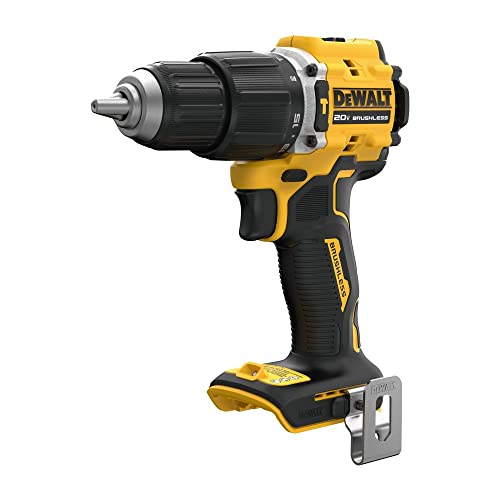
DEWALT's shortest 20V MAX hammer drill: 6.49 in. head, brushless, 1,650 rpm, 28,050 BPM, about 2.5 lb. Tool only.
Check price on Amazon$74.99 as of Nov 11, 2026 12:44 pm GMT+0000 — prices change; see Amazon for current price.Why we like it
- Shortest tool head stated on the shelf
- Lightest DEWALT here at about 2.5 lb
- BPM stated, unlike the other DEWALTs
- 1/2 in. ratcheting chuck despite the size
| Specification | Details |
|---|---|
| Tool head length | 6.49 in. |
| Power | 552 UWO |
| Speed / blows | Up to 1,650 rpm; up to 28,050 BPM |
| Chuck | 1/2 in. ratcheting |
| Weight | About 2.5 lb bare |
| Warranty | Not stated in listing beyond manufacturer warranty |
DEWALT DCD799B — 20V MAX ATOMIC, brushless, 6.49 in. head, 552 UWO, 1,650 rpm, 28,050 BPM, 2.53 lb, bare tool
The Only DEWALT Hammer Drill Here That States Blows per Minute
Four DEWALT hammer drills appear among the 11 listings (DCD806B, DCD1007B, DCD996B and this DCD799B). Only the DCD799B states a blow rate, up to 28,050 BPM, which makes it the one DEWALT you can compare head to head with the budget kits on that spec. It also states the shortest tool head of any listing here at 6.49 in.
Short and light pays off in the places homeowners actually drill masonry: between joists to anchor a sill plate, inside a window well, or under a deck to fasten a post base to a pier. At about 2.5 lb bare it is the lightest DEWALT on the shelf.
The trade-off is speed and runtime. Its top speed (1,650 rpm) is lower than the DCD806B’s, it has no anti-rotation system in the listing and no hole-count claim. For a handful of anchors at a time, none of that matters much.
Pros
- Very compact 6.49 in. head
- BPM stated
- Light at about 2.5 lb
Cons
- No anti-rotation feature listed
- No torque or hole-count claim
- Bare tool only
Check DEWALT DCD799B price on Amazon
4. DCK KDJZ05-13 20V Brushless — Best Budget Kit With a Large Battery

Brushless 20V hammer drill kit: 531 in-lbs, two speeds, 22+1+1 clutch, 4.0Ah battery, charger and 42 bits.
Check price on Amazon$79.99 as of Nov 11, 2026 12:44 pm GMT+0000 — prices change; see Amazon for current price.Why we like it
- Highest stated torque among the budget cordless kits
- 4.0Ah battery is the largest pack included here
- Three modes: drill, hammer and screwdriving
- Two-year warranty on the tool
| Specification | Details |
|---|---|
| Max torque | 531 in-lbs (60 N·m) |
| Blow rate | Up to 36,000 per minute claimed |
| Speeds / clutch | 0–550 and 0–2,200 rpm; 22+1+1 |
| Capacity | 1/2 in. in brick and steel, 1-1/2 in. in wood |
| Kit | One 4.0Ah battery, 2A charger, 42 bits, bag |
| Warranty | 2 years tool; 1 year battery and charger |
DCK KDJZ05-13 — 20V brushless, 531 in-lbs, 36,000 BPM claimed, 22+1+1 clutch, 4.0Ah kit, 2-yr tool warranty
The Biggest Battery Included With Any Kit Here
Only three of the 7 cordless listings include a battery at all: this DCK, the DCA (one 2.0Ah pack per its title) and the Dong Cheng (two batteries, capacity not stated). The DCK’s 4.0Ah pack is the largest stated, and masonry drilling drains batteries faster than wood, so capacity matters. The listing claims around 800 screws or 90 large holes in wood per charge.
Its 531 in-lbs is the highest torque among the budget kits, and its claimed 36,000 blows per minute is higher than the DCA and Dong Cheng (27,000 each) and the DEWALT DCD799B (28,050). The listing’s stated capacity, 1/2 in. in brick, is realistic for a hammer drill in this class and covers most anchor sizes a homeowner uses.
The DCK battery platform is not one of the major brands, so later tools will not share this pack. The listing is also heavier than the bare DEWALTs at about 8.2 lb, which likely includes the kit and bag.
Pros
- Large 4.0Ah battery included
- Stated torque, BPM and capacity
- 22+1+1 clutch for screws too
- 2-year tool warranty
Cons
- One battery only
- Off-brand battery platform
- Marketing claims are the seller’s own
Check DCK KDJZ05-13 price on Amazon
5. Dong Cheng DCJZ2050i 20V Brushless — Best Budget Two-Battery Kit
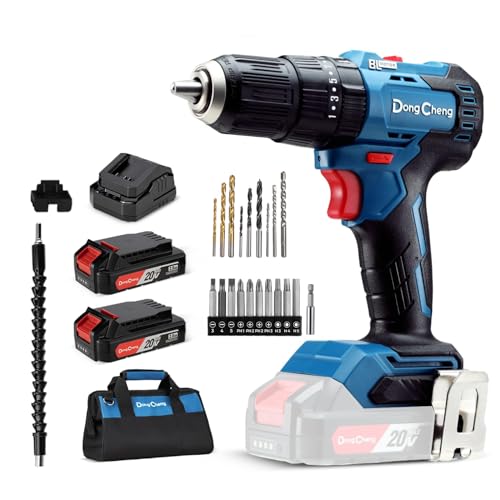
Brushless 20V hammer drill: 443 in-lbs, 27,000 BPM, 20+1+1 clutch, 1/2 in. metal chuck, sold with two batteries.
Check price on Amazon$69.99 as of Nov 11, 2026 12:44 pm GMT+0000 — prices change; see Amazon for current price.Why we like it
- Only cordless listing with two batteries
- Three modes: drill, drive and hammer
- About 2 lb stated, light for its class
- All-metal ratcheting 1/2 in. chuck
| Specification | Details |
|---|---|
| Max torque | 443 in-lbs (50 N·m) |
| Blow rate | 27,000 BPM |
| Speeds / clutch | 0–550 and 0–1,800 rpm; 20+1+1 |
| Chuck | 1/2 in. all-metal ratcheting, keyless |
| Batteries | Two, per the title; capacity not stated |
| Warranty | Not stated in listing |
Dong Cheng DCJZ2050i — 20V brushless, 443 in-lbs, 27,000 BPM, 20+1+1, 1/2 in. metal chuck, 2-battery kit
The Only Cordless Hammer Drill Listing With a Spare Battery
Masonry holes eat batteries, and a hammer drill that dies halfway through a row of anchors for a basement shelving unit is a frustration. This Dong Cheng is the only cordless listing here that comes with two batteries. The listing does not state their capacity, so compare runtime expectations cautiously against the DCK’s single 4.0Ah pack.
Its 443 in-lbs and 27,000 BPM are the lowest stated figures of the three budget cordless kits, but they are still in the right range for 1/4 in. and 3/8 in. masonry anchors in brick and block. The listing calls out attics, under-sink spaces and cabinet assembly as uses, which reflects its other role as a general drill/driver with a 20+1+1 clutch.
No warranty term is stated, and like the DCK, the battery platform does not extend to a broad tool line.
Pros
- Two batteries in the kit
- Light, compact build
- Metal 1/2 in. chuck
Cons
- Lowest torque of the budget kits
- Battery capacity not stated
- No warranty term stated
Check Dong Cheng DCJZ2050i price on Amazon
6. SKIL HD182001 7.5-Amp Corded — Best Corded Hammer Drill for Occasional Masonry
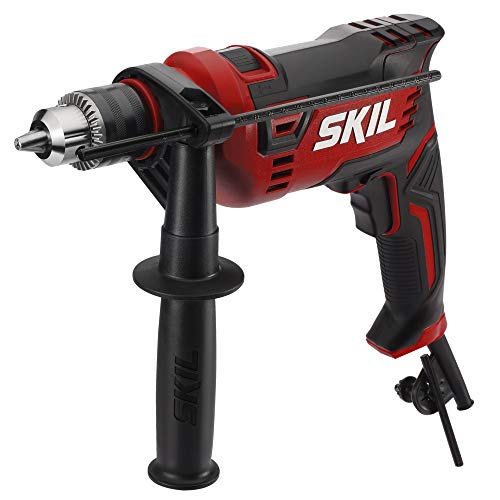
7.5-amp corded 1/2 in. hammer drill with a keyed chuck, side assist handle, variable trigger and lock-on button.
Check price on Amazon$64.99 as of Nov 11, 2026 12:44 pm GMT+0000 — prices change; see Amazon for current price.Why we like it
- No battery to buy, charge or replace
- Keyed 1/2 in. chuck for large-diameter bits
- Side assist handle for control
- Lock-on button for long drilling runs
| Specification | Details |
|---|---|
| Power | Corded, 7.5 amp |
| Modes | Drill and hammer drill |
| Chuck | 1/2 in. heavy-duty keyed |
| Handles | Soft-grip main handle plus side assist handle |
| Speed / BPM | Not stated in listing |
| Warranty | 1-year limited |
SKIL HD182001 — corded 7.5 A, 1/2 in. keyed chuck, drill/hammer modes, side handle, lock-on, 1-yr limited warranty
The Only Corded Listing With Both a 7.5-Amp Motor and a Side Handle
Four of the 11 listings are corded (SKIL, Hammerhead, GALAX PRO and DEKOPRO). The SKIL pairs the strongest stated corded motor (7.5 amp, tied with the Hammerhead) with a side assist handle, which the Hammerhead listing does not mention; the GALAX PRO and DEKOPRO include side handles but list smaller 5- and 6-amp motors. For a homeowner who drills masonry once or twice a year, a corded drill avoids the cost and slow aging of batteries entirely.
A keyed chuck is old-fashioned but grips large masonry bits hard, which matters once the hammer action starts vibrating a keyless chuck loose. The side handle is not optional in practice: it is what keeps the drill straight and lets you resist the twist if the bit catches.
The listing does not state speed or BPM, and the warranty is the shortest stated here at one year.
Pros
- No battery to maintain
- Keyed 1/2 in. chuck
- Side assist handle
- Lock-on for long runs
Cons
- Speed and BPM not stated
- Shortest stated warranty
- Needs an outlet and a cord
Check SKIL HD182001 price on Amazon
7. DEKOPRO DKPDIDE071C1 6-Amp Corded — Best Corded Kit With a Depth Gauge

6-amp corded hammer drill, 3,000 rpm and 48,000 bpm claimed, keyed chuck, 360 degree side handle, depth gauge.
Check price on Amazon$29.79 as of Nov 11, 2026 12:44 pm GMT+0000 — prices change; see Amazon for current price.Why we like it
- Highest blow rate claimed on the shelf
- Depth gauge for consistent anchor holes
- 360 degree rotating side handle
- Includes three cement bits
| Specification | Details |
|---|---|
| Power | Corded, 6 amp |
| Speed / blows | Up to 3,000 rpm; up to 48,000 bpm claimed |
| Chuck | 1/2 in. keyed metal |
| Accessories | Side handle, depth gauge, 12 bits incl. 3 cement bits |
| Speed control | 12 adjustable speeds per the listing |
| Warranty | Not stated in listing |
DEKOPRO DKPDIDE071C1 — corded 6 A, 3,000 rpm, 48,000 bpm claimed, keyed 1/2 in. chuck, side handle, depth gauge
The Highest Blow Rate Claimed Among the 11 Listings
Five listings state a blow rate. The DEKOPRO’s claimed 48,000 bpm is the highest, ahead of the DCK’s 36,000 and the DEWALT DCD799B’s 28,050. Blow rate is only part of the story (the energy of each blow matters as much, and no hammer drill here states it), but a higher rate generally means faster progress in brick and block.
The kit is practical for anchor work. A depth gauge, also included with the GALAX PRO, lets you drill every hole to the same depth so sleeve or plastic anchors seat flush, and the 360 degree side handle helps control the drill on a vertical foundation wall. Three cement bits in 6, 8 and 10 mm cover common anchor sizes.
Its 6-amp motor sits below the 7.5-amp SKIL and Hammerhead and above the 5-amp GALAX PRO, and no warranty term is stated.
Pros
- Highest claimed bpm
- Depth gauge and side handle
- Cement bits included
Cons
- 6-amp motor, below the 7.5-amp picks
- No warranty term stated
- Bpm claim not independently verified
Check DEKOPRO DKPDIDE071C1 price on Amazon
Hammer drill vs regular drill vs rotary hammer
A regular drill/driver only spins the bit. Several drill listings we reviewed for our cordless drill guide say outright that they are not for concrete or masonry. A hammer drill adds a fast, light pulse, switchable on and off, so one tool handles both wood and masonry. It is the right choice for anchor holes up to about 1/2 in. in brick, block and concrete.
A rotary hammer is a different machine. The four SDS-Plus rotary hammers our searches returned (two Deshuo corded models and two DEWALT cordless models) use a piston-driven mechanism that delivers far heavier blows, measured in joules: the listings state 2.1 to 3 joules. They take SDS-Plus bits rather than round-shank bits, and several add chisel modes for removing tile or chipping concrete. If you are drilling many holes in poured concrete, setting large anchors, or chipping out a section of slab, a rotary hammer is the better tool. For a few holes a year in brick or block, a hammer drill is enough and far more versatile.
And if your job is mostly screws, buy an impact driver instead; despite the name, an impact driver’s hammering is rotational and does not help in masonry.
How to read a hammer drill spec sheet
BPM (blows per minute)
BPM, sometimes printed as IPM, is how many forward pulses the hammer delivers each minute. Stated figures here run from 27,000 to 48,000. Higher generally drills faster, but no listing states the energy per blow, so BPM alone does not tell the whole story. Three of the four DEWALT listings do not state BPM at all.
Torque and speed
Torque matters for large bits and for driving screws in drill mode. Stated torque runs from 443 to 2,100 in-lbs. For masonry, speed control matters more: start slowly to keep the bit from wandering on a smooth surface, then increase speed once the bit bites.
Chuck: keyed vs keyless
All 11 listings are 1/2 in. hammer drills. The three keyed-chuck models (SKIL, GALAX PRO, DEKOPRO) grip bits more securely under vibration; keyless ratcheting metal chucks on the cordless models are faster to change and hold well if tightened firmly.
Side handle and depth gauge
A side handle gives a second point of control and helps you resist the twist if a bit binds. Three of the 11 listings mention one. A depth gauge (two listings) stops each hole at the anchor’s required depth.
Battery platform
All 7 cordless listings claim brushless motors, so that is not a differentiator. The platform is. If you own DEWALT 20V MAX batteries, the bare DCD806B, DCD1007B or DCD799B are the obvious buys. If you own another major brand’s batteries, buy that brand’s hammer drill even though it is not on this shelf. If you own none and drill masonry rarely, a corded model avoids the question entirely.
Silica dust: the real hazard of drilling concrete
Drilling into concrete, brick, block and mortar makes fine dust that is more dangerous than it looks. The Occupational Safety and Health Administration explains that respirable crystalline silica, particles at least 100 times smaller than ordinary sand, is created when drilling, cutting or grinding stone, concrete, brick, block and mortar, and that inhaling it raises the risk of silicosis, lung cancer, chronic obstructive pulmonary disease and kidney disease.
OSHA’s silica rules govern workplaces, not homeowners, but its compliance guide shows what good practice looks like. For handheld drills, including hammer and rotary hammer drills, its Table 1 calls for a shroud or cowling with a dust collection system that has a filter of 99 percent or greater efficiency, and a HEPA-filtered vacuum for cleaning holes. At home, that translates to:
- Use a drill-mounted dust shroud connected to a vacuum with a fine-dust or HEPA filter. Our shop vac guide explains which filters capture fine dust.
- Never dry-sweep concrete dust; vacuum it or wipe with a damp cloth.
- Wear a well-fitted respirator rated for fine particulates when drilling more than a hole or two, especially indoors.
- Keep children and pets out of the area and ventilate basements while you work.
Older homes add another layer. Some older plaster, textured coatings and wall or ceiling products can contain asbestos. The EPA advises leaving materials in good condition undisturbed and having an accredited professional sample them before work that would disturb them, rather than sampling them yourself.
Drilling safely: noise, eyes and hidden utilities
Hammer drills are among the loudest tools a homeowner owns. The National Institute on Deafness and Other Communication Disorders says long or repeated exposure to sounds at or above 85 dBA can cause hearing loss, so wear earplugs or earmuffs. Eye protection is equally basic; OSHA notes that thousands of people are blinded each year by work-related eye injuries that proper eye and face protection could have prevented, and masonry chips fly.
OSHA’s hand and power tool booklet adds general rules that apply directly: secure work so both hands are free, keep good footing and balance, disconnect the tool before changing bits, and do not use electric tools in damp or wet locations unless they are approved for it. That last point matters in Colorado basements during spring snowmelt and around window wells. For corded drills, plug into a GFCI-protected outlet.
Before drilling into a foundation wall or slab, think about what is inside or behind it. Basement walls can hide water lines, gas lines and electrical runs, and some slabs hold radiant heat tubing or, in some newer construction, post-tension cables. If you are not sure, stop and ask.
Front Range jobs a hammer drill handles
- Fastening a handrail or a post base to concrete steps and piers.
- Anchoring basement shelving, a water heater strap or a furnace stand to a foundation wall.
- Mounting hose reels, house numbers, mailboxes and lights on brick.
- Setting lag bolts with lag shields into masonry for a ledger or awning, after checking that the design is allowed and properly flashed.
Expansive clay soils along the Front Range move foundations and flatwork, so a hammer drill is often bought to re-anchor something that has shifted. If you are drilling to fix a crack, a sinking step or a wall that is moving, the anchor is treating a symptom.
When a hammer drill is not the fix
Foundation cracks wider than hairline, stair-step cracks in block, bowing basement walls or doors that suddenly stick are signs that something structural is going on. Drilling and anchoring will not solve them. Our guide to hiring structure and exterior specialists explains who evaluates foundations and what credentials to look for.
Buying or selling a Front Range home with foundation questions? Contact us to connect with a vetted local inspector who can tell you whether it is a weekend project or a call for a structural engineer.
Hammer drill FAQ
Frequently asked questions
Do I need a hammer drill for concrete?
Yes, for anything beyond a soft mortar joint. A regular drill only spins the bit, and many drill listings say they are not meant for masonry. A hammer drill adds a fast forward pulse that chips concrete, brick and block, and it is the right tool for anchor holes up to about 1/2 inch.
What is the difference between a hammer drill and a rotary hammer?
A hammer drill uses a light, fast pulse and takes ordinary round-shank bits, so it doubles as a regular drill. A rotary hammer uses a piston mechanism that delivers much heavier blows, takes SDS-Plus bits and often has a chisel mode. Choose a rotary hammer for frequent or large holes in poured concrete.
What does BPM mean on a hammer drill?
BPM means blows per minute, the number of forward hammer pulses each minute. Stated figures on current listings run from about 27,000 to 48,000. Higher numbers generally drill faster, but listings rarely state the energy per blow, so compare BPM alongside torque and brand.
Is drilling into concrete dust dangerous?
Yes. OSHA explains that drilling concrete, brick and mortar creates respirable crystalline silica, which raises the risk of silicosis, lung cancer and other diseases. Use a dust shroud with a fine-dust or HEPA vacuum, avoid dry sweeping and wear a respirator rated for fine particles.
Should I buy a corded or cordless hammer drill?
If you already own a brand's batteries, a cordless hammer drill on that platform is convenient and doubles as an everyday drill. If you drill masonry only a few times a year and own no batteries, a corded hammer drill avoids battery cost and aging. Either way, use the side handle.
References
- Crystalline Silica — Occupational Safety and Health Administration
- Small Entity Compliance Guide for the Respirable Crystalline Silica Standard for Construction (OSHA 3902) — Occupational Safety and Health Administration
- Hand and Power Tools (OSHA 3080) — Occupational Safety and Health Administration
- Noise-Induced Hearing Loss — National Institute on Deafness and Other Communication Disorders (NIH)
- Protect Your Family from Exposures to Asbestos — U.S. Environmental Protection Agency