Basement Mold Removal Near Me: Cold-Zone Vetting Guide
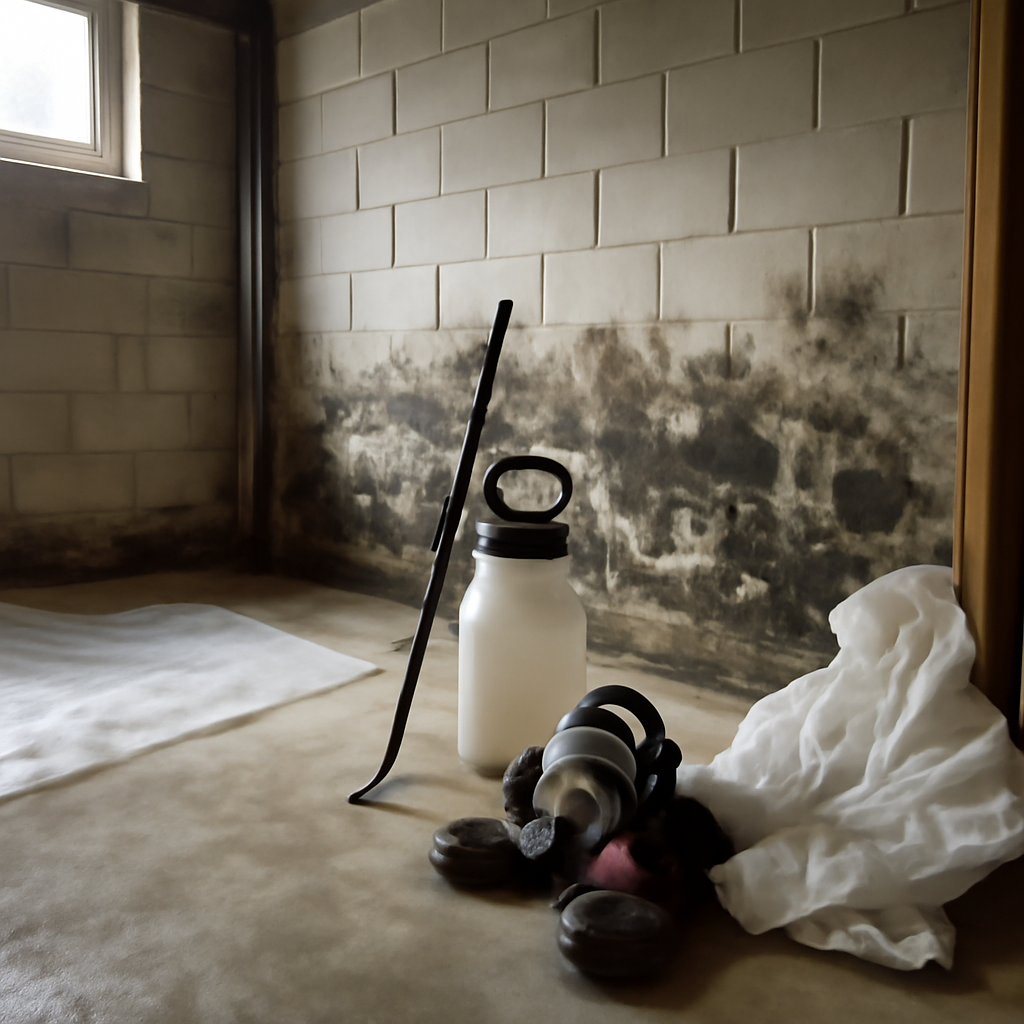
“Basement mold removal near me” returns the same crowded field of franchises and one-truck operators as any other mold search, but basements present a distinct problem set: cold-zone humidity dynamics, foundation moisture intrusion, finished-versus-unfinished space differences, and the freeze-thaw cycles that drive most Front Range basement issues. This commercial-vetting guide walks through what separates a contractor who understands basement-specific work from one applying a generic remediation template. The framework draws on EPA, CDC, and Colorado public-health guidance current as of 2026; consult a certified industrial hygienist for occupant-health concerns.
Part of our Mold Removal & Remediation guide — start there for the full picture →
Is this mold, asbestos, or water damage? Get a free instant screen
Upload a clear photo of the suspect area. You'll get an instant AI screening opinion and what to do next. This is screening guidance, not a professional determination.
Screening guidance only. AI can be wrong. Confirm asbestos, mold type, or lead with lab testing or a licensed professional before acting.
Why Basements Concentrate Mold Risk
Basements combine three conditions that promote mold growth: below-grade walls that draw moisture from soil, cooler surface temperatures that create condensation when warm interior air meets cold concrete, and limited ventilation compared to above-grade space. The combination means basement mold often persists after surface cleanup if the underlying moisture dynamics are not addressed. EPA mold guidance treats below-grade space as a higher-risk category for these structural reasons.
Front Range basements add freeze-thaw cycling. Soil moisture migrates through foundation walls during spring snowmelt, then dries seasonally. Contractors who treat basement mold as a one-time event rather than a recurring moisture dynamic often miss the underlying pattern.
Finished vs Unfinished Basement Differences
An unfinished basement allows direct inspection of concrete walls, exposed framing, and visible moisture. Remediation is typically simpler — clean the concrete with appropriate biocide, address the moisture source, and verify with sampling. Scope is contained because no finish materials hide contamination.
A finished basement multiplies complexity. Drywall, insulation, carpet, and trim conceal moisture pathways and contamination. Remediation in finished basements typically requires removing affected materials, drying the substrate, and reconstructing — often at three to five times the cost of unfinished cleanup for equivalent square footage. Contractors quoting finished basement work without specifying demolition scope are under-bidding.
Foundation Moisture Sources
Five sources drive most Front Range basement moisture. Surface drainage carrying water toward the foundation during rain or snowmelt. Inadequate gutter and downspout extensions concentrating runoff at corners. Window-well drainage failure during heavy precipitation. Failed perimeter drain systems below grade. Plumbing leaks from supply lines or drain pipes routed through the basement.
A competent remediation contractor walks the exterior grade, gutters, and window wells before scoping interior work. A contractor who only inspects the visible mold is treating symptoms. Source identification typically saves homeowners thousands compared to repeat remediation cycles.
Cold-Zone Humidity Dynamics
Basement air is cooler than upper-floor air year-round, and cooler air holds less moisture before condensation forms. During humid summer months — yes, the Front Range has them, especially in monsoon season — warm air infiltrating a basement encounters cold concrete and frames out moisture as condensation. This produces mold growth in patterns that look like leaks but originate from air-handling dynamics.
Remediation that addresses visible growth without correcting the humidity dynamic produces regrowth within a season. Solutions include dehumidification rated for the space volume, addressing air-sealing leaks between conditioned and basement air, and adjusting HVAC return-air balance. The cluster on emergency mold remediation timing covers the moisture-control window that often determines remediation scope.
IICRC S520 Condition Levels in Basements
The Institute of Inspection, Cleaning and Restoration Certification S520 standard classifies contamination into three condition levels. Condition 1 is normal fungal ecology. Condition 2 is settled spores from a nearby Condition 3 source. Condition 3 is active growth. Basement projects often involve mixed condition levels — Condition 3 at the source, Condition 2 in adjacent space — which changes both containment and clearance scope.
Ask contractors to specify the condition level expected in each area and how containment will be staged. Generic “full basement remediation” scopes that don’t differentiate are bidding by square footage rather than contamination level.
Credentials for Basement Specialists
Beyond the standard IICRC AMRT credential, basement remediation benefits from contractors who understand foundation moisture management. Some firms hold complementary credentials in basement waterproofing, which is useful when source correction crosses into foundation work. The American Council for Accredited Certification offers the CMR designation at the senior level.
Ask which credentialed technicians will be on site and whether the firm partners with a foundation contractor for moisture-source correction. Firms that handle only the visible cleanup and refer source work without coordination produce fractured projects.
The Inspection-Remediation Conflict
The same structural conflict that exists in general mold work intensifies in basements because finished-basement projects expand scope significantly as demolition reveals additional contamination. A firm that inspects, scopes, demolishes, and clears its own work has every incentive to expand scope mid-project. Use an independent inspector for the pre-work assessment and clearance testing.
An independent inspection typically costs $400-$800 on the Front Range and routinely identifies under-scoped or over-scoped bids. The investment is small compared to the potential bid variance on basement projects.
Pricing Anchors for Basement Work
Front Range basement remediation in 2026 typically prices as follows: contained unfinished cleanup runs $1,500-$4,000; partial finished-basement demolition and remediation runs $5,000-$12,000; full finished-basement reconstruction following remediation runs $15,000-$40,000 depending on finish level. Bids dramatically below these ranges usually omit demolition, containment, or reconstruction; bids dramatically above usually bundle finish upgrades the homeowner could competitively bid separately.
Insist on line-item bidding: demolition, remediation labor, disposal, drying, clearance testing, and reconstruction as separate categories. This makes apples-to-apples comparison possible across bidders who structure invoices differently.
Containment in Below-Grade Spaces
Basement remediation containment requires negative-pressure isolation from the rest of the home, HEPA-filtered air scrubbing during work, and sealing of HVAC returns and supplies serving the basement. Without containment, demolition aerosolizes spores into the conditioned air handler, contaminating upper floors. This is the most common cause of complaints in budget basement remediation projects.
A scope that does not include negative-pressure containment and HVAC isolation should be flagged. Containment equipment rental and operation typically adds $500-$1,500 to a project but eliminates upper-floor cross-contamination risk.
Post-Remediation Drying
After demolition and surface cleaning, the basement substrate must be dried before reconstruction. This typically requires industrial dehumidifiers and air movers running for three to seven days, with moisture content verified by meter before any wall, floor, or insulation reinstall. Premature reconstruction over residual moisture causes regrowth in concealed spaces — the single most expensive failure mode in basement work.
Ask contractors how long drying typically runs on basement projects of comparable size and what moisture-content thresholds trigger reconstruction. Specific numerical answers — “below 16% on framing, below 4% on concrete” — indicate operational discipline.
Clearance Testing Considerations
Post-remediation clearance testing for basements should include air sampling from the work area, an upstairs control sample for baseline comparison, and surface sampling on any porous materials retained. Testing should be performed by a different entity than the remediation contractor — a structural separation that protects the homeowner from conflicting incentives.
Clearance criteria typically require basement spore counts to be statistically similar to or lower than the outdoor control, and surface samples to show no active growth. Reports should include the laboratory accreditation, sampling methodology, and clear pass/fail determination.
Front Range County Variations
Different Front Range counties present different basement risk profiles. Older Denver and Boulder neighborhoods include homes with stone or cinderblock foundations that present more moisture pathways than newer poured-concrete walls. Douglas and Elbert County newer construction more often shows drainage-related issues from grading. Adams and Arapahoe County mid-century homes frequently combine both. Contractors familiar with the specific neighborhood type often diagnose faster.
Warranty Specific to Basements
Basement remediation warranties should explicitly address regrowth from incomplete removal versus regrowth from new moisture events. Strong warranties cover the first; reasonable warranties exclude the second. Ambiguous warranty language that excludes any regrowth where the homeowner cannot prove source elimination is weak — the homeowner usually cannot prove a negative.
Ask for warranty language in writing before signing the contract. Warranties presented orally rarely match the written terms.
When to Walk Away
Disqualifying signals on basement projects include refusal to differentiate finished from unfinished scope, refusal to commit to containment with HVAC isolation, refusal to accept third-party clearance, and inability to produce a current COI. Each of these alone justifies moving to the next bidder. The general mold inspection workflow is detailed on the mold inspection hub.
Foundation Type and Project Complexity
Front Range basement projects vary significantly by foundation type. Older homes in central Denver, Boulder, and Colorado Springs often have stone or cinderblock foundations that present multiple moisture pathways. Mid-century homes typically have poured concrete walls with cold joints that can leak under pressure. Newer construction in Douglas, Elbert, and Adams counties usually has full poured walls with exterior waterproofing membranes that fail differently when they fail.
A contractor familiar with the specific foundation type often diagnoses faster and scopes more accurately. Ask candidate firms about their experience with the foundation type in question — generic “we do basements” answers signal less depth than specific construction-type discussion.
Sump Pump and Perimeter Drain Considerations
Many Front Range basements include perimeter drain systems and sump pumps that protect against foundation-water intrusion. When these systems fail — pumps burn out, drains clog with soil fines, or discharge lines freeze in winter — water enters the basement and produces the conditions that drive mold growth. A competent remediation contractor inspects these systems as part of moisture-source diagnosis.
Sump-pump replacement runs $500-$1,500 typically. Perimeter drain remediation runs $2,000-$8,000 depending on access and damage. These costs are often separate from the mold remediation scope, but contractors should identify them as source-correction work that must precede or accompany remediation to prevent regrowth.
Working in Occupied Basements
Many basement projects proceed while the home is occupied above. Effective containment isolates the basement from the rest of the home, but occupied projects require additional coordination: scheduling work hours, managing HVAC isolation, controlling odor from disinfectants, and protecting common-use areas like stairs and laundry. Contractors experienced in occupied work scope these elements proactively.
Some projects warrant temporary relocation, particularly when occupants have asthma, immune compromise, or other health conditions that make any spore exposure problematic. Ask candidate contractors how they handle occupied versus vacant projects and what protections they put in place.
References
- Basic Information About Mold — U.S. Environmental Protection Agency
- Dampness and Mold in Buildings — Centers for Disease Control and Prevention
- Basement Moisture Inspection Guide — InterNACHI
- Mold in Indoor Environments — Colorado Department of Public Health and Environment
- Healthy Homes Reference Guide — U.S. Department of Housing and Urban Development
Frequently asked questions
How much does basement mold removal cost on the Front Range?
Contained unfinished work runs $1,500-$4,000. Partial finished-basement projects run $5,000-$12,000. Full reconstruction following remediation can reach $15,000-$40,000 depending on finish level. Bids should break out demolition, remediation, drying, and reconstruction separately.
Can I remove basement mold myself?
EPA guidance allows DIY cleanup for contained areas under 10 square feet with a clear moisture source corrected first. Larger affected areas, occupant health complaints, or finished-basement contamination warrant professional remediation with containment and clearance.
Why does mold keep returning to my basement?
Regrowth indicates the moisture source was not corrected. Common causes include foundation seepage, condensation on cold walls, plumbing leaks, or inadequate dehumidification. Source diagnosis is more important than repeat surface cleaning.
Does insurance cover basement mold removal?
Most policies cover mold only when it results from a covered water event — burst pipe, sudden leak — and cap coverage at $5,000-$10,000 typically. Mold from chronic seepage or condensation is generally excluded. Review your specific policy.
Front Range homeowners dealing with basement moisture and wanting an independent inspector before remediation can connect through our contact page.
Mold removal & cleanup picks
For a small, contained patch (under ~10 sq ft) these EPA-friendly removers handle surface mold. Larger or recurring growth warrants a professional assessment first.
| Product | Why | Buy |
|---|---|---|
 RMR-86 Instant Mold Stain Remover RMR-86 Instant Mold Stain Remover | Fast-acting on stains; ventilate and wear PPE. | Amazon — $29.99 |
 Concrobium Mold Control Concrobium Mold Control | No-bleach formula that also helps prevent regrowth. | Amazon — $11.26 |
 Mold Armor Mold & Mildew Remover Mold Armor Mold & Mildew Remover | Widely stocked bathroom/surface remover. | Amazon — $22.98 |