What Causes High Radon Levels in Homes: Homeowner Fix Guide
Radon does not produce immediate symptoms in most people. Persistent cough, shortness of breath, chest pain, or unexplained weight loss can be late-stage indicators of radon-caused lung cancer — but these appear only after years of exposure, not as a warning sign. Searches for what causes high radon levels in homes usually come from homeowners with a recent test result above the EPA action level who want to know what actions reduce indoor radon. This guide focuses on the homeowner-actionable angle: which fixes work, which fixes have marginal impact, and what Colorado Front Range mitigation typically costs. The content summarizes EPA and CDPHE guidance current as of 2026 and is not professional mitigation advice; engage a certified radon-mitigation contractor for site-specific evaluation.
Part of our Radon Levels guide — start there for the full picture →
The Short Answer: Sub-Slab Depressurization Solves Most Cases
For a homeowner who tested elevated and wants to know what fix actually works, the practical answer is sub-slab depressurization. A small fan and PVC piping system installed at the foundation slab draws soil gas from below the slab and vents it above the roofline before the gas can enter the house. The technique is reliable, well-documented, and achieves 80 to 99 percent radon reduction in most installations. Most homes with test results between 4 and 20 pCi/L drop below the EPA action level after sub-slab depressurization is installed.
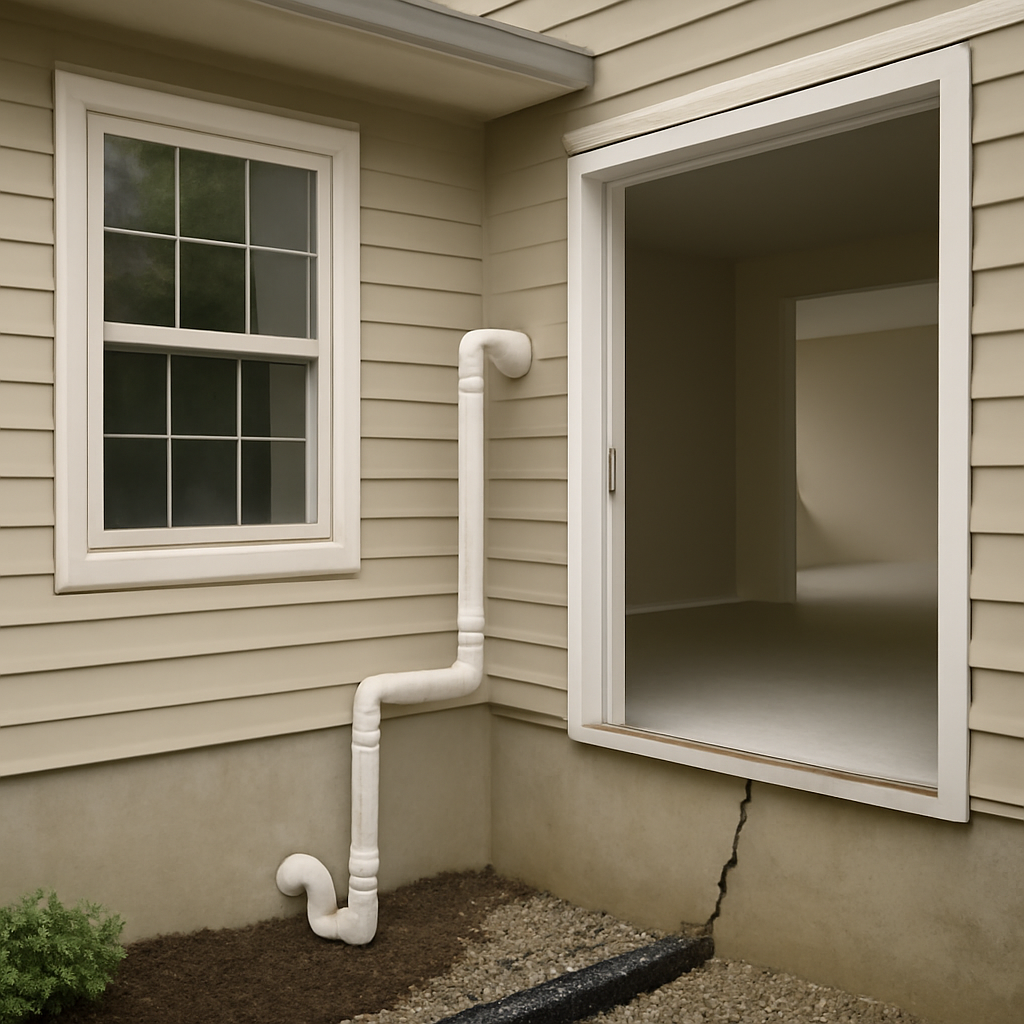
The fan runs continuously and uses 30 to 60 watts of electricity. The piping system is typically PVC, three or four inches in diameter, routed through an interior chase or along the exterior of the house. Front Range mitigation costs run $1,000 to $2,500 in 2026 depending on home design, foundation type, and contractor selection. The Colorado Department of Public Health and Environment radon program maintains a public list of certified Colorado mitigation contractors.
Why Sealing Foundation Cracks Has Marginal Impact
One common homeowner question is whether sealing foundation cracks will reduce radon. The honest answer is: only marginally. Foundation cracks contribute to soil-gas entry, but they are usually not the dominant entry pathway. Soil gas enters through the entire foundation envelope including small porosity in concrete, joint seams between slab and walls, plumbing penetrations, and gaps around utility services. Sealing visible cracks closes some of the entry area but leaves the majority of the foundation envelope unchanged.
Sealing as a sole mitigation strategy rarely brings elevated readings below the action level. EPA explicitly cautions against relying on sealing alone for elevated test results. Sealing can be useful as a companion measure during sub-slab depressurization installation; it reduces parasitic air loss from the system and improves overall efficiency. As a standalone fix, sealing is not a substitute for an active mitigation system.
The Building-Envelope Tightness Paradox
Newer energy-efficient homes paradoxically concentrate radon more than older drafty homes. The reason is straightforward: tight building envelopes reduce outdoor-air infiltration that would otherwise dilute indoor radon, while at the same time creating larger negative pressure differentials that drive soil-gas advection through the foundation. The result is that two homes on the same site with the same soil-gas radon production can show dramatically different indoor concentrations based on construction era and building-envelope tightness.
This pattern does not argue against energy-efficient construction. The trade-off is straightforward: tight building envelopes provide energy savings and comfort benefits, with the mitigation cost being one item on the building-design list rather than a structural deficiency. Energy-efficient construction and radon-resistant design can be combined from the ground up; a certified radon professional can advise on the details.
Front Range Geological Drivers
The uranium-bearing geology under Front Range soils produces elevated radon-gas generation. The Pikes Peak granite batholith, the Idaho Springs Formation, and various Front Range igneous and metamorphic units contain elevated uranium concentrations relative to national averages. Radon production rates in soils derived from these formations are correspondingly elevated.
Within the Front Range, geological setting varies by location. Homes built on granite-derived soils in Jefferson and Boulder Counties typically test higher than homes built on sedimentary soils in parts of Adams and Arapahoe Counties. The entire state remains EPA Zone 1, but within-zone variation is substantial. The broader Colorado radon testing guide covers the geological patterns across Front Range counties.
House-Level Factors That Amplify Radon
Beyond geology and building envelope, several house-level factors amplify radon concentration. Negative pressurization from exhaust fans (bathroom, kitchen, dryer) and combustion appliances (furnace, fireplace) increases soil-gas draw. Sump pits without sealed lids provide a direct soil-gas entry path. Crawlspaces with exposed dirt floors leak soil gas into the above-grade living space. Stack-effect pressure differentials in tall houses pull soil gas in through the lowest level and exhaust it through upper-level leakage paths.
Each amplifier suggests a potential intervention. Sealing sump-pit covers, replacing exposed-dirt crawlspace floors with poly-membrane vapor barriers, and balancing exhaust ventilation can all reduce indoor radon at the margin. None of these reliably substitute for an active sub-slab depressurization system in homes with elevated test results, but they can complement the system and improve overall building-envelope performance.
What Mitigation Actually Costs in Front Range Colorado
Sub-slab depressurization installed in a typical Front Range single-family home runs $1,000 to $2,500 in 2026. The range reflects home design (smaller homes with simple foundations cost less; larger homes with complex foundations cost more), foundation type (poured-concrete slab is easiest; block walls and stone foundations are more involved), and contractor pricing.
The system installation usually takes one full day. A typical installation includes one suction pit cut into the basement slab, three or four-inch PVC piping routed to an exterior or attic chase, an inline radon fan, a manometer pressure indicator, and connection to a 120V power circuit. Post-installation testing confirms the system reduced radon levels as expected. Most contractors include a 30-day post-installation test in the contract price.
CDPHE Subsidy Programs for Low-Income Households
CDPHE periodically operates mitigation subsidy programs for low-income Colorado households. Program availability and eligibility vary by year. The CDPHE radon program website above publishes current program details when funding is available. American Lung Association radon resources also list national low-income mitigation assistance programs that can complement state-level support.
Post-Mitigation Testing and Long-Term Monitoring
Post-mitigation testing is standard practice. EPA recommends a follow-up test no sooner than 24 hours after the mitigation system is operational, conducted in the same lowest-occupied level under closed-house conditions. The follow-up test confirms the system is working and documents the post-mitigation concentration for warranty and resale purposes.
EPA also recommends re-testing every two years even after successful mitigation, because mitigation-system performance can degrade over time. Fan failures, blocked pipes, foundation settling, and major house renovations that change air-flow patterns can all reduce mitigation-system effectiveness. Continuous radon monitors installed alongside the mitigation system provide ongoing visibility into post-mitigation concentration without requiring repeat short-term tests. EPA radon information for homeowners covers the long-term monitoring framework.
What If the Test Result Is Between 2 and 4 pCi/L
Test results between 2 and 4 pCi/L do not require mitigation under the federal action level, but the residual lung-cancer risk at those levels is not zero. EPA explicitly recommends considering mitigation at 2 to 4 pCi/L when feasible. The homeowner decision often comes down to budget priorities and household composition. Homes with children, elderly occupants, or current smokers carry higher cumulative-risk profiles and warrant stronger consideration of mitigation even at sub-4 pCi/L levels.
An alternative for borderline results is improved natural ventilation and balanced mechanical ventilation. Increasing outdoor-air supply dilutes indoor radon, though the effect is usually smaller than active mitigation provides. A sibling article on what causes radon in homes covers the broader entry-pathway and amplifier framework.
What This Means for a Front Range Homeowner
The practical takeaway is simple. Sub-slab depressurization is the proven, reliable fix for elevated radon. Sealing cracks alone is marginal. Energy-efficient construction concentrates radon more than older drafty construction, but well-designed mitigation handles that pattern. Front Range mitigation runs $1,000 to $2,500 and CDPHE maintains a list of Colorado-certified contractors. Post-mitigation testing and biennial re-testing keep the risk picture current.
Front Range homeowners with elevated radon test results who want to talk to a vetted Colorado-certified mitigation contractor can reach out through our contact page.
Radon-Resistant New Construction
For Front Range homeowners involved in new construction or major addition projects, radon-resistant new construction (RRNC) techniques cost a fraction of post-construction mitigation and produce the same indoor-radon outcome. RRNC standards include a gravel layer below the foundation slab, a polyethylene vapor barrier, sealed slab penetrations, a vertical vent pipe routed from below the slab to above the roofline, and an electrical junction box in the attic for future fan installation if needed.
The RRNC package adds roughly $500 to $1,200 to construction cost depending on home size and the local builder’s familiarity with the technique. If post-construction testing shows the passive system alone keeps indoor radon below the action level, no fan is needed and the system operates by natural-draft convection. If testing shows the passive system is insufficient, adding a fan to the existing piping converts the passive system to an active sub-slab depressurization system at a fraction of the retrofit cost. Several Front Range builders include RRNC as standard practice; others offer it as an option.
Crawlspace and Slab-on-Grade Mitigation Variants
Sub-slab depressurization is the primary residential radon mitigation approach for homes with basements or basement-with-slab construction. Homes built on other foundation types use variant mitigation techniques. Sub-membrane depressurization is the standard for homes with crawlspaces: a polyethylene vapor barrier is sealed across the crawlspace floor, and a fan draws soil gas from below the barrier and vents it above the roofline. Slab-on-grade homes use a variation of sub-slab depressurization, with suction pits cut into the slab in interior closets or utility rooms where piping can be concealed.
Each variant uses the same general principle: create a continuous negative-pressure plenum below the foundation envelope that captures soil gas before it can enter living space. Mitigation contractors evaluate the specific foundation type during the pre-installation site visit and propose the variant best suited to the home. Front Range housing stock includes all three foundation types, and Colorado-certified mitigation contractors handle each variant routinely.
What to Look For When Hiring a Mitigation Contractor
Mitigation contractor selection has a few key criteria. Verify Colorado certification status through CDPHE; the program maintains a public list. Ask for at least three references from recent Front Range installations and contact the references to ask about installation quality, post-installation re-test results, and ongoing system performance. Request a written proposal that specifies the system design (suction pit count, pipe routing, fan model, manometer placement) before signing.
Pricing transparency matters. Front Range mitigation pricing runs $1,000 to $2,500 for a typical single-family home; quotes substantially below $1,000 sometimes reflect under-spec’d designs that produce limited radon reduction, and quotes substantially above $2,500 typically reflect either complex home designs or premium contractor positioning. The system itself is well-understood enough that pricing variation within the typical range is mostly about contractor overhead rather than installation quality. Most reputable contractors include a post-installation re-test in the quoted price.
References
- EPA Radon Information for Homeowners — EPA
- CDPHE Colorado Radon Program — Colorado Department of Public Health and Environment
- American Lung Association Radon Resources — Lung.org
- ENERGY STAR: Seal and Insulate — U.S. Environmental Protection Agency (ENERGY STAR)
Frequently asked questions
What is the best way to reduce radon in a home?
Sub-slab depressurization is the standard residential radon mitigation approach and achieves 80 to 99 percent radon reduction in most installations. A fan and PVC piping system draws soil gas from below the foundation slab before it enters the house, venting above the roofline.
Does sealing foundation cracks lower radon levels?
Only marginally. Foundation cracks are not usually the dominant entry pathway; soil gas enters through the entire foundation envelope. EPA explicitly cautions against relying on sealing alone for elevated test results. Sealing can complement an active mitigation system but rarely substitutes for one.
How much does radon mitigation cost on the Front Range?
Front Range mitigation typically runs $1,000 to $2,500 in 2026. The range reflects home design, foundation type, and contractor selection. CDPHE maintains a list of Colorado-certified mitigation contractors and periodically operates subsidy programs for low-income households.
Do energy-efficient homes have higher radon?
Tight building envelopes can concentrate radon more than older drafty construction because reduced outdoor-air infiltration limits dilution. The trade-off is energy savings and comfort. Sub-slab depressurization handles the pattern reliably; the mitigation cost is one item on the building-design list.
Front Range homeowners considering radon mitigation can get in touch through our contact page for a referral to a Colorado-certified mitigation contractor.
Test your home for radon
Radon is invisible and odorless, so a test is the only way to know your level. A short-term kit gives a first reading in days; a digital monitor tracks it over time.
| Product | Why | Buy |
|---|---|---|
 AirChek Charcoal Radon Test Kit AirChek Charcoal Radon Test Kit | Lab fee usually included; EPA short-term protocol. | Amazon — $21.95 |
 First Alert RD1 Radon Test Kit First Alert RD1 Radon Test Kit | Widely stocked; 48-hour charcoal test. | Amazon — $16.98 |
 Airthings Corentium Home Airthings Corentium Home | Digital monitor with a long-term average. | Amazon — $142.99 |