Residential Asbestos Abatement: Process, Containment, and Cost
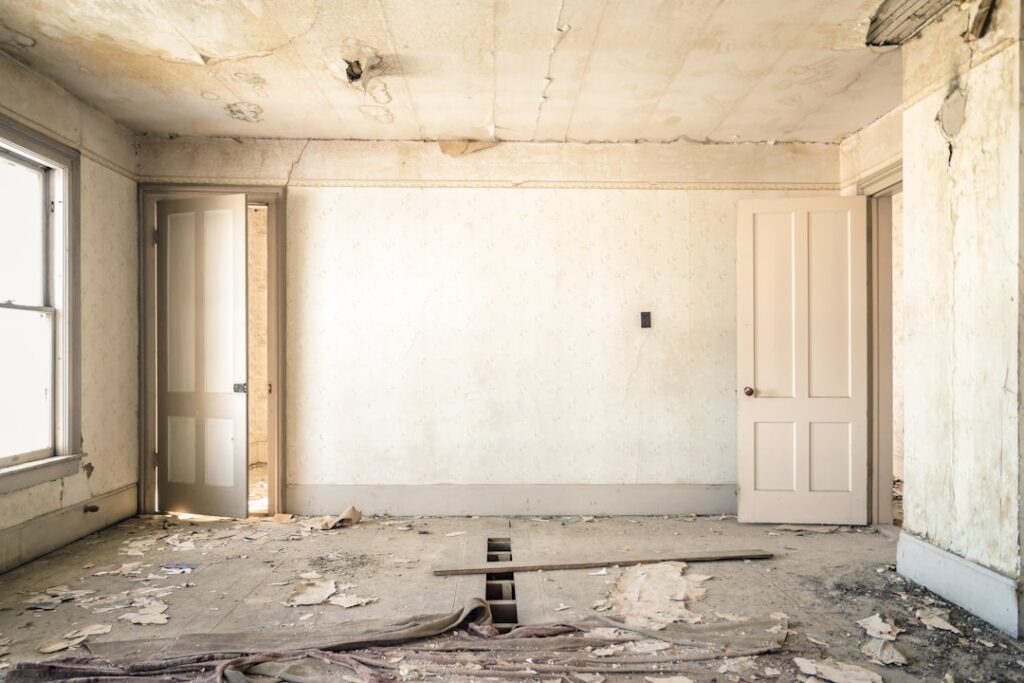
Residential asbestos abatement is the regulated process of removing asbestos-containing materials (ACMs) from a home so they no longer pose a fiber-release hazard. The work is licensed-contractor-only in nearly every U.S. jurisdiction, governed federally by EPA NESHAP and OSHA, and supplemented by state and local rules that often add stricter requirements. This guide walks the actual sequence — survey, containment, removal, disposal, clearance — with cost benchmarks, timeline expectations, and the homeowner’s role at each step. Methodology reflects EPA, OSHA, and CDPHE guidance current as of 2026; consult a state-licensed abatement contractor for site-specific decisions.
Part of our Asbestos in the Home guide — start there for the full picture →
Is this mold, asbestos, or water damage? Get a free instant screen
Upload a clear photo of the suspect area. You'll get an instant AI screening opinion and what to do next. This is screening guidance, not a professional determination.
Screening guidance only. AI can be wrong. Confirm asbestos, mold type, or lead with lab testing or a licensed professional before acting.
What residential asbestos abatement involves
Abatement is a four-phase project: pre-work survey and notification, work-area containment with negative air pressure, wet-method removal with HEPA filtration, and post-abatement clearance testing. Homeowners must vacate the affected area for the duration of the project and typically for an additional period until clearance air sampling confirms the space is safe to reoccupy. Single-room abatement projects (popcorn ceiling, one floor of tile) typically span two to four working days. Whole-house abatement (multiple components across a full pre-1980 home) can run two to four weeks.
Why DIY is not a real option
EPA NESHAP regulates the demolition and renovation of properties containing regulated asbestos-containing material (RACM). For single-family homes, NESHAP exempts most renovation work but not demolition. State and local rules typically close the loophole: Colorado, for example, requires CDPHE-Air Pollution Control Division certification for any commercial abatement and tightly regulates homeowner-performed work on regulated materials. Even where homeowner abatement is technically legal, disposal requirements at permitted facilities, OSHA worker-protection standards for anyone helping, and the liability transfer to the next buyer make DIY a poor economic choice. The pre-1978 housing hazard pillar walks the broader regulatory backdrop.
Phase 1 — pre-abatement survey and notification
A licensed asbestos building inspector performs a pre-abatement survey, identifying every ACM in the work area, sampling where needed, and writing a scope document. The contractor then files notification with the appropriate regulatory agency — typically ten working days before work begins for projects above the threshold. Notification triggers regulator inspection rights and creates the paper trail that protects future buyers.
Phase 2 — work-area containment
Containment isolates the work area so fibers cannot migrate. The standard build includes:
Polyethylene barriers
Two layers of 6-mil polyethylene sheeting cover floors, walls, and any items that cannot be removed. Doorways, vents, and electrical outlets are sealed. The barrier creates a single enclosed work zone with one controlled entry.
Negative-air-pressure enclosure
HEPA-filtered negative air machines exhaust the enclosure to the exterior, creating a pressure differential that pulls air inward through the entry. The negative pressure means that even if barrier integrity is compromised, contaminated air cannot escape into occupied space. Standard practice requires four air changes per hour at minimum.
Decontamination chamber
A three-stage decon airlock at the work-zone entrance includes a clean room, shower, and equipment room. Workers don disposable Tyvek suits and full-face P100 respirators in the clean room, work in the contaminated zone, and shower out through the dirty room.
Phase 3 — wet-method removal
Removal proceeds with the wet method — amended water is misted onto materials before and during disturbance to suppress fiber release. Friable materials (those that crumble under hand pressure: spray-on texture, pipe wrap, vermiculite insulation) get the most aggressive wetting. Non-friable materials (vinyl floor tile, transite siding) are typically scored, lifted in intact sections, and double-bagged on the spot.
Waste collection follows strict protocol. Removed ACMs go directly into 6-mil polyethylene bags labeled with EPA-required warning text. Bags are sealed with gooseneck twists, double-bagged, and accumulated in a sealed waste storage area pending transport. No mechanical compaction is permitted because compaction shatters fibers and releases them.
Phase 4 — disposal at permitted facility
Asbestos waste is transported to a state-permitted asbestos disposal facility by a licensed transporter. The contractor provides the homeowner with a chain-of-custody manifest documenting bag count, weight, and destination. Disposal fees run $50 to $200 per cubic yard depending on region, with Front Range disposal handled through Denver-area permitted landfills.
Phase 5 — post-abatement clearance testing
Clearance is the regulatory sign-off that the work area is safe for reoccupation. Three components combine:
Visual inspection
A third-party clearance inspector — independent of the abatement contractor — performs a thorough visual inspection of the work area. Residual debris, dust accumulation on surfaces, or incomplete cleanup voids the clearance and triggers re-cleaning.
Aggressive air sampling
The clearance inspector creates aggressive air conditions in the work zone using leaf blowers and fans to dislodge any residual fibers, then runs air sampling pumps for a defined sample volume. Samples ship to a NVLAP-accredited lab.
TEM analysis to EPA AHERA clearance level
Lab analysis uses transmission electron microscopy (TEM) — the most sensitive available method — and compares results to the EPA AHERA clearance level of 70 structures per square millimeter. Below clearance: reoccupy. Above clearance: re-clean and resample. PCM (phase-contrast microscopy) is faster and cheaper but less sensitive and is typically reserved for worker-exposure monitoring rather than reoccupancy clearance.
Typical residential abatement costs
Cost varies by material type, quantity, and access. Industry estimates for 2026:
Popcorn ceiling removal
$3 to $7 per square foot, with single-room projects (12×14 ft, roughly 170 sq ft) running $500 to $1,200 plus mobilization and clearance fees.
Vinyl floor tile and mastic
$5 to $15 per square foot, depending on whether mastic is asbestos-containing (common with 9×9 black mastic) and whether the substrate must be preserved.
Pipe-wrap insulation
$8 to $15 per linear foot. Basement and crawlspace projects with extensive pipe runs commonly total $2,000 to $5,000.
Vermiculite attic insulation
$5 to $12 per square foot, with whole-attic projects (1,200 sq ft typical) running $6,000 to $15,000. Vermiculite from the Libby, Montana mine carries elevated tremolite asbestos risk and is handled with extra precaution.
Whole-house abatement
$15,000 to $50,000+ for pre-1980 homes with multiple ACM categories. Mobilization, containment, and clearance fees represent a meaningful fraction of small projects and a smaller fraction of larger ones.
What homeowners control during a project
Homeowners control three big decisions. First, removal scope — full removal versus enclosure or encapsulation (where ACMs are sealed in place rather than removed). Second, contractor selection — verifying state license, insurance, references, and clearance-testing-firm independence. Third, work scheduling and reoccupation — coordinating with abatement crews and any tenants or family members. The buyer’s guide to asbestos removal and testing includes contractor-vetting questions.
Red flags to watch for
Several contractor behaviors signal a project that will not pass clearance or that creates downstream liability. Skipping pre-abatement notification. Using a clearance inspector employed by the abatement contractor (third-party independence is the standard). No written disposal manifest. No worker air-monitoring during the project. Bid pricing that is dramatically below market norms — abatement is labor- and disposal-cost intensive, and lowball bids usually mean shortcuts.
When to call a professional
Any suspected asbestos disturbance in a pre-1980 home — from popcorn ceiling removal to bathroom remodels to attic insulation upgrades — should begin with a state-licensed asbestos building inspector survey before any work proceeds. Front Range homeowners can search the CDPHE certified-contractor database for current licenses. Confirmation of clean clearance air sampling before reoccupation protects both current occupants and the property record for future transactions.
Cost breakdown for common residential abatement scenarios
Abatement pricing varies by material, quantity, access, and regional labor market. Front Range homeowners weighing project scope can use the following 2026 benchmarks as starting points, with the understanding that final quotes depend heavily on site-specific conditions like containment complexity, building height, and disposal proximity.
Popcorn ceiling — 1000 sqft project
Single-room popcorn removal sits at $3-7 per square foot all-in, but the per-square-foot rate drops on larger projects as mobilization and clearance fees spread across more area. A 1000 sqft project covering the main floor of a typical Front Range bungalow lands at $1,500-3,000. The work includes pre-abatement survey, 6-mil polyethylene containment, negative-air machine setup, wet-method scraping, double-bagged disposal, decontamination, and post-abatement TEM clearance air sampling. Homeowners must vacate the work zone during the project and remain out until clearance results return — typically four to six days end-to-end.
Vermiculite attic insulation removal
Loose-fill vermiculite — especially Zonolite-brand insulation from the contaminated Libby, Montana mine — is among the most expensive residential abatement projects because of the volume of material and the friable nature of the product. A 1,200 sqft attic with 6-12 inches of vermiculite typically runs $5,000-15,000. The project requires full attic containment, negative air pressure, HEPA-vacuum extraction of the loose-fill material, sealed disposal containers, and post-abatement TEM clearance. Some Front Range projects approach the high end of the range when the attic is irregular or access is constrained. EPA explicitly recommends against homeowner handling of vermiculite under any circumstances.
Pipe lagging — per linear foot
Asbestos pipe-wrap insulation in basements, crawlspaces, and utility chases prices at $50-100 per linear foot for full removal including containment and clearance. A typical basement with 30-50 linear feet of insulated pipe runs $2,000-5,000. Pipe lagging is friable when disturbed, and the work-area containment is often the most expensive component of the project relative to the small volume of material actually removed. Buyers who can access the basement only through limited entry points face higher mobilization fees because containment is more elaborate.
Transite siding — partial replacement
Cement-asbestos siding (transite) is non-friable when intact, which simplifies handling but does not eliminate the abatement requirement. Partial-wall replacement covering a damaged section runs $3,000-8,000 depending on access, scaffolding needs, and the substitute siding chosen. Whole-house transite replacement on a 1,500 sqft single-story home commonly approaches $15,000-25,000 because the labor to remove and dispose of intact panels is substantial even though the per-panel disposal cost is modest.
Mobilization and clearance fees that apply to every project
Every abatement project carries fixed costs that do not scale with project size: pre-abatement survey ($300-700), containment setup and breakdown ($500-1,500), and third-party TEM clearance air sampling ($400-900). Those fees represent a substantial fraction of small projects (often 30-50% of total cost on a single-room popcorn ceiling) and a smaller fraction of large projects (often 5-15% on whole-house abatement). Homeowners with multiple components to address should consider bundling work to spread the fixed costs across more line items.
Post-abatement clearance testing requirements
Clearance is the regulatory and practical sign-off that a work area is safe for reoccupation. Without passing clearance, the project is incomplete — occupants cannot legally or safely return, and the contractor cannot close out the job. Three protocol elements determine whether a project clears or fails.
TEM air sampling per EPA AHERA
EPA AHERA prescribes transmission electron microscopy (TEM) for clearance air analysis. TEM identifies asbestos fibers specifically and distinguishes them from non-asbestos fibers, which is essential because non-asbestos fibers (fiberglass, cellulose, plant matter) are present in nearly every indoor air sample and would falsely inflate counts under less specific methods. The clearance inspector — independent of the abatement contractor — collects samples in the contained work zone after the abatement crew has cleaned and demobilized.
The 70-structures-per-square-millimeter threshold
EPA AHERA sets the clearance level at 70 asbestos structures per square millimeter of filter area. Below the threshold, the work zone passes and reoccupation is permitted. The threshold is intentionally conservative — it sits well below any concentration associated with measurable health risk, but it provides a defensible regulatory line. Lab reports list both the raw structure count and the per-square-millimeter calculation, with the latter being the regulatory benchmark.
Aggressive sampling protocol during clearance
Aggressive sampling is mandatory during AHERA clearance. The clearance inspector runs five fans in the work zone and uses a leaf blower to disturb every surface — floors, walls, ceiling, and any temporary structures — before air sampling begins. The protocol simulates worst-case fiber disturbance and ensures that future occupant activity (vacuuming, foot traffic, furniture placement) cannot dislodge fibers that passive sampling missed.
What happens if clearance fails
A failed clearance triggers re-cleaning followed by resampling. The contractor re-enters the work zone, HEPA-vacuums every surface, wet-wipes accessible areas, and may repeat the wet-method final cleanup. The clearance inspector then performs aggressive sampling again. Most failures clear on the second attempt. Persistent failures sometimes indicate a missed source — a section of incomplete removal, a contaminated HVAC duct, or settled dust in inaccessible corners — and require source investigation before another sampling attempt. The cost of re-cleaning and resampling is typically the contractor’s responsibility under standard abatement contracts, which is one reason reputable firms invest heavily in thorough first-attempt cleaning. Homeowners can review the air sampling kit guide for context on what sampling pumps and cassettes the clearance inspector uses.
References
- EPA Asbestos NESHAP Requirements — U.S. Environmental Protection Agency
- OSHA Asbestos Standards — Occupational Safety and Health Administration
- CDPHE Asbestos Program — Colorado Department of Public Health and Environment
- EPA Vermiculite Guidance — U.S. Environmental Protection Agency
Frequently asked questions
How long does residential asbestos abatement take?
Single-component projects like popcorn ceiling removal in one room typically take two to four working days. Whole-house abatement with multiple ACM categories runs two to four weeks. Add one to three additional days for clearance testing and lab turnaround before reoccupation.
Can I stay in the house during asbestos abatement?
You must vacate the contained work zone and any adjacent areas where containment integrity could be a concern. Many homeowners stay elsewhere for the duration of larger projects. Single-room abatements with strong containment sometimes allow continued occupancy of distant parts of the home.
What is the difference between PCM and TEM testing?
PCM (phase-contrast microscopy) counts fibers but cannot distinguish asbestos from non-asbestos fibers. TEM (transmission electron microscopy) identifies fiber type and is the EPA AHERA standard for post-abatement clearance. TEM is more sensitive and more expensive than PCM.
Does homeowners insurance cover asbestos abatement?
Standard homeowners policies do not cover asbestos discovery or abatement as a planned project. Some policies cover asbestos remediation when triggered by a covered loss (fire, water damage) that damages ACMs. Read your policy carefully before assuming coverage.
Front Range homeowners planning renovation in a pre-1980 home can reach a vetted local inspector through our contact page to coordinate pre-abatement survey work.
Asbestos test kits
Asbestos can only be confirmed by a lab. A mail-in kit gets you a sealed sample container and accredited analysis — never sand or disturb suspect material first.
| Product | Why | Buy |
|---|---|---|
| Asbestos Test Kit (mail-in lab) | Includes PPE + sealed mailer. | Amazon |
| Pro-Lab Asbestos Test Kit | Widely available; lab fee separate. | Amazon |