Asbestos Abatement Process: What Homeowners Need to Know
When asbestos-containing materials are damaged or must be disturbed during renovation, professional abatement is the controlled procedure that removes or seals them without releasing fibers into the air people breathe. The asbestos abatement process follows a strict, regulated sequence designed to protect both workers and occupants, and understanding each step helps homeowners hire competently and recognize whether a contractor is cutting corners. This guide walks through assessment, containment, negative air, removal, disposal, and clearance testing. It summarizes EPA, OSHA, and CDC guidance current as of 2026 and is informational only; consult a licensed abatement professional for decisions about your home and a physician for any health concerns.
Is this mold, asbestos, or water damage? Get a free instant screen
Upload a clear photo of the suspect area. You'll get an instant AI screening opinion and what to do next. This is screening guidance, not a professional determination.
Screening guidance only. AI can be wrong. Confirm asbestos, mold type, or lead with lab testing or a licensed professional before acting.
What is the asbestos abatement process?
Asbestos abatement is the regulated removal, encapsulation, or enclosure of asbestos-containing materials performed by licensed professionals using engineering controls that prevent fiber release. The defining feature is containment: the work area is sealed and placed under negative air pressure so that any disturbed fibers are captured rather than spread.
Abatement matters because asbestos is hazardous only when fibers become airborne and are inhaled. Intact, undisturbed materials often pose little immediate risk, which is why removal is not always the answer. The EPA notes that managing materials in place can be appropriate when they are in good condition. When disturbance is unavoidable, abatement is the safe path. Homeowners deciding between options can review the broader strategy in the guide to asbestos management and the foundational overview on the asbestos and lead pillar.
Step one: assessment and testing
Abatement begins with confirming asbestos is present and mapping its location. A licensed inspector collects samples of suspect materials, such as popcorn ceilings, vinyl flooring, pipe insulation, and certain joint compounds, and sends them to an accredited laboratory for analysis under a microscope.
The assessment defines the scope: which materials contain asbestos, how much, their condition, and whether they are friable or non-friable. Friable materials crumble easily and release fibers readily, demanding the strictest controls. This information drives the abatement plan and the regulatory notifications required before work begins. Details on how laboratories confirm a positive result appear in the guide to asbestos lab testing.
Step two: planning, permits, and notification
Before any material is touched, the contractor develops a written abatement plan and handles regulatory paperwork. Federal rules under the EPA and OSHA, layered with state and local requirements, govern how the work must proceed and often require advance notification to the relevant authority.
The plan specifies the containment design, the air-filtration equipment, worker protection, the disposal route, and the clearance criteria. In Colorado, abatement is regulated by the state health department, and projects above defined thresholds require certified contractors and permits. A reputable contractor handles these filings and can show proof of licensing and insurance before starting.
Step three: containment and isolation
Containment is the heart of safe abatement. The work area is sealed off from the rest of the home using heavy polyethylene sheeting on walls, floors, and openings. HVAC systems are shut down and vents sealed so contaminated air cannot circulate through the house.
A decontamination unit, often a series of chambers, is built at the entrance so workers can move in and out without tracking fibers. Warning signs restrict access. For full containment of friable materials, the sealed enclosure becomes the controlled environment in which everything else happens, and its integrity is checked before removal proceeds.
Step four: negative air pressure
Inside the containment, the crew establishes negative air pressure using HEPA-filtered air machines, sometimes called negative air units. These machines draw air out of the sealed space and filter it through high-efficiency particulate air filters before exhausting it, capturing asbestos fibers down to a very small size.
By keeping the enclosure at lower pressure than the surrounding areas, the system ensures that any leak pulls clean air inward rather than pushing contaminated air outward. This is the engineering control that protects the rest of the home and the occupants. OSHA standards require these controls precisely because airborne fiber concentration is the variable that determines exposure risk.
Step five: wetting and removal
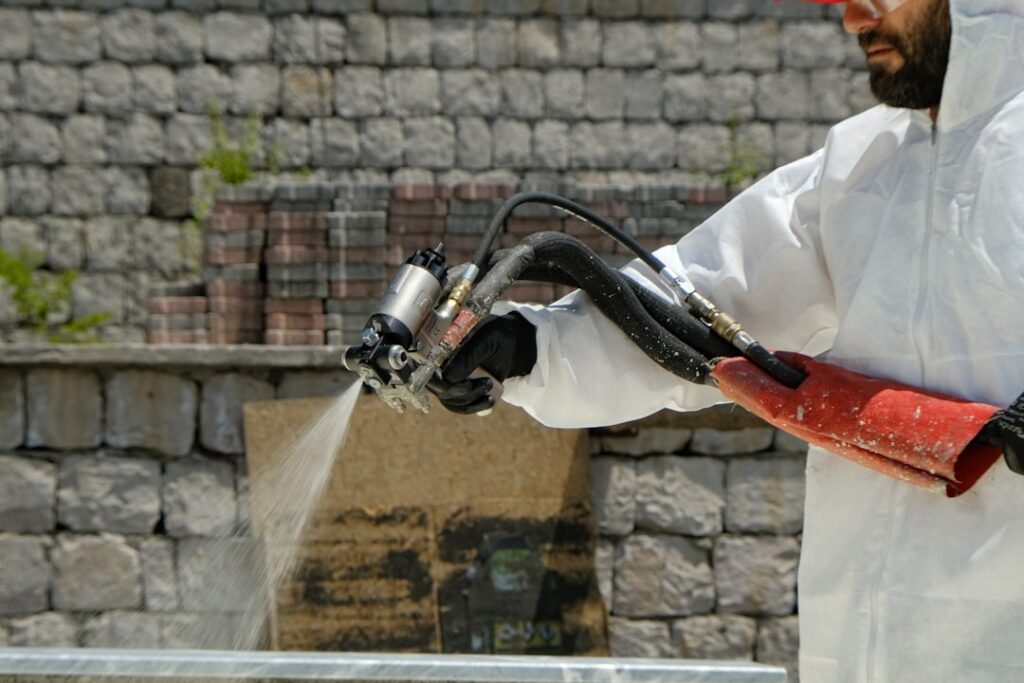
With containment and negative air established, the crew removes the asbestos-containing material. Workers wear respirators and disposable protective suits, and they keep the material wet throughout. Water with a surfactant, applied as a fine mist, weighs fibers down and dramatically reduces how many become airborne during removal.
Materials are removed carefully rather than smashed, then placed directly into labeled, leak-tight bags or wrapping while still damp. The goal at every moment is to minimize fiber release, which is why dry sweeping, power tools, and aggressive demolition are prohibited in this context. The same principles, scaled to homeowner-level questions, appear in the guide on how asbestos is removed.
Step six: cleaning, disposal, and decontamination
After bulk removal, the crew cleans the entire containment using HEPA vacuums and wet-wiping. Ordinary vacuums are never used because they exhaust fine fibers back into the air. Every surface inside the enclosure is decontaminated before the area can be cleared.
Waste handling is tightly regulated. Asbestos waste is double-bagged in labeled, leak-tight containers and transported to a landfill specifically authorized to accept asbestos. The contractor maintains disposal manifests documenting where the material went, which protects the homeowner and satisfies regulatory requirements. Improper disposal is both illegal and a renewed exposure hazard.
Step seven: clearance air testing
The final step verifies the home is safe to reoccupy. After cleaning, an independent third party, not the abatement contractor, performs clearance air testing inside the still-sealed containment. The most rigorous method, aggressive air sampling, uses fans and leaf blowers to stir settled dust, then measures airborne fiber concentration.
If the measured concentration falls below the established clearance standard, the area passes and containment can be dismantled. If it fails, the crew re-cleans and the area is re-tested until it passes. Only after clearance should the polyethylene come down and the home be reoccupied. This independent verification is the safeguard that separates true abatement from a superficial cleanup, and homeowners should insist on it.
Removal versus encapsulation versus enclosure
Abatement is not synonymous with removal. The term covers three approaches, and a competent assessment recommends the one that best fits the material’s condition and the homeowner’s plans.
Removal physically takes the asbestos-containing material out of the home. It eliminates the hazard permanently but is the most disruptive and expensive option, and the removal itself temporarily raises fiber risk, which is why containment is so critical. Removal is the right choice when material is damaged, deteriorating, or in the way of a renovation.
Encapsulation seals the material with a coating that bonds the fibers in place so they cannot escape. Enclosure builds an airtight barrier around the material, such as new drywall over an asbestos surface. Both can be appropriate when the material is in good condition and will not be disturbed, and both are typically less costly than removal. The EPA recognizes that managing material in place is sometimes the safer choice, since disturbing intact asbestos can create exposure that would not otherwise occur. The right path depends on condition, location, and future plans, which is exactly what the initial assessment determines.
Worker protection during abatement
The same controls that protect occupants also protect the crew, and OSHA sets specific requirements for worker safety during asbestos work. Understanding them helps a homeowner recognize a contractor who takes the work seriously.
Workers wear respirators rated for asbestos and disposable protective suits that are discarded as contaminated waste. They pass through a decontamination chamber when entering and leaving the containment, showering and changing so fibers are not carried out of the work area. Air monitoring during the job tracks fiber concentration, confirming the controls are working.
OSHA also limits how long workers can be exposed and requires medical surveillance for those who work with asbestos regularly, because the health effects of inhaled fibers, including asbestosis, lung cancer, and mesothelioma, can take decades to appear. A contractor who equips and protects their crew properly is also the contractor most likely to protect your home, since both depend on the same disciplined control of airborne fibers.
How long does abatement take?
Timelines vary with the size and complexity of the job, but understanding the rhythm helps a homeowner plan. A small, single-room removal of non-friable material can sometimes be completed in a day, while whole-house projects or removal of friable insulation can stretch across several days or longer.
The sequence itself sets the pace. Setup and containment take time before any material is touched, removal proceeds carefully and cannot be rushed, and the cleaning and clearance-testing phase adds time at the end, including waiting for the independent clearance results before the containment comes down. Weather, disposal logistics, and the home’s layout all influence the schedule.
Homeowners should be wary of any contractor promising a suspiciously fast turnaround, since cutting the setup or clearance steps to save time is exactly how fibers end up spread through a home. A realistic timeline that includes proper containment and independent verification is a sign the work is being done correctly. Planning to be out of the work area, and sometimes out of the home, during the project is part of a safe abatement.
How to hire an abatement contractor
Hire only licensed, certified abatement contractors, and verify their credentials and insurance directly. Ask for the abatement plan in writing, confirmation that an independent party will perform clearance testing, and documentation of the disposal route. A separation between the company doing the removal and the company doing the clearance testing protects against a conflict of interest.
Be wary of any contractor who proposes skipping containment, negative air, or clearance testing, or who suggests a homeowner simply remove friable material themselves. The cost of professional abatement reflects the equipment, training, and verification that keep fibers out of the air. Homeowners weighing the financial side can review the guide on whether insurance covers asbestos removal.
What homeowners should expect during the project
Knowing the rhythm of an abatement project helps a homeowner plan around it and recognize when something is off. After the assessment and notification, the crew arrives to build containment, which is often the most visible phase: sheeting goes up, the work area is sealed, and the decontamination chamber is constructed at the entry. During active removal, the home’s HVAC stays off, the sealed area is off-limits, and depending on the scope the household may need to relocate part of the living space or vacate entirely.
Communication separates a careful contractor from a careless one. A reputable firm explains the containment boundaries, confirms which areas remain usable, and provides the disposal manifests and clearance results before declaring the job complete. The homeowner should not have to ask whether clearance testing happened; a professional treats the independent clearance result as the milestone that ends the project. Keeping documentation of the assessment, the abatement plan, the disposal manifests, and the passing clearance test creates a record that protects the homeowner if the work is ever questioned, for instance during a future sale.
Why professional abatement is worth the cost
The price of professional abatement reflects engineering controls, trained labor, regulated disposal, and independent verification, none of which a homeowner can easily replicate. Each layer addresses a path by which fibers could escape, and skipping any one of them, the containment, the negative air, the wetting, the HEPA cleanup, or the clearance test, undermines the rest. Because the health effects of inhaled fibers can take decades to surface, the cost of doing the job correctly once is small against the risk of spreading contamination through a home that then requires a far larger and more expensive cleanup. A contractor who proposes shortcuts to lower the bid is offering a false economy.
References
- Protect Your Family From Asbestos Exposure — U.S. Environmental Protection Agency
- Asbestos Standards and Controls — Occupational Safety and Health Administration
- About Asbestos and Health Effects — Centers for Disease Control and Prevention
- Colorado Asbestos Regulations — Colorado Department of Public Health and Environment
If your Front Range home may contain asbestos and you are planning a renovation or have damaged materials, professional assessment is the safest first move. Connect with a vetted local inspector or abatement resource through our contact page to discuss your situation. This article is informational and not a substitute for licensed professional guidance.
Asbestos test kits
Asbestos can only be confirmed by a lab. A mail-in kit gets you a sealed sample container and accredited analysis — never sand or disturb suspect material first.
| Product | Why | Buy |
|---|---|---|
 Asbestos Test Kit (mail-in lab) Asbestos Test Kit (mail-in lab) | Includes PPE + sealed mailer. | Amazon — $29.99 |
 Pro-Lab Asbestos Test Kit Pro-Lab Asbestos Test Kit | Widely available; lab fee separate. | Amazon — $45.99 |