Radon Tests: What Homeowners Need to Know
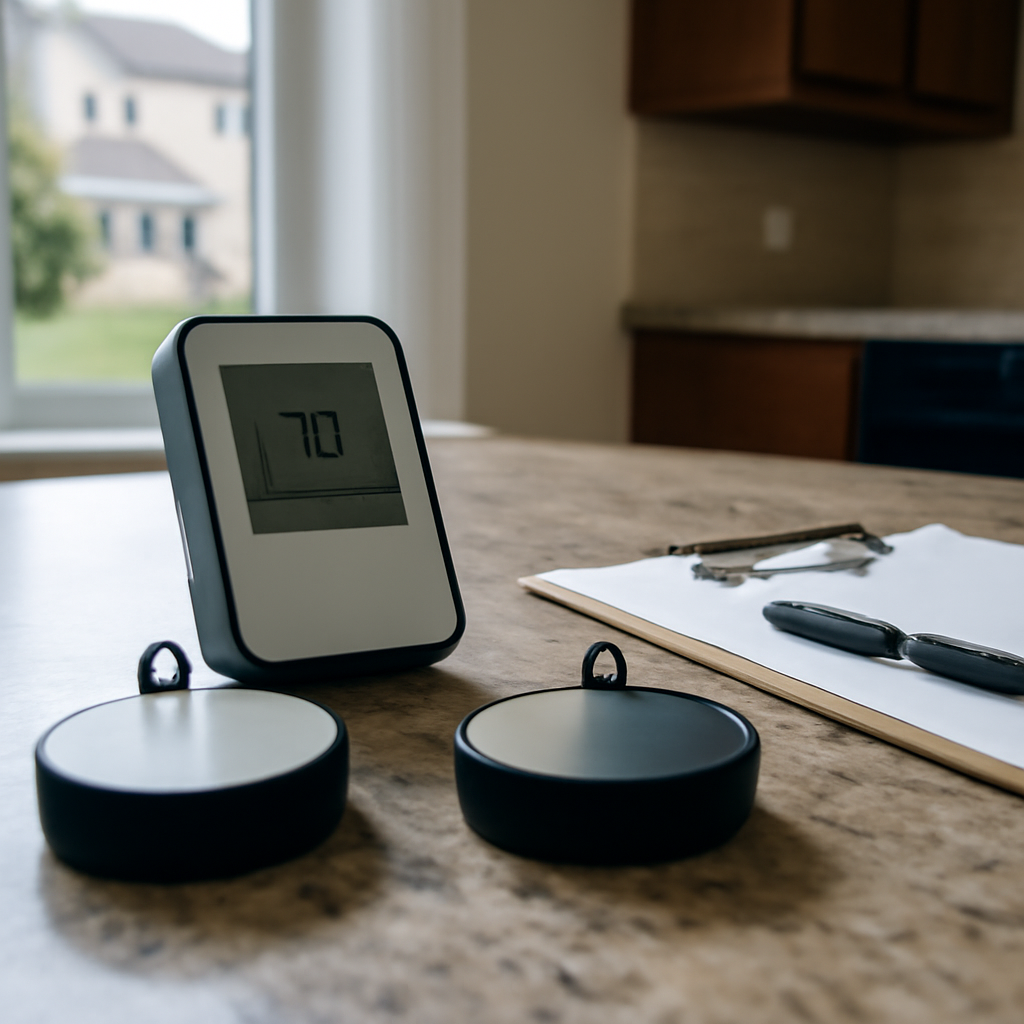
Radon tests come in five distinct method categories, each with its own measurement technology, duration, accuracy profile, and appropriate use case. Choosing among them depends on whether the test is for a real estate transaction, an initial homeowner assessment, periodic re-testing, or post-mitigation verification. This guide summarizes EPA and CDC guidance current as of 2026 — consult a certified professional for testing or mitigation and your physician for symptom evaluation. The catalog covers short-term charcoal canisters, long-term alpha-track detectors, continuous radon monitors (CRMs), electret-ion-chamber devices, and what each method is actually best suited for.
Part of our Radon Levels guide — start there for the full picture →
Why multiple radon test methods exist
Different testing scenarios call for different measurement approaches. A buyer under contract on a Colorado home needs immediate, defensible results within the inspection contingency window. A current homeowner doing periodic re-testing every few years has no time pressure and can use the cheapest option. A homeowner conducting post-mitigation verification needs a result that documents system effectiveness. A long-term resident curious about average annual exposure needs a long-duration test that captures seasonal variation.
No single radon test method handles every scenario well. Short-term tests answer the urgent question quickly but miss seasonal variation. Long-term tests capture annual averages but cannot drive transaction decisions. Continuous radon monitors provide hour-by-hour diagnostic data at higher cost. Each method has a place in the homeowner’s radon toolkit, and understanding the distinctions makes the choice clear.
Short-term charcoal canister tests
Charcoal canister tests are the most common short-term radon test method. The canister contains activated charcoal that adsorbs radon during the exposure period. The canister is opened, exposed for 2 to 7 days, sealed, and mailed to an accredited laboratory for analysis. The lab measures gamma emissions from the adsorbed radon decay products and computes the original radon concentration.
Charcoal canister tests cost $15 to $40 per kit, often with lab analysis included in the price. The kits are widely available at hardware stores, online retailers, and through state radon programs (some of which offer subsidized or free kits to residents). Total time from exposure start to result is typically 5 to 10 business days because of postal transit and laboratory turnaround.
Charcoal canister tests work well for initial homeowner assessment, periodic re-testing without time pressure, and screening before deciding whether to commission professional testing. They are less suited for real estate transactions because the lab turnaround often does not fit the inspection contingency window. The sibling article on home radon kit buying guide covers brand selection.
Continuous radon monitors (CRMs)
Continuous radon monitors are calibrated electronic devices that measure radon concentration at hourly intervals throughout the test window. Modern CRMs use alpha-spectroscopy or pulsed ionization chamber technology to distinguish radon decay products from other radioactive sources, producing accurate readings with hour-by-hour granularity.
CRM testing is typically performed by NRPP-certified or NRSB-certified Radon Measurement Specialists during a 48-hour deployment. The professional places the device, returns 48 hours later, and downloads the data on site. Results are available immediately at retrieval; the written report is typically delivered same-day or next-business-day. Front Range Colorado pricing runs $100 to $300 for the deployment.
CRMs are the right choice for real estate transactions because of the immediate results and the diagnostic hour-by-hour data. The data flags conditions like an open window mid-test (visible as an abrupt drop in readings) that might invalidate the result. CRMs are also the right choice for post-mitigation verification because the high accuracy confirms system effectiveness. The sibling article on continuous radon monitor and detector kit guide walks through the technology.
Long-term alpha-track detectors
Alpha-track detectors are passive devices that measure radon for 90 days to a year. The detector contains a polymer strip that records permanent damage tracks from alpha particles emitted by radon and its decay products. At the end of the exposure period, the detector is mailed to a laboratory; the lab etches the polymer to make the tracks visible, counts them under microscope, and computes the average radon concentration.
Alpha-track kits cost $25 to $60 per detector (often with lab analysis included). The long exposure period captures seasonal variation and produces a more representative annual average than a short-term test. Lab turnaround typically runs 2 to 4 weeks after the detector is mailed in. Total time from exposure start to result is 3 to 5 months.
Alpha-track detectors are ideal for capturing the annual average radon concentration in a home that the homeowner already knows is in the radon-affected category. They are not suited for transaction timing or for situations where an immediate decision is needed. A homeowner who tested with a short-term kit at 3.5 pCi/L (intermediate zone) and wants better data before deciding on mitigation might commission an alpha-track test as the confirmation step.
Electret-ion-chamber tests
Electret-ion-chamber tests use an electrostatic charge on a small electret (a permanently charged disc of dielectric material) that loses charge proportionally to the alpha radiation it absorbs. The device is exposed for 2 to 7 days (short-term) or 90 days or more (long-term), then the residual charge is measured to compute the radon concentration.
Electret testing is less common in the residential market than charcoal or alpha-track but is occasionally used by professionals who want a passive long-term technology that can be read on-site rather than mailed to a laboratory. Electret kits typically run $30 to $80. Some electret systems can be re-used by recharging the electret, reducing per-test cost over time.
Electret testing fits niche use cases. The on-site reading capability appeals to professionals who want long-term data without postal transit. The technology is sound but the workflow is less consumer-friendly than charcoal canisters for short-term homeowner testing or alpha-track for long-term. Most Colorado homeowners do not encounter electret testing in routine residential applications.
What radon tests measure
All radon test methods report concentration in picocuries per liter (pCi/L) in the United States or becquerels per cubic meter (Bq/m-cubed) internationally. The conversion is 1 pCi/L equals 37 Bq/m-cubed. The EPA action level is 4 pCi/L; the World Health Organization recommended reference level is 100 Bq/m-cubed (approximately 2.7 pCi/L). Different organizations use slightly different reference levels, but all converge on the principle that lower indoor radon is better for long-term health.
Outdoor radon concentrations average about 0.4 pCi/L. Indoor concentrations vary widely based on soil and bedrock conditions, foundation type, building tightness, HVAC operation, and seasonal pressure dynamics. Colorado’s combination of uranium-bearing geology, high altitude, and typical Front Range building design produces some of the highest residential radon concentrations in the country. CDPHE data shows approximately half of Colorado homes test above 4 pCi/L. The EPA Radon Program reference publishes the action-level framework. For Colorado-specific context, the parent guide on Front Range radon testing walks through the regional picture.
Test placement: lowest livable level
Regardless of the test method, placement follows the same principle. Place the device in the lowest livable level of the home that is regularly occupied. A finished basement that serves as bedroom or family room is the placement target. An unfinished basement that no one regularly uses is not; for that home, placement is on the first floor.
Within the chosen level, place the device in a regularly occupied room, at least 20 inches above the floor and 12 inches from exterior walls. Avoid placement near windows, doors, ventilation registers, or strong air-flow patterns. Avoid placement within 3 feet of heaters, fans, or electronic equipment.
The placement principle reflects that radon concentrations are highest in the lowest level of the home because soil-gas entry is at the foundation. Placement above this level produces a lower reading that may not represent the worst-case exposure in the home. The sibling article on self radon test DIY methodology and placement guide covers placement specifics.
Closed-house conditions for short-term tests
Short-term tests (charcoal canister, alpha-track in short-term mode, CRM in transaction mode) require closed-house conditions during the test window and for the 12 hours preceding it. Windows and exterior doors stay closed except for normal entry and exit. HVAC systems operate on normal settings. Whole-house fans should not run.
Long-term tests (alpha-track at 90 days or longer, long-term electret) do not require closed-house conditions because the long duration averages out short-term variation. A long-term test in a home with normal seasonal window-opening behavior captures a more representative annual average than a short-term test under tight closed-house conditions.
How to choose the right test for your situation
Scenario-based test selection:
Real estate transaction, buyer under contract. CRM testing by a certified professional. The immediate result and defensible report fit the inspection contingency window.
Initial homeowner assessment, no time pressure. Charcoal canister DIY kit. Low cost and adequate accuracy for initial screening.
Periodic re-testing, established homeowner. Charcoal canister DIY kit every 2 to 5 years, or alpha-track every few years to capture seasonal averages.
Confirmation testing after a borderline short-term result. Alpha-track long-term test (90 days to a year) to capture seasonal variation and produce a more representative annual average.
Post-mitigation verification. CRM testing by a certified professional, often by the mitigator at the end of the installation project.
Pre-mitigation diagnostic. CRM testing with hour-by-hour data to inform system design.
For the broader testing decision framework, the sibling article on radon test duration by test type covers timing in detail.
Variability in radon test results
Indoor radon concentrations vary substantially over time. Daily variation can be a factor of two; seasonal variation can be a factor of three to five, with winter typically showing higher concentrations than summer because building tightness and the stack effect both increase. A single short-term test result represents a snapshot of conditions during a specific 48-hour window.
This variability is why the EPA recommends confirming an initial short-term result with a follow-up test for borderline results (just above or below the 4 pCi/L action level). The confirmation can be another short-term test (taken at a different season ideally) or a long-term alpha-track test that averages out short-term variation. For clear-cut results well above or well below the action level, the confirmation step is less critical.
What the result actually tells you
The test result is one input into the response decision. A result at or above 4 pCi/L points toward mitigation. A result in the 2 to 4 pCi/L range points toward considering mitigation, especially for occupants who spend significant time in the lower levels of the home. A result below 2 pCi/L points toward periodic re-testing without immediate action.
The test does not tell you whether your home has uranium-bearing soil or what specific entry pathway dominates. Those questions matter for mitigation system design but not for the action decision. The mitigation contractor handles the design questions during the pre-installation site visit. For more on what happens after a high result, the sibling article on what is radon mitigation walks through the system installation.
Combining multiple test types over time
Many Colorado homeowners progress through multiple radon test types as their understanding of the property develops. A typical pattern: initial short-term charcoal canister DIY test at move-in produces a starting reading; long-term alpha-track test over 90 days confirms the short-term result with seasonal averaging; if mitigation is installed, a professional CRM verifies system effectiveness; biennial follow-up short-term tests track ongoing system performance.
This sequence builds a multi-method understanding of the property’s radon profile. Each test answers a different question and contributes to the overall picture. The total cost across the sequence over a few years is modest ($100 to $300 in DIY kits plus $100 to $300 for professional CRM verification) and produces durable confidence in the home’s long-term radon status.
Test brand and lab accreditation
Several radon test brands sell into the residential market. Air Chek, RTCA, AccuStar, and Alpha Energy Laboratories all sell short-term charcoal canister kits widely. Landauer and Radalink sell alpha-track long-term kits. The brand differences are modest; all major brands use EPA-recognized methodology, accredited laboratory analysis, and produce results in pCi/L.
What matters more than brand is whether the laboratory is EPA-accredited. The laboratory accreditation appears on the kit packaging and in the result report. Accredited labs follow quality-control protocols including blind sample testing, calibration verification, and reproducibility checks. The accreditation is the technical foundation of the result; without it, the reading is less reliable.
Radon and weather conditions during the test
Weather conditions affect short-term radon readings because barometric pressure changes alter soil-gas pressure dynamics. Falling barometric pressure (associated with approaching storms) reduces atmospheric pressure on the soil, allowing more soil gas to migrate upward into the home. Rising barometric pressure has the opposite effect.
Short-term test results during severe weather may run higher than long-term averages because of barometric effects. The 48-hour test window is short enough that weather variation cannot be averaged out as it can in a 90-day test. This is one reason long-term alpha-track testing produces a more representative annual average; short-term test results captured during specific weather windows may not represent the year-round indoor radon profile.
Front Range homeowners considering professional radon testing services can connect with a vetted certified Radon Measurement Specialist through our contact page.
References
- EPA Radon Program — Environmental Protection Agency
- Colorado Department of Public Health and Environment radon program — CDPHE
- CDC Radon Information — Centers for Disease Control and Prevention
- American Lung Association radon guidance — American Lung Association
Frequently asked questions
What are the main types of radon tests?
Five categories: short-term charcoal canister tests, long-term alpha-track detectors, continuous radon monitors (CRMs), electret-ion-chamber devices, and combination short-term/long-term professional testing. Each has its own accuracy profile and appropriate use case.
Which radon test is most accurate?
Continuous radon monitors (CRMs) provide the highest accuracy with hour-by-hour data and immediate results. CRMs require certified professional deployment. For long-term annual averages, alpha-track detectors at 90 days or longer capture seasonal variation.
How much do radon tests cost?
DIY short-term charcoal canister kits run $15 to $40. DIY long-term alpha-track kits run $25 to $60. Professional CRM testing in Front Range Colorado runs $100 to $300 for a 48-hour deployment.
Should I do multiple radon tests?
For borderline results just above or below the 4 pCi/L EPA action level, EPA recommends confirmation testing. For clear-cut results well above or well below, a single test is typically sufficient to inform the response decision.
Test your home for radon
Radon is invisible and odorless, so a test is the only way to know your level. A short-term kit gives a first reading in days; a digital monitor tracks it over time.
| Product | Why | Buy |
|---|---|---|
 AirChek Charcoal Radon Test Kit AirChek Charcoal Radon Test Kit | Lab fee usually included; EPA short-term protocol. | Amazon — $21.95 |
 First Alert RD1 Radon Test Kit First Alert RD1 Radon Test Kit | Widely stocked; 48-hour charcoal test. | Amazon — $16.98 |
 Airthings Corentium Home Airthings Corentium Home | Digital monitor with a long-term average. | Amazon — $142.99 |