Mold Companies Near Me: Cost Framing and Bid Compare
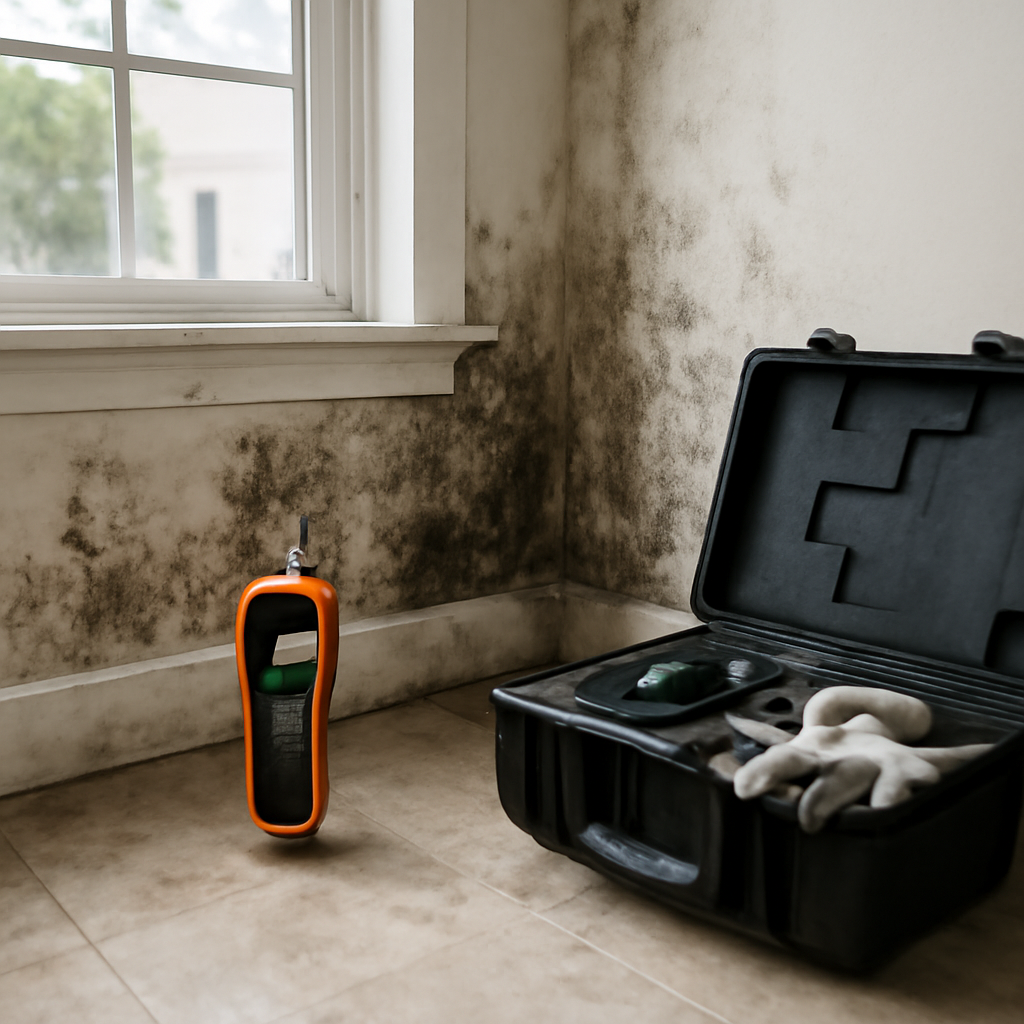
Calls to mold companies near you can return wildly different price quotes for the same visible patch of growth — sometimes a 3x spread between the lowest and highest bid. The price difference rarely reflects quality. More often it reflects different assumptions about scope, containment level, demolition extent, and post-remediation testing. This guide walks through how to frame cost when comparing mold companies, what each line item should actually cover, and how to spot a bid that is too low to be safe or too high to be reasonable. Health-adjacent guidance here summarizes EPA, CDC, and IICRC sources current as of 2026; for medical symptoms speak with your physician.
Part of our Types of Mold guide — start there for the full picture →
Is this mold, asbestos, or water damage? Get a free instant screen
Upload a clear photo of the suspect area. You'll get an instant AI screening opinion and what to do next. This is screening guidance, not a professional determination.
Screening guidance only. AI can be wrong. Confirm asbestos, mold type, or lead with lab testing or a licensed professional before acting.
What “mold companies near me” charges look like in 2026
Industry pricing reports place average residential mold remediation between $1,500 and $9,000 nationally, with the Front Range typically falling near the median. The wide range reflects scope: a single shower-wall remediation may be $500 to $1,000, a wall-cavity project after a slow pipe leak typically lands $2,500 to $5,500, and a finished basement with foundation seepage often exceeds $8,000. The single biggest cost driver is square footage of demolition, followed by containment level and drying-equipment runtime.
The four cost components in any mold bid
Every mold remediation bid should break into four lines: assessment and testing, containment and air handling, demolition and cleaning, and structural drying. If a quote arrives as a single lump sum without the breakdown, ask for itemization. Lump-sum quotes are not necessarily dishonest, but they make apples-to-apples comparison impossible and they hide where the contractor has padded margin or skimped on labor. Companies confident in their scope provide the itemization without resistance.
Why low bids are often a warning
A bid that comes in at half the average of the other quotes usually reflects one of three things: the contractor missed the containment level required, they plan to skip post-remediation verification, or they intend to leave demolition to the homeowner. None of those are inherently disqualifying, but you need to know which corner is being cut before you sign. EPA’s mold remediation guide makes the point that inadequate containment during demolition spreads spores throughout the home — the cleanup then becomes the new project. Cheap remediation that triggers a second remediation is the most expensive kind.
Why high bids are not always premium service
Restoration franchises with carrier-direct insurance relationships tend to price 20 to 40 percent above independent shops because they carry overhead the small operators do not. The premium can be worth it when the homeowner wants the franchise to manage the insurance claim end-to-end and prefers consolidated paperwork. The premium is harder to justify on out-of-pocket projects where the homeowner is paying the invoice directly. Ask each company what is included that the others may not be quoting, rather than assuming higher equals better.
Certifications worth paying for
IICRC S520 is the baseline. Beyond that, certifications worth verifying include the firm’s WRT (Water Damage Restoration Technician), AMRT (Applied Microbial Remediation Technician), and CMR (Certified Mold Remediator) credentials. Individual technicians on the crew should hold AMRT at minimum. Some states layer additional certifications; Colorado does not require state-issued mold credentials, which puts the burden on the homeowner to verify IICRC standing. Verification takes one search at iicrc.org and confirms whether the firm and its named technicians are current.
The contractor types you will encounter
Calls to “mold companies near me” surface several distinct business categories: dedicated mold remediation specialists, restoration franchises that handle water, fire, and mold under one roof, general remediation contractors who also do asbestos and lead, and handymen who add mold cleanup as a service line. The specialists typically have the deepest mold-specific expertise; the franchises have the strongest insurance-claim infrastructure; the general remediation contractors are useful when multiple hazards overlap; the handymen should be reserved for small surface work or skipped entirely.
How to vet on the first phone call
Three minutes on the phone separates serious vendors from drive-by operators. Ask: do you follow IICRC S520, what containment level are you proposing, are you carrying pollution liability insurance, will you provide three recent references, and who performs the post-remediation verification. Note whether the answers are quick and specific or vague and deflective. The pace and specificity of the answers is itself the signal — the actual cost of the work is the second-order question.
Front Range geographic considerations
Denver metro pricing tends to run 10 to 15 percent above Colorado Springs and Pueblo because of labor cost differentials. Boulder County frequently sees premium pricing because of higher household incomes and stricter homeowner association requirements that drive scope. Mountain communities in Summit, Eagle, and Pitkin counties see further premiums tied to travel and accommodations for crews. For homeowners in the I-25 corridor, the price spread between metro-Denver-based companies and Colorado Springs operators is often worth a phone call to both.
Reading the scope of work line by line
The scope is the contract. Read it before you sign. Specific items to look for: explicit square footage of demolition, the antimicrobial product name and EPA registration number, the air scrubber model and CFM rating, the negative-air machine model, the dehumidifier sizing, projected runtime in days, and the named clearance criteria. If the document says “treat affected area” with no specifics, that is not a scope — it is a marketing brochure with a price on it. Send it back asking for specifics or use a different vendor.
Time and disruption — the non-monetary cost
A typical small remediation takes 2 to 4 days; a mid-size project 5 to 10 days; a large project 2 to 4 weeks. During the work, the affected portion of the home is unusable and the air handling will be loud. Some projects require relocating pets or human occupants, especially when the homeowner has asthma or other respiratory sensitivities. Factor temporary housing into the total cost when the project scope is significant. Restoration franchises often include temporary housing coordination in their fee; smaller shops typically do not.
Antimicrobial use — what the standards actually say
EPA and IICRC both indicate that antimicrobials and biocides are not substitutes for physical removal of contaminated porous material. A contractor selling biocide treatment in lieu of demolition is selling something other than IICRC-compliant remediation. Biocides have a role on non-porous surfaces and during the cleaning phase, but they are not a shortcut. Be skeptical of any quote that lists “fogging treatment” as the primary intervention without accompanying demolition for visible growth.
Cost framing for insurance claims
If the project will run through homeowner’s insurance, expect the adjuster to involve a preferred-vendor list. Homeowners are not required to use the carrier’s preferred vendors, but choosing an off-list contractor sometimes triggers additional documentation requirements. The tradeoff: preferred vendors price closer to the carrier’s allowable schedule (which can be below market), while independent vendors price closer to market but require more paperwork from the homeowner. Read your mold-inspection guide for homeowners alongside the insurance documents to clarify what your specific policy covers.
Watch for scope creep mid-project
A bid signed at $4,000 that grows to $9,000 mid-job is a common complaint pattern. Some scope expansion is legitimate (hidden growth discovered behind a wall) and some is not (a contractor pushing demolition on materials that did not need it). Insist on written change orders for any scope expansion, with measurements and photos documenting the new finding. Refuse verbal “we found more, it’ll be another $X” handshakes — the change-order paperwork is what protects you in any later dispute.
References and reviews — what is signal versus noise
Online review averages are weak signal because mold companies actively manage them. Better signal: three references from work completed in the last 90 days, with phone numbers you can call directly, and BBB complaint history. State attorney general complaint records (free public records in Colorado) sometimes surface patterns that online reviews suppress. Spending 20 minutes on background research before signing a $5,000 contract is reasonable due diligence.
The clearance test that proves the work succeeded
Plan to pay an independent inspector $300 to $500 for post-remediation verification. The verification should include visual inspection, moisture meter readings on dried materials, and air sampling that compares the work area to a same-day outdoor control. Skipping this step means trusting the remediator to certify their own work — a position EPA guidance specifically warns against. The clearance cost is not optional; it is the line item that proves you paid for results rather than activity.
How a homeowner should budget for the unknown
Plan a 15 to 25 percent contingency on top of the signed scope. Real-world mold projects regularly uncover hidden conditions — additional growth behind cabinets, unreported plumbing leaks, compromised insulation — that legitimately expand scope. The contingency is not a budget for contractor padding; it is a budget for genuine discoveries that the pre-work inspection could not have surfaced. Going into a project assuming the signed scope is the final scope sets up a difficult conversation later.
When to call a professional versus DIY the project
EPA’s 10-square-foot threshold is the practical line. Below that, with a clear single moisture source that has been corrected, homeowner cleaning is reasonable. Above that, professional remediation with containment is the right call. Households with asthma, immunocompromised members, or infants should treat the threshold as roughly half — even small growth warrants a professional opinion. Cost-framing makes sense only after the threshold question is settled.
How to structure the three-bid evaluation meeting
Once three written scopes are in hand, sit down with the documents and a single-page comparison grid. Columns: company name, demolition square footage, containment level, antimicrobial product, air-scrubber and dehumidifier count, drying days, clearance protocol, warranty length, and total price. Filling the grid surfaces where the bids genuinely differ and where they describe the same work with different language. Schedule a follow-up call with each vendor to resolve specific deltas, then make the decision based on the corrected scope comparison rather than the original price tags.
The role of payment timing in cost framing
Standard mold remediation payment is one-third at signing, one-third at midpoint inspection, and one-third at clearance pass. A vendor offering steep discounts for “pay 100 percent upfront” is trading cash flow for the homeowner’s leverage. The discount is rarely worth the lost protection. A vendor unwilling to accept staged payments tied to milestones is a vendor whose financial position the homeowner should examine before signing. Healthy firms accept staged payment because their cash flow does not depend on a single contract closing in full.
Local versus regional pricing differentials
Within the Front Range, Denver metro pricing typically runs slightly above Colorado Springs but well below Boulder County. Northern Colorado (Fort Collins, Loveland, Greeley) sits near the metro Denver average. Mountain communities reliably price 20 to 40 percent above Front Range cities because of crew travel and per-diem costs. Homeowners in border zones between markets sometimes find better pricing by calling vendors in adjacent metros — the geographic search radius is wider than the typical “mold companies near me” map suggests.
References
- EPA — Mold Remediation Reference Guide — U.S. Environmental Protection Agency
- CDC — Mold and Health — Centers for Disease Control and Prevention
- EPA — Mold Cleanup in Your Home — U.S. Environmental Protection Agency
- CDPHE — Indoor Air Mold Guidance — Colorado Department of Public Health and Environment
Frequently asked questions
How do I compare mold company quotes fairly?
Insist each company provide an itemized scope covering assessment, containment, demolition, and drying as separate lines. Place the three quotes side by side and reconcile differences in square footage, containment level, and clearance protocol. A 30 percent or larger spread usually means the companies are quoting different scopes.
Why are some mold companies near me so much cheaper?
Low bids often skip containment, leave demolition to the homeowner, or omit post-remediation verification. Sometimes a low bid is legitimate scope reduction; sometimes it is corner-cutting that creates a worse problem. Ask the low bidder to explain the delta against the others.
Should I use my insurer's preferred vendor?
Not required. Preferred vendors price closer to carrier schedules and reduce paperwork, while independent vendors often price closer to market but require more documentation. Read your policy's mold sublimit before deciding.
What certifications matter most for mold companies?
IICRC S520 compliance is the baseline. Firms holding AMRT, WRT, and CMR credentials are stronger candidates. Verify the firm and named crew members at iicrc.org rather than trusting marketing claims.
If you are in the Denver metro or Front Range and want a connection to a vetted mold inspector before signing remediation contracts, reach out through our contact page.