FLIR One Thermal Imaging Camera: What Homeowners Need to Know
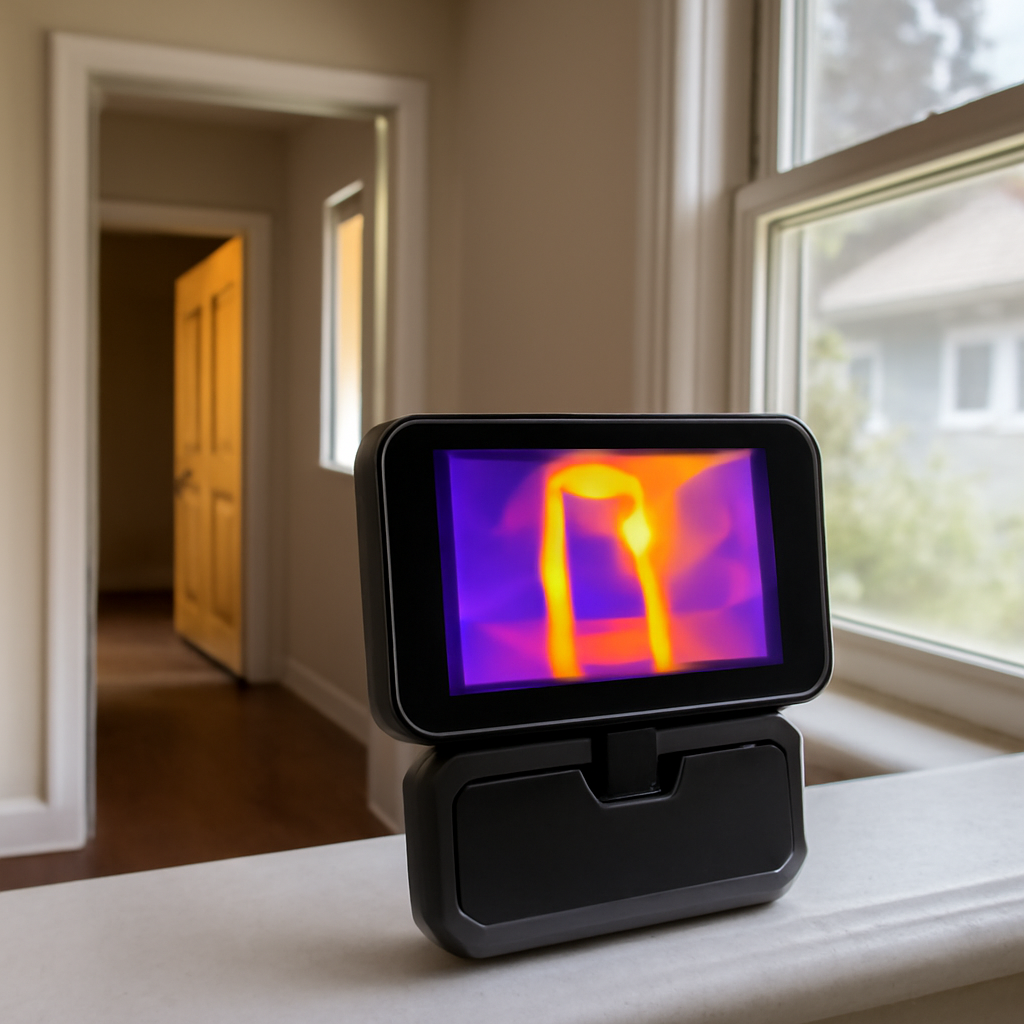
The FLIR One thermal imaging camera is a compact infrared attachment that turns a smartphone into a thermal camera, putting heat-mapping in reach of homeowners for a fraction of what standalone professional units cost. It plugs into a phone’s charging port, pairs with an app, and overlays temperature data on the screen — handy for spotting drafts, missing insulation, and damp spots. This guide explains how the device works, what its specifications mean in practice, where it genuinely helps, and where its limits show, leaning on home-inspection standards rather than promotional claims.
Part of our Thermal Imaging for Homes guide — start there for the full picture →
What the FLIR One is and how it works
The FLIR One is a clip-on or plug-in module sold in versions for both major phone platforms. Inside is a small microbolometer thermal sensor paired with a standard visible-light camera. The accompanying app blends the two feeds using an edge-detection technique that lays crisp visible-light outlines over the lower-resolution thermal image, making heat patterns easier to interpret on screen. The result is a temperature map showing hot and cold areas in a chosen color palette.
Because it runs off the phone, the FLIR One has no display, battery (in newer models it draws from the phone or has a small internal cell depending on generation), or processor of its own beyond the sensor and optics — the phone does the heavy lifting. That design keeps it small and affordable, and it is why the device sits at the entry point of the thermal-camera market rather than competing with dedicated professional cameras. Our home inspection tools hub places it in context against pricier standalone options.
The dependence on the phone cuts both ways. On the positive side, you carry one less device, the phone’s large bright screen makes images easy to read, and sharing or saving a finding is as simple as any other photo. On the downside, cold weather drains phone batteries quickly, the attachment occupies the charging port while in use, and performance varies with the host phone’s processing power. For a homeowner who already carries a capable phone, the trade is usually worth it; for sustained field work, the lack of a dedicated battery and ruggedized body becomes a real limitation that standalone cameras avoid.
Across its generations the FLIR One has improved steadily, with later Pro models raising resolution and sensitivity and refining the connector design. Anyone buying used should check which generation they are getting, since an early unit performs noticeably worse than a current Pro. The MSX edge-detection feature, which overlays visible-light outlines on the thermal image, has been a constant strength and is a large part of why such a low-resolution sensor produces usable, interpretable images at all.
Specifications that matter
The FLIR One line has evolved across generations (the Gen 3 and Pro lines, for example), but the specs to weigh are consistent across thermal devices:
- Thermal resolution — typically around 80×60 on the standard model and 160×120 on the Pro, modest compared with professional cameras but adequate for whole-wall scanning at short range.
- Thermal sensitivity (NETD) — the Pro versions reach roughly 70 mK or better, letting them distinguish subtle temperature differences that matter for moisture detection.
- Temperature range — broad enough to read both cool damp patches and warm electrical components, commonly spanning well below freezing to several hundred degrees Fahrenheit.
- MSX edge enhancement — the visible-light overlay that compensates for the low thermal resolution by adding detail and context.
- Field of view and spot temperature — the app reports a center-point temperature, useful for quick comparisons.
Resolution is the headline limitation. At 80×60 or 160×120, the FLIR One resolves far less detail than a 320×240 or 640×480 professional camera, so the user must work closer to a surface to see fine anomalies. For comparison shopping across the class, our handheld thermal imaging camera guide lines up the resolution tiers.
To put the resolution in perspective: an 80×60 sensor holds 4,800 temperature points, while a 320×240 sensor holds 76,800 — sixteen times as many. That difference is why a professional camera can resolve a thin wet streak from across a room while the FLIR One needs to be a few feet away to show the same detail. The MSX overlay narrows the perceived gap because the visible outlines guide the eye, but it does not add thermal data; the temperature information is still only as fine as the underlying 80×60 or 160×120 grid. Understanding this prevents over-trusting a small or distant anomaly the camera cannot truly resolve.
Thermal sensitivity is the other spec worth weighing. The Pro models’ roughly 70 mK NETD is decent for an entry device and adequate for many moisture and insulation tasks, though professional cameras reaching 30 to 50 mK pull subtler patterns out of a noisy scene. For a homeowner, the Pro’s sensitivity is usually enough; for fine diagnostic work, it is the point where stepping up to a standalone unit starts to make sense.
Real home-inspection uses
Within its limits, the FLIR One handles a useful range of household tasks:
- Moisture screening — damp drywall reads cooler from evaporative cooling, showing as a darker patch worth confirming with a moisture meter.
- Insulation gaps — missing or settled insulation appears as cooler stripes between studs in winter.
- Air leaks — drafts around windows, doors, and outlets streak across the image.
- Electrical hot spots — an overloaded breaker or loose connection runs warmer than its neighbors.
- Radiant-floor and plumbing tracing — warm lines reveal heating loops and hot-water runs.
For a homeowner doing a pre-winter energy check or chasing a suspected leak, that capability is real and inexpensive. The Department of Energy notes that thermographic scanning is a recognized way to locate insulation gaps and air leakage during a home energy assessment, and the FLIR One brings a basic version of that to a phone. It will not match the documentation and precision of a professional thermal imaging inspection, but it is a capable screening tool.
A practical homeowner workflow looks like this: on a cold day with the heat running, sweep the exterior walls from inside, watching for cool streaks that mark missing insulation or air leaks around windows, outlets, and rim joists. Check the electrical panel with the cover on for any breaker glowing warmer than its neighbors. Scan under sinks and around the water heater for cool damp patches. Anything suspicious gets a follow-up with a moisture meter or a closer look, rather than being treated as a confirmed problem. Used this way, the FLIR One turns vague suspicions into specific spots to investigate, which is genuinely useful for a few hundred dollars.
What it costs and the alternatives
The FLIR One sits at the affordable end of the market. The standard model typically runs around $200 to $250, while the Pro version with higher resolution and better sensitivity runs roughly $400 to $550. That is a small fraction of the $1,000-plus a homeowner would spend on a standalone professional camera.
Alternatives in the same neighborhood include competing smartphone thermal attachments and budget standalone units like spot-style thermal cameras. Stepping up, a dedicated handheld unit adds a built-in display, its own battery, faster operation, and often higher resolution — worth it for frequent or semi-professional use, overkill for an occasional homeowner check. The right choice depends on how often you will use it and whether you need documented, calibrated readings.
A common comparison is the FLIR One against a spot-style thermal camera with a similar low resolution but a built-in screen and battery. The spot camera operates independently of a phone and often adds a precise center-point temperature reading, which is handy for electrical work; the FLIR One leans on the phone’s screen and processing and tends to cost a bit less. Neither is clearly superior — it comes down to whether standalone operation or phone integration suits the user better. For someone who will use the tool a handful of times a year and already has a good phone, the FLIR One is hard to beat on value.
Honest limitations and care
The FLIR One’s constraints are the constraints of all entry-level thermal gear, amplified by low resolution. It reads surface temperature only, so it cannot see through walls or directly detect moisture — it shows temperature differences a person must interpret. It needs a temperature differential between inside and outside to reveal insulation and leak issues, so mild weather limits its usefulness. Reflective surfaces, sunlight, and recent HVAC operation can all create misleading patterns. And because the phone does the processing, performance and battery drain depend on the host device.
Care is minimal: keep the lens clean and free of fingerprints, store the unit in a protective case, avoid extreme temperatures, and keep the companion app updated. Unlike professional cameras that benefit from periodic factory calibration, the FLIR One is a consumer device whose readings should be treated as indicative rather than laboratory-grade. Used with realistic expectations and verified with a moisture meter, it is a genuinely useful first thermal tool.
Who should and should not buy one
The FLIR One fits a clear profile: the homeowner who wants to investigate a specific concern or do a seasonal check without committing to an expensive standalone camera. Someone chasing a cold draft, deciding which rooms need attention before winter, spot-checking an electrical panel, or verifying that a contractor actually insulated a wall can get real answers from it. The low cost means the device pays for itself if it catches a single insulation gap or a developing leak, and the phone integration makes it easy to save and share findings with a spouse, a contractor, or an inspector.
It is a poor fit for a few situations. Anyone who needs calibrated, documented measurements for a report — a working inspector, for instance — will outgrow it quickly and should buy a dedicated camera with the right measurement and reporting features. Anyone expecting to find subtle, fine-grained moisture problems at a distance will be frustrated by the low resolution. And anyone hoping the camera will “see through” walls or detect mold directly is misunderstanding what any thermal device does. Matching the tool to honest expectations is the difference between a satisfied buyer and a disappointed one.
For homeowners weighing the FLIR One against simply hiring a professional, the math often favors the professional for a one-time need like a pre-purchase inspection, where a trained eye and calibrated equipment matter. The FLIR One shines instead as an owned tool for recurring, low-stakes checks around a home you live in — the kind of ongoing monitoring a hired inspection cannot cover. Seen that way, it is less a replacement for professional inspection than a complement to it.
One practical habit improves results more than any spec: scan when conditions cooperate. For insulation and air-leak work, that means a day with a real temperature gap between inside and outside, with the heating or cooling running so the building envelope is under thermal load. A FLIR One pointed at an exterior wall on a mild, still day shows little, not because the wall is sound but because there is no contrast to image. Choosing the right moment turns the same inexpensive device from a curiosity into a tool that reliably finds the cold streaks and missing insulation a homeowner is looking for. Combined with realistic expectations about resolution and a moisture meter to confirm damp findings, the FLIR One delivers genuine value at the bottom of the thermal-camera market.
References
- ENERGY STAR: Seal and Insulate — U.S. Environmental Protection Agency (ENERGY STAR)
- Infrared Thermal Imaging in Home Inspections — InterNACHI
- Standard of Practice — American Society of Home Inspectors
Frequently asked questions
What can the FLIR One detect?
It maps surface temperature differences that point to missing insulation, air leaks, damp drywall, and electrical hot spots. It does not see through walls or measure moisture directly; you confirm a cool patch with a moisture meter. It is a screening tool, not a final verdict.
How much does a FLIR One cost?
The standard model typically runs about $200 to $250, and the Pro version with higher resolution and better sensitivity runs roughly $400 to $550. That is a fraction of the $1,000-plus cost of a standalone professional thermal camera.
Is the FLIR One good enough for home inspection?
For homeowner screening of insulation, drafts, and leaks it is useful, especially the Pro. Its low resolution and lack of calibrated documentation mean it does not replace a professional camera or a documented thermal imaging inspection.
What are the FLIR One's main limitations?
Low thermal resolution (80x60 or 160x120) requires working close to surfaces, it reads only surface temperature, it needs a temperature difference to reveal insulation and leaks, and reflective surfaces or sunlight can mislead. Performance also depends on the host phone.
Thermal imaging cameras
Infrared cameras reveal hidden moisture, missing insulation, and air leaks. Phone-attachment models are the budget entry point; standalone units have higher resolution.
| Product | Why | Buy |
|---|---|---|
 FLIR ONE Pro (phone) FLIR ONE Pro (phone) | Plugs into iPhone/Android; inspector favorite. | Amazon — $349.00 |
 Topdon TC001 Topdon TC001 | High-res phone module at a low price. | Amazon — $199.99 |
 FLIR C5 Compact FLIR C5 Compact | Standalone pocket camera with Wi-Fi. | Amazon — $611.50 |