Black Mold Killer: What Actually Works on Stachybotrys
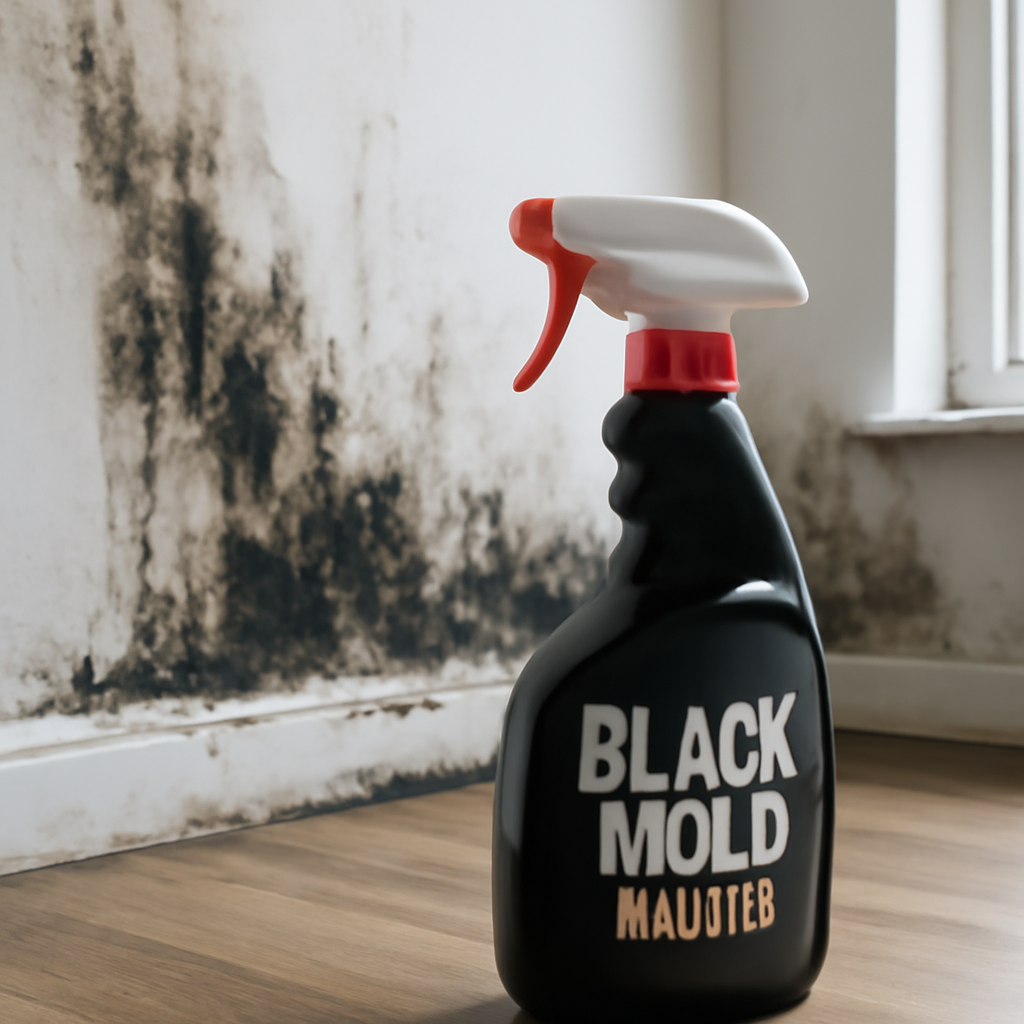
Spotting dark, fuzzy growth in a basement corner or behind a bathroom vanity sends most homeowners straight to the store shelf labeled “mold killer.” The marketing is confident, but the chemistry is more complicated than the bottle suggests. A true black mold killer has to kill living spores, lift the staining they leave behind, and — most importantly — never substitute for fixing the moisture that fed the colony in the first place. This guide summarizes EPA and CDC guidance current as of 2026; consult a physician for symptoms and a certified professional for testing and large-scale remediation decisions.
Part of our Black Mold & Your Health guide — start there for the full picture →
Is this mold, asbestos, or water damage? Get a free instant screen
Upload a clear photo of the suspect area. You'll get an instant AI screening opinion and what to do next. This is screening guidance, not a professional determination.
Screening guidance only. AI can be wrong. Confirm asbestos, mold type, or lead with lab testing or a licensed professional before acting.
What is the best black mold killer?
There is no single chemical that the EPA endorses as the definitive black mold killer, and the agency is blunt about why: on porous materials, no product reliably kills mold rooted inside the material. For hard, non-porous surfaces — tile, glass, sealed metal, finished countertops — the effective options fall into a few families. Each kills surface growth, but they behave differently.
Among the products homeowners reach for most, results vary by surface and by how deep the colony has penetrated:
- EPA-registered antimicrobials (Concrobium, RMR-86, Mold Armor): formulated specifically to kill mold and inhibit regrowth, and the label carries an EPA registration number you can verify.
- Sodium hypochlorite (chlorine bleach): kills surface spores on hard materials but does not penetrate wood or drywall, and the CDC notes routine bleaching is not required for most cleanup.
- Hydrogen peroxide (3–10%): a milder oxidizer that lifts staining and kills surface growth without chlorine fumes.
- Distilled white vinegar: penetrates slightly better than bleach on porous surfaces and is often recommended for light growth.
The honest answer is that the “best” killer depends on the material. A tile shower responds to almost anything; a moldy stud bay responds to demolition, not a spray.
It also helps to understand what “black mold” actually refers to. The term gets attached to any dark growth, but the species most people mean is Stachybotrys chartarum, a greenish-black mold that favors cellulose materials kept wet for days or weeks — saturated drywall paper, cardboard, and ceiling tile. Many ordinary molds, including common Cladosporium and Aspergillus, also appear dark and look identical to a homeowner. The CDC’s position is that the species does not change the cleanup: you remove it and fix the moisture regardless. So a “black mold killer” is not a specialized chemical targeting one organism; it is a general mold cleaner marketed against the scariest name. Knowing that keeps you from overpaying for a product that does exactly what cheaper agents do.
Why bleach is not the universal answer
Chlorine bleach earned its reputation on bathroom tile, where it works well. The trouble starts when homeowners spray it on drywall, framing, or subfloor. Bleach is mostly water, and water is exactly what mold needs. The chlorine evaporates fast and stays on the surface, while the water content soaks into the porous material and can actually feed the roots — called hyphae — left behind.
The EPA’s mold remediation guidance does not recommend bleach as a routine cleaner for porous building materials. The CDC takes a similar position, noting that the key to control is moisture, not disinfection. For a deeper look at the trade-offs and where bleach genuinely helps, our companion piece on whether bleach truly kills mold walks through the science. If you have already started a bleach-based cleanup, the guide on how far bleach actually penetrates black mold is worth a read before you buy a second gallon.
Matching the killer to the surface
The single most useful skill in mold cleanup is reading the surface. Porous and non-porous materials demand different responses, and using the wrong approach wastes both money and effort.
Hard, non-porous surfaces
Glazed tile, glass, sealed stone, fiberglass tubs, and finished metal can be cleaned and reused. A registered antimicrobial or a peroxide solution, applied with a scrub brush and adequate dwell time (usually 10 minutes), removes both the growth and the stain. Rinse, dry thoroughly, and improve ventilation. These materials do not absorb the cleaner, so the chemical stays where you need it.
Semi-porous surfaces
Wood framing, hardwood, and concrete fall in the middle. Light surface growth on structurally sound wood can sometimes be sanded or wire-brushed and treated, but if the wood is soft, stained deep, or smells musty after cleaning, the colony has gone below the surface. Concrete tolerates scrubbing well because mold rarely roots deeply into dense slab.
Porous surfaces
Drywall, ceiling tile, carpet, insulation, and upholstery generally cannot be saved once visibly colonized. No black mold killer reaches the roots threaded through the gypsum or fiber. The EPA recommends removing and discarding porous materials with significant mold growth rather than trying to disinfect them in place. A homeowner who insists on spraying moldy drywall usually ends up tearing it out anyway, months later, after the stain returns.
How to use a black mold killer safely
Spraying chemicals at a mold colony stirs spores into the air, which is the moment exposure spikes. The CDC and EPA both stress controlling that release. A sensible sequence looks like this:
- Protect yourself. Wear an N95 respirator, nitrile gloves, and eye protection. Avoid mixing bleach with ammonia or vinegar — the combination releases toxic gases.
- Contain the area. Close doors, cover vents, and run a window fan exhausting outward when working in a small room.
- Mist, do not blast. A pressurized stream aerosolizes spores. A gentle spray that wets the surface keeps spores down.
- Allow dwell time. Most antimicrobials need 5–10 minutes of wet contact to work.
- Dry completely. The killing step fails if the surface stays damp. Dehumidify or ventilate until moisture readings normalize.
The EPA suggests homeowners limit DIY cleanup to areas smaller than roughly 10 square feet. Anything larger, or any mold tied to sewage or persistent flooding, belongs to a professional. Front Range homeowners weighing the call should review whether the job is genuinely a safe black mold cleanup to do yourself before committing.
Dwell time and why it gets ignored
The most common DIY mistake is rushing. A homeowner sprays, immediately wipes, and assumes the product worked because the visible growth came off. But the active ingredient in most antimicrobials needs sustained wet contact — usually five to ten minutes — to actually kill the spores rather than just smear them around. Wiping too soon removes the surface coating while leaving viable mold behind. Read the label’s specified contact time and respect it. Reapply if the surface dries before the time elapses, particularly in Colorado’s low-humidity air, where sprays evaporate faster than the label assumes.
What the products cannot do, no matter the dwell time
No black mold killer addresses three things: roots inside porous material, the moisture source, and spores already dispersed into the air. A bottle that promises to “kill mold and prevent it from returning” can only prevent return on the treated surface, and only if that surface stays dry. The “prevent regrowth” claim is true within those narrow limits and misleading outside them. Treat the bottle as a surface tool, not a cure.
Comparing the common black mold killers
Each product family has a clear best use and a clear failure mode. Matching them to the job avoids wasted money:
- Concrobium-style mineral antimicrobials: dry to a film that crushes mold mechanically as it dries; effective on hard surfaces and low-odor, but the film still cannot reach roots in drywall.
- Quaternary-ammonium and hydrogen-peroxide commercial cleaners (RMR-86, Mold Armor): fast stain removal and disinfection on tile, grout, and sealed surfaces; some contain bleach, so check the label before using near fabrics.
- Plain 3% hydrogen peroxide from the pharmacy: inexpensive, decent on light surface growth, lifts staining slowly; weaker than commercial concentrations.
- Distilled white vinegar: the cheapest option, kills many surface species, mild odor that fades; ineffective on heavy or rooted growth.
- Chlorine bleach (diluted): strong on non-porous tile and grout; poor on anything porous and never to be mixed with other cleaners.
The pattern across all of them is identical: strong on hard surfaces, useless against roots. The product choice matters far less than the surface and the moisture decision.
The step a killer cannot replace: fixing moisture
Every effective mold strategy ends with the same instruction — stop the water. Black mold (often Stachybotrys chartarum) needs sustained dampness, typically from a leak, condensation, or chronic high humidity. Kill the visible patch without correcting the source, and the colony returns within weeks.
Along the Colorado Front Range, the dry climate masks indoor moisture problems. Homes in Denver, Boulder, and El Paso County still develop mold around poorly sealed basements, swamp-cooler condensation, ice-dam leaks, and bathrooms with weak exhaust fans. The fix might be a $20 bathroom fan upgrade or a $3,000 basement drainage correction, but it is always the real cure. For the broader picture of how testing and source-finding fit together, the mold inspection and testing hub ties the pieces together.
Regional moisture sources to check first
Before reaching for any killer, Front Range homeowners should rule out the moisture patterns specific to the region. Evaporative (swamp) coolers, common in the dry Colorado summer, add substantial humidity and frequently feed mold around ducts and ceilings if poorly maintained. Spring snowmelt and ice dams drive water under shingles and into attic sheathing and top-floor ceilings. Below-grade basements in expansive clay soils — widespread across Douglas, Arapahoe, and El Paso counties — experience seasonal seepage that wicks into framing and finished walls. And the daily temperature swings characteristic of the high plains create heavy condensation on cold-side surfaces. Identifying which of these is feeding your mold tells you whether a $12 spray is even relevant or whether the real fix is a fan, a downspout extension, or a drainage correction.
A realistic DIY budget
For a small, surface-level patch on hard material, the supply cost is modest: an N95 respirator (a few dollars), nitrile gloves, eye protection, a quart of antimicrobial cleaner or a gallon of peroxide, and a stiff brush — typically under $40 all in. A moisture meter, useful for confirming the area has dried and for hunting the source, runs roughly $25 to $60 for a basic pin-type model. Against that, the cost of repeatedly re-treating a wall that should have been opened, or of letting hidden growth spread, climbs into the hundreds or thousands. The cheap supplies are worth buying; the cheap shortcut of skipping the moisture fix is not.
When to stop spraying and call a professional
A black mold killer is a tool for small, accessible, surface problems. Certain signs mean the bottle is the wrong tool entirely. Call a certified remediation contractor or inspector when:
- Visible growth exceeds 10 square feet.
- Mold appears inside HVAC ducts, where spraying spreads spores building-wide.
- The source is sewage, flooding, or a slow leak hidden behind walls.
- Occupants have asthma, allergies, or compromised immune systems.
- The stain returns after cleaning, signaling roots in porous material.
Professionals use containment barriers, HEPA filtration, and negative air pressure that a homeowner cannot replicate with a spray bottle and a box fan. The cost is higher than a $12 product, but so is the cost of doing the job three times.
References
- Mold Cleanup in Your Home — U.S. Environmental Protection Agency
- About Mold and Health — Centers for Disease Control and Prevention
- A Brief Guide to Mold, Moisture and Your Home — U.S. Environmental Protection Agency
- Mold and Dampness Indoor Air Quality — American Lung Association
Frequently asked questions
Does a black mold killer actually kill the roots?
On hard, non-porous surfaces like tile and glass, a registered antimicrobial kills both the surface growth and the spores. On porous materials such as drywall or carpet, no spray reliably reaches the roots, so the EPA recommends removing and discarding the material instead.
Is bleach the strongest black mold killer?
Bleach works well on hard surfaces but is mostly water, so it cannot penetrate porous materials and can leave moisture that feeds regrowth. The EPA and CDC do not recommend it as a routine cleaner for building materials like wood or gypsum.
How much mold can I safely clean myself?
The EPA suggests homeowners limit DIY cleanup to areas smaller than about 10 square feet. Larger areas, HVAC contamination, or mold tied to sewage and flooding should be handled by a certified professional with containment and HEPA filtration.
Will the mold come back after I kill it?
It will return if the moisture source is not corrected. Black mold needs sustained dampness, so fixing leaks, condensation, or chronic humidity is the only permanent solution. Killing the visible patch alone is temporary.
If black mold keeps coming back in your Front Range home and you want a clear read on the moisture source before you spend more on sprays, connect with a vetted local inspector through our contact page.
Mold removal & cleanup picks
For a small, contained patch (under ~10 sq ft) these EPA-friendly removers handle surface mold. Larger or recurring growth warrants a professional assessment first.
| Product | Why | Buy |
|---|---|---|
 RMR-86 Instant Mold Stain Remover RMR-86 Instant Mold Stain Remover | Fast-acting on stains; ventilate and wear PPE. | Amazon — $29.99 |
 Concrobium Mold Control Concrobium Mold Control | No-bleach formula that also helps prevent regrowth. | Amazon — $34.27 |
 Mold Armor Mold & Mildew Remover Mold Armor Mold & Mildew Remover | Widely stocked bathroom/surface remover. | Amazon — $22.98 |