Best Way to Clean Up Mold: DIY vs Pro Methodology
The best way to clean up mold is not a single technique — it is a decision-tree built around three variables: patch size, substrate type, and the health status of the people living in the home. A small bathroom-tile finding cleaned by a homeowner with hydrogen peroxide can be the right answer. A larger drywall finding cleaned by the same homeowner with the same product is the wrong answer. This guide compares DIY methods and professional remediation methodology head-to-head, ranks the products that actually work by substrate, and frames the decision-tree Front Range homeowners need before reaching for any cleaning agent. This guide summarizes EPA and CDC guidance current as of 2026 — consult a certified mold inspector for testing decisions and your physician for symptom evaluation.
Part of our Mold Removal & Remediation guide — start there for the full picture →
Is this mold, asbestos, or water damage? Get a free instant screen
Upload a clear photo of the suspect area. You'll get an instant AI screening opinion and what to do next. This is screening guidance, not a professional determination.
Screening guidance only. AI can be wrong. Confirm asbestos, mold type, or lead with lab testing or a licensed professional before acting.
The Best Way to Clean Up Mold Depends on Three Variables
Patch size sets the first decision boundary. The Environmental Protection Agency recommends professional remediation for contiguous growth exceeding roughly ten square feet — about the area of a standard bath towel laid flat. Below that threshold, on the right substrate, homeowner cleanup is reasonable. Above it, the containment, equipment, and protocols needed exceed what an unprotected DIY effort can replicate safely.
Substrate type sets the second boundary. Non-porous surfaces — glazed tile, glass, sealed metal, fiberglass — allow effective surface cleaning because the colony has nothing porous to feed on below. Porous substrates — paper-faced drywall, unsealed wood, carpet, fabric, drywall paper — host colonies that penetrate below the visible surface and cannot be effectively cleaned in place. Porous substrate plus visible growth almost always equals material removal rather than cleaning.
Occupant health sets the third boundary. CDC guidance recommends professional remediation regardless of patch size when occupants have asthma, allergies, immune-compromising conditions, or unexplained respiratory symptoms. Children under one year and adults over sixty-five are also at elevated risk from spore exposure during cleaning. The threshold for DIY drops as the household’s sensitivity rises.
DIY Approach: When It Is the Right Answer
The qualifying scenario for a homeowner-managed cleanup has all three boundaries on the favorable side. Patch under ten square feet, contiguous, on a non-porous substrate, with a known and corrected moisture source, in a household without sensitized occupants. Examples include shower-tile mildew on glazed ceramic, refrigerator-gasket growth on rubber, window-sill condensation staining on sealed paint, laundry-machine gasket growth on rubber seals.
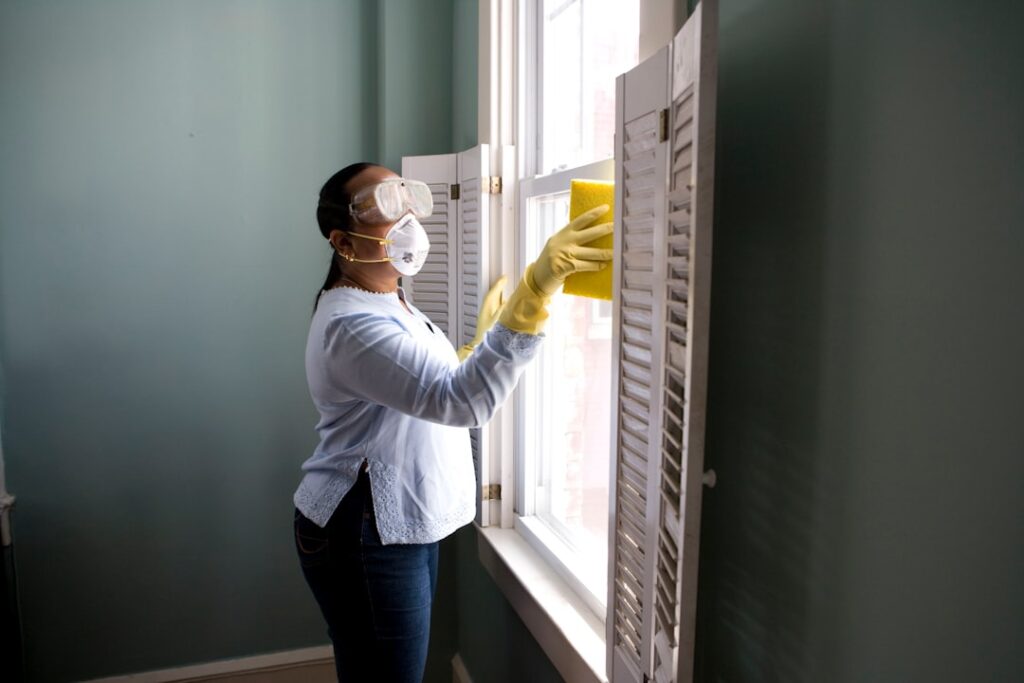
The DIY workflow takes thirty to sixty minutes per location for small patches and costs under fifty dollars in supplies. Personal protective equipment is non-negotiable even for small jobs — N95 respirator, nitrile gloves, sealed eye protection. The cleaning agent should match the substrate. The scrub-and-wipe step matters as much as the chemistry. The verification step at forty-eight hours and again at two weeks confirms the work held.
Professional Remediation: When It Is Required
The qualifying scenario for professional remediation involves any of the three escalation triggers. Patch size exceeds ten square feet contiguous, or thirty square feet total across multiple rooms. Porous substrate has visible growth requiring removal rather than surface cleaning. Sensitized occupants are in the household, regardless of patch size. Additionally, growth on or near HVAC components is automatically a professional job because of the dispersion risk during disturbance.
Professional remediation follows IICRC S520 protocols. That includes pre-work assessment, source-moisture correction, physical containment with six-mil polyethylene sheeting, HEPA-filtered air scrubbers maintaining negative pressure, controlled removal of unsalvageable porous materials, HEPA vacuuming and antimicrobial application on remaining substrates, and post-remediation verification by an independent third party. Costs range from a few hundred dollars for small single-room work to five figures for whole-home projects involving HVAC contamination and significant drywall removal.
Product Effectiveness Ranked by Substrate
The cleaning agent selection follows the substrate, not the homeowner’s preference. The practical ranking changes meaningfully depending on what is being cleaned.
EPA-Registered Antimicrobials: The Top Performers
Products like Concrobium, Sporicidin, Moldstat, and Mold Armor are formulated specifically for mold and registered with the EPA for that use. They produce the most predictable results on non-porous substrates and have manufacturer-tested dwell times that give the chemistry time to work. Cost runs ten to twenty-five dollars per quart. These are the right default for any homeowner cleaning effort and the products professional remediation contractors use for post-removal substrate treatment.
Three Percent Hydrogen Peroxide: The Best Pharmacy Option
Three percent hydrogen peroxide from any pharmacy oxidizes mold organisms effectively on non-porous surfaces. It produces less respiratory irritation than bleach and lightens staining as effectively as most EPA-registered products on tile, glass, and sealed metal. Cost is under three dollars per bottle. The peroxide is the homeowner-friendly second choice and a reasonable default for households where bleach fumes are a problem.
Diluted Bleach: Cosmetic on Porous, Acceptable on Non-Porous
Household chlorine bleach diluted at one cup per gallon of water kills surface organisms on non-porous substrates but does not penetrate porous materials. On drywall, unsealed grout, and wood, bleach removes visible staining temporarily without addressing the colony below the surface — a result described in EPA guidance as cosmetic rather than remedial. Bleach also produces fumes that irritate asthma and acts as a respiratory hazard noted by OSHA. It is acceptable for non-porous surface mildew when no better product is available, but it is not the EPA’s preferred recommendation.
White Vinegar: Surface Mildew Only
Distilled white vinegar handles light surface mildew on tile grout, shower walls, and similar non-porous applications. It works more slowly than peroxide or registered antimicrobials and does not lift staining as quickly. Vinegar is the right choice for households committed to non-chemical cleaning and a reasonable supplement to humidity control as a maintenance product, but it is not the right primary product for visible mold colonies.
Products That Should Stay Off the List
Tea-tree oil produces variable results depending on commercial product concentration. Baking soda is a mild abrasive that kills organisms slowly. Borax is sometimes recommended in DIY guides but lacks the predictability of registered antimicrobials. Proprietary fogger devices marketed on social media disperse antimicrobial mist without the physical scrubbing that removes spore-laden material — the CDC does not endorse fogging as a primary remediation method. None of these belongs as the first-line product for a visible mold finding.
The Decision-Tree Framework
The practical decision-tree starts with a single yes-or-no question: is the patch under ten square feet of contiguous growth on a non-porous substrate? If no, the answer is professional remediation. If yes, proceed to the next question. Is anyone in the household sensitized — asthma, allergies, immune-compromising condition, infant under one, adult over sixty-five? If yes, default to professional remediation. If no, proceed.
Is the moisture source identified and corrected? If no, fix the source first before any cleaning. Cleaning over an active moisture source produces repeat work within months. If yes, proceed. Is the substrate truly non-porous, or is there a thin paper layer (drywall paper, wallpaper, sealed wood veneer) that could be hiding penetration? Test by scrubbing a small area firmly with peroxide. If the staining lifts cleanly leaving the substrate looking original, surface cleaning will work. If staining remains after mechanical cleaning, the colony has penetrated and the response shifts to removal.
Cost Comparison: DIY Versus Professional
The cost comparison between DIY and professional remediation depends entirely on whether the DIY effort actually succeeds. A successful homeowner cleanup costs forty to seventy dollars in supplies and one to three hours of labor. A failed DIY effort followed by professional remediation costs the supplies plus the professional fee plus the additional time required because the cross-contamination during the failed effort expanded the contaminated area.
Professional remediation for a small single-room project on the Front Range typically runs six hundred to fifteen hundred dollars. Whole-basement post-flood work runs three to seven thousand. Multi-room projects with HVAC contamination can exceed fifteen thousand. The cost driver is square footage of porous material removed, number of containment zones required, and any third-party verification testing. Third-party clearance typically adds three to six hundred dollars and is worth specifying as a non-negotiable line item rather than skipping to save money.
What the Best-Way Comparison Misses
Side-by-side comparisons of cleaning methods often miss the source-correction step entirely. The best cleaning method paired with an uncorrected moisture source produces the same result as the worst cleaning method paired with an uncorrected moisture source — recurrence within months. The single highest-leverage decision in any mold cleanup is correctly identifying and correcting the moisture source.
Moisture sources include plumbing leaks, roof flashing failures, basement seepage, condensation behind vapor barriers, ice-dam meltwater intrusion, slab moisture wicking through concrete, and elevated indoor humidity from cooking and showering without ventilation. Each source requires a different fix, and each fix involves a different trade. A plumber for a supply-line drip. A roofer for a flashing failure. A waterproofing contractor for basement seepage. A general contractor or HVAC technician for ventilation upgrades. Identifying which trade is needed is the function of a pre-cleanup assessment, available through the mold inspection and testing hub.
The Verification Step That Closes the Loop
The best cleaning method, executed correctly, on the right substrate, with the moisture source corrected, still needs verification to confirm the result. For DIY work, verification means visual inspection under bright direct light, moisture meter readings on the substrate at forty-eight hours, and a recheck at two weeks and again at three months. The three-month recheck catches seasonal moisture issues that may not appear in the initial six weeks.
For professional work, verification means independent third-party air and surface sampling. The inspector takes samples in remediated rooms, unaffected control rooms, and outdoor air. Remediated rooms should show airborne spore counts at or below baseline. Failed clearance triggers contractor re-work under standard remediation contracts. Homeowners reviewing remediation services can consult the affordable remediation service overview for context on what to expect from a credentialed contractor.
Side-by-Side Comparison Across Common Scenarios
The decision-tree applied to specific scenarios produces predictable answers. A shower-tile mildew patch under two square feet on glazed ceramic with the exhaust fan working: DIY with hydrogen peroxide or EPA-registered antimicrobial, total project cost under twenty dollars and ninety minutes of effort. A bathroom ceiling patch of four square feet with no exhaust fan and visible drywall paper damage: DIY for the cleaning but fix the ventilation first; the drywall paper visible damage may indicate substrate penetration warranting removal of that section.
A basement-corner finding of eight square feet on poured concrete after a single-event leak that has been repaired: DIY with EPA-registered antimicrobial is reasonable because concrete is non-porous and the source is corrected. A basement-corner finding of the same size on the drywall above the concrete: professional remediation because drywall is porous and the colony likely penetrated. A whole-wall finding of fifteen square feet after a long-standing slow leak: professional remediation regardless of substrate, because the patch size alone exceeds the EPA threshold.
An HVAC closet finding with visible growth on the air handler exterior: professional remediation immediately, because any disturbance risks distributing spores through every supply register in the home. A refrigerator-gasket finding visible only in the door fold: DIY with peroxide and a soft brush, plus a weekly gasket-wipe routine going forward. The patterns are consistent — non-porous, small, source-corrected, healthy occupants equals DIY; porous, large, source-active, or sensitized occupants equals professional.
What the Best-Way Comparison Misses About Hidden Growth
Visible mold is often the smaller portion of the actual colony. The growth that breaks through to a visible surface usually has a larger hidden component behind drywall, under flooring, or inside wall cavities. A two-square-foot visible patch on the front face of a bathroom wall might be paired with twenty square feet of growth on the cavity side, fed by the same hidden moisture source. Cleaning the visible portion leaves the bulk of the colony untouched.
The diagnostic for hidden growth is the smell test. A musty odor without proportional visible growth indicates a hidden colony somewhere in the affected room. The other diagnostic is moisture mapping with infrared imaging and pin meters, which finds temperature and moisture anomalies suggesting hidden saturation. Either diagnostic shifts the project from a cleaning question to an assessment question, and the assessment usually shifts the project from DIY to professional.
Front Range Conditions That Affect the Right Approach
Colorado’s semi-arid climate creates a misleading sense that mold cannot establish here, but interior microclimates produce localized exceptions across the Front Range. Bathrooms without exhaust fans, kitchens venting into attics rather than outside, basements behind vapor barriers, closets backing exterior walls in older homes — each produces the localized moisture that mold needs despite the dry outside air.
Seasonal patterns matter for both cleaning timing and the verification phase. Spring snowmelt drives basement seepage along the Front Range foothills. Late-summer monsoon storms push wind-driven rain past aging window flashing. Winter humidifier use combined with poorly insulated exterior walls produces condensation behind paint. A cleaning completed in March may show different conditions by August because different moisture drivers are active. Schedule the verification re-check to span at least one full season change after the cleanup, and consider the season-specific moisture pathways when assessing whether the source has actually been corrected.
Elevation adds a complication for Front Range homes above five thousand feet. Lower outdoor air pressure speeds evaporation from exposed surfaces, which helps most of the house stay dry. The same physics works against homeowners in basement spaces where ground temperatures stay cold year-round and condensation forms on any below-grade surface warmer than the surrounding earth. Insulated cold-water lines, vapor-permeable insulation strategies, and active dehumidification become more important the higher the elevation. A cleaning approach in Evergreen at 7,200 feet should differ from the same approach in Denver at 5,280 feet, with more attention paid to ongoing dehumidification and less reliance on natural ventilation that may not move enough air during cold months.
The other Front Range factor is wildfire-smoke season. Late-summer wildfire events drive homeowners to close windows for air quality, which simultaneously prevents the ventilation that bathroom and kitchen humidity control depends on. Plan for HEPA-filtered air purifiers and active dehumidification during smoke events, because the same week that closes the windows can produce the moisture buildup that supports new mold growth in vulnerable rooms.
References
- Mold Cleanup in Your Home — U.S. Environmental Protection Agency
- Cleanup and Remediation — Centers for Disease Control and Prevention
- Mold Standards and Worker Protection — Occupational Safety and Health Administration
- Mold Health Topic — National Institute of Environmental Health Sciences
Frequently asked questions
What is the single best product for cleaning mold?
EPA-registered antimicrobials like Concrobium, Sporicidin, and Moldstat produce the most predictable results on non-porous substrates. Three percent hydrogen peroxide is the best pharmacy alternative. Bleach kills surface organisms on non-porous materials but is mostly cosmetic on porous substrates.
When should I hire a professional instead of cleaning myself?
Hire a professional when the patch exceeds ten square feet, when porous substrates are saturated, when occupants have asthma or other sensitivities, when growth is on or near HVAC components, or when the moisture source was sewage or category-three water. The threshold drops as occupant sensitivity rises.
How much does professional mold cleanup cost on the Front Range?
Single-room projects run six hundred to fifteen hundred dollars. Whole-basement post-flood work runs three to seven thousand. Multi-room projects with HVAC involvement can exceed fifteen thousand. Third-party verification adds three to six hundred dollars and is worth specifying as non-negotiable.
Does the cleaning method matter more than fixing the moisture source?
No. The single highest-leverage decision in any mold cleanup is correctly identifying and correcting the moisture source. The best cleaning method paired with an uncorrected source produces recurrence within months.
Front Range homeowners evaluating whether to clean mold themselves or hire a contractor can request an independent assessment through our contact page before committing to either path.