Asbestos Sheet Removal: What Homeowners Need to Know
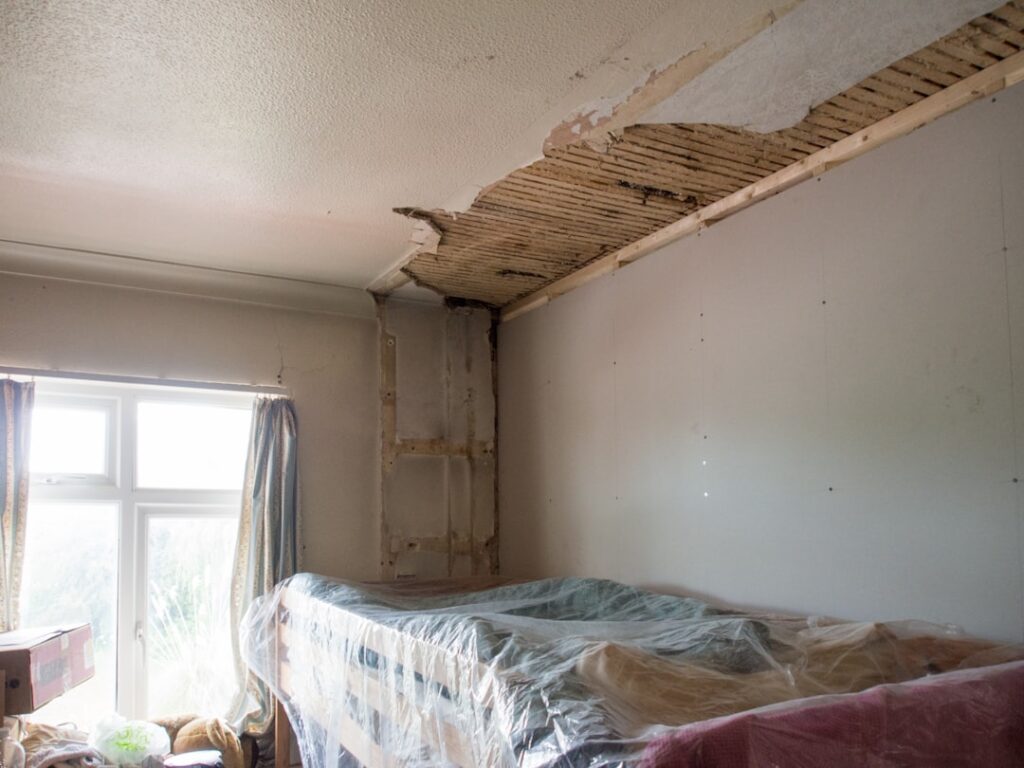
Asbestos sheet removal covers a family of pre-1980 building products that look ordinary on the wall or ceiling but require licensed abatement when they come off. The category includes transite roofing and ductwork, asbestos-cement (AC) exterior siding, AC interior wall panels, ceiling tiles with asbestos binders, and AC corrugated roof sheets on outbuildings. The removal process is the same in every case: state-licensed contractor, EPA NESHAP work practices, double-bagged or wrapped disposal, manifested transport to an approved landfill. This guide summarizes EPA, OSHA, and state-health guidance as of 2026 — it is not legal advice. Consult a state-licensed asbestos inspector before any work.
Part of our Asbestos in the Home guide — start there for the full picture →
Is this mold, asbestos, or water damage? Get a free instant screen
Upload a clear photo of the suspect area. You'll get an instant AI screening opinion and what to do next. This is screening guidance, not a professional determination.
Screening guidance only. AI can be wrong. Confirm asbestos, mold type, or lead with lab testing or a licensed professional before acting.
Asbestos sheet removal: what counts as a sheet product
The sheet category in residential asbestos work refers to flat or corrugated cement-based products with chrysotile (and sometimes amosite) fibers bound into the cement matrix. Common installations include AC exterior siding shingles or panels (think gray, white, or painted cement boards on pre-1980 homes), AC corrugated roof sheets on garages, sheds, and small barns, transite roofing slates and tiles, interior cement-board wall panels in utility rooms and basements, asbestos-binder ceiling tiles (12×12 or 24×24 squares with characteristic fissures or pinholes), and transite HVAC ductwork in older furnaces.
All of these materials are classified as Category I non-friable on installation — meaning they do not crumble under hand pressure when intact and new. The classification shifts to Category II non-friable or friable when the material is weathered, broken, cut, sanded, or otherwise rendered crumbly. By the time a homeowner is considering removal, most sheet products have crossed into Category II or friable status due to decades of UV exposure, freeze-thaw cycling, hail damage, and general aging. Plan for friable handling regardless of how solid the sheet looks.
Why sheet products need licensed removal even when intact
The instinct to treat intact AC siding as a normal demolition material is understandable — the sheets feel like dense cement when tapped. The problem is that removal involves cutting, prying, or breaking, and any of those actions can convert Category I non-friable material into Category II or friable status. EPA NESHAP treats material that has been rendered friable through removal work as regulated asbestos waste, with all the work-practice, transport, and disposal rules that come with it.
Colorado’s CDPHE applies the same logic at the state level. Above the trigger thresholds (32 square feet of non-pipe asbestos materials in residential settings), licensed abatement is required regardless of the material’s initial friability classification. Below trigger, CDPHE strongly recommends licensed contractors for any project involving asbestos sheet products. The recommendation reflects how easily intact sheets become friable during removal.
The NESHAP-compliant removal process for sheet products
A typical residential asbestos sheet removal job follows a sequence engineered to keep the material intact during handling and the fibers contained when intact handling is not possible.
Step 1 — Inspection and bulk sampling
A state-licensed inspector samples a representative cross-section of the sheets — typically one to three samples per homogeneous area. A NVLAP- or AIHA-accredited lab analyzes the samples by polarized light microscopy and reports asbestos type and percentage. Typical AC siding contains 12-18% chrysotile.
Step 2 — Site preparation and containment
Plastic ground sheeting (6-mil polyethylene) is laid under the work area to catch fragments. Air-quality monitoring stations may be set up at the property perimeter for larger jobs. For interior work, the room is sealed off with poly sheeting and negative-air HEPA filtration. Workers don P100 respirators, Tyvek suits, and gloves.
Step 3 — Wet-method intact removal
The compliant technique removes sheets intact whenever possible. Crews use amended-water sprayers to keep sheets continuously wet. Fasteners are unscrewed or pried with care; sheets are lowered (not dropped) to ground sheeting. Each sheet is immediately wrapped in 6-mil poly with sealed edges or double-bagged if size allows. Breaking sheets is treated as an aggressive fiber-release event and avoided when fastener patterns permit.
Step 4 — Containment of fragments
Inevitable fragments from corners, fasteners, and weathered edges are collected with HEPA vacuums (standard vacuums do not retain asbestos fibers and will exhaust them through the motor). Bagged fragments are labeled and treated as asbestos waste.
Step 5 — Substrate cleaning
The wood, masonry, or sheathing substrate behind removed sheets is HEPA-vacuumed and wet-wiped to remove residual fibers. Any visible asbestos dust on the substrate requires additional containment cleaning before the area is released.
Step 6 — Manifested transport and disposal
Wrapped sheets and bagged fragments are transported by a licensed asbestos hauler to an EPA-approved Class II or Class III landfill. The chain-of-custody manifest is signed at pickup and at the landfill. The homeowner retains a copy. For more on the disposal endpoint, the [how to properly dispose of asbestos guide](https://inspectandtest.net/guides/how-to-properly-dispose-of-asbestos/) walks through the EPA NESHAP step-by-step.
Step 7 — Clearance verification
For larger projects or interior removals, an independent third-party industrial hygienist takes post-removal air samples to verify fiber concentrations below the regulatory threshold (typically 0.01 fibers per cubic centimeter). The clearance report becomes part of the homeowner’s permanent records. The abatement of asbestos inspection-to-clearance guide walks through how that final verification step ties the full project together.
Cost ranges by sheet-product category
Pricing varies by sheet type, accessibility, condition, and quantity. The ranges below reflect Denver metro 2026 pricing for typical residential projects.
AC exterior siding on a 1,200-1,800 sq ft single-family home runs $8,000 to $22,000 for full removal. Smaller targeted siding repair removal (one wall or one elevation) runs $2,500 to $6,000. AC corrugated roof sheets on an outbuilding (garden shed to detached garage) run $1,800 to $9,000. Transite roofing on a small structure runs $3,500 to $12,000. Interior AC wall panels or ceiling tiles in a basement or utility room run $1,500 to $5,000 for targeted removal. Whole-room interior abatement runs higher.
What pricing covers: inspection sampling, NESHAP notification, PPE and consumables, wet-method intact removal, double-bagged or wrapped containment, hauling, landfill tipping fees ($150-$400 per ton for asbestos waste in 2026), and clearance air sampling. What pricing does not always cover: replacement materials, structural repairs to substrate, or general-contractor coordination for follow-up trades. Separate those line items in your quote.
What homeowners should not do with sheet products
Do not power-wash AC siding to “clean” it for sale — the high-pressure water turns intact non-friable material into friable fiber release and is illegal under most state interpretations. Do not paint over visibly damaged sheet products as a fix; cracked AC siding continues to release fibers under encapsulant paint. Do not cut sheets to fit them in a vehicle for disposal — even partial cutting creates a regulated waste stream that no normal vehicle is permitted to carry. Do not let general contractors or roofers remove sheets as part of a larger renovation without a documented pre-renovation asbestos survey and a licensed abatement subcontractor on the job. The [asbestos removal companies vetting guide](https://inspectandtest.net/guides/asbestos-removal-companies/) covers contractor selection criteria.
Renovation and demolition coordination
Sheet-product removal usually happens in coordination with a larger renovation or demolition project. Common pairings include: re-siding a 1950s home (AC siding removal before new siding), re-roofing a pre-1980 outbuilding (AC roof sheet removal before new roof), demolishing a detached garage (sheet removal before structural demolition), or basement finishing (interior AC panel removal before drywall installation). Sequence matters. The asbestos abatement must complete and clearance-pass before any non-asbestos trade enters the work area.
Why pre-1980 sheet products contain asbestos in the first place
Asbestos-cement sheet products were dominant in residential construction from the 1930s through the late 1970s because the combination of properties was exceptional and the cost was low. Chrysotile fiber bound into Portland cement produced sheets that were fireproof, weatherproof, dimensionally stable, easy to fabricate, and durable for decades. The fibers provided the flexural strength that pure cement lacks; the cement matrix locked the fibers in place under normal service conditions.
The U.S. produced AC sheet products under brand names including Transite (Johns-Manville), Cemboard, Eternit, and several regional manufacturers. EPA’s 1989 ban on most new asbestos products effectively ended new domestic manufacture, though the ban was partially overturned in 1991. Some imported AC products continued to enter the U.S. market into the 1990s, which means even some 1980s and early-1990s construction can contain asbestos sheet products. Lab analysis remains the only definitive identification method.
The legacy of AC sheet products is a large population of pre-1990 residential structures across the Front Range still carrying asbestos in roofing, siding, interior panels, and ductwork. Identification and decision-making — manage in place or abate — falls to current owners as the materials age, deteriorate, or come into the path of renovation projects.
Substrate inspection after sheet removal
One step often overlooked in DIY thinking about sheet removal is what happens to the underlying substrate. AC siding, roof sheets, ceiling tiles, and wall panels were installed over wood, masonry, or sheathing materials that may themselves have absorbed asbestos fibers during decades of contact with the sheets. Post-removal substrate cleaning — HEPA vacuuming, wet-wiping, and sometimes encapsulant sealing — is part of compliant abatement work.
Substrate inspection also identifies structural condition issues that need attention before replacement materials go on. Wood sheathing beneath AC siding may have weather damage, rot, or insect activity that was hidden by the asbestos cladding. Roof decking beneath AC corrugated sheets may have similar issues. The abatement contractor’s clearance step releases the area for the next trade, which is when the structural and finish work takes over. Plan for the possibility of substrate repair as a separate scope and budget line.
Storm damage and emergency removal scenarios
Hail, wind, and ice damage to AC sheet products produce friable asbestos release. Front Range hailstorms regularly damage AC siding and AC roofing on older outbuildings. The compliant emergency response sequence is: secure the area to prevent access, document the damage with photographs, contact a state-licensed asbestos contractor for emergency assessment, and coordinate temporary containment until full abatement can be scheduled.
Insurance carriers typically cover asbestos abatement as part of storm-damage claims on dwellings, but coverage varies by policy. Homeowners filing claims should explicitly itemize asbestos abatement on the claim documentation rather than rolling it into “siding repair” or “roof replacement” line items. Adjusters experienced with pre-1980 housing in Colorado know to expect asbestos line items on properties in that age range. The broader [asbestos and lead in your home pillar](https://inspectandtest.net/asbestos-lead/) covers emergency-response decisions in more depth.
When to call a professional
Call a state-licensed asbestos inspector before any sheet-product removal on a pre-1980 home or outbuilding, before re-siding or re-roofing those structures, after storm damage to suspected sheet products, and when buying or selling a property with visible AC siding, roofing, or interior cement panels. Call before filing an insurance claim involving suspected AC products; itemized abatement scope produces better claim outcomes than rolled-in repair language.
References
- Asbestos NESHAP Category I and II Non-Friable — U.S. Environmental Protection Agency
- Asbestos in Buildings — U.S. Environmental Protection Agency
- OSHA Asbestos Construction Standard — Occupational Safety and Health Administration
- Colorado Asbestos Trigger Levels and Licensing — Colorado Department of Public Health and Environment
Frequently asked questions
Can intact asbestos cement siding be left in place?
Yes, if it is undamaged and not part of a planned renovation. EPA recognizes manage-in-place strategies for intact non-friable sheet products under an operations-and-maintenance plan. Removal becomes necessary when damage, renovation, or demolition is in the picture.
What does AC siding removal typically cost in the Denver metro?
Full AC siding removal on a 1,200-1,800 square foot home typically runs $8,000 to $22,000 in 2026. Targeted single-wall removal runs $2,500 to $6,000. Pricing covers inspection, NESHAP notification, removal, bagging, hauling, tipping fees, and clearance sampling.
Can a roofer remove asbestos roof sheets as part of a roof replacement?
Only if the roofer is also a state-licensed asbestos abatement contractor, or has a licensed asbestos subcontractor on the job. Standard roofing crews are not permitted to remove asbestos roof sheets, and doing so without a license violates federal and state law.
How long does asbestos sheet removal take?
A small outbuilding roof or single-wall siding project typically completes in one to three days of on-site work. Whole-house siding or roofing removal runs three to seven days of removal, plus the 10-working-day NESHAP notification before work starts.
Front Range homeowners with asbestos sheet products on their home or outbuildings can connect with a vetted local inspector through our contact page for a pre-removal assessment.
Asbestos test kits
Asbestos can only be confirmed by a lab. A mail-in kit gets you a sealed sample container and accredited analysis — never sand or disturb suspect material first.
| Product | Why | Buy |
|---|---|---|
| Asbestos Test Kit (mail-in lab) | Includes PPE + sealed mailer. | Amazon |
| Pro-Lab Asbestos Test Kit | Widely available; lab fee separate. | Amazon |