Asbestos Meter: Why It Does Not Exist and What to Use
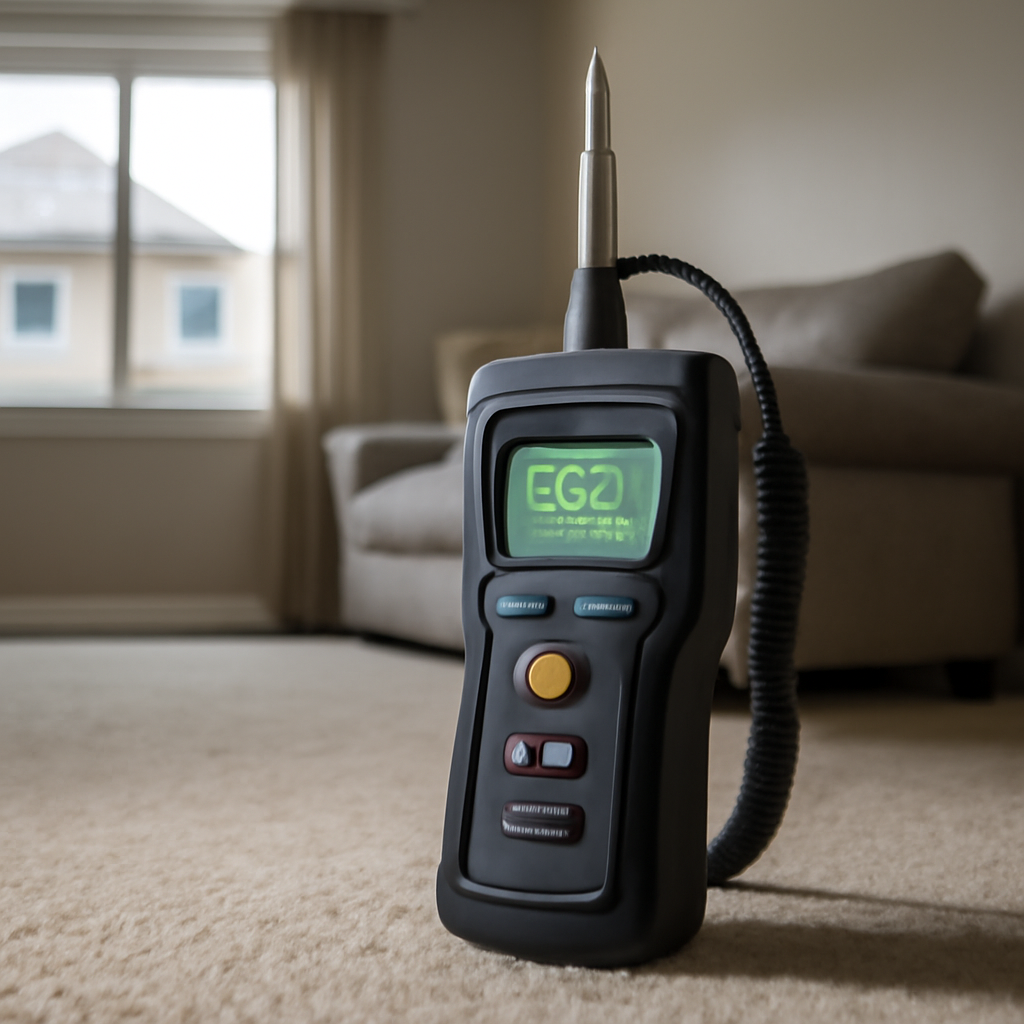
Search the phrase “asbestos meter” and you will find listings, ads, and forum threads — but no real product. Unlike radon (which has continuous monitors), carbon monoxide (which has wall plug-ins), or moisture (which has handheld pin meters), asbestos cannot be detected in real time by any consumer or professional handheld device. The reasons are physical: asbestos fibers are microscopic mineral structures that require optical or electron microscopy to identify. This guide summarizes EPA, OSHA, NIOSH, and NVLAP guidance current as of 2026 — consult a licensed inspector for any suspect material in your home.
Part of our Asbestos in the Home guide — start there for the full picture →
Is this mold, asbestos, or water damage? Get a free instant screen
Upload a clear photo of the suspect area. You'll get an instant AI screening opinion and what to do next. This is screening guidance, not a professional determination.
Screening guidance only. AI can be wrong. Confirm asbestos, mold type, or lead with lab testing or a licensed professional before acting.
Why There Is No Asbestos Meter
Detection technology depends on something measurable in the air or on the surface. Radon emits alpha particles a detector can count. Carbon monoxide undergoes electrochemical reactions on a sensor. Moisture changes a material’s electrical resistance. Asbestos does none of those things. Asbestos is a class of six naturally occurring silicate minerals: chrysotile, amosite, crocidolite, anthophyllite, tremolite, and actinolite. The fibers are chemically stable and emit no radiation, gas, or measurable energy that a sensor could pick up.
The only way to confirm asbestos is microscopy. The Environmental Protection Agency recognizes Polarized Light Microscopy (PLM) for bulk samples and Transmission Electron Microscopy (TEM) for air samples and low-concentration confirmation. Both require a trained analyst at a NVLAP-accredited laboratory. Neither fits in a handheld device.
What the “Asbestos Meter” Listings Actually Are
Marketplace search results for “asbestos meter” return three categories of product, none of which actually detect asbestos.
Particulate Counters
Handheld laser particulate counters measure total particles in the air by size class (PM2.5, PM10, etc.). They register dust and any other airborne particulate but cannot identify the chemical or mineral identity of those particles. A high reading near suspect material is suggestive at best and meaningless at worst. Particulate counters are useful for HVAC and indoor-air-quality work but not for asbestos identification.
Fiber Counters (Phase Contrast Microscopy)
Phase Contrast Microscopy (PCM) is a method used in industrial-hygiene air sampling to count fibers in a measured volume of air. PCM is performed on a sampling cassette in a laboratory and reports fibers per cubic centimeter (f/cc). It cannot distinguish asbestos fibers from non-asbestos fibers — only that a fiber is present. PCM has occasional use in OSHA compliance monitoring but is not a real-time meter and not appropriate for asbestos identification.
Generic VOC or Gas Meters Mislabeled by Sellers
Some marketplace listings use the term “asbestos meter” to describe air-quality monitors that measure volatile organic compounds, carbon dioxide, or temperature and humidity. None of these gases have any relationship to asbestos exposure. The listings are misleading.
What Actually Detects Asbestos
Bulk Sampling Plus PLM Analysis
The standard method. A small piece of the suspect material — a dime-sized fragment of floor tile, joint compound, popcorn ceiling, or pipe insulation — is collected using the wet-method protocol, double-bagged, and shipped to a NVLAP-accredited lab. PLM analysis identifies asbestos type and percentage. Cost runs $25 to $50 per sample for standard turnaround. Our piece on the asbestos sampling kit category covers the bulk-sampling workflow.
Air Sampling Plus TEM Analysis
TEM is the gold standard for air analysis and post-abatement clearance testing. A high-volume pump draws air through a sampling cassette over hours or days. The cassette is sent to a lab where the filter is analyzed under an electron microscope. TEM can identify and count individual fibers below the threshold of optical microscopy. Cost is $75 to $200 per sample. TEM is overkill for routine homeowner identification but essential after abatement work.
Specialized Vermiculite Analysis
Vermiculite insulation from the Libby Montana mine is contaminated with tremolite asbestos at variable concentrations. Standard PLM can miss low-concentration contamination. EPA-recommended analysis for vermiculite uses a stratified method involving heating and microscopy. Most NVLAP labs offer it as a separate test for $50 to $150 per sample.
Where the “Asbestos Meter” Myth Came From
Two sources. First, radon monitoring is well-established with consumer devices like the Airthings Corentium Home and Radonova Radonest, so homeowners reasonably assume asbestos has an equivalent. It does not. Second, industrial hygienists use real-time fiber-counting equipment in occupational settings — but those are laboratory PCM workflows, not handheld field devices, and they identify only fiber count, not mineral identity.
The myth persists because marketplaces allow ambiguous product titles. A $200 “asbestos detector” sold on overseas e-commerce sites is almost always a particulate counter with an unrelated label. Save the money.
What to Do Instead
Identify Suspect Materials Visually
Asbestos was used in residential construction primarily between 1930 and 1980. Vinyl floor tile (9×9, sometimes 12×12), joint compound and drywall texture, popcorn ceiling spray, pipe insulation (corrugated paper, white-painted plaster), cement-fiber siding, transite roofing, vermiculite attic insulation, and HVAC duct wrap are all suspect. Our piece on visual identification methods walks through the high-probability categories.
Sample and Send to a Lab
If you suspect asbestos, take a bulk sample using the wet method, double-bag it, and mail to a NVLAP-accredited lab. Or hire a licensed inspector if the suspect material is friable, in a hard-to-reach location, or part of a real-estate transaction. Our guide on choosing asbestos testers covers the DIY-vs-pro decision.
Assume Positive and Manage
For undisturbed, intact materials in a pre-1980 home, the EPA explicitly recommends “manage in place” — leave it alone, monitor for damage, and only test when disturbance is unavoidable (renovation, demolition, water damage). A real-time meter would not change that recommendation even if one existed.
Real-Time Monitoring in Abatement Settings
Professional abatement crews use real-time particulate monitoring during work to verify negative-pressure containment and detect breaches. The instruments do not identify asbestos — they identify particle activity that indicates the containment is failing. Personal air-sampling pumps worn by workers collect cassettes for later PCM or TEM analysis. None of this gear is appropriate for homeowner use, and OSHA regulates the workflow under 29 CFR 1926.1101.
What “Asbestos Detection” Means in Different Contexts
Homeowner context: identify suspect materials, sample, lab analysis, decide. Real-estate context: hire a licensed inspector, formal report, NVLAP results in writing. Renovation context: pre-renovation survey by a state-licensed asbestos inspector. Abatement context: licensed abatement contractor with real-time particulate monitoring and post-abatement TEM clearance air sampling.
None of these workflows uses a handheld meter labeled “asbestos detector.” If a vendor or contractor claims otherwise, ask which NVLAP-accredited lab analyzes the results and which EPA-recognized method is used. The honest answer is none.
Cost of Real Asbestos Detection
- DIY bulk sampling kit plus lab: $50 to $75 per sample
- Lab-direct mailer with analysis: $35 to $55 per sample
- Licensed inspector site visit and sampling: $150 to $400 per sample
- TEM air analysis (post-abatement clearance): $75 to $200 per sample
- Vermiculite-specific analysis: $50 to $150 per sample
A fictional asbestos meter at $200 would be terrible value if it existed. The parent guide on asbestos and lead in pre-1978 housing covers when a full inspection is the right move.
If You Saw a Vendor Selling an Asbestos Meter
Three things to do. Ask for the EPA-recognized method (PLM or TEM). Ask which NVLAP-accredited lab confirms results. Ask for the OSHA or NIOSH reference that supports the device’s accuracy. If the vendor cannot answer any of those, it is not a real product. The American Lung Association and asbestos.com both publish consumer-protection guidance that aligns with this framing.
What the Future Might Hold
Could a real-time asbestos detector ever exist? In theory, an advanced spectroscopic technique like Raman spectroscopy or laser-induced breakdown spectroscopy could identify mineral signatures in airborne particulate. Research labs have demonstrated bench-top versions. Field-portable handheld versions remain experimental and expensive. Even if such a device were commercialized, it would likely cost $10,000 to $50,000 and require trained operators — not a consumer-grade product.
So for at least the next several years, the answer to “is there an asbestos meter” remains no. Sampling and lab analysis are the only practical detection methods. Treat any marketing claim to the contrary as misleading.
What Homeowners Actually Need
The honest tool kit for residential asbestos identification is small. A consumer bulk-sampling kit ($35 to $55 lab-direct or $50 to $72 at retail with separate lab fee). Personal protective equipment for safe wet-method sampling. A NVLAP-accredited lab to analyze the result. For friable or hard-to-access materials, a licensed inspector instead of any of the above. That is the full list. No real-time meter, no detector, no smart sensor, no app fits anywhere in this list.
Front Range homeowners shopping for asbestos identification tools should plan around this reality. Skip the search results for “asbestos detector” and “asbestos meter” and go straight to NVLAP-accredited lab options or a licensed inspector. The piece on asbestos sample testing near me covers the lab options in detail.
Comparing Asbestos to Other Detectable Hazards
The consumer-detector landscape for indoor hazards looks something like this. Radon: continuous monitors exist ($150 to $300) and short-term kits ($15 to $30). Carbon monoxide: wall plug-in or hard-wired detectors with audible alarms ($25 to $100). Smoke: ubiquitous detectors with alarms ($15 to $80). Mold: spore trap kits and indoor air quality monitors with some predictive capability ($30 to $200). Lead: rhodizonate swabs for paint screening ($10 to $25). VOCs and formaldehyde: continuous monitors ($150 to $400).
Asbestos stands alone in this list as a hazard with no real-time consumer detector. The physics — non-radioactive, chemically stable, mineral fiber — preclude the sensor categories that work for the other hazards. The only way in is sampling plus microscopy. This is not a marketing gap waiting to be filled; it is a constraint of the material itself.
References
- Learn About Asbestos — U.S. Environmental Protection Agency
- NIOSH Asbestos Topic Page — Centers for Disease Control and Prevention
- OSHA Asbestos Standards — U.S. Occupational Safety and Health Administration
- Asbestos Testing Overview — Asbestos.com
- Asbestos and Indoor Air Quality — American Lung Association
Frequently asked questions
Is there a Geiger counter for asbestos?
No. Asbestos is non-radioactive and emits no detectable energy. A Geiger counter measures ionizing radiation, which asbestos fibers do not produce. The only valid identification is microscopy at a NVLAP-accredited lab.
What about handheld particle counters at $300 to $800?
Particle counters measure total airborne particulates by size class. They cannot distinguish asbestos fibers from any other dust. Useful for HVAC and indoor air quality, useless for asbestos identification.
Does any handheld meter even count fibers?
Some industrial-hygiene fiber-counting microscopes exist but they are laboratory instruments costing $5,000 to $25,000, not handheld field devices. They count fibers but do not identify asbestos versus non-asbestos minerals.
Should I just hire a pro instead?
For most homeowners, yes — especially in pre-1980 houses with multiple suspect materials. A licensed inspector charges $300 to $800 for a whole-house survey and provides a defensible written report.
Homeowners on the Colorado Front Range who want a licensed inspector rather than a misleading meter can get in touch through our contact page for a referral to a vetted local sampler.