What Radon Actually Is and How It Enters Your Home
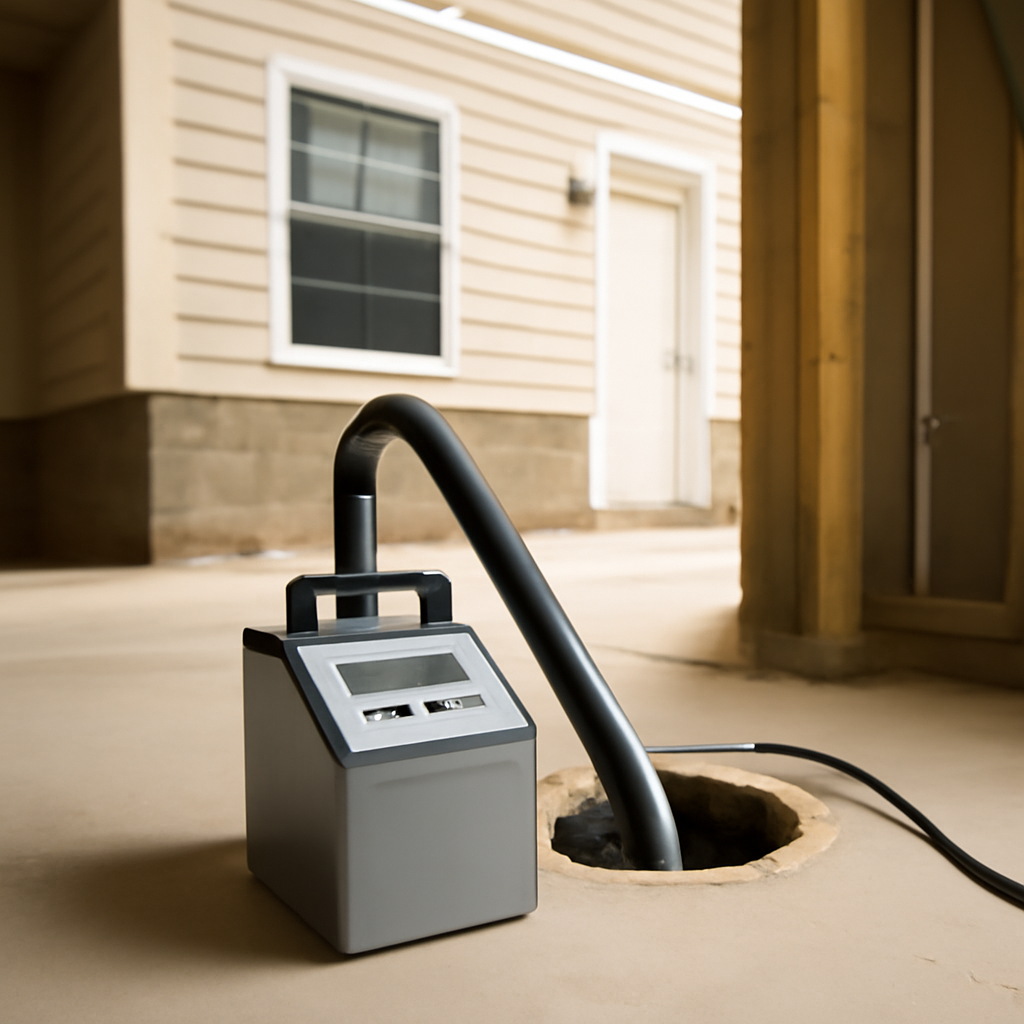
Radon is a radioactive gas that forms naturally in the ground and seeps up into buildings, where it can build to concentrations high enough to raise your risk of lung cancer. You cannot see it, smell it, or taste it, and it produces no symptoms you would notice day to day. That combination — invisible, harmful, and common in Colorado soil — is why it gets its own place on nearly every home inspector’s radar. This page explains what radon is, where it comes from, how it gets indoors, and what the numbers mean, so you understand what you’re dealing with before you decide to test.
Part of our Radon Levels guide — start there for the full picture →
Where radon comes from
Radon is element 86, a colorless noble gas, and it is radioactive in every form found in nature. The isotope that matters indoors is radon-222, which has a half-life of just 3.8 days. It is one link in a long decay chain that starts with uranium-238 — an element present in trace amounts in most soil and rock on Earth:
- Uranium-238 decays slowly (half-life 4.5 billion years) through a series of intermediate elements down to radium-226.
- Radium-226 (half-life 1,600 years) decays directly into radon-222.
- Because radon is a gas, it escapes the parent rock and soil and diffuses upward — into open air outdoors, or into a building sitting on top of it.
- Radon-222 then decays into short-lived solid particles (polonium-218, lead-214, bismuth-214, polonium-214) that stick to dust and can be inhaled.
That last step is the health problem. When those solid decay products lodge in lung tissue, they emit alpha radiation directly against lung cells. According to the U.S. Environmental Protection Agency, this is what drives radon’s cancer risk — not the gas itself passing through, but its progeny embedding in the lungs.
How radon gets into a house
A building sits at slightly lower air pressure than the soil beneath it, especially in heating season, when warm air rising through the house pulls replacement air in from below (the stack effect). That pressure difference draws soil gas — radon included — through any opening between the ground and your indoor air. The main entry points:
- Cracks in the slab and foundation walls — both visible structural cracks and the microscopic shrinkage cracks in every poured concrete floor.
- The floor-to-wall joint — the seam where a basement slab meets the foundation wall is one of the most common pathways.
- Slab penetrations — gaps around plumbing, electrical conduit, and other utility lines passing through the floor.
- Sump pits — an open or loosely covered sump is a direct opening to the soil.
- Hollow block walls — the open cores of concrete-block foundations act as chimneys, carrying soil gas upward.
- Crawlspace floors — bare earth or an unsealed crawlspace lets radon enter freely.
- Well water — private wells in radon-bearing rock can carry dissolved radon indoors, which releases into the air during showering and laundry.
Because entry depends on the specific cracks, foundation type, and soil under one particular building, two houses on the same street — even two built by the same crew on adjacent lots — can test completely differently. Radon is not something you can smell as it enters; if you’re wondering, the short answer is covered in our guide on whether radon has a smell.
What the numbers mean
Radon is measured in picocuries per liter of air (pCi/L), a unit of radioactive decay rate. One picocurie equals about 0.037 decays per second in every liter of air. The reference points every homeowner should know:
| Level (pCi/L) | What it represents |
|---|---|
| ~0.4 | Average radon in outdoor air across the U.S. |
| ~1.3 | Average radon in U.S. indoor air |
| 2 to 4 | EPA suggests you consider reducing levels in this range |
| 4 | EPA action level — fix the home at or above this |
| Above 10 | Clearly elevated; mitigate promptly |
The EPA action level of 4 pCi/L comes from the Citizen’s Guide to Radon. It isn’t a bright line between “safe” and “dangerous” — the risk is a smooth curve, and EPA is explicit that there is no known threshold below which radon carries zero risk. It’s the level at which the agency says the benefit of fixing the home clearly outweighs the cost. If you want the fuller picture of what counts as an acceptable reading, we break it down in what a safe radon level actually is.
Why radon is worth taking seriously
Radon is the second-leading cause of lung cancer in the United States after smoking, and the leading cause among people who have never smoked. The EPA attributes roughly 21,000 lung-cancer deaths a year to radon exposure. The Centers for Disease Control and Prevention and the American Lung Association both classify it as a confirmed human carcinogen.
Two features make it dangerous in a way most home hazards are not. First, the risk is cumulative — it’s a function of concentration multiplied by years of exposure, so the same level in a home you’ll live in for twenty years matters far more than a weekend rental. Second, it’s completely silent. Radon causes no cough, no headache, no irritation at any concentration ever recorded in a home. The damage happens quietly at the cellular level and shows up, if it shows up, as lung cancer years or decades later. That’s precisely why testing exists: your senses give you no warning at all. For smokers, the two risks combine to something worse than adding them together, because both attack the same tissue.
Why Colorado homes are more likely to have it
The EPA sorts U.S. counties into three predicted-risk zones based on geology and measured data. Every Front Range county — Denver, Douglas, Elbert, Arapahoe, Jefferson, El Paso, Adams, Boulder, and Broomfield — falls in Zone 1, the highest category, with predicted average indoor levels above 4 pCi/L. The Colorado Department of Public Health and Environment reports that roughly half of Colorado homes test above the action level.
The geology behind that is specific to the region: the Pierre Shale and Niobrara Formation underlying the eastern plains carry modest uranium; the foothills granites and pegmatites carry more; and the alluvial soils washed down from those foothills spread uranium-bearing material across the valleys where most people build. A Zone 1 designation raises the odds for any given house, but it does not decide the outcome — Front Range homes routinely test anywhere from under 2 pCi/L to over 20. The map tells you the prior probability; only a test tells you your home. If you want to see how the zones are drawn, we cover that in our explainer on EPA radon zones.
What to do with this
Understanding what radon is leads naturally to two questions: is my home elevated, and what do I do if it is. Testing is inexpensive and something a homeowner can start themselves — see whether you should test for radon and the broader Colorado radon testing overview. If a test comes back high, the fix is a well-understood engineering job, not a demolition project; the options are laid out in what radon mitigation involves. The gas is common here, but it is also one of the most straightforward home hazards to measure and remove.
Frequently asked questions
Is radon a gas or a solid?
Radon itself is a gas (radon-222), which is why it can move from soil into your home so easily. But it decays into solid radioactive particles — polonium, lead, and bismuth isotopes — and it is those particles, inhaled and lodged in the lungs, that cause the actual health damage.
Can I smell or feel radon in my home?
No. Radon is colorless, odorless, and tasteless, and it produces no symptoms at any concentration ever measured in a home. There is no sensory way to detect it — the only way to know your level is to run a test.
What is the EPA action level for radon?
4 pCi/L (picocuries per liter). EPA recommends fixing a home at or above this level and considering action between 2 and 4. For reference, average outdoor air is about 0.4 pCi/L and average U.S. indoor air is about 1.3 pCi/L.
Why do Colorado homes have more radon?
Every Front Range county sits in EPA Radon Zone 1, the highest-risk category, and CDPHE estimates about half of Colorado homes test above the action level. The uranium-bearing Pierre Shale, Niobrara Formation, foothills granites, and the alluvial soils derived from them all feed radon into the ground beneath homes.
Figures and thresholds here reflect current EPA, CDC, and CDPHE guidance and are informational only; test your own home to know your actual level.
Test your home for radon
Radon is invisible and odorless, so a test is the only way to know your level. A short-term kit gives a first reading in days; a digital monitor tracks it over time.
| Product | Why | Buy |
|---|---|---|
 AirChek Charcoal Radon Test Kit AirChek Charcoal Radon Test Kit | Lab fee usually included; EPA short-term protocol. | Amazon — $21.95 |
 First Alert RD1 Radon Test Kit First Alert RD1 Radon Test Kit | Widely stocked; 48-hour charcoal test. | Amazon — $16.98 |
 Airthings Corentium Home Airthings Corentium Home | Digital monitor with a long-term average. | Amazon — $143.65 |