Radon Testing What Is It: A Plain-Language Beginner Guide
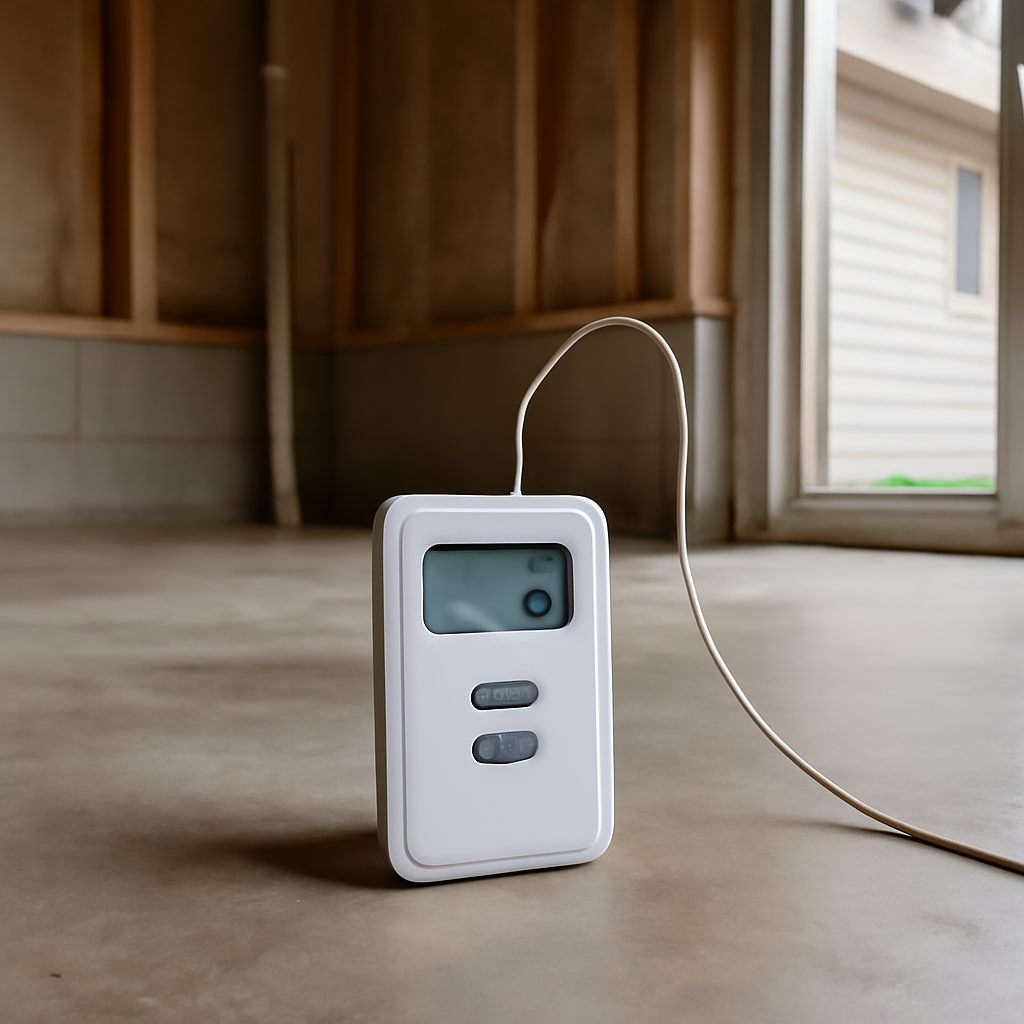
Radon testing — what is it? At the simplest level, it is the process of measuring how much radon-222 gas accumulates in your home’s indoor air over a defined test period. The result is reported in picocuries per liter (pCi/L) and compared against the EPA action level of 4 pCi/L. For Front Range homeowners, the question is rarely whether to test — Colorado’s geology produces elevated radon in roughly half of tested homes — but how to test, how to interpret the result, and what action thresholds matter. This guide summarizes EPA and CDC guidance current as of 2026 and consults your physician for symptoms, a NRPP- or NRSB-certified contractor for mitigation decisions.
Part of our Radon Levels guide — start there for the full picture →
What radon is, briefly
Radon is a naturally-occurring radioactive gas produced by the decay of uranium and radium in soil and bedrock. It is colorless, odorless, and tasteless. The gas seeps through cracks and openings in foundations, accumulates in indoor air, and produces short-lived decay products that deposit in the lungs when inhaled. EPA attributes roughly 21,000 lung-cancer deaths per year in the United States to radon exposure — the second leading cause of lung cancer after smoking, and the leading cause among nonsmokers.
The Colorado Front Range sits on Pikes Peak granite and related uranium-bearing bedrock, which produces continuous radon emission into soil pores. The gas migrates upward and enters homes through any soil-contact opening: sump pits, foundation cracks, slab-soil penetrations, exposed crawl space dirt. CDPHE classifies most Front Range counties as EPA Radon Zone 1, the highest predicted-level designation.
Why test for radon
Because there is no way to know the radon level in a specific home without measuring it. Two adjacent houses on the same block can produce dramatically different readings depending on foundation type, soil conditions, ventilation rates, and HVAC operation. CDPHE testing data consistently shows roughly half of Colorado homes above 4 pCi/L, but the other half are below — and no visual inspection of a home reveals which group it belongs to.
Testing is also inexpensive relative to the information it provides. Consumer short-term test kits run $15-$30 plus a small lab fee. Long-term test kits run $20-$40. Professional continuous radon monitor (CRM) testing for real estate purposes runs $125-$200. The cost of a single radon test is trivial compared to the cost of mitigation ($1,500-$3,500) and far less than the long-term health cost of unmitigated elevated radon exposure.
How to test
Three main methods exist for homeowner and professional radon testing. Each works under different time constraints.
Short-term tests (2-7 days)
Charcoal canisters, electret ion chambers, and continuous radon monitors in short-term mode produce results in days. The canister sits in the lowest livable level of the home for 48-96 hours under closed-house conditions (windows closed, normal HVAC operation), then ships to a lab for analysis. EPA recommends short-term tests for initial screening and for real estate transactions where time is short.
Long-term tests (90 days to 1 year)
Alpha track detectors and long-term electret chambers sit in place for 90 days or longer and capture an integrated average. They are less affected by short-term weather and HVAC changes and produce a better estimate of actual annual exposure. EPA recommends long-term tests for confirming initial results and understanding seasonal variability.
Continuous radon monitors
CRMs are the professional-grade instrument. They produce hourly readings, tamper detection, and rapid result turnaround. Professional radon testers use CRMs for real estate transactions because the hourly data confirms test integrity. CDPHE and EPA both recognize CRM results as valid.
For our deeper coverage of each method, see how radon test kits work. The parent radon testing in Colorado guide covers the full process from kit selection through mitigation planning.
The 4 pCi/L action level
EPA’s action level for indoor radon is 4 picocuries per liter (pCi/L). At or above this level, EPA recommends mitigation — installing a radon reduction system that vents soil gas above the roofline. The 4 pCi/L threshold reflects EPA’s judgment about where mitigation is reliably feasible and cost-effective, not a level below which exposure is considered safe.
EPA also identifies a 2 pCi/L consideration level. Between 2 and 4 pCi/L, residents should consider mitigation — especially nonsmokers (radon and smoking interact multiplicatively on lung-cancer risk) and households with children spending significant time on lower floors. Below 2 pCi/L, EPA does not specifically recommend action but acknowledges no exposure level is risk-free.
What action thresholds mean for Front Range homeowners
For a Colorado home with a basement, the most common test placement is in the basement during normal occupied use. Basement readings tend to run higher than upstairs readings because the gas enters from soil and is denser than air. A basement reading above 4 pCi/L warrants mitigation. A basement reading between 2 and 4 pCi/L warrants serious consideration and a confirmation test.
For homes on slab-on-grade construction, the ground-floor reading is the relevant measurement. For homes with crawl spaces, exposed-dirt crawl spaces produce far more soil-gas entry than sealed crawl spaces, and mitigation strategies vary accordingly. CDPHE’s radon mitigation guidance covers these construction-type distinctions in detail.
Closed-house conditions
Test results depend on conditions during the test period. EPA recommends closed-house conditions for short-term tests: windows and doors kept closed except for normal entry and exit, no fans running that vent air outside, no fireplaces or whole-house fans operating, and HVAC operating normally. The closed-house requirement starts at least 12 hours before the test begins and continues throughout the test.
Tests run during open-house conditions (windows open, ventilation cranked up) systematically underestimate radon levels because the soil-gas entry rate stays roughly constant while the ventilation rate rises. The EPA Citizen’s Guide is explicit about closed-house requirements. For real estate transaction tests, the requirement is typically enforced by tamper-detecting CRMs.
What happens after the test
The result arrives by mail, email, or app, depending on the test type. For consumer kits, the lab emails the result with a comparison to the EPA action level. For CRM tests, the operator delivers a report with hourly data, an average, and a recommendation. For results above 4 pCi/L, EPA recommends a confirmation test followed by mitigation. For results between 2 and 4 pCi/L, EPA recommends a confirmation test and a mitigation conversation.
Mitigation systems work by collecting soil gas before it enters the home and venting it above the roofline. The most common design is active soil depressurization (ASD), in which a fan continuously pulls soil gas from under the slab through a vent pipe that exits above the roof. Effective ASD systems reduce indoor radon by 50-99% and cost $1,500-$3,500 for a typical single-family home on the Front Range. NRPP (National Radon Proficiency Program) and NRSB (National Radon Safety Board) certifications identify qualified contractors.
How often to retest
EPA recommends retesting every two years for homes with previous results below the action level. Retest after any major HVAC change, foundation work, or remodeling that affects soil-to-living-space pathways. Retest after installing a mitigation system to confirm it brought levels below the action level. Retest if you finish a previously unfinished basement and start using it as occupied space.
Retesting captures seasonal and structural variability. Winter results often run higher than summer because closed-house conditions and active heating draw soil gas inward more effectively. A summer test that came in just below 4 pCi/L may show above the action level in winter. CDPHE recommends winter testing when possible for the most representative result.
Radon testing in real estate transactions
For Front Range home purchases, a radon test is nearly mandatory. CDPHE’s data showing roughly half of Colorado homes above the action level argues for testing every transaction. EPA’s home buyer guidance recommends radon testing in any real estate transaction. The test is typically scheduled during the inspection objection period and runs as a 48-96 hour CRM placement.
Results above 4 pCi/L produce typical buyer requests for seller-funded mitigation or a price credit reflecting mitigation cost. The seller’s response varies by market conditions, but mitigation is a reasonable ask in any market because the EPA action level is widely recognized. HUD’s radon guidance also covers radon in federally-backed mortgage transactions.
References
- A Citizen’s Guide to Radon — U.S. Environmental Protection Agency
- Radon information — Colorado Department of Public Health & Environment
- Radon and your health — Centers for Disease Control and Prevention
- Radon and lung health — American Lung Association
Frequently asked questions
What is radon testing?
Radon testing measures the concentration of radon-222 gas in your home's indoor air over a defined test period. Results are reported in picocuries per liter (pCi/L) and compared against the EPA action level of 4 pCi/L.
How long does a radon test take?
Short-term tests run 2-7 days. Long-term tests run 90 days to 1 year. Continuous radon monitors used by professional testers typically run 48-96 hours and produce hourly data plus an average.
How much does radon testing cost?
Consumer short-term kits run $15-$30 plus a small lab fee. Long-term kits run $20-$40. Professional CRM testing for real estate purposes typically costs $125-$200 inclusive of placement, retrieval, and report.
How often should I retest for radon?
EPA recommends retesting every two years for homes below the action level. Retest after HVAC changes, foundation work, or finishing a basement. Retest after installing a mitigation system to confirm it reduced levels below 4 pCi/L.
What does it mean if my radon test is above 4 pCi/L?
EPA recommends mitigation. Schedule a confirmation test, then engage a NRPP- or NRSB-certified contractor. Active soil depressurization systems typically reduce indoor radon by 50-99% and cost $1,500-$3,500 for a Front Range single-family home.
Colorado Front Range homeowners who tested above the EPA action level can connect through our contact page for an introduction to NRPP- and NRSB-certified mitigation contractors familiar with the local geology and construction.
Test your home for radon
Radon is invisible and odorless, so a test is the only way to know your level. A short-term kit gives a first reading in days; a digital monitor tracks it over time.
| Product | Why | Buy |
|---|---|---|
 AirChek Charcoal Radon Test Kit AirChek Charcoal Radon Test Kit | Lab fee usually included; EPA short-term protocol. | Amazon — $21.95 |
 First Alert RD1 Radon Test Kit First Alert RD1 Radon Test Kit | Widely stocked; 48-hour charcoal test. | Amazon — $16.98 |
 Airthings Corentium Home Airthings Corentium Home | Digital monitor with a long-term average. | Amazon — $142.99 |