Lead Paint Testing Near Me: 2026 Pricing and Methods
Lead paint testing near me is a common search from homeowners of pre-1978 housing facing renovation, child-safety concerns, or pre-purchase due diligence. The honest answer is that several testing pathways exist, each with different cost, accuracy, and use cases. DIY swab kits run $10 to $30. Paint-chip lab analysis costs $30 to $60 per sample. Professional XRF inspection runs $300 to $700 per home. The right choice depends on whether the goal is screening before renovation, regulatory compliance under EPA’s RRP Rule, or HUD Title X disclosure during a sale. This guide summarizes EPA, HUD, and CDC guidance current as of 2026 and is informational only.
Part of our Lead Paint & Lead Testing guide — start there for the full picture →
Is this mold, asbestos, or water damage? Get a free instant screen
Upload a clear photo of the suspect area. You'll get an instant AI screening opinion and what to do next. This is screening guidance, not a professional determination.
Screening guidance only. AI can be wrong. Confirm asbestos, mold type, or lead with lab testing or a licensed professional before acting.
The three lead-paint testing pathways
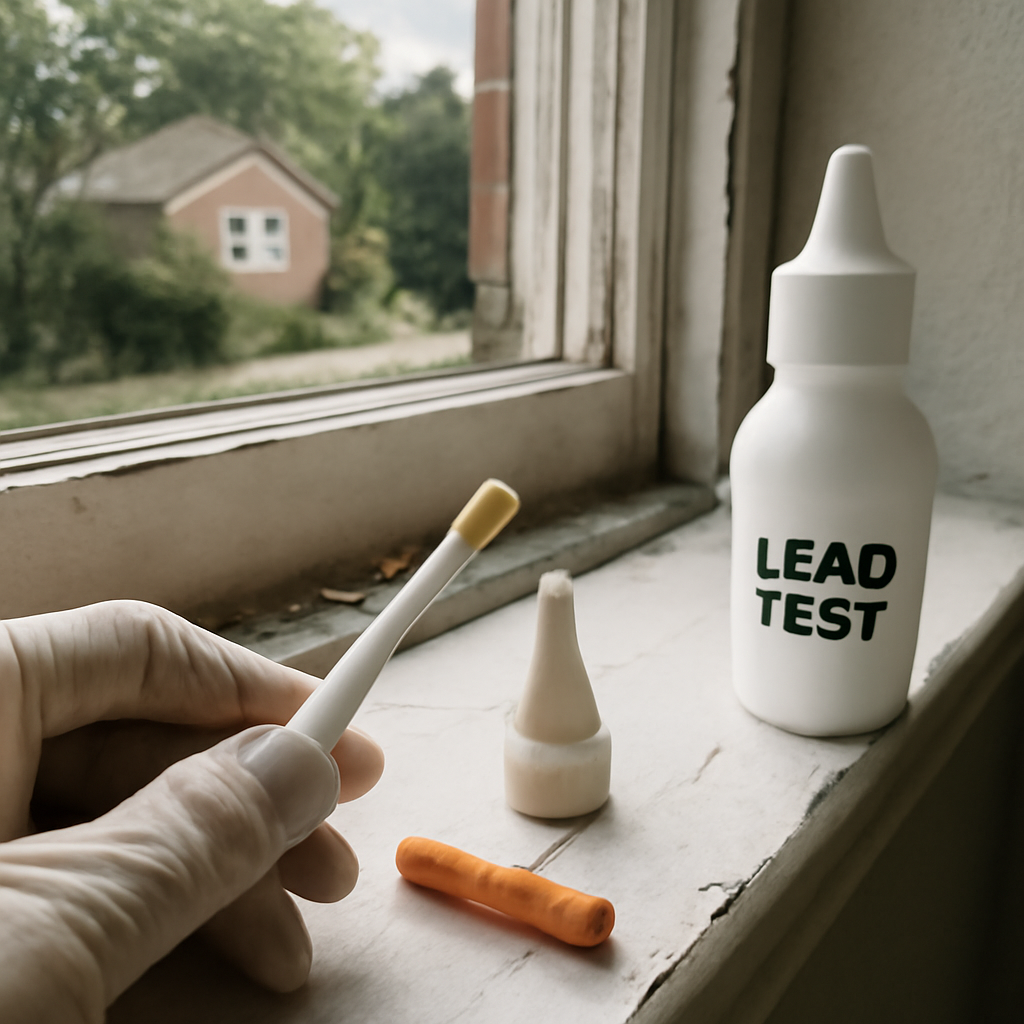
Homeowners typically choose one of three pathways. First, DIY rhodizonate-based swab tests (sold under the 3M LeadCheck brand, among others) provide a qualitative pink-color change when lead is present at 5,000 parts per million or higher. The kit is EPA-recognized for use under the RRP Rule and runs $10 to $30 for a multi-swab package at most hardware stores. The swab is rubbed on a freshly scored painted surface, and pink color development within 30 seconds indicates positive presence of lead. Negative results do not rule out lower lead concentrations, only that the surface is below the 5,000 ppm threshold.
Second, paint-chip sampling sent to an accredited lab for atomic absorption spectroscopy (AAS) or inductively coupled plasma (ICP) analysis returns quantitative results in parts per million. The homeowner or inspector collects a sample of paint roughly the size of a quarter, double-bags it with chain-of-custody labeling, and ships it to an EPA-recognized National Lead Laboratory Accreditation Program (NLLAP) lab. Turnaround is typically five to seven business days, with same-day or next-day rush available for an upcharge. Cost is $30 to $60 per sample plus shipping.
Third, X-ray fluorescence (XRF) inspection is performed in-situ by an EPA-certified lead inspector using a handheld XRF spectrometer. The instrument bombards the painted surface with X-ray photons and reads the fluorescence signature characteristic of lead. Results are quantitative, immediate, and non-destructive. A whole-home XRF inspection covers all painted surfaces, takes two to four hours, and costs $300 to $700 in the Front Range. XRF is the method specified for pre-1978 child-occupied target-housing inspections under HUD lead-safe rules.
EPA RRP Rule: when sampling is required
The Environmental Protection Agency’s Renovation, Repair and Painting (RRP) Rule applies to all renovation projects that disturb more than six square feet of interior or twenty square feet of exterior painted surfaces in pre-1978 target housing or child-occupied facilities. Under the rule, the contractor must either presume lead is present and use lead-safe work practices, or test the surface with an EPA-recognized test kit (such as the 3M LeadCheck rhodizonate kit) and document the result.
If the kit shows lead present, the contractor must use the full lead-safe work practices: containment with 6-mil polyethylene, HEPA vacuum cleanup, wet-method dust control, and respirators. If the kit shows lead absent, the contractor may proceed with ordinary work practices. Homeowners hiring an RRP contractor for a renovation will see the test happen on day one of the project. For more detail on how lead inspection methodologies compare, see the lead inspections guide.
HUD Title X disclosure during a sale
The federal Title X Lead-Based Paint Hazard Reduction Act requires sellers and landlords of pre-1978 housing to disclose any known lead-based paint hazards before sale or rental. Title X does not require testing; it requires disclosure of what is known. Sellers who have not tested their home need only check the “not known” box on the federal disclosure form. Buyers, however, have a 10-day right under federal law to conduct lead-paint testing during the inspection contingency. Many Front Range buyers use this window to schedule an XRF inspection or pull paint-chip samples from suspect surfaces.
The disclosure form itself is two pages and must be signed by both parties before any binding contract. The seller must also provide the EPA pamphlet “Protect Your Family From Lead in Your Home” to the buyer. Real-estate agents are required to ensure compliance with the disclosure rule on their transactions.
Where to find lead paint testing in the Front Range
Front Range homeowners searching for lead paint testing near me have several options. EPA-certified lead inspectors and risk assessors operate throughout Denver, Boulder, Colorado Springs, and Fort Collins. The EPA maintains a public lookup of certified firms and individuals at epa.gov. Most inspectors offering radon, mold, or general home inspection also subcontract lead testing or hold dual certifications.
For DIY testing, 3M LeadCheck swabs are stocked at Home Depot, Lowe’s, Ace Hardware, and most independent hardware stores across the Front Range. Pricing runs $25 to $35 for a 4-pack. Paint-chip lab sampling can be ordered online from NLLAP-accredited labs that ship sample kits with prepaid return packaging; total turnaround including shipping is typically 10 to 14 days.
How to choose between testing methods
The right testing pathway depends on the use case. For a homeowner about to repaint a small bedroom in a pre-1978 house, the DIY 3M swab is appropriate: cheap, fast, and EPA-recognized for RRP compliance. For a homeowner with a young child showing slightly elevated blood-lead levels, a comprehensive XRF inspection of the entire home is the right call. For a buyer with a 10-day inspection contingency on a pre-1978 home with visible peeling paint, paint-chip sampling of the suspect surfaces sent for lab analysis is the cost-effective middle ground.
A common mistake is using a DIY swab test on a freshly painted surface and getting a false negative. Lead-based paint in pre-1978 homes typically lies under one to three layers of newer non-lead paint. The swab only reacts when lead is exposed at the test surface. EPA RRP procedure requires the tester to score down through all paint layers before applying the swab, exposing every layer to the rhodizonate reagent. Skipping the score step is the most common DIY testing error.
Interpreting lead-paint results
HUD defines lead-based paint as paint containing lead at concentrations of 5,000 parts per million or 1 milligram per square centimeter or higher. Results above these thresholds trigger the full lead-safe work practices for any disturbance. Results below the thresholds but above zero are sometimes called “lead-containing paint” rather than “lead-based paint” — the regulatory distinction matters because the lower-concentration material is not subject to the RRP Rule’s full requirements, though prudence still suggests lead-safe practices.
Children are the highest-risk group. The Centers for Disease Control and Prevention identifies blood lead reference value of 3.5 micrograms per deciliter or higher as warranting public-health response. Any child living in pre-1978 housing should have blood-lead screening at ages 12 months and 24 months, per CDC recommendations. CDC lead-poisoning prevention guidance is at cdc.gov. The asbestos and lead pillar guide provides the broader context of pre-1978 housing hazards.
What lead testing does not test for
Lead-paint tests detect lead-based paint on surfaces. They do not detect lead in drinking water (which requires a water sample to a different lab), lead in soil (separate sampling protocol), or lead in dust (requires wipe-sample analysis). Comprehensive lead risk assessment includes all four pathways: paint, dust, water, soil. For a child with elevated blood lead, all four should be investigated. EPA RRP-Rule renovations focus narrowly on paint disturbance and do not address the other pathways.
Common testing mistakes
Beyond the “didn’t score through paint layers” error mentioned above, the other frequent DIY testing mistakes are: testing only one or two locations and assuming whole-home results from that small sample (paint history within a single home can vary by room and era of renovation); testing exterior trim and assuming interior trim matches (interior and exterior paint history were often different products); and testing wood substrate only without sampling baseboards, window sashes, doors, and stair handrails (which historically contained higher lead concentrations than wall paint).
A reliable DIY screening covers at least one sample per room from window sash, door casing, baseboard, and wall surfaces. For pre-1950s homes, additional sampling of stair handrails and porch trim is appropriate.
Sampling protocol for paint chips
Homeowners collecting paint-chip samples for lab analysis should follow a specific protocol to ensure representative and uncontaminated results. First, choose a sampling location that includes all paint layers from substrate to top coat — typically a window sash edge, baseboard end, or other location where the layered paint structure is exposed or easily accessed. Second, wet the area lightly with water from a spray bottle to reduce airborne dust during cutting. Third, use a clean scalpel or paint scraper to cut a sample approximately the size of a quarter (1 to 2 grams) down to the substrate, capturing all paint layers in the sample.
Fourth, place the sample directly into the chain-of-custody sample bag without touching it with bare hands. Fifth, label the bag with the room, surface, and date of collection. Sixth, fill out the chain-of-custody form completely, including the homeowner’s name, return address, billing information, and rush-turnaround preference. Seventh, double-bag the sample and place into the prepaid shipping envelope. The sample should arrive at the lab within a week of collection for best results; longer storage in non-ideal conditions can degrade some sample types.
What the lab report includes
The lab returns a written or digital report typically within 5 to 10 business days. The report identifies the laboratory name and accreditation status (NLLAP for EPA-recognized lead analysis), the date of receipt, the analysis method (typically atomic absorption spectroscopy or ICP-OES), the result expressed in parts per million dry weight, and any quality-control notes. A typical positive result might read: “Sample ID PR-001: lead detected at 12,000 ppm.” A typical negative result reads: “Sample ID PR-001: lead detected below 100 ppm method detection limit.”
Results between detection limit and 5,000 ppm are reported as “lead-containing paint” but not “lead-based paint” per HUD’s regulatory definition. The distinction affects which lead-safe work practices apply during any future disturbance. Results above 5,000 ppm trigger full RRP-Rule practices for renovation. For a lead-paint hazard in a child-occupied dwelling, the lead risk assessor’s interpretation should always be sought, since a “lead-containing” finding in a dust-friction surface like a window sash can still pose meaningful hazard even though it falls below the formal lead-based paint threshold.
Coordinating lead testing with other inspections
Buyers conducting pre-purchase due diligence on a pre-1978 home can often coordinate lead-paint testing with the general home inspection, radon testing, mold inspection, and asbestos sampling into a single coordinated visit. Some Front Range home inspectors hold dual EPA lead certifications and can offer combined services. Others coordinate with subcontracted lead inspectors who arrive during the general inspection window. The combined approach reduces total visits to the property during the inspection contingency and lets the buyer compare findings holistically across all hazard categories. For broader context, the asbestos and lead pillar overview covers how lead testing fits into the broader pre-1978 hazard framework.
Cost-benefit comparison summary
For pre-purchase due diligence on a pre-1978 home priced above $500,000 in the Front Range, the $300 to $700 professional XRF inspection is consistently cost-effective: the report provides surface-by-surface results that inform negotiation, renovation budgeting, and child-safety planning. For an isolated renovation project in a known pre-1978 house, the $25 swab kit is the right tool. For a single suspect surface in an unclear-era home, paint-chip sampling at $30 to $60 per sample provides the quantitative answer at modest cost.
References
- EPA Renovation Repair and Painting (RRP) Rule — U.S. Environmental Protection Agency
- HUD Title X lead-based paint disclosure rule — U.S. Department of Housing and Urban Development
- CDC childhood lead poisoning prevention — Centers for Disease Control and Prevention
- National lead-paint information clearinghouse — National Lead Information Center
Frequently asked questions
How much does lead paint testing cost in the Front Range?
DIY 3M LeadCheck swab kits cost $25 to $35 for a 4-pack at hardware stores. Paint-chip lab analysis is $30 to $60 per sample plus shipping. Professional XRF whole-home inspection runs $300 to $700 in the Denver and Front Range markets.
Are DIY lead-paint swab tests reliable?
3M LeadCheck rhodizonate swabs are EPA-recognized under the RRP Rule for screening at the 5,000 ppm threshold. Common errors include not scoring through paint layers before applying the swab and false negatives on recently overpainted surfaces. Score through every layer for accurate results.
Do I have to test for lead before selling a pre-1978 home?
No. Federal Title X requires disclosure of known lead-based paint hazards but does not require testing. Sellers who have not tested simply mark not known on the federal disclosure form. Buyers retain a 10-day right to conduct their own testing during inspection contingency.
What is XRF lead-paint inspection?
X-ray fluorescence is a non-destructive in-situ test method used by EPA-certified lead inspectors. The handheld device reads quantitative lead concentration at the painted surface in seconds. XRF is the standard for HUD-funded inspections of child-occupied target housing.
Front Range homeowners ready to schedule lead-paint testing with a vetted EPA-certified inspector can reach out through our contact page.
Lead paint test kits
Instant swab kits flag lead on painted surfaces in minutes — useful before a renovation in any pre-1978 home.
| Product | Why | Buy |
|---|---|---|
 3M LeadCheck Swabs 3M LeadCheck Swabs | EPA-recognized instant swabs. | Amazon — $15.00 |
 Lead Test Kit (lab-based) Lead Test Kit (lab-based) | Mail-in for a documented result. | Amazon — $65.00 |