Landlord Lead Paint Disclosure: HUD Title X Rental Guide
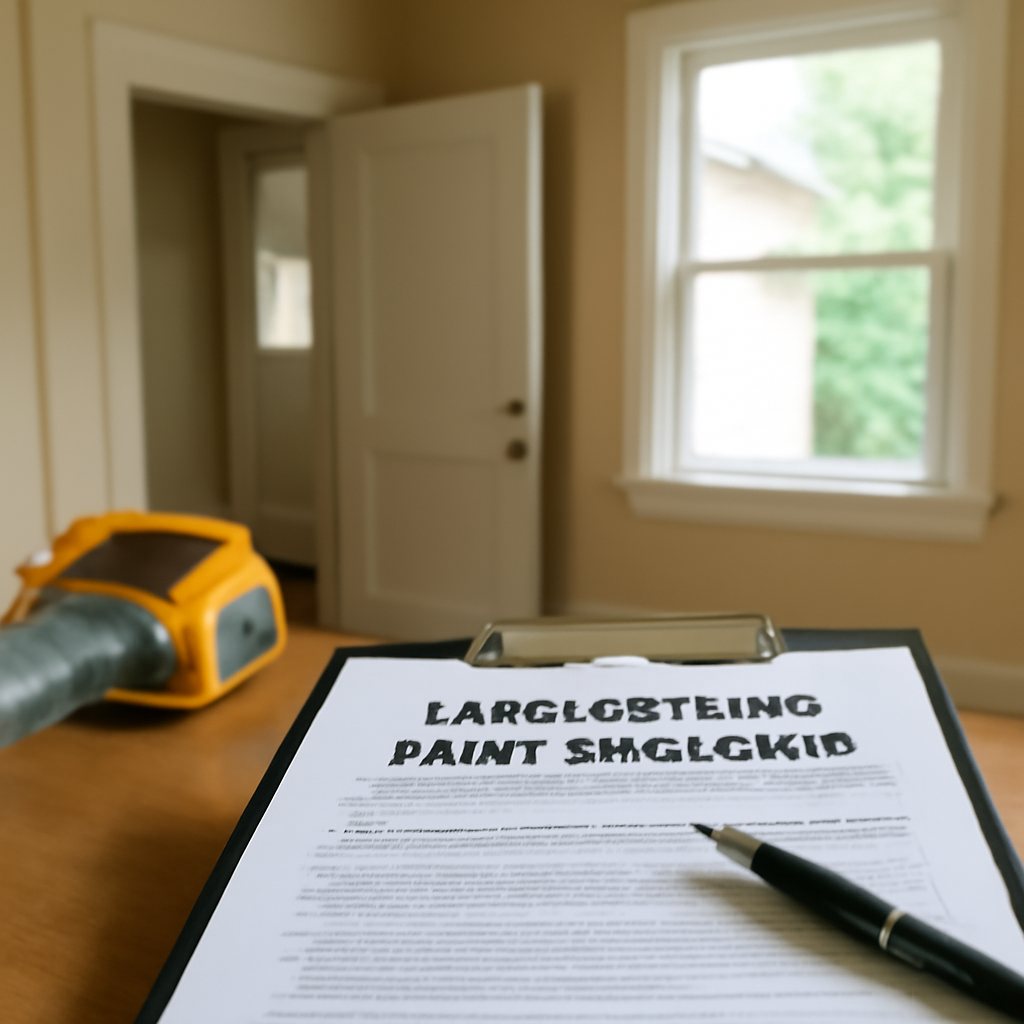
Landlord lead paint disclosure is a federal obligation, not a state one, and it applies to every U.S. rental property — including units on the Colorado Front Range — that was constructed before January 1, 1978. The Lead-Based Paint Hazard Reduction Act of 1992 (Title X) and the implementing rule at 24 CFR Part 35 and 40 CFR Part 745 set a clear landlord workflow: pamphlet delivery, signed disclosure form, ten-day tenant inspection window (sales only, not standard leases), and recordkeeping for three years. This guide summarizes HUD and EPA guidance current as of 2026; it is not legal advice, and landlords with portfolio-scale exposure should retain landlord-tenant counsel for their state.
Part of our Lead Paint & Lead Testing guide — start there for the full picture →
Is this mold, asbestos, or water damage? Get a free instant screen
Upload a clear photo of the suspect area. You'll get an instant AI screening opinion and what to do next. This is screening guidance, not a professional determination.
Screening guidance only. AI can be wrong. Confirm asbestos, mold type, or lead with lab testing or a licensed professional before acting.
The Direct Answer: Four Steps Before Every Pre-1978 Lease
The federal landlord workflow has four steps that must be completed before the tenant signs the lease — not at move-in, not after, but before signature.
First, deliver the EPA-approved lead-hazard pamphlet titled “Protect Your Family From Lead in Your Home.” Second, complete the federal disclosure form stating whether the landlord has knowledge of lead-based paint or lead-based paint hazards in the unit, and list any available records or reports. Third, obtain the tenant’s signed acknowledgment that they received the pamphlet and the disclosure. Fourth, retain signed copies for at least three years from the start of the leasing period. That’s the entire workflow. There is no separate state form in Florida, Colorado, Texas, or most other states — the federal form serves nationally.
What Triggers the Landlord Disclosure
The trigger is the construction date of the target housing, not the age of the lease or tenant turnover. If the rental unit was constructed before January 1, 1978, the disclosure applies to every new lease and every lease renewal where the parties or material conditions have changed. A renewal of the existing lease with the existing tenant under the same terms does not require re-disclosure, but a new lease, new tenant, or substantively new lease terms does.
For the broader regulatory background and the federal trigger logic, the pre-1978 housing hazard pillar walks through Title X’s history and reach. Construction date is verified from county property records — for Front Range landlords, that’s the county assessor records in Denver, Jefferson, Adams, Arapahoe, Douglas, Boulder, Broomfield, El Paso, and Elbert counties.
The Pre-Lease Pamphlet Delivery
The pamphlet “Protect Your Family From Lead in Your Home” is published jointly by EPA, HUD, and the Consumer Product Safety Commission. It is available free in English, Spanish, Vietnamese, Russian, Chinese (Simplified and Traditional), Arabic, and Somali on epa.gov. Landlords may print copies or deliver an electronic version (the federal rule allows electronic delivery as long as the tenant has consented to electronic communications).
The pamphlet must be delivered before the tenant signs the lease. Delivery cannot be merely “made available” at the property — the tenant must actually receive a copy. The disclosure form contains a tenant acknowledgment that creates evidence of delivery.
The Disclosure Form Itself
The federal lease-version disclosure has five required elements that the landlord (or property manager acting as agent) must complete.
1. Lead Warning Statement
A statutory paragraph informing the tenant that pre-1978 housing may contain lead-based paint posing health hazards, particularly to young children and pregnant women. The text is fixed by regulation.
2. Landlord Knowledge Statement
The landlord checks one of two boxes: either they have knowledge of lead-based paint and/or lead-based paint hazards in the unit (and must describe them) or they have no knowledge. They must also list any available records or reports — past inspection reports, risk assessments, or abatement records — and provide copies to the tenant.
3. Property Manager or Agent Acknowledgment
Any property management company or rental agent involved must acknowledge in writing that they informed the landlord of the disclosure duty and confirm they are aware of their own role in compliance.
4. Tenant Acknowledgment
The tenant signs to acknowledge receipt of the pamphlet and the disclosure form before signing the lease.
5. Signatures and Dates
All parties sign and date. The disclosure must be complete and signed before — not contemporaneously with — the lease signing.
The Ten-Day Inspection Window: Sales vs. Leases
One of the most common landlord misunderstandings: the ten-day buyer inspection window applies to sales, not standard leases. For lease transactions, federal law does not grant tenants a ten-day window to conduct a lead-based paint inspection at the landlord’s premises. Tenants can request testing, and landlords can accommodate it as a courtesy, but it is not a mandated waiting period before lease signing.
That said, if the property is being marketed for sale and the tenant is concurrently negotiating a lease-to-own or rent-to-own arrangement that includes purchase elements, the ten-day window may apply to the sale portion. The federal trigger rules cover edge cases including lease-purchase and short-term arrangements.
The Three-Year Recordkeeping Rule
Landlords must retain signed copies of the disclosure form for at least three years from the start of the leasing period. This is a federal minimum — many landlord-tenant attorneys recommend longer retention (seven years or for the duration of any potential limitations period for tenant suits, whichever is longer). Records must be available for inspection by HUD or EPA on request.
Acceptable recordkeeping forms include digital scans of signed paper forms or electronically signed PDFs with a clear signature audit trail. Landlords with multi-unit portfolios should integrate disclosure-form retention into their property management software’s tenant file.
Renovation, Repair, and Painting (RRP) — Separate Landlord Duty
Distinct from disclosure, landlords who perform or contract renovation work disturbing more than six square feet of interior paint (or twenty square feet of exterior paint) in a pre-1978 unit must use EPA-certified RRP firms. Self-performing landlords must themselves be EPA-certified renovators after completing approved training. This is enforced separately from the disclosure rule and carries its own penalty structure.
For landlords on the Front Range planning renovations in pre-1978 units, see the broader lead inspections methodology guide for context on how XRF, paint-chip, and dust-wipe testing identifies lead-paint surfaces before disturbance.
Penalties for Non-Compliance
HUD and EPA can assess civil penalties up to roughly $22,000 per disclosure violation (adjusted annually). Tenants may sue privately for triple damages plus attorney fees. Multi-unit landlords with systematic non-disclosure across a portfolio have faced enforcement actions running into hundreds of thousands of dollars in aggregate penalties. The disclosure rule is one of the more actively enforced federal landlord obligations.
What Landlords Should Build Into Their Standard Workflow
Practical operationalization for landlords with pre-1978 units: keep printed copies of the EPA pamphlet in the leasing folder, include the federal disclosure form in every lease packet for pre-1978 properties, never let a tenant sign a lease without the disclosure already signed, scan all signed disclosures into the tenant’s electronic file, and set a calendar reminder to retain disclosure records for at least three years past tenancy end.
If a landlord has actual knowledge of lead-based paint — from a prior risk assessment, an abatement record, or a contractor’s RRP work order — that knowledge must be disclosed. Stating “no knowledge” when records exist is a federal violation.
When to Engage a Professional
Landlords uncertain whether their pre-1978 unit contains lead-based paint should commission a lead-based paint inspection by an EPA-certified inspector. The inspection is a one-time exercise that, if it documents lead-free status, can support a future certification that exempts the property from ongoing disclosure obligations.
Front Range landlords looking for a connection to a qualified local lead-paint inspector or general home inspector can get in touch here.
Pamphlet Translation Requirements
The EPA pamphlet is published in English, Spanish, Vietnamese, Russian, Chinese (Simplified and Traditional), Arabic, and Somali. Federal law does not explicitly mandate delivery in a specific language, but a tenant who cannot read English would have a strong argument that English-only delivery did not constitute meaningful disclosure. Landlords operating in markets with substantial non-English-speaking tenant populations should stock pamphlets in the relevant languages. The translations are free to print from epa.gov.
For tenants with limited literacy in any language, the disclosure form itself contains a tenant acknowledgment that the tenant must sign. Landlords cannot rely on signature alone as evidence of comprehension — but a signed acknowledgment in a language the tenant can read is the practical minimum standard for federal compliance.
Multi-Unit Property Recordkeeping Practical Tips
Landlords with portfolios of pre-1978 rental units face an aggregate recordkeeping burden that scales with unit count. Practical operational approaches include: integrating the disclosure into the standard lease packet so it cannot be inadvertently skipped, training every leasing-office staff member on the disclosure obligation, scanning all signed disclosures into electronic tenant files with consistent naming conventions, setting calendar reminders for the three-year retention minimum, and conducting periodic file audits to confirm signed disclosures are on file for every active and recently terminated tenancy.
Property-management software now commonly includes disclosure-form modules that auto-populate the federal form from tenant data, route the form for electronic signature, and store the signed PDF in the tenant file with an audit trail. For multi-unit portfolios in pre-1978 stock, these systems significantly reduce compliance risk.
HUD-Assisted Housing: Additional Layers
Pre-1978 housing that receives federal rental assistance — public housing, Project-Based Section 8, Housing Choice Voucher (HCV) tenant-based assistance — is subject to additional HUD Lead Safe Housing Rule (LSHR) requirements beyond the basic disclosure. These additional requirements include visual assessment in some assistance categories, risk assessment in others, lead-safe work practices for maintenance, and enhanced recordkeeping. Landlords accepting HCV vouchers or operating PBS8 properties must comply with both the disclosure rule and the LSHR.
The LSHR is codified at 24 CFR Part 35 Subparts B through R, with different subparts applying to different categories of federally assisted housing. Landlords in this space typically engage compliance consultants or HUD-trained staff to manage the layered requirements. For standard private-market rentals (no federal assistance), only the basic disclosure rule and the RRP rule apply.
What Tenants Typically Care About
Landlords delivering disclosures often see two recurring tenant concerns. First, tenants with young children frequently want to know whether the unit has actually been tested for lead-based paint — and what the results were. Landlords with prior testing or risk-assessment records must disclose them; landlords without should be prepared to explain that “no records” means “not tested,” not “no lead present.” Second, tenants concerned about deteriorating paint visible in the unit (peeling windowsills, chalking exterior trim) often ask whether the landlord will commission testing or repair. Landlords are not federally required to do either, but state and local laws may impose additional duties.
Practical landlord posture: disclose what you know honestly, document what you don’t know, fix obvious paint deterioration promptly using RRP-certified contractors, and treat tenant lead-paint questions seriously rather than dismissively. The landlords who run into federal enforcement problems are typically those who hid records, made misleading statements about lead-paint status, or refused to address obvious paint hazards.
References
- HUD Lead Disclosure Rule — U.S. Department of Housing and Urban Development
- Lead-Based Paint Real Estate Disclosure — U.S. Environmental Protection Agency
- Lead Renovation, Repair and Painting Program — U.S. EPA
- Lead Paint Consumer Information — Federal Trade Commission
Frequently asked questions
Does the federal lead paint disclosure apply to every rental?
Only to target housing constructed before January 1, 1978. Post-1978 rentals are exempt. Zero-bedroom units (efficiencies, studios, dormitories), short-term leases of 100 days or less with no renewal, and units certified lead-free by a certified inspector are also exempt.
How long must landlords keep disclosure records?
At least three years from the start of the leasing period under federal law. Many landlord-tenant attorneys recommend longer retention to cover the full statute of limitations for potential tenant suits.
Does a lease renewal require a new disclosure?
Renewing the existing lease with the same tenant under the same terms does not require re-disclosure. A new lease, new tenant, or substantively new lease terms does require a fresh signed disclosure.
What is the penalty for skipping landlord disclosure?
Civil penalties up to roughly $22,000 per violation (inflation-adjusted), plus tenant private rights of action for triple damages and attorney fees. Multi-unit portfolios with systematic non-compliance have drawn six-figure aggregate penalties.
Lead paint test kits
Instant swab kits flag lead on painted surfaces in minutes — useful before a renovation in any pre-1978 home.
| Product | Why | Buy |
|---|---|---|
 3M LeadCheck Swabs 3M LeadCheck Swabs | EPA-recognized instant swabs. | Amazon — $15.00 |
 Lead Test Kit (lab-based) Lead Test Kit (lab-based) | Mail-in for a documented result. | Amazon — $35.00 |