Klein Tools ET20 WiFi Borescope: What to Know
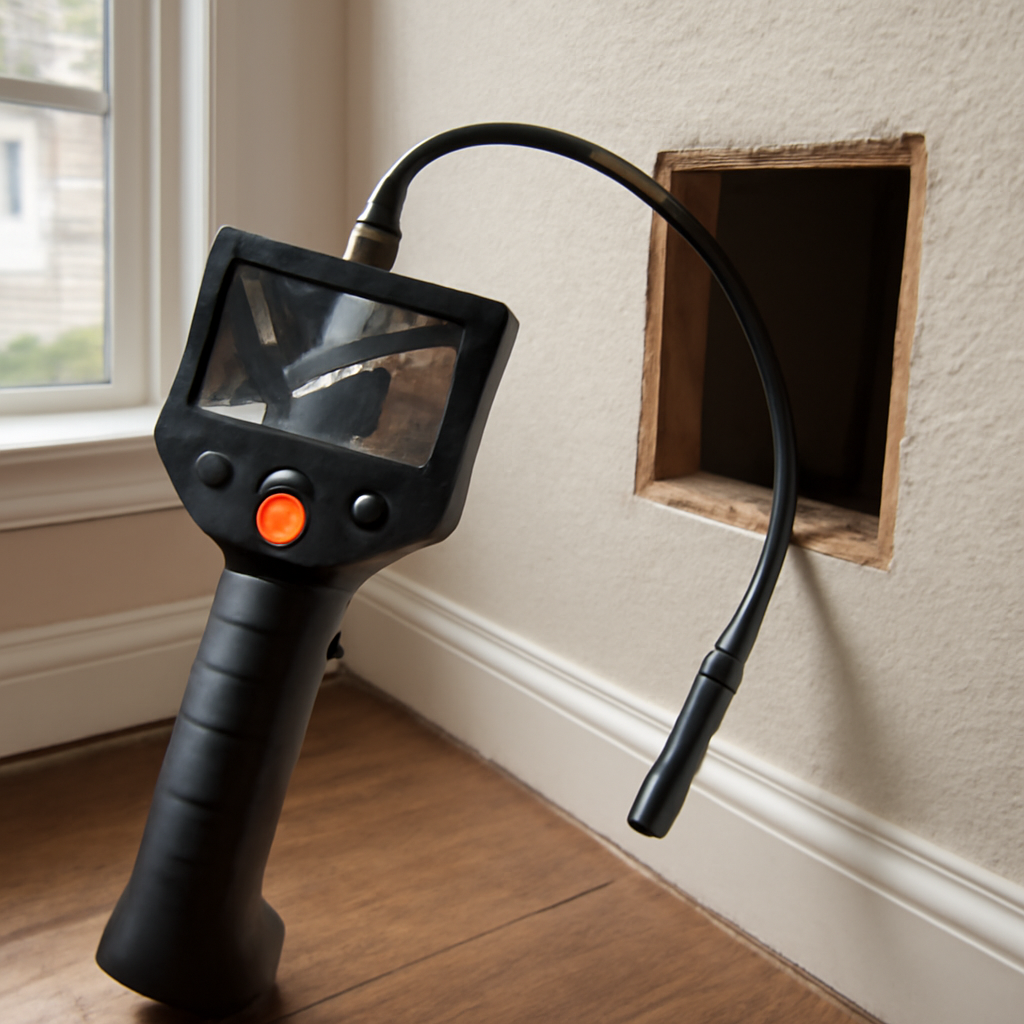
The Klein Tools ET20 wifi borescope is built for the homeowner and tradesperson who wants to see inside a wall, drain, or appliance using a phone they already own. It streams video over wifi from a small flexible camera, and at its price point it answers a lot of practical questions without the cost of a professional videoscope. This overview summarizes manufacturer specifications and trade-body guidance current as of 2026, and places the tool within the broader gear set covered in our home inspection tools guide.
Part of our Home Inspection Tools guide — start there for the full picture →
What the Klein Tools ET20 is
The ET20 is a wifi-connected borescope: a flexible camera probe with built-in LED lighting that broadcasts its own wifi signal to a smartphone or tablet running Klein’s app. There is no separate screen to buy, since the phone is the display. The probe is semi-rigid, holding a bend so the camera can be aimed into a cavity, and the camera head is small enough to slip through a modest opening. Because there is no separate display to buy, charge, or carry, the whole tool packs into a small case alongside the phone most people already keep within reach.
Klein Tools is a long-established hand-tool brand serving electricians and tradespeople, and the ET20 reflects that audience: it is a practical field tool rather than a precision optical instrument. The wifi approach means it works with the device most people carry, which keeps the cost and learning curve low.
The wifi-to-phone design is worth understanding, because it shapes both the strengths and the quirks. The scope creates its own local wifi network that the phone joins; no home internet or cell signal is needed, so it works in a basement or crawl space with no coverage. The phone screen becomes a large, familiar display, which is more comfortable than the small built-in screens on some dedicated scopes, and the phone’s storage and sharing make saving and sending images effortless. The trade-off is a dependence on a stable connection, which can drop momentarily and need rejoining, and a slight lag between moving the probe and seeing the image update.
Key specifications
The ET20’s specifications define what it can reach and how clearly it shows what it finds.
- Camera head diameter: compact, on the order of single-digit millimeters, to fit small holes and tight passages.
- Probe length: roughly a meter of semi-rigid cable, typical for consumer scopes and enough for wall cavities and short runs.
- Resolution: a small digital sensor delivering a clear streamed image at close range, adequate for spotting clogs, leaks, or pests.
- LED illumination: built-in adjustable lights around the camera head, since cavities are dark.
- Connectivity: self-generated wifi to a phone app; no internet connection needed.
- Water resistance: a sealed camera head and probe rated for damp environments such as drains.
- Capture: the app records photos and video for documentation.
Probe length and camera-head diameter are the practical specs. They determine how far the camera reaches and how small an opening it fits, which is what most buyers actually care about.
The semi-rigid probe deserves a closer look, because it shapes how the tool handles. Unlike a fully flexible cable that flops under its own weight, a semi-rigid probe holds whatever bend you set into it, which lets the user pre-shape the probe to aim the camera up, down, or around a near corner before inserting it. That is a genuine advantage in a wall cavity, where you often need to point the camera at the framing above or below the access hole. The trade-off is that it cannot snake through multiple tight bends the way a fully flexible scope can, so it suits short, mostly straight reaches rather than long winding runs.
Home-inspection use cases
A wifi borescope shines at quick, accessible look-and-confirm tasks. The ET20 lets a homeowner inspect inside a wall cavity through a drilled hole to check for moisture, pests, or missing insulation; look down a sink or floor drain to spot a clog or root intrusion; peer behind a built-in appliance without pulling it out; and examine an HVAC duct opening or the inside of a vent.
These uses align with the non-invasive philosophy ASHI and InterNACHI describe: look before you cut. A scope confirms a suspicion that a moisture meter or a musty smell first raised, often saving an unnecessary hole in the wall. For the moisture-detection step that frequently precedes a scope inspection, our overview of how a moisture meter works explains the companion tool. The broader category is covered in our flexible borescope guide.
A practical workflow for a wall inspection
A typical homeowner inspection shows how the tool earns its price. Suppose a musty odor and a faint stain suggest moisture inside an exterior wall. The careful sequence is to first check the surface with a moisture meter, then, if a reading confirms dampness, drill a small access hole in an inconspicuous spot, feed the ET20 probe in, and survey the cavity for wet insulation, water staining on the framing, or mold growth. The camera turns a guess into a look, and the saved images document the condition for a contractor or insurer. Because the probe is semi-rigid, the user can pre-bend it to aim up or down inside the cavity rather than only straight in.
The same method applies to drains and appliances. Before snaking a slow drain, a quick look down the line with the waterproof camera head can reveal whether the blockage is grease, a foreign object, or root intrusion, which determines the right fix. Behind a built-in dishwasher or refrigerator, the scope checks for a slow supply-line leak without the labor of pulling the unit out.
Getting a usable image
A few habits improve results with any consumer scope. Adjust the LED brightness, since a too-bright light reflects off nearby surfaces and washes out the image in a tight space, while too little light leaves the view murky. Keep the camera head clean, because a smear of dust or grease on the tiny lens blurs everything. And move the probe slowly, giving the wifi feed time to catch up and the eye time to register what is on screen. These small adjustments make the difference between a frustrating blur and a clear, decision-ready picture.
Pricing
The ET20 sits at the affordable consumer end, typically priced well under $100, often in the $50 to $90 range. That makes it an easy purchase for a homeowner facing a single problem, and a low-cost addition to a tradesperson’s truck.
The value is access for the price. It will not match the optical clarity of a Hawkeye rigid scope or the articulation and reach of an industrial videoscope, but those tools cost many times more. For the common household question of “what is going on inside that wall or drain,” the ET20 answers it for the cost of a couple of restaurant meals.
That low price also changes the buying calculus compared with renting or hiring. A homeowner could pay a professional to scope a drain, but for the cost of a single service call they can own a tool that handles that question and many future ones. Because the scope leans on a phone they already own, there is no ongoing cost, and the tool sits in a drawer ready for the next mystery. For a recurring or DIY-minded household, owning an inexpensive scope usually beats paying per look.
How it compares to other borescopes
Three comparisons frame where the ET20 fits. Against a Milwaukee borescope M12, the Milwaukee runs on the M12 battery system and integrates with that tool ecosystem, often with a dedicated display, at a higher price; the ET20 leans on your phone and costs less. A tradesperson invested in Milwaukee batteries may prefer the M12, while a homeowner usually finds the ET20 sufficient and cheaper. The Milwaukee option is covered in our Milwaukee borescope M12 overview.
Against a Hawkeye rigid optical borescope, the difference is image quality versus flexibility and price. The Hawkeye delivers superior glass-optic clarity in straight bores but costs far more and cannot bend; the ET20 bends and records easily but uses a small digital sensor. Against an industrial videoscope, there is no real contest on capability, only on price: the videoscope articulates, reaches meters, and measures defects, at fifty to a hundred times the cost. The ET20’s job is everyday access, and it does that job well. Buyers comparing the consumer field can review our best inspection camera guide.
Who the ET20 is right for
The ET20 fits a clear profile. A homeowner facing an occasional mystery, a slow drain, a suspected leak inside a wall, something dropped behind an appliance, gets a capable tool for the price of a small household gadget, and the phone-based design means there is no extra screen to charge or store. A DIY enthusiast or a tradesperson who already owns Klein hand tools adds a practical scope to the kit without a big outlay. And a renter or first-time buyer who wants to look before assuming the worst about a stain or odor gets real information for very little money.
It is not the right tool for someone who needs to inspect long, winding runs, grade fine surface detail like rifling or cylinder scoring, or document findings to a professional standard where image quality is paramount. Those needs point toward an articulating video scope, a rigid optical borescope, or, at the extreme, an industrial videoscope. Matching the tool to the job prevents both the disappointment of buying too little capability and the waste of buying far too much. For the common household questions, the ET20 lands in the practical middle: enough capability to answer them, little enough cost to be an easy decision.
Accessories and longevity
A few accessories extend the tool’s usefulness. Magnet, hook, and mirror attachments that clip near the camera head help retrieve dropped objects or angle the view, turning the scope into a recovery tool as well as an inspection one. Keeping the probe coiled loosely in storage rather than kinked preserves the internal wiring, and rinsing and drying the camera head after drain use prevents grime buildup on the lens. Treated with that modest care, an inexpensive scope lasts for years of occasional use, which is exactly the duty cycle most owners put it through.
Care, handling, and limitations
A consumer borescope lasts longer with gentle handling. The probe should not be forced around tight bends beyond its semi-rigid limit, which can crease the cable and damage the wiring. Clean the camera head after use in drains, and avoid exceeding its temperature and immersion ratings. The phone connection occasionally needs reconnecting if the app loses the wifi signal.
The limitations are honest ones for the price. Resolution is fine at close range but soft at distance, the fixed camera angle cannot steer like an articulating scope, and the meter-long probe limits reach. Like every borescope, it sees only what light reaches and detects neither moisture behind an intact surface nor temperature. When the inspection involves a confined space or energized equipment, OSHA’s safety guidance applies regardless of the tool. Within those bounds, the ET20 is a capable, affordable way to see the unseen.
For the homeowner deciding whether to buy one, the case is straightforward: for the price of a single professional service call, you own a tool that answers the common household questions about walls, drains, ducts, and the spaces behind appliances, with no ongoing cost because it leans on a phone you already own. It will not grade fine surface detail or navigate long winding runs, and it should not be expected to. As an inexpensive way to look before you cut, confirm before you assume, and document what you find, the Klein ET20 earns its modest price for the kind of practical, occasional inspection most homes actually need.
References
- Standards of Practice — International Association of Certified Home Inspectors
- Standard of Practice — American Society of Home Inspectors
- Confined Spaces Safety — Occupational Safety and Health Administration
Frequently asked questions
What does the Klein Tools ET20 wifi borescope do?
It streams video from a small flexible camera probe over its own wifi signal to a phone or tablet, letting you see inside walls, drains, ducts, and behind appliances. Built-in LEDs light the cavity, and the app records photos and video for documentation.
How much does the Klein ET20 cost?
It typically sells for well under $100, often in the $50 to $90 range, which makes it an easy purchase for a single household problem and an inexpensive addition to a tradesperson's kit.
ET20 or Milwaukee borescope M12, which should I buy?
The Milwaukee M12 runs on Milwaukee's battery system, often with a dedicated display, at a higher price, suiting tradespeople already in that ecosystem. The ET20 uses your phone and costs less, which most homeowners find sufficient.
What are the limits of a wifi borescope like the ET20?
Resolution is good close up but soft at distance, the camera angle is fixed and cannot steer like an articulating scope, and the meter-long probe limits reach. Like all borescopes, it sees only what light reaches and cannot detect hidden moisture or temperature.
Borescopes & inspection cameras
A borescope lets you see inside walls, ducts, drains, and crawlspaces without opening anything up.
| Product | Why | Buy |
|---|---|---|
 DEPSTECH Wireless Borescope DEPSTECH Wireless Borescope | Wi-Fi to your phone; semi-rigid cable. | Amazon — $39.99 |
 Teslong Dual-Lens Borescope Teslong Dual-Lens Borescope | Side + front view; good for ducts. | Amazon — $149.99 |
 Ridgid micro CA-150 Ridgid micro CA-150 | Rugged handheld with screen. | Amazon — $288.27 |