Black Mold Symptoms Long Term: Home-Side Damage Guide
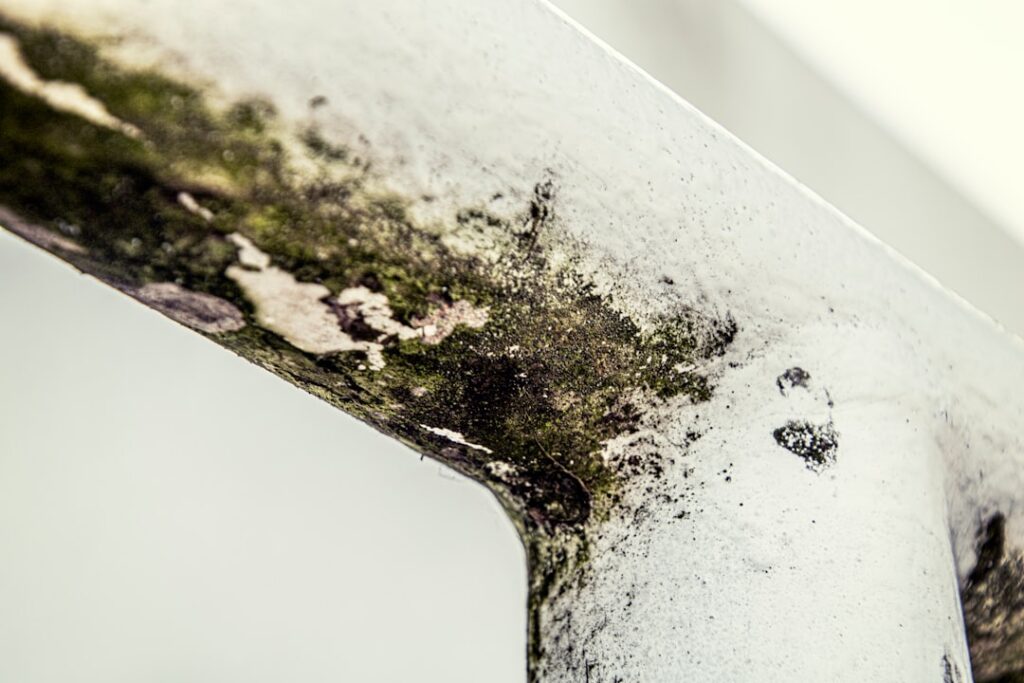
“Black mold symptoms long term” is two questions wearing one set of words. The medical version — what happens to people exposed over time — is a clinical question that belongs to a physician. The home version — what happens to a house when a mold colony has been active for months or years — is the homeowner’s problem and the focus of this guide. Long-term mold growth in a building damages structure, finishes, contents, and HVAC systems in cumulative ways that short-duration exposures do not produce. This article summarizes EPA, CDC, and NIEHS guidance and is general information for homeowners. It is not medical advice. For health symptoms you believe relate to mold exposure, consult a physician — diagnosis and treatment of long-term mold-related illness require professional medical evaluation.
Part of our Black Mold & Your Health guide — start there for the full picture →
Is this mold, asbestos, or water damage? Get a free instant screen
Upload a clear photo of the suspect area. You'll get an instant AI screening opinion and what to do next. This is screening guidance, not a professional determination.
Screening guidance only. AI can be wrong. Confirm asbestos, mold type, or lead with lab testing or a licensed professional before acting.
The Long-Term Picture in a Building
A short-duration mold problem — a leak that was discovered within days, dried within 24 to 48 hours, and remediated promptly — typically leaves the building intact. A long-term mold problem is different. Cellulose substrates progressively lose mass as colonies digest them. Paper facings on drywall become soft, delaminate, and stain through. Wood framing experiences slow strength reduction in chronically wet members. Adhesive binders in particle board, MDF, and certain subfloor products fail. Insulation in affected cavities becomes contaminated and loses thermal performance. HVAC components accumulate biological growth and circulate spores throughout the home. None of this happens overnight. It happens over months to years, and by the time a homeowner finally addresses it, the scope is larger and more expensive than a short-duration project.
Structural Effects: Wood and Drywall Over Time
Wood-decay fungi differ from typical surface molds in their ability to digest both cellulose and lignin, but even surface molds growing on chronically wet wood contribute to substrate degradation. Repeated wetting-and-drying cycles compound the damage. CDC and EPA both describe progressive material damage as one of the main risks of unaddressed indoor mold growth. Field-observable effects include softening that a probe sinks into, dimensional changes (cupping, warping), fastener pull-through, and visible decay patches on framing in concealed cavities. Rim joists at slab-on-grade walls, crawlspace floor framing over chronically damp soil, and basement plate framing along leaky foundation walls are the most common locations for long-term structural-grade damage.
Paper-faced drywall is even more vulnerable. The paper facing is the food source, and once it has been digested over time, the gypsum core loses cohesion. Long-term wet drywall sections are typically removed wholesale during remediation rather than spot-treated, because the substrate is no longer structurally sound for paint, finishes, or fastener retention.
Finish Damage: Paint, Trim, and Flooring
Finish damage from long-term mold growth shows up in predictable patterns. Paint film bubbles, cracks, and peels along surfaces that experience repeated wetting cycles. Baseboards swell and rot at the bottom edge where they sit on wet flooring. Hardwood floors cup, then crown as moisture cycles through them. Vinyl plank and laminate flooring lift at the seams. Tile and stone show grout failure and efflorescence as salts migrate with the moisture. Cabinet kick boards rot. Trim around windows shows bottom-corner staining and softening. The black mold damage walkthrough on this site catalogs each finish failure mode and what it implies for scope.
Contents Damage: The Quiet Cost
Contents are often the largest line item on a long-term mold remediation estimate. Upholstered furniture in a damp basement family room, mattresses in a moist bedroom, books and paper records in a basement office, electronics stored in a chronically humid space — all of them absorb spores over time. Porous contents with embedded contamination cannot reliably be cleaned to a serviceable state and are typically written off. Semi-porous contents may be cleanable depending on penetration. Hard, non-porous contents (glass, metal, glazed ceramics) generally clean back to usable condition. The remediation contractor sorts the contents during scoping and itemizes what is being cleaned versus disposed.
HVAC Damage Over Time
HVAC components in a home with long-term mold growth accumulate biological load along several paths. Cooling-coil drain pans grow visible colonies when humidity is high. Flexible duct with damaged inner liner harbors growth along the corrugations. Air-handler cabinets in damp basements grow surface mold on the exterior insulation and inside the blower compartment. Return-air paths through wall cavities and floor cavities pick up spores from contaminated framing and redistribute them throughout the home. The longer the underlying mold problem has been active, the more likely the HVAC has become part of the contamination picture. EPA does not recommend routine duct cleaning, but the agency does recommend professional cleaning when visible mold growth is found inside the system.
The Compounding Insurance Problem
Insurance policies generally cover sudden, accidental water releases — burst supply lines, overflowing tubs, roof penetrations from hail — and may include mold sub-limits for resulting contamination. Long-term seepage, gradual deterioration, and maintenance failures are generally excluded. A homeowner who discovers a long-term mold problem typically faces an out-of-pocket project. Dated photographs of the source, the saturated materials, and any visible colonies; receipts for emergency dry-out; and a written scope from a remediation contractor support the strongest possible claim, but the long-term nature of the damage usually limits coverage. The homeowner guide to long-term mold exposure effects covers the documentation strategy in detail.
Why Long-Term Problems Got That Way
Long-term mold problems share a small set of causes. A hidden plumbing leak — a drip from a fitting inside a wall, a seeping toilet flange, a refrigerator water line behind cabinetry — produces months of slow wetting before any visible symptom appears in the room. A roof leak that drips into an attic and trickles down a rafter to a hidden cavity. Chronic basement seepage during seasonal high water table. Bath-fan ducts venting into the attic instead of through the roof. Failed window flashings producing slow water intrusion at the head and jambs. Sump-pump failures during extended power outages. Crawlspace vapor-barrier failures. Each of these can run for years before the indoor symptom is severe enough to force investigation. Our cause-of-black-mold ranking for homeowners ranks these by frequency.
The Medical Question Belongs to a Physician
People who have lived in a home with long-term mold growth sometimes have health concerns that have built up over years. Those concerns deserve clinical evaluation. CDC notes that occupants of damp or moldy buildings have reported respiratory and irritation symptoms, and that susceptibility varies. NIEHS describes the population-level evidence for respiratory effects as the most consistently supported. None of that translates to a homeowner article diagnosing anyone. For health questions from long-term exposure, the patient’s physician — primary care, allergist, pulmonologist, depending on the picture — handles evaluation, testing, and any treatment that is indicated. This guide stays on the building.
Remediation Scope Grows With Duration
The longer a mold problem has been active, the larger the remediation scope tends to be. Material removal expands as wetted substrates degrade. Adjacent rooms become involved as spores spread through cavities and HVAC. Verification testing becomes more important because the affected area is harder to scope by eye alone. Front Range homeowners scoping a long-term mold project benefit from starting with an inspector rather than going directly to a remediation contractor. The inspector’s independent scope sets the baseline; the contractor’s bid responds to it.
When to Call a Professional
Long-term mold problems usually exceed the EPA’s homeowner self-remediation threshold of about 10 square feet, often by a wide margin. HVAC involvement is common. Multiple-room contamination is common. Susceptible occupants — particularly those who have lived in the building for the duration of the problem — may be in the picture. All of these factors point toward professional engagement. The mold inspection and testing pillar walks through the inspection-to-remediation handoff. The house black mold overview covers the broader homeowner-side decision sequence.
References
- A Brief Guide to Mold, Moisture, and Your Home — U.S. Environmental Protection Agency
- About Mold — Centers for Disease Control and Prevention
- Mold Health Information — National Institute of Environmental Health Sciences
- Mold Remediation in Schools and Commercial Buildings — U.S. Environmental Protection Agency
- Mold and Dampness — American Lung Association
Frequently asked questions
Does long-term black mold weaken framing?
Sustained wetting and microbial activity can soften wood framing and reduce its load-bearing capacity over time, particularly in concealed cavities like rim joists and crawlspace framing. The extent depends on duration, species, and substrate. A probe test and moisture readings help distinguish cosmetic staining from structural-grade damage.
Will insurance cover long-term mold damage?
Generally no. Most policies cover sudden, accidental water releases with potential mold sub-limits but exclude long-term seepage and maintenance failures. Dated documentation of the source and a contractor scope support the strongest available claim, though coverage for long-term problems is typically limited.
Can long-term mold be remediated as a DIY project?
Most long-term mold problems exceed the EPA homeowner threshold of about 10 square feet, often substantially. HVAC involvement, multiple-room contamination, and susceptible occupants are common in long-term cases — these factors point toward professional engagement rather than DIY.
If your home has a mold problem that has been active for an extended period, a Front Range inspector can scope the cumulative damage independently of the remediation contractor — contact us to start.