What a Thermal Imaging Scan Finds (and What It Can’t)
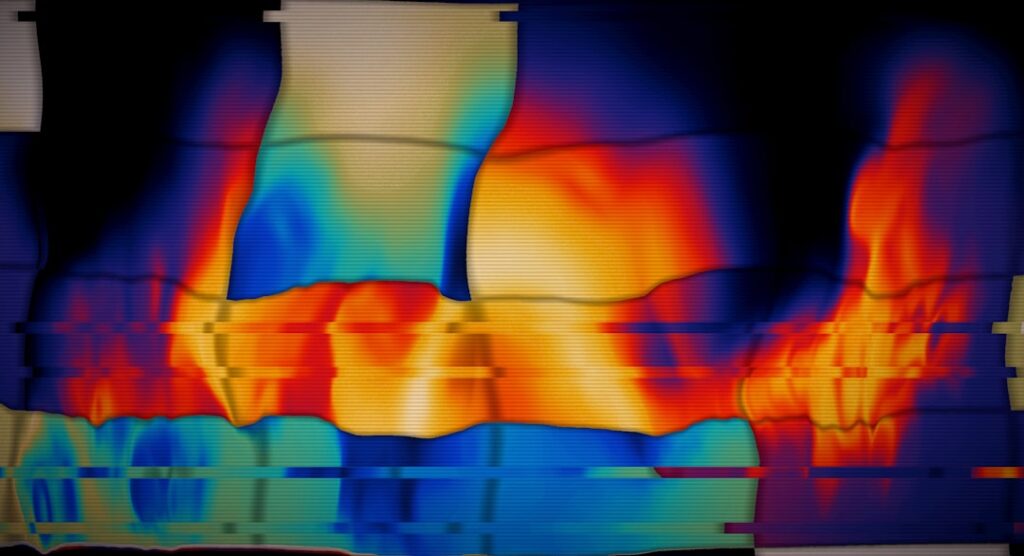
Booking a thermal imaging scan means paying an inspector to walk your home with an infrared camera and document what the eye can’t see. The scan itself is quick. Its value lives entirely in interpretation, timing, and follow-up testing. This page explains what the camera actually measures, what it reliably finds, what it cannot do, and how to judge whether a scan is worth the money on your specific house.
Part of our Thermal Imaging for Homes guide — start there for the full picture →
What the camera is really measuring
An infrared imager does not see heat pass through walls and it does not photograph moisture or mold. It measures the surface temperature of whatever the lens points at, then renders those temperatures as a false-color image called a thermogram. Every meaningful finding is an inference from a temperature difference.
A damp wall reads cooler than the dry wall beside it because evaporation pulls heat off the surface. A stud bay missing insulation reads colder in winter and warmer in summer than its neighbors. A loose electrical connection reads hotter because resistance generates heat. The inspector’s job is turning those patterns into a diagnosis, which is why the same camera produces a useless report in untrained hands and a defensible one in skilled hands. If you want the underlying physics, see how thermography works and what a thermal imaging camera is.
Why timing decides whether the scan is worth it
Infrared only works when there is a temperature difference to read. The U.S. Department of Energy’s guidance on professional home energy assessments notes that thermographic surveys are most accurate when there is a large indoor-outdoor temperature spread, on the order of 15 to 20 degrees Fahrenheit or more.
On the Colorado Front Range that makes December through February the strongest window. Sustained sub-freezing mornings create sharp contrast against a heated interior, so insulation gaps and air leakage light up clearly. Summer scans can work for finding heat intrusion, but solar loading on walls and roofs muddies the picture, and mild shoulder-season days often produce differentials too small to be diagnostic. A scan booked in October when it’s 60 degrees out will find far less than the same scan in January, no matter how skilled the inspector is. If your question is about moisture rather than energy, schedule during or right after a sustained rain event so wet areas are actively evaporating.
What a scan reliably finds
A residential scan typically covers the interior faces of exterior walls, ceilings below the attic, window and door perimeters, under-sink and fixture plumbing, the electrical panel face, and HVAC ducts and registers. The recurring findings on Front Range housing stock are consistent:
- Missing or slumped insulation between studs and thin spots in attic coverage, common in homes built before modern code minimums.
- Air leakage at outlets and recessed lights on exterior walls and ceilings. Pre-1990 can lights predate insulation-contact ratings and leak conditioned air at every fixture.
- Electrical hotspots at breaker or lug connections, often the earliest detectable sign of a loose or overloaded circuit and usually the highest-priority thing a scan turns up.
- Duct and register problems such as leakage in unconditioned space and cold downstream registers that explain rooms running hot or cold.
- Moisture patterns behind finishes, which the camera flags but never confirms on its own.
What it can’t do, and why confirmation matters
Three limits are worth being blunt about. The camera does not see through solid material. It does not identify mold, radon, asbestos, lead, or VOCs, all of which require their own test methods. And a thermogram alone is qualitative, meaning it shows that a spot is colder or warmer, not why.
That’s why a moisture flag should never end the investigation. A cool patch could be active water intrusion, or plain thermal bridging where framing conducts cold inward, or condensation from an interior humidity source. The standard next step is a moisture meter reading against the suspect area, and sometimes a borescope opening, before anyone commits to demolition. Pairing tools is the whole game, which is why our coverage of what a moisture meter does and detecting moisture and mold behind walls matters alongside the imaging itself. InterNACHI’s own infrared thermography material stresses that infrared findings are indications requiring verification, not conclusions.
What you should get in the report
A finished deliverable is more than a handful of colorful pictures. Expect the equipment model and resolution, the indoor and outdoor temperature and humidity at scan time, each thermal image paired with a matching visible-light photo and a location note, written findings grouped by area, and recommendations sorted by urgency. If the report will support a resale disclosure or an insurance claim, that environmental context and pairing is what makes it hold up. A folder of unlabeled thermal images with no conditions recorded is not a report.
What it costs
Pricing tracks scope, equipment, and credentials more than anything else:
| Service | Typical 2026 range |
|---|---|
| Add-on to a standard home inspection | $100 – $300 |
| Standalone scan, single-family home | $250 – $600 |
| Energy-audit scan with blower door | $400 – $900 |
| Commercial or large residential | $600 – $2,000+ |
The add-on is by far the most common purchase. Most inspectors offer infrared as an extra during a pre-purchase inspection, and it’s the cheapest way to get a trained operator behind the camera. Resolution is where equipment quality shows: entry cameras around 160×120 pixels catch gross problems but blur detail, while the 320×240 to 640×480 range that professionals carry resolves the fine patterns that drive real decisions. Cheap smartphone attachments in the $200–$500 tier are fine for curiosity and poor for anything you’ll spend money on.
When it’s genuinely worth booking
Book it for pre-purchase due diligence on an older home, to document the extent of water intrusion after a leak or flood, to chase high utility bills, or to investigate a persistent complaint like a room that never warms up. Skip it, or don’t expect much, on recent new construction with documented insulation, on a house scanned within the last year, or during a season with no temperature contrast to read. To vet who’s holding the camera, our home inspection tools hub covers the wider diagnostic toolkit a good inspector brings.
Frequently asked questions
Does a thermal scan detect mold?
No. It flags temperature and moisture patterns that can point to conditions where mold grows, but confirming mold requires visual inspection and sampling. The scan narrows down where to look.
How long does the scan take?
Sixty to 120 minutes for a typical single-family home. Multi-story homes and finished basements run longer, and an energy audit with a blower door can take two to three hours.
Can the camera see through walls?
No. It reads only the surface it’s pointed at. What’s behind a wall changes that surface temperature indirectly, which is how insulation gaps and leaks become visible without any penetration of the material.
Is a DIY smartphone thermal camera good enough?
For satisfying curiosity, yes. For any decision involving real money, no. The resolution and thermal sensitivity are too low, and the interpretation is the hard part regardless of the hardware.
This guide reflects U.S. Department of Energy and InterNACHI thermography guidance current as of 2026. A scan finding is an indication, not a diagnosis; confirm with a moisture meter or a licensed trade before acting.
Thermal imaging cameras
Infrared cameras reveal hidden moisture, missing insulation, and air leaks. Phone-attachment models are the budget entry point; standalone units have higher resolution.
| Product | Why | Buy |
|---|---|---|
 FLIR ONE Pro (phone) FLIR ONE Pro (phone) | Plugs into iPhone/Android; inspector favorite. | Amazon — $349.00 |
 Topdon TC001 Topdon TC001 | High-res phone module at a low price. | Amazon — $199.99 |
 FLIR C5 Compact FLIR C5 Compact | Standalone pocket camera with Wi-Fi. | Amazon — $611.50 |